


Executive Summary
Aegean closed FY 2025 with consolidated revenue of €1.86 billion (up 5% year over year), net profit of €147.8 million (up 14%), EBITDA of €421.5 million, and 17.3 million passengers across the group, supported by €955.1 million in cash and financial assets at year end.
The fleet stood at 88 aircraft as of early 2025 and is shifting decisively toward the Airbus A320neo family, with a total commitment of 60 A320/A321neo aircraft, including 4 A321neo LRs and 2 A321neo XLRs delivered between late 2025 and 2028.
Long-haul expansion began March 2026 with 5 weekly Athens to New Delhi flights and 3 weekly Mumbai services from May, supported by a reciprocal codeshare with IndiGo and underpinned by 24 seat fully flat business class XLR cabins.
Aegean retained the Best Regional Airline in Europe title at the Skytrax World Airline Awards 2025 for the 14th consecutive year, while domestic share faces continued pressure from Sky Express and pan-European LCC encroachment at Athens.
Recommended - Read Full Reports


Read All Reports
Table of Contents
Executive Summary
Aegean Airlines Company Profile: Key Facts
Aegean Airlines Revenue & Financial Analysis
Top Line Revenue: 2025 in Numbers
Revenue LTM and Quarterly Trajectory
Q4 2025 Earnings Report and Forward Guidance
Revenue Growth Drivers
Key Services and Products
Cargo and Ancillary Streams
Aegean Airlines Fleet Analysis
Current Fleet Size and Composition
Fleet Age and Renewal Strategy
Aircraft Type Strategy and Configuration
Fleet Strategy and Forward Orderbook
Olympic Air Regional Fleet Renewal
Sub-fleet Designation: The Special Purpose Long Range Aircraft
Aegean Airlines Route Network Strategy, Major Destinations and Analysis
Network Footprint as of 2026
Network Strategy: From Greek Carrier to Hub Operator
Domestic Network
European Network
Middle East and North Africa Network
The Long Haul Leap: India Launch in March 2026
Charter and Seasonal Capacity Flexibility
Major Operational Bases (Hubs)
Athens International Airport: The Primary Hub
Thessaloniki: The Northern Greek Stronghold
Larnaca International Airport: The Cypriot Base
Secondary Greek Bases
Aegean Airlines Competitive Position
Major Competitors
Aegean vs Sky Express
Aegean vs Ryanair
Aegean vs easyJet
Aegean vs Wizz Air
Aegean vs Lufthansa Group
Aegean vs Turkish Airlines
Aegean vs Emirates and Qatar Airways
Aegean’s Loyalty Strategy and Miles+Bonus Reform
Key Strengths Supporting the 2026 and Beyond Strategy
Key Risks and Scenario Analysis
Risk 1
Risk 2
Risk 3
Risk 4
Risk 5
Risk 6
Risk 7
Risk 8
Sustainability and Fleet Decarbonization
Digital Transformation and Customer Experience
Workforce and Operational Capacity
Strategic Outlook for 2026 and Beyond
My Final Thoughts
Official Sources and Data
Introduction
On March 17, 2026, an Athens-based airline best known for short and medium haul European flying lifted off from Eleftherios Venizelos Airport bound for New Delhi.
That single rotation ended Aegean’s 27-year identity as a purely regional carrier and inaugurated a long-haul chapter that few European mid-sized airlines have managed to pull off profitably.
The Greek flag carrier ended fiscal 2025 with €1.86 billion revenue, a record 17.3 million passengers, and almost €1 billion in cash and equivalents, giving it enough liquidity to bankroll a fleet of 60 A320neo family aircraft plus two A321neo XLRs without compromising its dividend.
The story for 2026 and beyond is not just about survival in Greece. It’s about whether Aegean can scale beyond it.

Aegean Airlines Company Profile: Key Facts
Aegean Airlines is the largest Greek carrier and the parent of Olympic Air, operating from a primary hub at Athens International Airport with significant secondary bases in Thessaloniki and Larnaca, Cyprus.
The carrier has been listed on the Athens Exchange since 2007 under the ticker AEGN.
The airline is a Star Alliance member since June 2010, providing it global connectivity through 25 partner airlines, including Lufthansa, United, Singapore Airlines, ANA, and Air Canada.


AEGEAN AIRLINES KEY FACTS (As of May 2026)

Founded:                  1995 (Aegean Aviation); commercial flights began May 1999
Headquarters:             Kifissia, Athens, Greece
Stock listing:            Athens Exchange (AEGN.AT); listed since 2007
Chairman:                 Eftichios Vassilakis
CEO:                      Dimitris Gerogiannis
Alliance:                 Star Alliance (member since June 30, 2010)
Subsidiary:               Olympic Air (acquired October 2013)
Fleet size:               88 aircraft (early 2025); 68 mainline + ATR/Dash via Olympic
Primary hub:              Athens International Airport (ATH)
Secondary bases:          Thessaloniki, Larnaca, Heraklion, Rhodes,
                          Chania, Kalamata, Corfu
Destinations served:      ~133 scheduled destinations in 47 countries
FY 2025 Revenue:          €1.86 billion (+5% YoY)
FY 2025 Net Profit:       €147.8 million (+14% YoY)
FY 2025 Passengers:       17.3 million (group, +6% YoY)
Awards:                   Skytrax Best Regional Airline in Europe
(14 consecutive years, 15 times total)The company was founded by Theodoros Vassilakis, with his family’s holding company retaining the largest stake to this day. Founder leadership transitioned to son Eftichios Vassilakis, who serves as Chairman, while Dimitris Gerogiannis serves as Chief Executive Officer.
Aegean carried out its first commercial flights in May 1999, initially connecting Athens with Heraklion and Thessaloniki.
Through a succession of mergers absorbing Air Greece and Cronus Airlines, and the 2013 acquisition of Olympic Air, the airline established uncontested dominance of the Greek mainland to islands network.
Aegean Airlines Revenue & Financial Analysis
Top Line Revenue: 2025 in Numbers
Consolidated revenue for fiscal year 2025 reached €1,859.7 million, a 5% increase compared to €1.78 billion recorded in 2024. The growth derived from a combination of capacity expansion, network broadening, and a modestly improved revenue per available seat kilometer.
Aegean transported 17.3 million passengers at the group level in 2025, compared with 16.3 million in 2024. That represents a 6% increase, with available seat capacity also up 6% year over year.
International traffic accounted for 10.2 million of those passengers, while domestic flights carried 7.1 million.
The international segment grew at a faster clip than domestic, reflecting both Greece’s continued strength as an inbound tourism destination and Aegean’s deliberate strategy to push beyond the Greek market.
AEGEAN FY 2025 vs FY 2024: HEADLINE FINANCIALS

Metric                        FY 2024          FY 2025         Change
Consolidated Revenue          ~€1,777 mil      €1,859.7 mil    +5%
Net Profit after tax          ~€130 mil        €147.8 mil      +14%
EBITDA                        ~€405 mil        €421.5 mil      +4%
Passenger Traffic (group)     16.3 million     17.3 million    +6%
International Passengers      ~9.6 million     10.2 million    +6%
Domestic Passengers           ~6.7 million     7.1 million     +5%
Cash & Financial Assets €769 mil (Jun) €955.1 mil +24%Revenue LTM and Quarterly Trajectory
The trailing twelve months ending December 31, 2025 effectively coincide with the full fiscal year figure of €1.86 billion, since Aegean reports on a calendar year basis.
Quarterly seasonality remained pronounced, with the third quarter dominating annual revenue and profit because of Greek summer inbound demand.
The first half of 2025 showed mixed dynamics. While passenger traffic rose 4%, net profit after tax in Q2 surged 109% year over year, supported partly by a favorable euro to dollar exchange rate movement on fuel and lease costs denominated in dollars.
The third quarter delivered the heaviest contribution as expected for a leisure leaning carrier, while Q4 revenue rose 7% to €425.6 million on the back of strong off season international traffic. Net profit growth of 14% on revenue growth of 5% confirms that operating leverage and disciplined cost management remained intact.
Q4 2025 Earnings Report and Forward Guidance
The Q4 2025 results were published on March 12, 2026. EBITDA in the quarter reached approximately €75.4 million versus €64.9 million the year prior, although the full year EBITDA growth of 4% lagged revenue growth of 5% reflecting cost pressures on labor and certain airport charges.
Management’s guidance for 2026 struck a notably cautious tone. While the first two months of 2026 showed positive booking momentum, the executive team explicitly flagged that the operating environment remains highly volatile due to recent developments in the Middle East.
The company stated that operations in suspended Middle Eastern markets accounted for roughly 4 to 5 percent of total scheduled activity. Combined with elevated jet fuel prices, this is expected to weigh particularly on first quarter 2026 results before potentially normalizing.
Q4 2025 SNAPSHOT (Aegean reporting basis)

Q4 Revenue:        €425.6 million (+7% YoY)
Q4 EBITDA:         €75.4 million
Full year EBITDA:  €421.5 million (+4% YoY)
Full year Net:     €147.8 million (+14% YoY)
Cash position:     €955.1 million (31.12.2025)
Dividend:          Proposed, subject to AGM approval
Guidance flag: Middle East volatility, ~4-5% capacity affectedA proposed dividend reflecting the improved profitability has been put forward subject to Annual General Meeting approval.
Given Aegean’s track record of returning capital while simultaneously investing in fleet renewal, the move signals that management remains comfortable with the cash buffer.
Revenue Growth Drivers
Three structural drivers powered the 2025 top line and look set to define 2026 and beyond.
The first is the underlying strength of inbound tourism to Greece, where international arrivals continued to grow above the European average and Athens has now become Europe’s fastest growing major hub for two consecutive years.
The second driver is capacity expansion through new generation aircraft, which deliver more available seat kilometers per fleet unit and lower unit costs simultaneously. Each A321neo replacement of a legacy A320 lifts seat count meaningfully while improving fuel burn by around 15 to 20%.
The third driver is yield management on premium and ancillary products. Aegean’s expansion into long haul markets via the A321neo XLR will introduce a 24 seat business class with fully flat beds, a substantially higher yield product than anything currently in the fleet.
Key Services and Products
Aegean’s product is segmented across three primary fare bundles for short and medium haul: Light, Flex, and Business.
The Light fare is unbundled in line with low cost carrier practice, while Flex offers refundability and Business includes lounge access, priority handling, and a separate cabin.
The carrier has invested heavily in its Athens business lounge, which opened in 2022 and serves both Schengen and non-Schengen departures. The Miles+Bonus frequent flyer program has approximately 8 million members and integrates fully into Star Alliance for accrual and redemption.
In November 2025, Aegean announced major changes to its loyalty scheme. A new top tier Platinum status launches on November 5, 2026, requiring 72,000 tier miles and 32 flights on Aegean or Olympic Air within a twelve month qualification window, the steepest top tier threshold in Greek aviation history.
The Business Class hard product currently consists of a recliner style seat in a 2-2 configuration. With the introduction of the A321neo XLR in 2026, Aegean will deploy 24 fully flat business suites in a 1-1 staggered layout, with direct aisle access for every passenger.
Cargo and Ancillary Streams
Cargo remains a minor but useful contributor to total revenue, generated through belly hold capacity on scheduled passenger flights rather than dedicated freighter aircraft.
Ancillary revenue from baggage, seat selection, lounge upgrades, and on board sales constitutes a high single digit percentage of total revenue.
Aegean Airlines Fleet Analysis
Current Fleet Size and Composition
As of early 2025, the Aegean group operated 88 aircraft across the parent carrier and Olympic Air subsidiary.
The mainline fleet comprised 38 A320neo family aircraft (21 A320neo and 17 A321neo), supplemented by 32 A320 family classic engine option (ceo) aircraft (28 A320ceo and 4 A321ceo).

The regional operation, branded Olympic Air, contributed 18 turboprops to the group total. That consisted of 13 ATR 72-600s, 3 ATR 42-600s, and 2 legacy Dash 8-100s scheduled for retirement as ATR deliveries continue.
The official Aegean fleet page listed 20 A320neo, 14 A321neo, 4 A321ceo, 28 A320ceo, 2 Dash 8-100s, 3 ATR 42-600s, and 12 ATR 72-600s at one point during 2025, which reconciles with the year end figure once newest deliveries are accounted for.
AEGEAN GROUP FLEET COMPOSITION (Early 2025)

A320neo family (next generation):     38 aircraft
  - Airbus A320neo                    21
  - Airbus A321neo                    17

A320ceo family (current generation):  32 aircraft
  - Airbus A320ceo                    28
  - Airbus A321ceo                     4

Turboprop (Olympic Air):              18 aircraft
  - ATR 72-600                        13
  - ATR 42-600                         3
  - De Havilland Dash 8-100            2

GROUP TOTAL 88 aircraftFleet Age and Renewal Strategy
The average fleet age sits at approximately 8.2 years according to publicly tracked records, although the mainline jet fleet skews younger as A320neo and A321neo deliveries from the 2018 Airbus order continue. The neo family aircraft began arriving in 2020 with the most recent delivered in 2025.
The classic engine A320 and A321 aircraft are progressively cycling out of the fleet as their leases mature and as the neo deliveries replace them.
Management has stated a goal of being a predominantly neo family operator by the late 2020s, with classic aircraft retained only for peak season flexibility.
Aircraft Type Strategy and Configuration
Aegean’s fleet philosophy centers on a single mainline aircraft family - the A320 family - with derivatives chosen to serve specific mission profiles. The A320neo handles short and medium haul European routes with typical sector lengths of one to four hours.
The A321neo handles higher density routes and longer sectors within Europe and to the Middle East and North Africa. With more seats and only marginally higher trip cost than the A320neo, the A321neo offers superior unit economics on slot-constrained markets.
The A321neo LR adds a centerline auxiliary fuel tank for a 7.5 hour range, enabling flights from Athens to destinations like the Persian Gulf cities, sub-Saharan Africa, and the Indian subcontinent. The four LRs on order are scheduled for delivery in 2027 and 2028.
The A321neo XLR, the newest derivative, takes range up to 10.5 hours with a permanent rear center fuel tank and reconfigured fuel system. The two XLRs Aegean has ordered will arrive in late 2025 and early 2026 with a special 138 seat configuration including 24 fully flat business suites.
AEGEAN AIRBUS A320 FAMILY ORDER STATUS (per March 2025)

Aircraft Variant         Original Order   Add-on Order   Total
Airbus A320neo                21              0           21
Airbus A321neo                25              8           33
Airbus A321neo LR              4              0            4
Airbus A321neo XLR             0              2            2

TOTAL A320/A321 NEO FAMILY                                60

Delivered as of 31/7/2025:                                36
Remaining to be delivered (2025-2028 onward): 24Fleet Strategy and Forward Orderbook
The 2018 firm order with Airbus covered 42 aircraft and was twice expanded subsequently. In March 2025, Aegean placed a firm order for 8 additional A321neos, bringing the running total to 58 narrowbody commitments.
In July 2025, Aegean added 2 A321neo XLRs to that orderbook, taking the total to 60 firm A320 family commitments. Of those 60, the breakdown reveals a clear shift toward the larger A321 variants, which now represent two-thirds of the fleet plan compared to the smaller A320neo.
Chief Executive Dimitris Gerogiannis stated explicitly in the March 2025 release that the company has a strong preference for the larger-capacity and extended-range version of the A321neo type, which will soon represent two-thirds of the Airbus fleet.
Of the 60 firm A320 family aircraft on order, 36 had been delivered by July 31, 2025. The remaining 24 aircraft span deliveries from late 2025 through 2028 and beyond, providing steady capacity growth without the lumpy capital outlays of a one-shot order.
Olympic Air Regional Fleet Renewal
The Olympic Air turboprop fleet is undergoing parallel renewal. On October 7, 2025, Olympic took delivery of a new ATR 72-600 marking a significant step in its regional fleet renewal, and the airline placed an order for two more ATR 72-600s for delivery in December 2026.
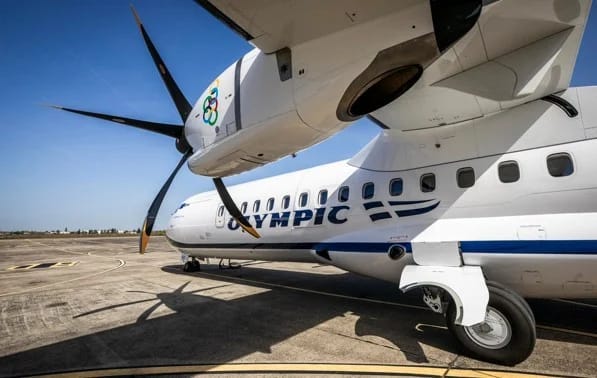
These additional ATRs will increase the Olympic Air fleet to 15 units of the type, enabling retirement of the remaining Dash 8 aircraft while enhancing connectivity to smaller Greek islands during peak summer demand periods.
OLYMPIC AIR (REGIONAL) FLEET RENEWAL TRAJECTORY

Current ATR 72-600:           13 units
Delivered Oct 2025:            1 unit (new)
Order Dec 2026:                2 units
Total ATR 72-600 by end 2026: ~15-16 units

ATR 42-600 in fleet:           3 units (retained for thin routes)
Dash 8-100 status:             2 units (scheduled retirement)
Sub-fleet Designation: The Special Purpose Long Range Aircraft
Within the broader narrowbody fleet, Aegean has created what it terms a special purpose sub-fleet consisting of six aircraft - four A321neo LRs and two A321neo XLRs.
These aircraft will all carry a differentiated 138-seat configuration with 24 fully flat business suites, 4K inflight entertainment screens at every seat, satellite Wi-Fi, USB and device charging ports, and extra-large overhead bins designed for long-haul travel.
The economics of this sub-fleet are crucial.
By keeping the special purpose aircraft on a common airframe and engine type with the rest of the mainline fleet, Aegean avoids the maintenance, training, and spares duplication that would come with introducing a widebody.