


Executive Summary
Aeroflot Group (Aeroflot, Rossiya, Pobeda) carried 55.34 million passengers in 2025, essentially flat year-on-year, with international traffic growing 5.2% to 13.38 million while domestic slipped 1.4% to 41.96 million.
Consolidated IFRS revenue reached 902.3 billion rubles in 2025 (+5.3% YoY), with adjusted EBITDA of 185.0 billion rubles, adjusted net profit of 22.6 billion rubles, and a 13.4% reduction in total debt.
The Group operates 352 aircraft across the holding (including three wet-leased), with the mainline Aeroflot fleet at 171 aircraft in 2026, and a 266-unit MC-21 order anchoring the long-term fleet replacement plan through 2030.
The 2026 summer schedule contains 302 unique routes across the Group, with a deliberate pivot toward bypassing Moscow (172 routes avoid the capital) and deepening “friendly market” coverage in China, India, Vietnam, Thailand, the Gulf, and Sri Lanka.
Recommended - Read Full Reports


Read All Reports
Table of Contents
Executive Summary
Introduction
Key Facts: Company Profile
Business Overview
Corporate Structure and Ownership
Financial Analysis: 2025 Full-Year Results
Fourth Quarter Performance and Margin Pressure
Q1 2026: The Year Begins Strongly
Revenue Growth Drivers
Key Services and Product Portfolio
Aeroflot Fleet: In-depth Analysis
Fleet Size and Composition Overview
Group-Level Fleet Breakdown
Fleet Age and Utilisation
Aircraft Type Strategy and Cabin Configuration
Fleet Strategy: The Russian Transition
Lessor Settlements and Ownership Conversion
Maintenance and Parts Strategy
Route Network, Major Destinations and Strategy
Network Scale and Structure
Strategic Pivot to Off-Moscow Routes
Domestic Network: The Core of the Business
International Network: The Friendly Markets Strategy
New Routes in 2026
Frequency Increases
Major Operational Bases (Hubs)
Moscow Sheremetyevo (SVO): The Primary Hub
Saint Petersburg Pulkovo (LED): Secondary Northwest Hub
Krasnoyarsk Yemelyanovo (KJA): Siberian Gateway
Sochi International Airport (AER): Southern Resort Hub
Moscow Vnukovo (VKO): Pobeda’s Home Base
Competitive Position
Russian Domestic Market Share
Major Domestic Competitors
S7 Airlines
Ural Airlines
UTair Aviation
Rossiya (intra-Group context)
Head-to-Head Comparisons
Aeroflot vs. S7 Airlines
Aeroflot vs. Ural Airlines
Aeroflot vs. UTair
Aeroflot vs. Foreign Carriers
The SkyTeam Suspension
Operational Efficiency and Product Quality
Load Factor Leadership
Net Promoter Score Target
Aeroflot Technics MRO Capability
Strategic Themes and Industry Positioning
The State Airline Identity
Digital Transformation
Social and Regional Programmes
Key Risks with Probabilities and Scenarios
Risk 1: MC-21 Delivery Slippage
Risk 2: Parts and Maintenance Constraints
Risk 3: Geopolitical Escalation
Risk 4: Ruble Volatility
Risk 5: Domestic Demand Softness
Risk 6: Aviation Fuel Price Spike
Risk 7: Competitive Pressure from Foreign Carriers
Risk 8: Lessor Litigation Spillover
Strategy to 2030: The Roadmap Ahead
Fleet Growth Targets
Operational Growth Targets
Financial Sustainability
Customer Experience
Cargo Operations
Scale and Structure
Freighter Additions
Loyalty Programme: Aeroflot Bonus
Programme Structure
Partners Post-SkyTeam
Regulatory and Policy Environment
Federal Aviation Agency (Rosaviatsia) Oversight
Ministry of Industry and Trade
Sanctions Regime
Industry-Wide Context
Russian Civil Aviation Outlook
Infrastructure Investment
Pobeda: The Low-Cost Engine
Operating Model
Network Growth
Subsidiary Strategic Role
Rossiya Airlines: The Versatile Subsidiary
Operational Role
Government-Contracted Operations
Regional Development
Customer Experience and Product Direction
Inflight Product
Cabin Densification
Digital Channels
Human Capital
Workforce Composition
Compensation Strategy
Partnerships and Interline Arrangements
Bilateral Codeshares
Interline Agreements
My Final Thoughts
Official Sources and Data
Introduction
Russia’s flag carrier closed calendar 2025 with 55.34 million passengers and a 41.8% domestic share, while posting the company’s first full-year net profit since 2019.
Those two numbers tell you almost everything you need to know about where the airline sits today.
The carrier is simultaneously the most operationally efficient major airline in Europe (a 90.2% load factor is unprecedented for a full-service network carrier) and the most geopolitically constrained, locked out of most Western destinations and unable to acquire new Airbus or Boeing jets.
The next three years will define whether the current equilibrium is sustainable or merely a holding pattern.
Our in-depth analysis report walks through the Group’s structure, financial performance, fleet composition, route network, hub strategy, competitive position, and the material risks facing stakeholders in 2026.
Let’s get started.
Key Facts: Company Profile
Legal Name:         PJSC Aeroflot – Russian Airlines
Ticker:             MOEX: AFLT (ISIN: RU0009062285)
Founded:            February 9, 1923 (civil aviation start);
                    rebranded as Aeroflot on March 25, 1932
Headquarters:       Arbat 10, Moscow, Russian Federation
CEO:                Sergey Aleksandrovsky (since April 2022)
Ownership:          Federal Agency for State Property
                    Management (Rosimushchestvo): 73.77%;
                    public float: remainder
Primary Hub:        Moscow Sheremetyevo (SVO) – Terminals B & C
Secondary Hubs:     St. Petersburg Pulkovo (LED),
                    Krasnoyarsk Yemelyanovo (KJA),
                    Sochi (AER)
Mainline Fleet:     171 aircraft (41 wide-body, 130 narrow-body)
Group Fleet:        352 aircraft (incl. 3 wet-leased)
2025 Revenue:       RUB 902.3 billion (IFRS)
2025 Net Profit:    RUB 105.5 billion (adjusted: RUB 22.6 bn)
2025 Passengers:    55.34 million (Group)
2025 Load Factor:   90.2% (Group, record high)
SkyTeam Status:     Membership suspended (April 2022)
Credit Rating: ruAA (Expert RA, ACRA) – stable outlookThe Group consists of three operating brands that segment the Russian market by price and product.
PJSC Aeroflot runs the full-service mainline, Rossiya Airlines handles government-contracted and regional operations plus the Far East flat-fare programme, and Pobeda runs the ultra-low-cost operation with a single-type Boeing 737-800 fleet.

Business Overview
Corporate Structure and Ownership
Aeroflot is a public joint-stock company, but in practical terms, it’s a state enterprise.
The Russian Federal Agency for State Property Management controls 73.77% of the shares directly, a stake enshrined in Russian federal ownership policy that designates the company as strategically significant infrastructure.
Shares continue to trade on the Moscow Exchange under the ticker AFLT. Depositary receipts that once traded in London were cancelled in 2022 when sanctions removed the carrier from Western capital markets.
The Group’s operating structure consolidates three distinct airline brands under a holding arrangement.
Aeroflot Group manages centralized functions such as procurement, MRO through Aeroflot Technics, IT, treasury, and network planning, while each subsidiary maintains its own Air Operator Certificate and commercial identity.
AEROFLOT GROUP OPERATING BRANDS
-------------------------------
Aeroflot (mainline)  Full-service, premium cabin, widebody
                     ops, flag carrier identity
Rossiya Airlines     Regional, charter, government
                     contracts, Far East flat-fare program
Pobeda               Ultra-low-cost, single-type 737-800,
                     unbundled ancillaries
Aeroflot Technics    In-house MRO (~2,000 engineers,
                     capacity for 19 simultaneous heavy
maintenance checks)Financial Analysis: 2025 Full-Year Results
The fiscal year 2025 was the first period since the pre-pandemic environment of 2019 in which the Group posted a net profit and paid a dividend based on the prior year’s earnings. Consolidated IFRS revenue totaled 902.26 billion rubles, a 5.3% year-on-year gain.
The revenue mix continues to be dominated by scheduled passenger service, which generated 844.41 billion rubles and rose 5.8%. Cargo revenue declined 4.4% to 32.98 billion rubles, a reflection of constrained belly capacity after sanctions grounded freighter operations across the wider Russian industry.
Operating expenses climbed faster than revenue at 8.6%, reaching 864.16 billion rubles. The cost pressure is instructive because it reveals where the sanctioned operating environment is biting hardest.
Payroll expanded 30.7% to 130.47 billion rubles, with average salaries rising 26.9% to roughly 270,000 rubles per month. Pilot retention has been a priority, and the Group’s labour productivity hit 7 million seat-kilometres per employee.
MRO expenditure jumped 19.0% to 67.95 billion rubles as spare-parts scarcity, parallel-import chains, and wet-lease maintenance clauses all contributed. Airport and en-route handling costs grew 11.2% to 179.87 billion rubles, driven by higher Russian airport tariffs and in-flight catering inflation.
Fuel expense stabilized at 303.84 billion rubles despite a 4.1% decline in the average price per ton of jet fuel. The paradox is explained by the ruble strengthening during the year, which reduced the value of fuel-subsidy compensations that had offset prior-year costs.
AEROFLOT GROUP FY2025 IFRS HEADLINE NUMBERS
-------------------------------------------
Revenue:                  RUB 902.26 bn (+5.3% YoY)
  Scheduled passenger:    RUB 844.41 bn (+5.8%)
  Cargo:                  RUB 32.98 bn (-4.4%)
Operating expenses:       RUB 864.16 bn (+8.6%)
  Fuel:                   RUB 303.84 bn (stabilized)
  Maintenance/MRO:        RUB 67.95 bn (+19.0%)
  Payroll:                RUB 130.47 bn (+30.7%)
  Airport & handling:     RUB 179.87 bn (+11.2%)
Reported EBITDA:          RUB 253.65 bn
Adjusted EBITDA:          RUB 185.04 bn
Net profit:               RUB 105.50 bn (prior year: 55.02)
Adjusted net profit:      RUB 22.61 bn
Total debt change:        -13.4%
Lease liabilities change: -33.6%
The 105.5 billion ruble reported net profit flatters the underlying performance. A 68.4 billion ruble one-off gain came from the conversion of lessor-related obligations on 30 aircraft to ruble-denominated claims, plus a 41.91 billion ruble foreign-exchange revaluation on lease liabilities as the ruble strengthened.
Stripping those items, adjusted net profit of 22.61 billion rubles is a more honest reflection of earnings power.
That figure is down from 237.59 billion rubles of adjusted EBITDA in 2024 (at the EBITDA line), highlighting how cost inflation is outpacing revenue growth.
Fourth Quarter Performance and Margin Pressure
The fourth quarter specifically exposed the margin compression. Q4 2025 revenue rose just 2.5% to approximately 225.8 billion rubles, but EBITDA plunged 51.1% to 22.8 billion rubles.
A small net loss of roughly 1.7 billion rubles (approximately $21.9 million) was recorded in Q4, driven by the confluence of fuel-subsidy reductions, higher payroll costs, and MRO spending to keep the legacy Airbus and Boeing fleet airworthy.
Seasonality amplifies the effect because Q4 is traditionally a weaker travel quarter in Russia outside the New Year holiday.
Q1 2026: The Year Begins Strongly
The 2026 trajectory has started on a much firmer footing. January 2026 passenger traffic rose 4.7% year-on-year to 4.11 million passengers, with international traffic particularly strong.
February 2026 traffic expanded 2% year-on-year to 3.6 million, and the first quarter overall delivered 11.9 million passengers, up 2.2%. International volumes grew 10.5% across January and February combined, while RPKs climbed 8.0% and capacity rose nearly 4%.
Revenue Growth Drivers
Yield management sits at the centre of the revenue story. With capacity effectively capped by fleet constraints, the carrier has relied on higher fares, premium cabin upsell, and international route mix to drive passenger revenue.
Secondary drivers include ancillary revenue from baggage, seat selection and meal upsell on Aeroflot mainline, and, crucially, the Pobeda low-cost subsidiary’s fully unbundled model.
The planned cabin densification on 29 aircraft will convert business-class seats to economy on A320ceo, A321ceo, 737-800 and A330 fleets, adding approximately 18 extra seats per airframe in many cases.
KEY FY2025 GROWTH LEVERS
------------------------
1. Seat load factor:   90.2% (record, +0.6 pp)
2. International mix:  13.38 mn pax (+5.2%)
3. Higher yield:       Fare increases absorbed by
                       constrained capacity
4. Ancillary & upsell: Pobeda unbundled model;
                       Aeroflot business-class focus
5. Network density: Off-Moscow routes 63% of networkKey Services and Product Portfolio
Aeroflot mainline offers a four-cabin experience on widebodies (Business, Comfort, Economy) and a two-class configuration on narrowbodies.
The product is structured around a traditional full-service carrier model with checked baggage, meals, and loyalty accruals on the Aeroflot Bonus programme.
Rossiya operates a simpler two-class product tailored for regional and government-subsidised routes. Pobeda has no business class, charges for every extra, and maintains one of the lowest cost bases of any low-cost carrier in Europe by virtue of high aircraft utilisation and single-type fleet commonality.
The cargo business operates under the Aeroflot Cargo brand, using belly space across the passenger fleet plus a small number of Boeing 747-400ERF freighters acquired in 2025 from the former Volga-Dnepr fleet for potential spare-parts harvesting and possible freighter operation.
Aeroflot Fleet: In-depth Analysis
Fleet Size and Composition Overview
The Aeroflot Group operates 352 aircraft as of the end of 2025, according to the CEO’s Kremlin meeting disclosure. Three of those are on wet-lease agreements, a category that has grown as a stopgap measure to restore cargo and certain international capacity.
The mainline Aeroflot airline operates 171 aircraft in its current published fleet plan, split between 41 wide-body aircraft (Airbus A330, A350, and Boeing 777-300ER families) and 130 narrow-body short- and medium-haul aircraft from the Airbus A320/A321 family and the Boeing 737-800.

Average fleet age sits at roughly 10.2 years according to independent fleet tracking, which is older than the carrier would typically maintain.
Under normal circumstances, Aeroflot rotated widebodies out of service at around 12 years and narrowbodies at 8-10 years. Sanctions have forced the airline to retain older frames.
MAINLINE AEROFLOT FLEET - 2026 SNAPSHOT
---------------------------------------
WIDE-BODY (41 total):
  Airbus A330-300     12 aircraft (28J/268Y or 36J/265Y)
  Airbus A350-900      7 aircraft (28J/24W/264Y)
  Boeing 777-300ER    22 aircraft (30J/48W/324Y or
                                   28J/24W/375Y)

NARROW-BODY (130 total):
  Airbus A320-200     52 aircraft
  Airbus A320neo       6 aircraft
  Airbus A321-200     33 aircraft
  Airbus A321neo       3 aircraft
  Boeing 737-800      37 aircraft

FIRM ORDERS (Russian OEMs):
  Yakovlev Superjet 100-95  89 units
  Tupolev Tu-214            40 units
Yakovlev MC-21-300 266 unitsGroup-Level Fleet Breakdown
Beyond the mainline, the Group’s fleet extends through its two subsidiary operators. Rossiya Airlines operates the widest range of types including Superjet 100s, Boeing 737s, 747s, 777s, Airbus A319s, and (since 2025) former cargo Boeing 747-400ERFs and 737-800BCF converted freighters.
Pobeda operates a pure 737-800 fleet of 42 aircraft at an average age of 9 years, based at Moscow’s Vnukovo and Sheremetyevo. The ultra-low-cost carrier’s fleet commonality allows exceptionally high daily utilisation, routinely exceeding 15 block hours per day in the summer peak.
The Group-level totals quoted on the airline’s own page before the recent recalibration listed 357 aircraft including 61 widebodies, 218 narrowbodies, and 78 regional Superjet 100s. The CEO-disclosed 352 figure at year-end 2025 reflects attrition and category-level adjustments.
Fleet Age and Utilisation
The average Group fleet age is functionally bimodal. The mainline’s Airbus A350 and A321neo aircraft are still young (2019-2022 vintage), while the Boeing 777-300ERs and A330-300s skew older.
Pobeda’s 737-800s average 9 years, and Rossiya’s mixed fleet spans new Superjets and 1990s-vintage wide bodies. The carrier has been taking older Boeing 747s back into service in 2025, with three 747s restored and additional airframes pulled from storage as capacity protection measures.
Aircraft utilisation has been pushed to extraordinary levels. The 90.2% seat load factor, combined with total flight hours exceeding one million across the Group in 2025, reflects a fleet worked at the upper end of feasible dispatch reliability.
Aircraft Type Strategy and Cabin Configuration
The Airbus A350-900 is the flagship. Seven frames operate in a three-class Business/Comfort/Economy configuration totalling 316 seats, with the Business cabin using Vantage XL seats in a reverse-herringbone layout. The A350 is deployed primarily on long and thick routes such as Moscow to Beijing, Phuket, Hong Kong, and Delhi.
The Boeing 777-300ER is the workhorse for high-density long-haul. Twenty-two aircraft are configured in 402-seat (30J/48W/324Y) or 427-seat (28J/24W/375Y) layouts, with the denser configuration increasingly used on leisure routes to Southeast Asia and the Maldives.
The Airbus A330-300 functions as a medium-capacity long-haul complement. Twelve aircraft in 296- or 301-seat configurations carry significant load on regional long-haul (Moscow to Dubai, Delhi, Bangkok) and certain European-replacement routes to the Gulf.
WIDE-BODY DEPLOYMENT LOGIC (2026)
---------------------------------
A350-900   Premium long-haul; Beijing, Phuket, Delhi,
           HKG, Mauritius, Maldives
B777-300ER High-density long-haul; Bangkok, Cancun (prior),
           Denpasar, Havana, Colombo
A330-300   Medium long-haul & thick Gulf; Dubai, New Delhi,
           Tehran, Abu Dhabi, Male
The narrow-body fleet follows a simpler logic. Airbus A321ceo/neo airframes are deployed on the thickest domestic and near-international routes such as Moscow-Yekaterinburg, Moscow-Novosibirsk, Moscow-Yerevan, and Moscow-Dubai (short-range) because of their capacity advantage.
Airbus A320ceo/neo aircraft handle mid-density domestic and CIS routes. Boeing 737-800 units serve as a flexible narrow-body workhorse at Aeroflot mainline, while Rossiya and Pobeda run much larger 737-800 fleets.
The cabin reconfiguration program announced in late 2025 will densify 29 aircraft. Seven A320ceos move from 140 seats (20J/120Y) to 158 seats (8J/150Y), capturing 18 extra seats per airframe.
The logic is simple: in a constrained-capacity environment, every additional seat raises unit revenue without adding fuel, crew, or maintenance cost.
Fleet Strategy: The Russian Transition
The strategic pivot at the centre of Aeroflot’s fleet planning is the shift to Russian-manufactured aircraft. The carrier’s 2030 strategy update targets more than 500 aircraft at the Group level by 2030, a substantial expansion anchored almost entirely on domestic airframes.
The anchor aircraft is the Yakovlev MC-21-300. Aeroflot placed a firm order for 266 units, which if delivered would replace nearly the entire current Airbus A320 and A321 fleet at mainline plus substantial subsidiary narrow-body capacity.
The CEO has publicly stated that the carrier expects to take delivery of more than 100 MC-21-300s by 2030.
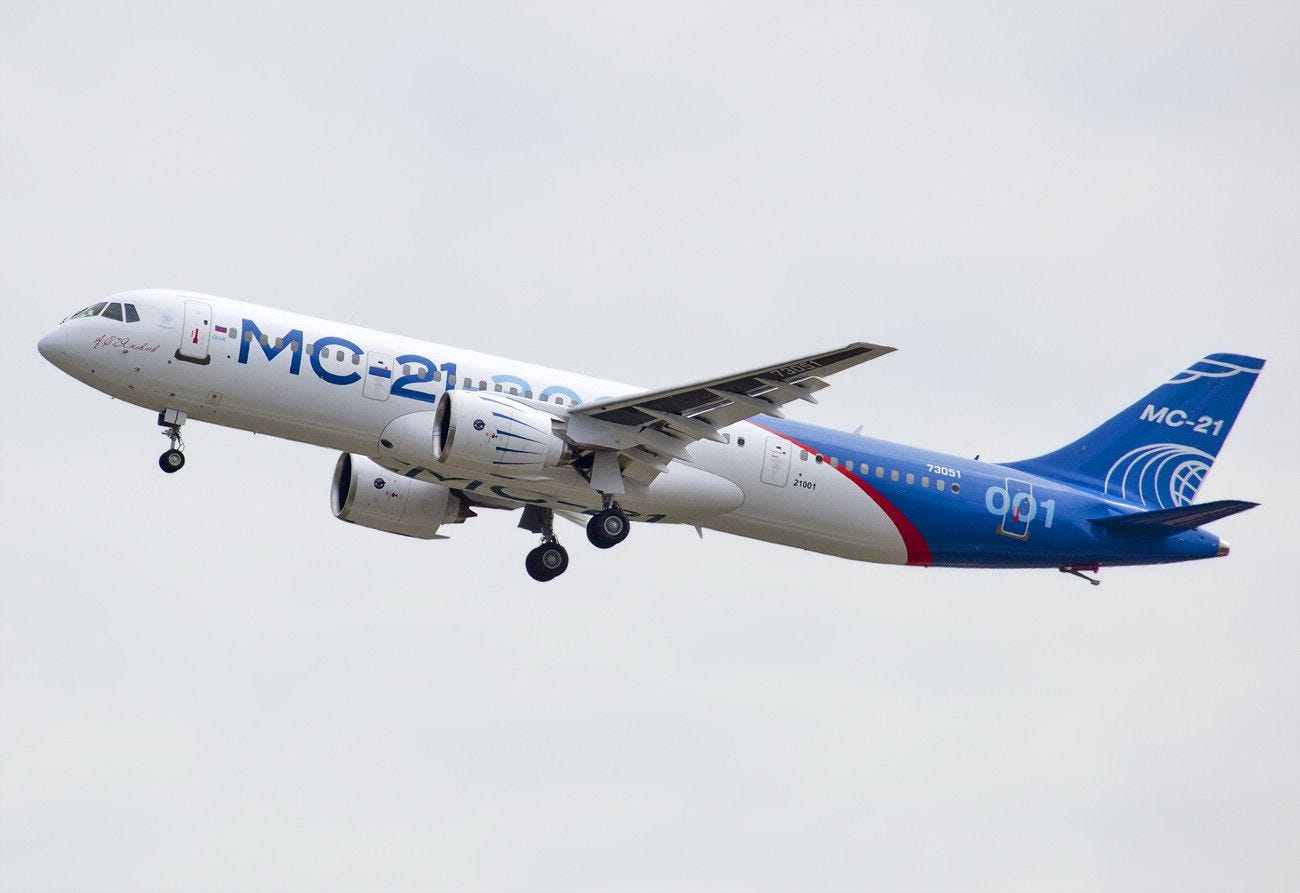
The first batch of 18 MC-21 mass production aircraft is now scheduled for delivery in 2026-2027, following multiple programme delays caused by the need to substitute Western-sourced components.
Aeroflot has indicated it expects its first MC-21 by end of 2026, though certification risk remains.
The MC-21-310 variant (with the Russian PD-14 engine) is scheduled for certification in 2026. The SJ-100 (the re-engined and re-avionicised Superjet) is expected to receive certification in August 2026, per Ministry of Industry and Trade disclosures.
The Tupolev Tu-214 order of 40 units provides a bridge capability. The Tu-214 is a 210-seat narrow-body based on 1990s-era design, but it benefits from 100% Russian content and established production infrastructure at the Kazan Aviation Plant.
FLEET RENEWAL ROADMAP (2026-2030)
---------------------------------
2026  First MC-21-300 delivery (expected Q4)
      SJ-100 certification (August, expected)
      Additional Tu-214 production ramp-up
2027  First batch of 18 MC-21s complete
      Continued Superjet 100-95 deliveries
2028  MC-21 deliveries scale (~20-30/year target)
2029  Widebody replacement strategy to crystallize
2030  Target: 500+ aircraft across Group; material
Russian content in mainline fleetLessor Settlements and Ownership Conversion
A defining feature of the 2022-2025 period has been the conversion of foreign-leased aircraft to Russian ownership. Following Western sanctions in February 2022, approximately 515 commercial aircraft at Russian carriers were subject to lease termination demands from foreign lessors, mostly Irish-based.
Aeroflot reached high-profile settlements with AerCap covering 18 aircraft and 5 engines, with SMBC Aviation Capital covering 17 aircraft, and with CDB Aviation for four aircraft. These deals used the state-backed insurer NSK to pay ruble-denominated settlements to the lessors in exchange for transfer of clear title.
Over 2025, the Group converted obligations on 30 aircraft to ruble payments, contributing the 68.4 billion ruble one-off gain in the IFRS accounts. The net effect is that a growing proportion of the mainline fleet is now genuinely owned by the carrier rather than leased.
Lease liabilities contracted 33.6% across 2025, reflecting both settlements and ruble strength. The balance sheet de-risking has been a material positive, offsetting some of the operational disadvantages of sanctions.
Maintenance and Parts Strategy
Aeroflot Technics employs approximately 2,000 skilled engineers and can service up to 19 aircraft simultaneously in its Sheremetyevo hangars. The unit provides base maintenance, line maintenance, component repair, and engine removal.
The persistent structural challenge remains access to Airbus and Boeing OEM parts. The carrier uses a combination of cannibalisation (systematic grounding of certain airframes for parts harvesting), parallel imports through third-country brokers, and in-country repair of time-controlled components where Russian capability exists.
Half of Russia’s commercial aircraft have been flagged by Gosaviatnadzor for approval irregularities between 2023 and 2025. Aeroflot’s in-house engineering and 2019-era serviceability claims suggest the flag carrier is at the better-managed end of that spectrum, but industry-wide parts pressure is real and growing.