


Executive Summary
Air Canada posted record operating revenues of C$22.4 billion in 2025, with an adjusted EBITDA of C$3.124 billion and net income of C$644 million, reinforcing its position as Canada’s dominant full-service carrier.
The airline is executing its most aggressive fleet modernization ever, with 35 new aircraft expected in 2026 alone, including Boeing 787-10 widebodies, the first Airbus A321XLR narrowbodies, and a firm order for eight Airbus A350-1000s scheduled for delivery starting in 2030.
Summer 2026 will see Air Canada connect Canada to more than 126 global destinations, operating up to 155,000 weekly international seats and solidifying its status as North America’s second-largest transatlantic network by destinations.
Key risks include rising labor costs from new collective agreements, Boeing delivery uncertainties, and a softening US-Canada transborder market, though strong international demand and premium cabin bookings are providing a meaningful offset.
Recommended - Read Full Reports


Read All Reports
Table of Contents
Executive Summary
Key Facts: Company Profile
Business Overview
Financial Performance: A Record-Setting 2025
Revenue Growth Drivers
Cargo Division: Surpassing the C$1 Billion Mark
Aeroplan Loyalty Program
Key Operating Metrics
2026 Financial Guidance
Air Canada Fleet: In-depth Analysis
Fleet Size and Composition
Widebody Fleet: The Backbone of International Operations
Boeing 787-10: A Major 2026 Arrival
Airbus A350-1000: Defining the Next Decade
Airbus A321XLR: Opening New Transatlantic Possibilities
Airbus A220-300: The Modern Narrowbody Workhorse
Fleet Strategy: The Rouge Transition
Route Network, Major Destinations, and Strategy - Air Canada
Network Scope: Six Continents, 126+ Destinations
Transatlantic Expansion: North America’s Second Largest
Asia-Pacific: Deepening Connections
Latin America and Caribbean: Winter Sun Strategy
The A321XLR Route Strategy: Thin Routes, Big Potential
Major Operational Bases (Hubs)
Toronto Pearson International Airport (YYZ)
Montreal-Trudeau International Airport (YUL)
Vancouver International Airport (YVR)
Secondary Bases: Calgary, Halifax, and Ottawa
Competitive Position
Major Competitors Overview
Air Canada vs. WestJet
Air Canada vs. Porter Airlines
Air Canada vs. Flair Airlines
Air Canada vs. US Mega-Carriers
Star Alliance and Strategic Partnerships
Star Alliance: A Founding Pillar
Joint Ventures
Sustainability and Environmental Strategy
Net-Zero Commitment by 2050
2030 Mid-Term Targets
Awards and Industry Recognition
Key Risks, Probabilities, and Scenarios
1. Labor Cost Escalation and Disruption
2. Aircraft Delivery Delays
3. US-Canada Trade Tensions and Demand Softening
4. Fuel Price Volatility
5. Increased Domestic Competition
6. Currency Fluctuation (CAD/USD)
Official Sources and Data
My Final Thoughts
Key Facts: Company Profile
Company Name:          Air Canada
Founded:               April 10, 1937 (as Trans-Canada Air Lines)
Headquarters:          Saint-Laurent, Montreal, Quebec, Canada
IATA / ICAO Code:      AC / ACA
TSX Ticker:            AC
CEO:                   Michael Rousseau
Employees (avg FTE):   ~37,000 (2025)
Alliance:              Star Alliance (founding member, 1997)
Fleet Size:            ~265 aircraft (incl. wet-leased)
Destinations:          126+ global (Summer 2026)
FY2025 Revenue:        C$22.372 billion (record)
FY2025 Adj. EBITDA:    C$3.124 billion
Loyalty Program:       Aeroplan (9+ million active members)
Awards (2025):         Best Airline in North America (Skytrax)
Air Canada has served as the nation’s flag carrier for over 85 years. Originally launched as Trans-Canada Air Lines through an Act of Parliament, the airline was renamed Air Canada in 1965 and has grown into one of the world’s 20 largest carriers by revenue.
The airline operates from three primary hubs: Toronto Pearson (YYZ), Montreal-Trudeau (YUL), and Vancouver International (YVR). It also maintains secondary operational bases at Calgary, Halifax, and Ottawa.

Business Overview
Financial Performance: A Record-Setting 2025
Air Canada delivered its strongest-ever top line in fiscal year 2025. The airline reported record operating revenues of C$22.372 billion, up from C$22.255 billion in 2024, a modest but positive gain of roughly 0.5%.
The fourth quarter of 2025 alone contributed C$5.8 billion to that total, representing a year-over-year increase from C$5.4 billion in Q4 2024. Adjusted EBITDA for the full year reached C$3.124 billion, while operating income totaled C$918 million.
Full Year 2025 Financial Highlights (in C$)
---------------------------------------------
Operating Revenue:        $22.372 billion (record)
Operating Income:         $918 million
Net Income:               $644 million
Adjusted EBITDA:          $3.124 billion
Diluted EPS:              $1.86
Free Cash Flow:           Positive
Net income for the year came in at C$644 million, with diluted earnings per share of C$1.86.
These figures marked a significant recovery from the previous year’s fourth-quarter loss of C$644 million, demonstrating how operational discipline and revenue management translated into bottom-line improvement.
Revenue Growth Drivers
The airline’s revenue profile is built on several pillars. Passenger revenue remains the dominant income stream, driven by strong demand on international routes, particularly transatlantic and transpacific corridors.
Premium cabin bookings have been a notable contributor. Air Canada executives have pointed to continued double-digit growth in corporate travel revenue during the latter part of 2025, a trend expected to carry forward as Canada diversifies its trade relationships away from the United States.
The softening of US-Canada transborder leisure traffic, driven by trade tensions and tariff disputes, has been partially offset by robust bookings on routes to Europe, Asia, and Latin America.
This geographic rebalancing of demand has allowed Air Canada to maintain pricing power where it matters most.
Cargo Division: Surpassing the C$1 Billion Mark
Air Canada’s Cargo division crossed C$1 billion in revenue for the full year 2025, recording C$1,033 million. This represented a 4% increase from C$991 million in 2024.
Cargo Revenue Breakdown (2025)
-------------------------------
Total Cargo Revenue:    C$1,033 million (+4% YoY)
Digital Bookings:       +28% year-over-year
Freighter Fleet:        6 Boeing 767-300ER freighters
Key Growth Regions:     Latin America, Pacific
Growth was primarily driven by higher volumes in Latin America and the Pacific. Shifts in shipping activity linked to tariff deadline adjustments and changes to US duty-free exemption rules for low-value goods also contributed. Domestic cargo benefited from improved year-over-year yields.
Digital bookings surged 28% year-over-year, signaling the ongoing modernization of Air Canada’s freight platform. The airline maintained a fleet of six Boeing 767-300ER dedicated freighters as of December 31, 2025.
Aeroplan Loyalty Program
Aeroplan is Canada’s leading travel loyalty program, with more than 9 million active members worldwide. The program underwent a significant structural overhaul effective January 1, 2026.
Under the new system, members earn points based on eligible spend rather than distance traveled. Elite status qualification also shifted to a revenue-based model, replacing the legacy system of status qualifying miles and segments.
Aeroplan Program Snapshot
--------------------------
Active Members:         9+ million worldwide
Points Earning (2026):  Based on eligible spend (not distance)
Elite Status (2026):    Revenue-based qualification
Partner Airlines:       50+ airlines globally
Credit Card Partners:   Multiple co-branded cards
This transition aligns Air Canada with a broader industry trend among major carriers moving toward spend-based loyalty structures. The program continues to be a significant revenue contributor through co-branded credit card agreements and partnerships with over 50 airlines globally.
Key Operating Metrics
The airline’s operational statistics for 2025 reflect stable demand and disciplined capacity management.
Key Operating Statistics (Full Year 2025)
------------------------------------------
Available Seat Miles (ASMs):    105,174 million
Revenue Passenger Miles (RPMs): 89,021 million
Passenger Load Factor:          84.6%
Passenger Yield:                22.0 cents per RPM
PRASM:                          18.6 cents per ASM
Average FTE Employees:          ~37,000
The 84.6% load factor indicates healthy demand relative to capacity, though it also suggests the airline left some room for yield optimization on certain routes. Passenger yield of 22.0 cents per RPM and PRASM of 18.6 cents per ASM were broadly consistent with 2024 levels.
2026 Financial Guidance
Air Canada’s forward guidance for 2026 projects continued growth. The airline forecasts adjusted EBITDA of C$3.35 billion to C$3.75 billion, which is marginally above Wall Street consensus estimates.
ASM capacity is expected to grow 3.5% to 5.5% versus 2025. Adjusted CASM is projected between 15.05 and 15.35 cents, reflecting some pressure from new labor agreements.
2026 Guidance Summary
---------------------------------------------
Adjusted EBITDA:         C$3.35B - C$3.75B
ASM Capacity Growth:     +3.5% to +5.5% vs. 2025
Adjusted CASM:           15.05 - 15.35 cents
Free Cash Flow:          C$400M - C$800M
New Aircraft Deliveries: 35 (record single-year intake)
CapEx Target:            At or below 12% of revenues
Free cash flow is anticipated between C$400 million and C$800 million. The airline has assumed execution on C$1 billion in sale-leaseback transactions during 2026 as part of its capital allocation strategy.
Air Canada Fleet: In-depth Analysis
Fleet Size and Composition
As of early 2026, Air Canada operates approximately 265 aircraft across its mainline, Rouge, and wet-lease operations. This includes seven Dash 8-Q400 turboprops wet-leased from PAL Airlines, with the remaining 258 being jet-powered twinjets.
The average fleet age stands at approximately 11.8 years, which is competitive among major North American carriers. The fleet is a deliberate mix of Airbus and Boeing types, covering everything from short-haul domestic flights to ultra-long-haul international services.
Air Canada Fleet Summary (Early 2026)
---------------------------------------
WIDEBODY AIRCRAFT:
  Boeing 777-200LR:       6
  Boeing 777-300ER:       19
  Boeing 787-8:           8
  Boeing 787-9:           32
  Airbus A330-300:        20
  Boeing 767-300ER:       6 (freighter)

NARROWBODY AIRCRAFT:
  Airbus A220-300:        42
  Airbus A321-200:        34
  Airbus A320-200:        26
  Airbus A319-100:        16
  Boeing 737 MAX 8:       49

WET-LEASE:
  Dash 8-Q400:            7 (PAL Airlines)

TOTAL:                    ~265 aircraft
Average Fleet Age:        ~11.8 years

Widebody Fleet: The Backbone of International Operations
Boeing widebodies dominate Air Canada’s long-haul operation. The 777 family, comprising six 777-200LRs and nineteen 777-300ERs, handles high-demand trunk routes to Europe, Asia, and South America. The 777-300ER is typically configured in a dense 450-seat layout for high-volume leisure routes.

The Boeing 787 Dreamliner family is the workhorse of the fleet, with eight 787-8s and thirty-two 787-9s. These aircraft fly a wide range of international services and offer superior fuel efficiency compared to the older 777s and A330s they supplement.
Airbus widebodies currently consist of twenty A330-300s, averaging 19.2 years of age. These are among the oldest aircraft in the fleet and are prime candidates for replacement as newer types arrive.
Boeing 787-10: A Major 2026 Arrival
Air Canada has 14 Boeing 787-10s on order, with deliveries expected to begin later in 2026. These aircraft will be based first in Toronto to support continued international growth from the airline’s largest hub.
The 787-10 is the largest variant in the Dreamliner family, offering roughly 15% more seating capacity than the 787-9 while maintaining the same fuel efficiency advantages. This makes it an ideal aircraft for high-demand international routes where additional capacity can be deployed without needing a second frequency.
Boeing 787-10 Order Details
-----------------------------
Aircraft on Order:      14
Expected First Delivery: 2026
Primary Base:           Toronto Pearson (YYZ)
Role:                   High-demand international routes
Replaces/Supplements:   Aging A330-300 and 777 fleet
CEO Michael Rousseau noted that these widebody deliveries will enable Air Canada to capitalize on Canada’s trade diversification away from the US, connecting Canadian businesses to markets across Europe and Asia with greater frequency.
Airbus A350-1000: Defining the Next Decade
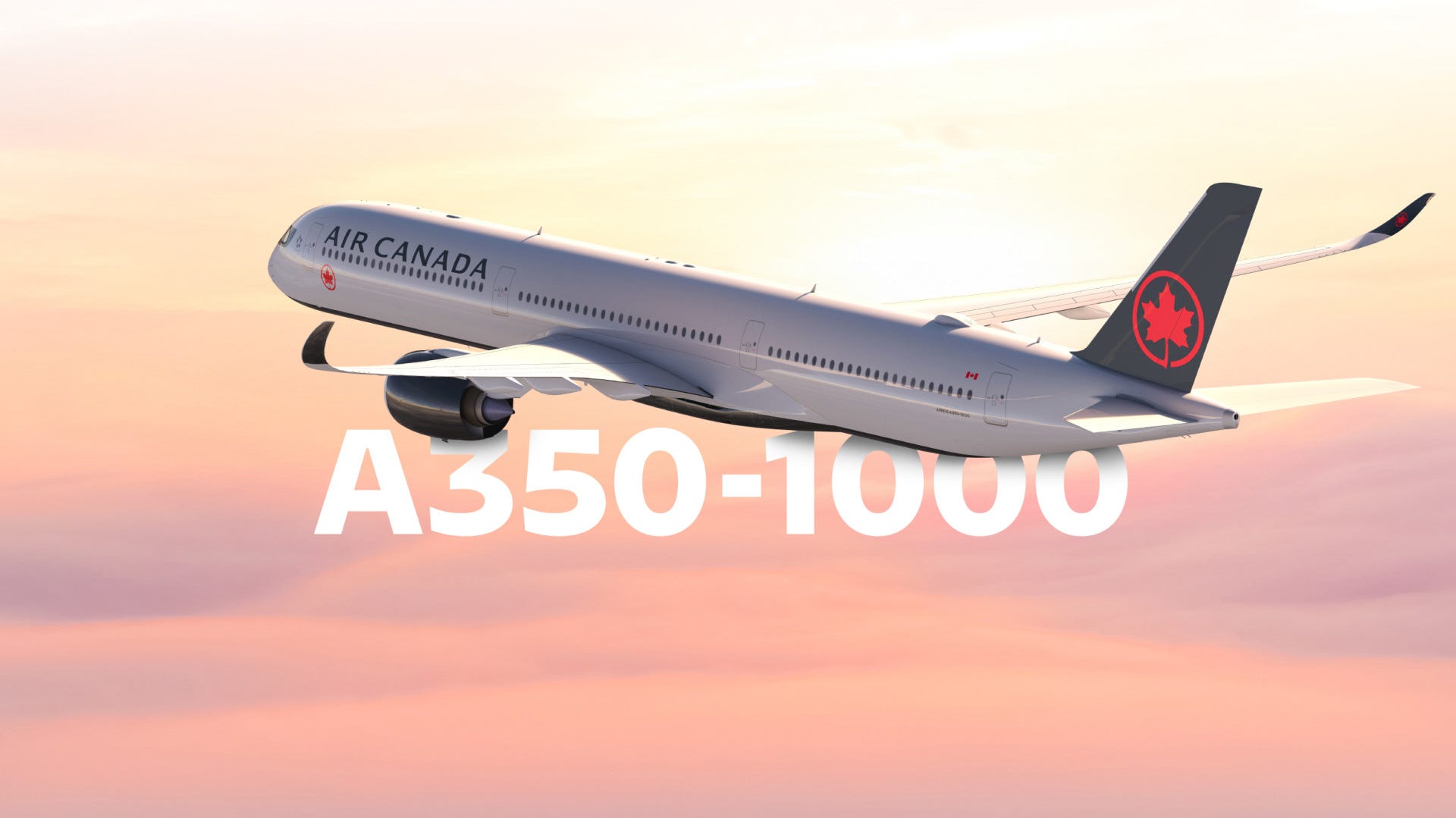
On February 11, 2026, Air Canada announced it had ordered eight A350-1000s, with rights to purchase eight additional aircraft. First deliveries are scheduled for the second half of 2030.
Mark Galardo, Executive Vice President and Chief Commercial Officer, described the A350-1000 as a aircraft that “adds a new dimension to Air Canada’s long-haul capabilities, with impressive range, enhanced payload, and proven economics.”
Airbus A350-1000 Order
-----------------------
Firm Orders:            8
Purchase Rights:        8 additional
First Delivery:         Second half of 2030
Engine:                 Rolls-Royce Trent XWB-97
Key Advantages:         Range, payload, fuel efficiency
Role:                   Ultra-long-haul flagship
Replaces:               Aging widebody types
CFO John Di Bert added that the A350-1000’s “lighter materials and advanced engines deliver meaningful fuel-burn improvements versus the aircraft they replace,” supporting both financial and environmental objectives.
The airline targets capital investments at or below 12% of revenues, and this order aligns with that discipline.
Airbus A321XLR: Opening New Transatlantic Possibilities
Air Canada has 30 A321XLR aircraft on order. The first unit is expected to enter service in June 2026, with the inaugural passenger-carrying flight planned from Montreal to Toulouse.
The A321XLR is configured with 182 seats and brings a game-changing capability: narrowbody economics on routes previously requiring widebody equipment.
This unlocks thin transatlantic routes that could not be served profitably with a 787 or A330.
Airbus A321XLR Program
------------------------
Total on Order:         30
Seat Configuration:     182 seats
First Service:          June 15, 2026 (Montreal-Toulouse)
Range Capability:       ~4,700 nautical miles
Planned European Routes (2026):
  From Montreal: Toulouse, Berlin, Lisbon, Lyon, Nantes,
                 Porto, Tenerife South
  From Toronto:  Copenhagen, London Heathrow, Manchester,
                 Tenerife South
Planned European XLR routes from Montreal include Berlin, Lisbon, Lyon, Nantes, Porto, and Tenerife South. From Toronto, the aircraft will fly to Copenhagen, London Heathrow, Manchester, and Tenerife South.
This represents a significant expansion of Air Canada’s point-to-point European network beyond its traditional widebody corridors.
Airbus A220-300: The Modern Narrowbody Workhorse
The A220-300 is one of the youngest types in the fleet, with 42 aircraft averaging just four years of age. Air Canada has a firm order for 65 total, meaning 23 remain to be delivered. These aircraft are assembled in Canada at the Mirabel facility near Montreal, adding a national dimension to the procurement.
The A220 serves as the backbone of Air Canada’s short-to-medium-haul domestic and transborder operations. It replaces older, less fuel-efficient A319s and A320s on many routes.
Fleet Strategy: The Rouge Transition
Air Canada is executing a major fleet reshuffle involving its leisure carrier, Air Canada Rouge. All 49 Boeing 737 MAX 8 aircraft currently in the mainline fleet will transition to Rouge through 2026.
These aircraft will be reconfigured with 12 Business Class seats, 18 Preferred extra-legroom Economy seats, and 147 Standard Economy seats. Every seat will feature personal seatback entertainment screens and Fast, Free Wi-Fi for Aeroplan members.
Rouge Fleet Transition (2026)
-------------------------------
Aircraft Transitioning:  49 Boeing 737 MAX 8
New Configuration:       12 Business + 18 Preferred + 147 Economy
Key Features:            Seatback entertainment, Fast Free Wi-Fi
New Rouge Crew Base:     Vancouver (opening 2026)
Objective:               All-Boeing 737 Rouge fleet by end 2026
Meanwhile, existing Rouge Airbus A319, A320, and A321 aircraft will receive cabin upgrades and transition to mainline Air Canada service. A new Rouge crew base in Vancouver will also open, expanding leisure travel options from Western Canada.
This represents the airline’s most comprehensive cabin renewal program to date, spanning mainline, Rouge, and Express operations.