


Welcome to AviationOutlook: The aviation newsletter built exclusively for decision-makers.
Become an “Annual” member now & get this special discount offer.
As a paid member, you get access to:
200+ Reports - All major airlines + aerospace & defense companies (updated regularly).
Daily / Weekly - Deep-dive analysis & insights.
Monthly - Industry outlook reports.
In case you missed it, here are the latest analysis reports:
Embraer - Company Analysis and Outlook Report 2026 (Updated)
American Airlines’ Six-Route Europe Play: Yield Discipline or Widebody Overreach?
Check Out All Reports
Executive Summary
Air China, the flag carrier of the People’s Republic of China, reported 2025 revenue of RMB 171.485 billion(+2.87% year-on-year), but posted its sixth consecutive annual net loss of RMB 1.77 billion, weighed down by domestic fare pressure and rising competition from high-speed rail.
The airline’s mainline fleet consists of 533 active aircraft across 18 types, with a group-wide fleet of 964 aircraft as of December 31, 2025. The carrier plans to add 171 new aircraft between 2026 and 2028, including 35 domestically produced COMAC C919s.
Air China is aggressively expanding its international route network, with new long-haul services from Beijing Daxing to Frankfurt and Milan launching in mid-2026, plus fresh connections to Brussels, Cairo, and Istanbul.
Significant headwinds remain for 2026 and beyond, including surging jet fuel costs driven by the Middle East conflict, domestic overcapacity, and currency fluctuation risks, with a return to profitability likely only by 2027.
Recommended - Read Full Reports


Read All Reports
Table of Contents
Executive Summary
Introduction
Executive Summary
Key Facts: Air China Company Profile
Introduction
Business Overview
Financial Performance: Full Year 2025
Revenue Drivers and Revenue Breakdown
Revenue Growth Drivers
Key Services and Products
Cost Structure and Operating Pressures
Air China Fleet: In-depth Analysis
Fleet Size and Composition
Widebody Fleet Strategy
Narrowbody Fleet: The COMAC C919 Factor
Fleet Strategy and Renewal Plan (2026 to 2028)
Route Network, Major Destinations, and Strategy
Network Overview
International Route Expansion Strategy
Domestic Network Dynamics
International Passenger Growth
Major Operational Bases (Hubs)
Beijing Capital International Airport (PEK)
Beijing Daxing International Airport (PKX)
Chengdu: The Western China Dual-Hub
Shanghai Pudong International Airport (PVG)
Competitive Position
China’s “Big Three” Airlines: A Comparative View
Why China Southern Outperformed
Air China vs. China Eastern: A Closer Look
Star Alliance Membership and Strategic Partnerships
The COMAC C919 and Its Impact on Air China’s Fleet
Where the C919 Program Stands
Production Challenges and Supply Chain Risks
What the C919 Means for Air China
Air China’s Subsidiary Network and Group Structure
A Multi-Layered Aviation Group
Passenger Experience and Service Quality
Cabin Products and Customer Satisfaction
Key Risks and Scenarios
Risk 1: Fuel Price Volatility
Risk 2: Domestic Overcapacity and Fare Erosion
Risk 3: Geopolitical Disruptions
Risk 4: Currency Fluctuations
Risk 5: C919 Production and Delivery Delays
Risk 6: Interest Rate and Debt Burden
The 2026 Outlook: What to Expect
Official Sources and Data
My Final Thoughts
Key Facts: Air China Company Profile
Company Name:           Air China Limited (中国国际航空)
IATA / ICAO Code:       CA / CCA
Founded:                July 1, 1988
Headquarters:           Shunyi District, Beijing, China
Type:                   State-owned flag carrier
Alliance:               Star Alliance (joined 2007)
Chairman:               Ma Chongxian
CEO:                    Wang Mingyuan
Primary Hubs:           Beijing Capital (PEK), Beijing Daxing (PKX),
                        Chengdu Shuangliu (CTU), Chengdu Tianfu (TFU)
Secondary Hub:          Shanghai Pudong (PVG)
Fleet Size (Mainline):  533 aircraft (Feb 2026)
Fleet Size (Group):     964 aircraft (Dec 2025)
Average Fleet Age:      10 years
Destinations:           203 across 6 continents
Countries Served:       51
Codeshare Partners:     34
Listed On:              Shanghai (601111.SH), Hong Kong (00753.HK)
2025 Revenue:           RMB 171.485 billion
Frequent Flyer:         Phoenix Miles (100+ million members)
Website:                airchina.com.cn

Introduction
Air China’s sixth straight annual net loss tells a much bigger story about where China’s aviation sector sits right now.
The flag carrier generated RMB 171.485 billion in revenue during 2025, carried over 160 million passengers, and continues to expand its international footprint with fresh routes across Europe, the Middle East, and Central Asia.
Yet, persistent fare pressure, relentless expansion of China’s high-speed rail network, and the sudden shock of war-driven fuel cost spikes have kept the airline from returning to profitability.
What makes Air China’s story worth close attention now is the convergence of several major strategic bets playing out simultaneously: a massive COMAC C919 orderbook reshaping its narrowbody fleet, an aggressive dual-hub expansion across Beijing’s two airports, and a push into European and Middle Eastern markets.
This in-depth analysis report breaks down each of these dimensions.
Business Overview
Financial Performance: Full Year 2025
Air China posted full-year 2025 revenue of RMB 171.485 billion, a 2.87% year-on-year increase. Despite this top-line growth, the airline reported a net loss attributable to shareholders of RMB 1.77 billion, significantly wider than its RMB 233 million loss in 2024.
The non-recurring net loss came in at RMB 2.485 billion, though this narrowed compared to the prior year. Basic earnings per share were negative RMB 0.11.
Air China Financial Summary: 2024 vs. 2025

Metric                        2024              2025           Change
Revenue                   RMB 166.70B       RMB 171.49B       +2.87%
Net Loss (to shareholders) RMB 0.23B         RMB 1.77B        Widened
Passengers Carried         154.8M             160.1M          +3.4%
Cargo Volume               1.48M tonnes       1.54M tonnes    +3.9%
ASK (seat-km)              356.1B             367.6B          +3.24%
EPS                        -RMB 0.01          -RMB 0.11       Widened
This marked Air China’s sixth consecutive annual loss since the pandemic began in 2020. The airline swung into a Q4 2025 loss of RMB 3.64 billion after posting a profit in Q3, during the peak summer travel season.
Revenue Drivers and Revenue Breakdown
Air passenger revenue accounted for the vast majority of Air China’s top line. For 2025, passenger revenue reached RMB 154.856 billion, an increase of RMB 3.067 billion year-on-year. Domestic routes continued to generate the largest share, though international passenger revenue grew at a faster clip due to capacity restoration on long-haul markets.
In 2024, the airline’s air passenger revenue was RMB 151.789 billion, with domestic contributing RMB 109.505 billion, international contributing RMB 37.385 billion, and regional (Hong Kong, Macau, Taiwan) contributing RMB 4.899 billion. Air cargo and mail revenue for 2024 was RMB 7.414 billion, with international freight dominating at RMB 5.703 billion.
Revenue Breakdown by Segment (2024, RMB Billions)

Segment                      Revenue       Share of Total
Domestic Passenger            109.5           65.7%
International Passenger        37.4           22.4%
Regional Passenger              4.9            2.9%
Air Cargo & Mail                7.4            4.4%
Other Revenue                   7.5            4.5%
Total 166.7 100.0%Revenue Growth Drivers
Several factors contributed to top-line growth in 2025. International passenger numbers rose 15.3% to 18.9 million, supported by new route launches and capacity restoration on previously suspended routes.
Total passengers carried increased 3.4% to 160.1 million, with domestic passengers at 136.9 million and Hong Kong/Macau/Taiwan passengers at 4.9 million.
Air China also found meaningful growth in ancillary products. The airline reported ancillary aviation product sales revenue increasing by over 40% year-on-year, while belly-hold cargo revenue grew 4.92%.
The carrier’s “aviation+” ecosystem, including through-check-in services and air-rail intermodal products, is becoming a more meaningful revenue contributor.
Key Services and Products
Air China operates across multiple cabin classes on its long-haul fleet, including First Class on its Boeing 747-8 and select Boeing 777-300ER aircraft, Business Class featuring lie-flat seats on widebody jets, Premium Economy on newer Airbus A350-900 routes, and Economy Class across the full network. The airline’s Phoenix Miles frequent flyer program crossed the 100-million-member milestone in 2025, with customer satisfaction scoring 88.1 points.
The airline’s cargo division, Air China Cargo, was founded in 2003 and listed on the Shenzhen Stock Exchange in December 2024. Air China Cargo reported 2025 revenue of approximately RMB 22.878 billion, making it one of China’s leading freight carriers and the first airline in the country to use certified Sustainable Aviation Fuel (SAF).
Air China Cargo Quick Facts

Founded:            December 12, 2003
Ownership:          51% Air China Group
Stock Exchange:     Shenzhen (listed Dec 30, 2024)
2025 Revenue:       ~RMB 22.88 billion
SAF Pioneer: First Chinese carrier to use certified SAFCost Structure and Operating Pressures
The airline’s cost structure remains heavily exposed to fuel prices. In 2024, jet fuel costs accounted for RMB 53.72 billion, or roughly 31% of total operating expenses of RMB 171.801 billion.
Other major cost items included employee compensation at RMB 34.269 billion, depreciation and amortization at RMB 29.103 billion, and take-off/landing/depot charges at RMB 20.915 billion.
According to HSBC analysts, fuel accounted for 35% to 38% of operating expenses for China’s Big Three airlines in the first half of 2025.
Critically, Air China does not hedge its jet fuel costs, unlike China Eastern, which held 500,000 barrels in hedge positions as of December 31, 2025.
Air China Fleet: In-depth Analysis
Fleet Size and Composition
As of February 2026, Air China’s mainline fleet consists of 533 active aircraft spanning 18 different types.
At the group level (including subsidiaries like Shenzhen Airlines, Shandong Airlines, Beijing Airlines, Dalian Airlines, and others), the total fleet stood at 964 aircraft as of December 31, 2025, after the airline introduced 45 new aircraft and phased out 11 older ones during the year.
The average fleet age sits at approximately 10 years, reflecting a blend of newer neo-family Airbus narrowbodies and older legacy Boeing types.
Air China Mainline Fleet Breakdown (February 2026)

NARROWBODY AIRCRAFT                 Count
Airbus A319-100                       30
Airbus A319neo                         6
Airbus A320-200                       39
Airbus A320neo                        51
Airbus A321-200                       61
Airbus A321neo                        43
Boeing 737-700                        17
Boeing 737-800                        87
Boeing 737 MAX 8                      31
COMAC C919                             9
COMAC ARJ21-700                       35
Subtotal Narrowbody:                 409

WIDEBODY AIRCRAFT                   Count
Airbus A330-200                       15
Airbus A330-300                       28
Airbus A350-900                       30
Boeing 747-400                         3
Boeing 747-8                           6
Boeing 777-300ER                      28
Boeing 787-9                          14
Subtotal Widebody:                   124

TOTAL FLEET: 533Widebody Fleet Strategy
Air China’s widebody fleet is built around four core types. The Airbus A350-900 is the newest and most advanced, with 30 aircraft in service.
The newest A350, registration B-32F1, was built in July 2023 and operates daily rotations between Beijing, Guangzhou, Milan, Chengdu, and Kunming. The A350 has become Air China’s preferred aircraft for premium long-haul routes, including its flagship Beijing-London and Beijing-Milan services.
The Boeing 777-300ER fleet numbers 28 aircraft and covers high-demand, high-density long-haul routes.

Air China has chosen the 777-300ER for its new Daxing-Frankfurt daily service launching April 27, 2026, signaling continued confidence in the type for European operations.
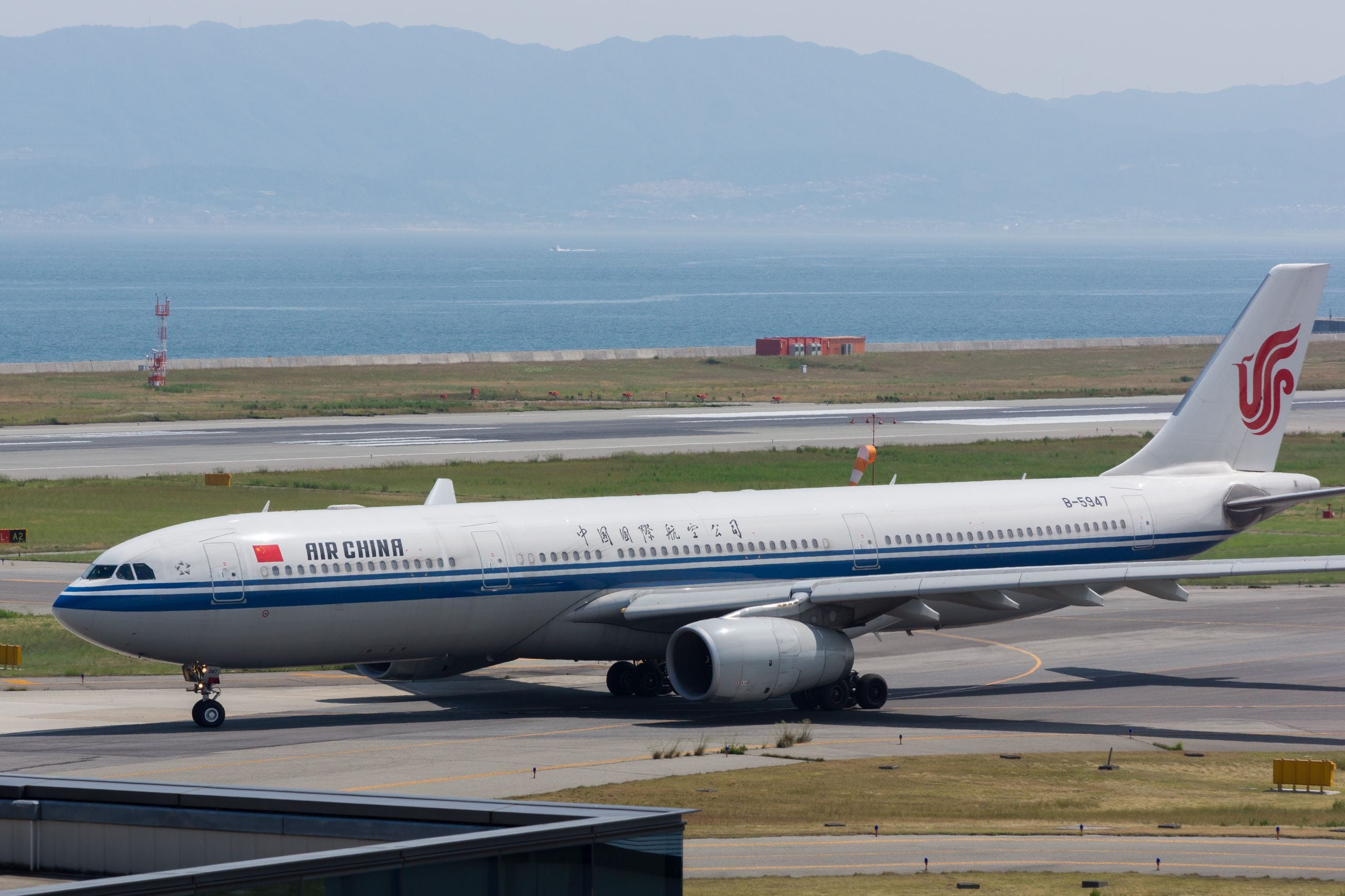
The 43-strong Airbus A330 fleet (15 A330-200s and 28 A330-300s) handles medium- and long-haul routes and is being deployed on the new Daxing-Milan service starting June 2026. The Boeing 787-9 fleet of 14 aircraft provides additional widebody capacity, with 15 more 787s on order for delivery in the coming years.
Air China still operates a small fleet of Boeing 747s: three 747-400s and six 747-8Is. The iconic 747-8 serves flagship routes and VIP government charter duties. However, these aircraft are nearing the end of their operational life with the airline, and no replacement for the 747 program has been publicly announced.
Widebody Fleet Deployment Summary

Aircraft Type       Count    Primary Deployment
A350-900              30     Premium long-haul (Europe, Americas, Oceania)
Boeing 777-300ER      28     High-density long-haul (North America, Europe)
A330-300              28     Medium/long-haul (Europe, Asia-Pacific)
A330-200              15     Medium-haul (Asia, Middle East)
Boeing 787-9          14     Long-haul (Americas, Oceania)
Boeing 747-8           6     Flagship routes, VIP charters
Boeing 747-400 3 Legacy long-haul, winding downNarrowbody Fleet: The COMAC C919 Factor
The most significant fleet story for Air China in 2026 is the integration of the COMAC C919. As of February 2026, the airline operates nine C919 aircraft. In April 2024, Air China signed a landmark purchase agreement with COMAC for 100 C919ER (extended-range) aircraft, with a catalog price of US$108 million per aircraft and deliveries scheduled through 2031.
The C919ER variant has a maximum takeoff weight of 78.9 tonnes (3.8 tonnes more than the base model) and a standard payload range of 5,555 kilometers, which is 36% greater than the base C919’s 4,075 km. This gives the ER variant the ability to cover a wider range of domestic and some shorter international routes.
Air China expects 10 C919 deliveries in 2026. Across China’s Big Three carriers, the combined expectation is 33 C919 deliveries in 2026, which would double last year’s output.
However, COMAC’s production capacity remains a concern. The manufacturer delivered only 15 C919s in 2025 against significantly higher initial targets.
Air China COMAC C919 Order Overview

Order Size:               100 aircraft (all C919ER variant)
Catalog Price Per Unit:    US$108 million (discounts applied)
Order Signed:              April 2024
Delivery Window:           2024 to 2031
In Service (Feb 2026):     9 aircraft
Expected Deliveries 2026:  10 aircraft
Total C919s on Order
  (Big Three combined):    ~300 aircraft
The existing narrowbody fleet is dominated by the Airbus A320 family (230 aircraft including neo variants) and the Boeing 737 family (135 aircraft including MAX 8s).
Air China also operates 35 COMAC ARJ21-700 regional jets, which serve thinner domestic routes and feed traffic into its main hubs.
Fleet Strategy and Renewal Plan (2026 to 2028)
Air China has outlined a clear three-year fleet renewal plan.
According to its 2025 annual report, the airline expects to receive 40 new aircraft in 2026, 61 in 2027, and 70 in 2028, while phasing out a combined 43 aircraft over that period.
The incoming fleet mix includes 68 Airbus A320neo family aircraft, 53 Boeing 737 MAX jets, 15 Boeing 787-9s, and 35 COMAC C919s.
This plan signals a dual-track strategy: maintaining relationships with both Western OEMs (Airbus and Boeing) while progressively integrating the domestically produced C919 into the mainline fleet. The C919 will partially replace older Boeing 737-700s and 737-800s nearing the end of their economic life.
Air China Fleet Renewal Plan (2026-2028)

Year    New Aircraft    Retired Aircraft    Net Growth
2026         40               ~14              +26
2027         61               ~15              +46
2028         70               ~14              +56
Total       171               ~43             +128

Incoming Types:
  68x Airbus A320neo family
  53x Boeing 737 MAX
  15x Boeing 787-9
  35x COMAC C919