


Executive Summary
Air France closed the 2025 financial year with group revenues of €20.24 billion and an operating result of €1.36 billion, translating to an operating margin of 6.7% and a year-on-year improvement of 382 million euros, as the carrier carried more than 42 million passengers on its own metal.
The mainline airline operated a fleet of 229 aircraft at the close of 2025 with an average age of 11.8 years, supported by 39 Embraer regional jets at Air France Hop, and continues to execute a fleet renewal plan anchored on the Airbus A350 and A220 programme.
The summer 2026 schedule consolidates operations at Paris-Charles de Gaulle, launches a new Las Vegas route, doubles Newark frequencies, and exits mainline flying at Paris-Orly after eight decades.
A new La Première first-class suite, extended Wi-Fi deployment, and a 50-aircraft A350 long-haul order position the airline to raise unit revenue while 59 Boeing 777-300ERs move into the replacement queue.
Recommended - Read Full Reports


Read All Reports
Table of Contents
Executive Summary
Key Facts: Company Profile
Business Overview
Financial Performance: A Record-Setting 2025
Revenue Growth Drivers
Key Services and Products
Guidance for 2026
Air France Fleet: In-depth Analysis
Fleet Size and Composition
Fleet Age
Aircraft Types: Long-Haul
Aircraft Types: Medium-Haul
Fleet Strategy: Renewal, Decarbonisation and Premiumisation
The 2025 Landmark Order and the 777-300ER Question
Route Network, Major Destinations and Strategy
Network Size and Shape
New Routes and Upgrades in 2026
Asia Network Reallocation
Domestic Restructuring: The Orly Exit
Major Operational Bases (Hubs)
Paris-Charles de Gaulle (CDG): The Global Hub
Paris-Orly (ORY): From Legacy Base to Transavia Base
Lyon-Saint Exupéry: The Secondary French Base
Overseas and Regional Bases
Competitive Position
The European Big Three
Air France vs British Airways (IAG)
Air France vs Lufthansa
Air France vs KLM (intra-group complementarity)
Air France vs Low-Cost Carriers (Ryanair, easyJet)
Air France vs Emirates, Qatar Airways, Turkish Airlines
Alliances, Joint Ventures, and Partnerships
SkyTeam
The Transatlantic Joint Venture
The 2026 Partnership with IndiGo
The Premium Strategy: La Première and the New Business Class
La Première: The Cabin at the Centre of the Strategy
The New Long-Haul Business Class
Wi-Fi and Digital Experience
Sustainability and Decarbonisation
Key Risks, with Probabilities and Scenarios
Risk 1: Middle East Escalation
Risk 2: ATC Strikes and Weather Disruption
Risk 3: Fuel Price Volatility
Risk 4: Boeing 777-300ER Replacement Timing
Risk 5: Labour Relations and Pilot Actions
Risk 6: Transavia Integration Missteps at Orly
Risk 7: Foreign Exchange and Macro Shocks
Corporate Governance and Ownership Structure
Cargo, Maintenance, and Ancillary Businesses
Air France-KLM Martinair Cargo
AFI KLM E&M Maintenance
Ground Handling
Loyalty and Distribution: Flying Blue
Outlook for 2026 and Beyond
My Final Thoughts
Official Sources and Data
Key Facts: Company Profile
Air France remains the French flag carrier and one of the two airline pillars of the Air France-KLM group, carrying the colours of France across every continent since its founding in 1933.
The company is headquartered at the Roissypôle complex on the grounds of Paris-Charles de Gaulle Airport, with its legal address registered at 45 rue de Paris, Tremblay-en-France.
Legal name        : Société Air France S.A.
Parent group      : Air France-KLM S.A.
Founded           : 1933
Headquarters      : Roissypôle, Tremblay-en-France
CEO (Air France)  : Anne Rigail
CEO (AF-KLM Group): Benjamin Smith
Employees         : 37,000+ (Air France alone)
IATA / ICAO code  : AF / AFR
Callsign          : AIRFRANS
Alliance          : SkyTeam
Frequent flyer : Flying Blue (30M+ members)The airline sits inside a group that generated €33 billion in revenue across 2025, of which Air France alone represents roughly 61%.
The group includes Air France, KLM Royal Dutch Airlines, low-cost carrier Transavia, regional subsidiary Air France Hop, Air France-KLM Martinair Cargo, and the AFI KLM E&M maintenance business.
Leadership of the mainline carrier sits with CEO Anne Rigail, while Benjamin Smith, a Canadian airline veteran with twenty years at Air Canada, has led the broader group since September 2018. Monocle has described Smith’s agenda as a focus on fleet growth and competing on a fairer world stage.
Air France’s fleet footprint is heavily French and European in both origin and routing, but the business model is intensely global.
The company serves over 170 destinations in 73 countries this summer, working alongside joint-venture partners in a transatlantic framework that is one of the largest in commercial aviation.
The 37,000-plus workforce breaks down into 20,816 ground staff, 11,923 cabin crew, and 4,275 pilots, based on the December 31, 2025 internal count. That payroll is concentrated at Paris-Charles de Gaulle, but also extends across Lyon, Toulouse, Sophia Antipolis, and overseas stations.

Business Overview
Financial Performance: A Record-Setting 2025
Air France produced its strongest bottom-line performance in recent memory during 2025, benefitting from disciplined capacity management, continued premium-segment strength, and a more favourable cost environment after two years of inflation absorption.
Revenue at Air France Group climbed to €20,242 million in 2025, a 5.3% year-on-year expansion. Operating result rose to €1,362 million, equivalent to an operating margin of 6.7%, up 1.6 percentage points from the prior year.
The scale of the parent is worth noting. Air France-KLM as a whole posted over €2 billion in operating profit for the first time in its history, with net profit of €1.7 billion for the full year 2025 and a record Q4 net profit of €585 million.
AIR FRANCE GROUP - FULL YEAR 2025 FINANCIALS
----------------------------------------------------
Revenues                     : €20,242 m (+5.3% YoY)
Operating result             : €1,362 m (+€382 m)
Operating margin             : 6.7%    (+1.6 pts)
Salaries & related costs     : €5,759 m
Aircraft fuel (excl. ETS)    : €3,860 m
Other operating expenses     : €7,342 m
Depreciation & amortisation  : €1,919 m
Passengers carried           : 42+ million
Load factor                  : 95%
The revenue mix is dominated by passenger traffic, but ancillary streams matter. Cargo revenues at the group level reached €2,389 million with traffic cargo revenues of €2,001 million, while maintenance and handling added further diversification to the top line.
On costs, the story of 2025 was the easing of the fuel bill and continued labour-cost discipline. Jet fuel (excluding ETS allowances) at Air France Group came in at €3,860 million, allowing the carrier to reinvest in premium cabins, digital experience, and fleet without dragging the margin.
Revenue Growth Drivers
The first growth engine is premium-cabin strength.
Smith, the group CEO, has publicly pointed to Air France as the vehicle for the group’s most aggressive upmarket push, anchored by the brand-new La Première suite and a refreshed long-haul Business cabin.
Reuters reported that the group wants to widen its operating margin to over 8% by 2028, and a sizeable share of that uplift is expected to come from Air France’s premium mix.
The second driver is North Atlantic capacity.
The summer 2026 schedule delivers up to 11 daily flights between Paris and the New York metropolitan area, combined with a new three-times-weekly Las Vegas service and additional frequencies to Canada, Mexico, and South America.
The third engine is Asia.
With flights to Tel Aviv, Beirut, Dubai, and Riyadh suspended due to the Middle East security situation, Air France is redeploying widebodies eastward, with additional services and up-gauged aircraft to Bangkok, Singapore, Delhi, Mumbai, Bangalore, Tokyo, and Osaka.
2025 REVENUE GROWTH LEVERS
---------------------------------------
1. Premium cabin uplift (La Premiere, new J)
2. North Atlantic capacity + Delta/Virgin JV
3. Asia reallocation from Middle East
4. Cargo recovery on belly + freighters
5. Ancillary revenue (bags, upgrades, seats)
6. Flying Blue loyalty monetisation
The fourth stream is the loyalty programme.
Flying Blue celebrated its 20th anniversary in 2025 with more than 30 million members, and the airline reports that a new member joins roughly every five seconds.
Key Services and Products
Air France operates three main lines of business that touch the customer directly: scheduled passenger aviation, air cargo through Air France-KLM Martinair Cargo, and engineering services through AFI KLM E&M.
Passenger transport is the core. Across long-haul, medium-haul, and regional networks, Air France offers four cabins on most widebody jets: La Première, Business, Premium Economy, and Economy, with new La Première suites being progressively installed fleet-wide.
AIR FRANCE CABIN PORTFOLIO
---------------------------------
La Premiere : First class suite with sliding doors
              (only on select 777-300ER aircraft)
Business    : Lie-flat reverse-herringbone suite
              with sliding doors (new generation)
Premium     : Fixed-shell recliner with 38" pitch
Economy     : Standard long-haul Economy
Short-haul  : Euro-Business / Economy
The new La Première first-class suite has now been recognised with a 2026 iF Design Award, its multi-zone layout and five-window footprint designed to imitate a private-jet feel.
Beyond flying, the Air France-KLM Martinair Cargo unit serves 117 destinations worldwide, operating belly capacity alongside a small fleet of dedicated freighters. In 2023, it moved roughly 917,000 tons of cargo, with volumes broadly stable through 2025.
AFI KLM E&M, the maintenance arm, employs about 7,700 people across four core facilities in France and handles more than 3,000 aircraft each year. This business is often overlooked in coverage of the mainline carrier, but it delivers a meaningful and stable earnings stream for the group.
Guidance for 2026
The group has set clear numerical goalposts for this year. Capacity is projected to grow by 3 to 5% versus 2025, with long-haul up roughly 4%, short and medium-haul broadly flat, and Transavia expanding by about 10%.
Unit cost is guided to rise between 0% and plus 2%, including a 0.5-point drag tied to the premiumisation programme. Net capital expenditures will land around €3 billion, and the leverage ratio is expected to stay inside a 1.5 to 2.0 times band.
Early January 2026 was rougher than planned: severe weather in Amsterdam and Paris is expected to cost the group roughly €90 million in Q1 operating result. That figure is an important reminder that even an improving operation remains exposed to weather and air-traffic disruption.
Air France Fleet: In-depth Analysis
Fleet Size and Composition
At December 31, 2025, the Air France mainline fleet comprised 229 aircraft in operation, a net stabilisation versus 230 at the end of 2024, but with a materially younger and more efficient mix.
Within that total, 120 are long-haul jets, 107 are medium-haul narrowbodies, and 2 are dedicated freighters.
Including the regional subsidiary Air France Hop, whose Embraer E170 and E190 fleet stands at 39 aircraft, the broader Air France operating fleet reaches 268 units.
AIR FRANCE FLEET AT 31 DECEMBER 2025
------------------------------------------
Long-haul aircraft       : 120
Medium-haul aircraft     : 107
Freighters               :   2
Total mainline           : 229 in operation

Air France Hop (regional): 39 Embraer jets
 - Embraer 170 (76 seats): 13
 - Embraer 190 (100 seats): 26

Group Air France fleet   : 268 aircraft
Ownership structure is instructive. Of the 229 mainline aircraft, 95 are fully owned (41.5%), 33 are under finance lease (14.4%), and 101 are under operating lease (44.1%), leaving Air France with meaningful flexibility to flex fleet over a medium-term horizon.
Fleet Age
The average fleet age is 11.8 years as of end-2025, down from 12.5 years twelve months earlier.
That reduction is significant in operational terms, given that each year of average age typically translates into higher fuel, higher maintenance, and higher emissions per seat.
FLEET AGE BREAKDOWN (31 DEC 2025)
---------------------------------
Overall average : 11.8 years
Long-haul       : 13.2 years
Medium-haul     : 10.3 years
Cargo fleet     : 16.9 years
The medium-haul fleet is now younger than the long-haul fleet, a direct consequence of the rapid A220 ramp-up.
Over time, the balance is expected to shift again as A350 deliveries accelerate on long-haul and older Airbus A330s and Boeing 777-200ERs exit the fleet.
Aircraft Types: Long-Haul
The long-haul line-up is built around four principal Airbus and Boeing families, each with its own mission profile and cabin configuration.
The Airbus A350-900 is now the workhorse of the fleet renewal. Air France received its 40th A350 (named “Noirmoutier-en-L’Île”) in November 2025, with six A350s joining the fleet in 2025 alone.
The type offers 292 seats in a 48 Business / 32 Premium / 212 Economy configuration and consumes 25% less fuel per seat than the previous generation.
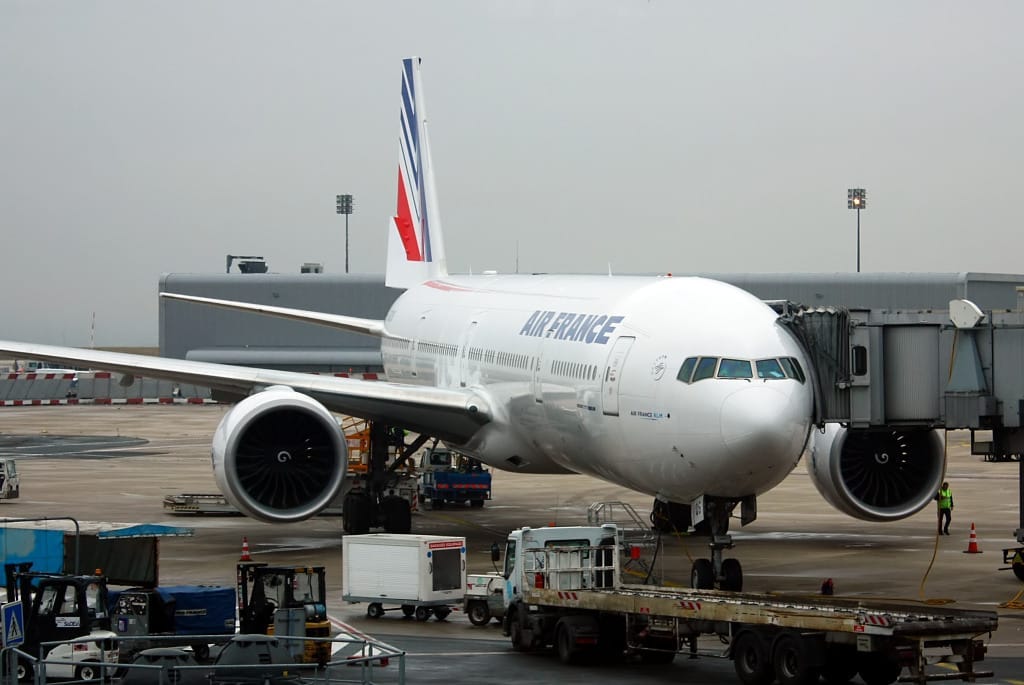
The Boeing 777-300ER remains the largest widebody in the fleet, used on the highest-density long-haul routes such as New York, Los Angeles, and Tokyo.
Air France operates this type in dense 468-seat four-class configurations, including the new La Première suite, the new Business class, Premium Economy, and Economy cabins.

The Boeing 777-200ER is a smaller complement, with 18 aircraft listed on the group’s official fleet page. These jets handle a mix of long thin routes and medium long-haul sectors, particularly to Africa, the Americas, and select Asian markets.
The Airbus A330-200 and the Boeing 787-9 round out the long-haul line-up, the latter serving a rotating set of destinations from Paris-Charles de Gaulle with a densely configured three-class layout.
LONG-HAUL FLEET SUMMARY (end 2025 indicative)
----------------------------------------------
Airbus A350-900 : 40 (primary renewal type)
Boeing 777-300ER: ~40 (replacement candidates)
Boeing 777-200ER: 18
Boeing 787-9    : mid-size long haul
Airbus A330-200 : remaining units, being retired
Airbus A380     : fully retired by 2022
The Airbus A380, once the flagship, is no longer part of the active Air France fleet.
Two further A380s were withdrawn during 2025 to complete the type’s retirement process across the group, a decision tied to very high operating costs and insufficient post-pandemic demand for four-engine widebodies.
Aircraft Types: Medium-Haul
On medium-haul, the single most important airframe today is the Airbus A220-300. Air France took delivery of its 50th A220 in November 2025 (named “Valbonne”), with 11 of these jets arriving during 2025 alone.
The A220 offers 148 seats in a five-abreast configuration, and is credited with 20% lower CO₂ emissions and a 34% smaller noise footprint than the narrowbodies it replaces. Its single-aisle layout also improves boarding efficiency on short sectors.
The rest of the medium-haul fleet is composed of Airbus A320 family aircraft, progressively being withdrawn. During 2025, Air France retired 12 A320 family aircraft, a meaningful acceleration of the phase-out plan.
MEDIUM-HAUL AIRCRAFT CHANGES DURING 2025
-----------------------------------------
Added   : +11 Airbus A220-300
Removed : -12 Airbus A320 family

Net change: essentially flat, but newer, quieter,
and more fuel efficient per seat.
For genuinely short and thin routes, the regional fleet at Air France Hop covers the gap using Embraer 170s and 190s, with the Embraer 190 in particular increasingly used on routes connecting secondary European and French cities with the Paris-Charles de Gaulle hub.
Fleet Strategy: Renewal, Decarbonisation and Premiumisation
Air France invests more than €1 billion each year in renewing its fleet, a pace the carrier calls unprecedented in its own history. The strategy has three entangled objectives.
The first is decarbonisation.
Next-generation aircraft, combined with operational levers such as eco-piloting, descent profile optimisation, and lighter cabin equipment, are the fastest way to bring down CO₂ emissions per seat kilometre before sustainable aviation fuel is available at scale.
The group’s ambition is to have up to 80% next-generation aircraft by 2030, up from 34% at end-2025. That acceleration requires sustained fleet capital expenditure and a visible order book.
The second objective is premiumisation.
Every new A350 and every retrofitted 777-300ER now features the new Business class with sliding doors and reverse-herringbone layout, while the new La Première suite is progressively rolled out on select 777-300ERs.
The third objective is simplification.
Air France is closing on a structure dominated by four families: the A350 and A220 as new-generation types, plus the 787-9 and a gradually reducing 777 fleet, supported by the Embraer family at Hop. Over time, this reduces training, maintenance, and spares complexity.
The 2025 Landmark Order and the 777-300ER Question
In late 2025, Air France-KLM confirmed a firm order for 50 Airbus A350 aircraft (a mix of A350-900 and A350-1000), with deliveries scheduled between 2026 and 2030.
Reporting from aviation trade press indicates the group has since shifted the majority of those A350-1000 commitments to A350-900s, a rebalancing that reflects a preference for the more flexible smaller variant.
The open question is the Boeing 777-300ER replacement plan. Air France-KLM has signalled an evaluation between the A350-1000 and the Boeing 777-9 as the eventual replacement for 59 777-300ERs across the group, a programme whose timing will be critical to long-haul capacity in the late 2020s and early 2030s.
LONG-HAUL RENEWAL ORDER BOOK (group-wide)
-----------------------------------------
Firm       : 50 Airbus A350 (900 / 1000 mix)
              Deliveries 2026 to 2030
Evaluating : Replacement for 59 x 777-300ER
              Contenders: A350-1000 vs 777-9
For the medium-haul book, Air France has committed to a total of 60 A220-300 aircraft, with 50 already delivered and ten more to come.
Together with the A350, these two families will define the airline’s fleet identity for the next decade.