


Executive Summary
Air India Express has emerged as India’s second-largest low-cost carrier under Tata Group ownership, with a fleet exceeding 110 aircraft as of early 2026 and operations spanning 61 destinations across India, the Gulf, and Southeast Asia.
The airline completed its legal merger with AIX Connect on 1 October 2024, harmonising operating manuals, transferring Air Operator Certificates, and consolidating the Tata Group’s low-cost arm into a single carrier code (IX).
The Air India Group, which includes Air India Express, posted a combined net loss of ₹9,568.4 crore in FY25 on revenue near ₹78,636 crore, reflecting heavy investment in fleet inductions, retrofits, and integration costs.
A new order for 30 Boeing 737 MAX jets announced in January 2026, comprising twenty 737-8s and ten 737-10s, sets the stage for a long-term fleet ambition of approximately 170 aircraft as competitive intensity with IndiGo, Akasa Air, and SpiceJet rises sharply.
Recommended - Read Full Reports


Read All Reports
Table of Contents
Executive Summary
Key Facts: Company Profile
Business Overview
Corporate Structure
Revenue, Profitability, and the Cost of Transformation
Revenue Growth Drivers
Key Services and Products
Fleet: In-depth Analysis
Fleet Size, Composition and Age
Aircraft Type Strategy and Configuration
Fleet Strategy: A Boeing-Heavy Future With Airbus Tail
Cabin Product and Onboard Experience
Route Network, Major Destinations and Strategy
Network Footprint as of April 2026
Domestic Strategy: Tier-2 and Tier-3 Penetration
International Strategy: Gulf Anchored, ASEAN Building
Codeshare and Group Network Synergy
Major Operational Bases (Hubs)
Primary Hubs: Bengaluru, Delhi, Hyderabad, Mumbai, Kochi
Secondary Hubs and Focus Cities
Competitive Position
Major Competitors
Air India Express vs. IndiGo
Air India Express vs. Air India (Internal Group Position)
Air India Express vs. Akasa Air
Air India Express vs. SpiceJet
Air India Express vs. Alliance Air and Regional Carriers
Brand Architecture and the Vihaan.AI Transformation
Vihaan.AI as the Strategic Anchor
Brand Refresh and the “Xplore More, Xpress More” Identity
Commercial and Operational KPIs
Capacity, Frequency, and Daily Departures
Yield, Load Factor, and Industry Context
Safety, Operations, and Regulatory Context
Key Risks, with Probabilities and Scenarios
1. Integration Execution Risk
2. Fleet Delivery Risk
3. Talent and Leadership Risk
4. Competitive Pressure Risk
5. Macro and Geopolitical Risk
6. Financial Sustainability Risk
Strategic Outlook and Key Themes
Theme 1 - The Race to 170 Aircraft
Theme 2 - Cabin Standardisation as a Competitive Lever
Theme 3 - Group Synergy with Air India and Codeshares
Theme 4 - Tier-2 City Build-Out
Theme 5 - Brand and Loyalty
How Air India Express Compares Against Itself: Year-on-Year Progression
Pre-Merger (FY22)
Post-Tata Acquisition (FY23-FY24)
Post-Merger (FY25)
Now (FY26 in Progress)
My Final Thoughts
Official Sources and Data
Key Facts: Company Profile
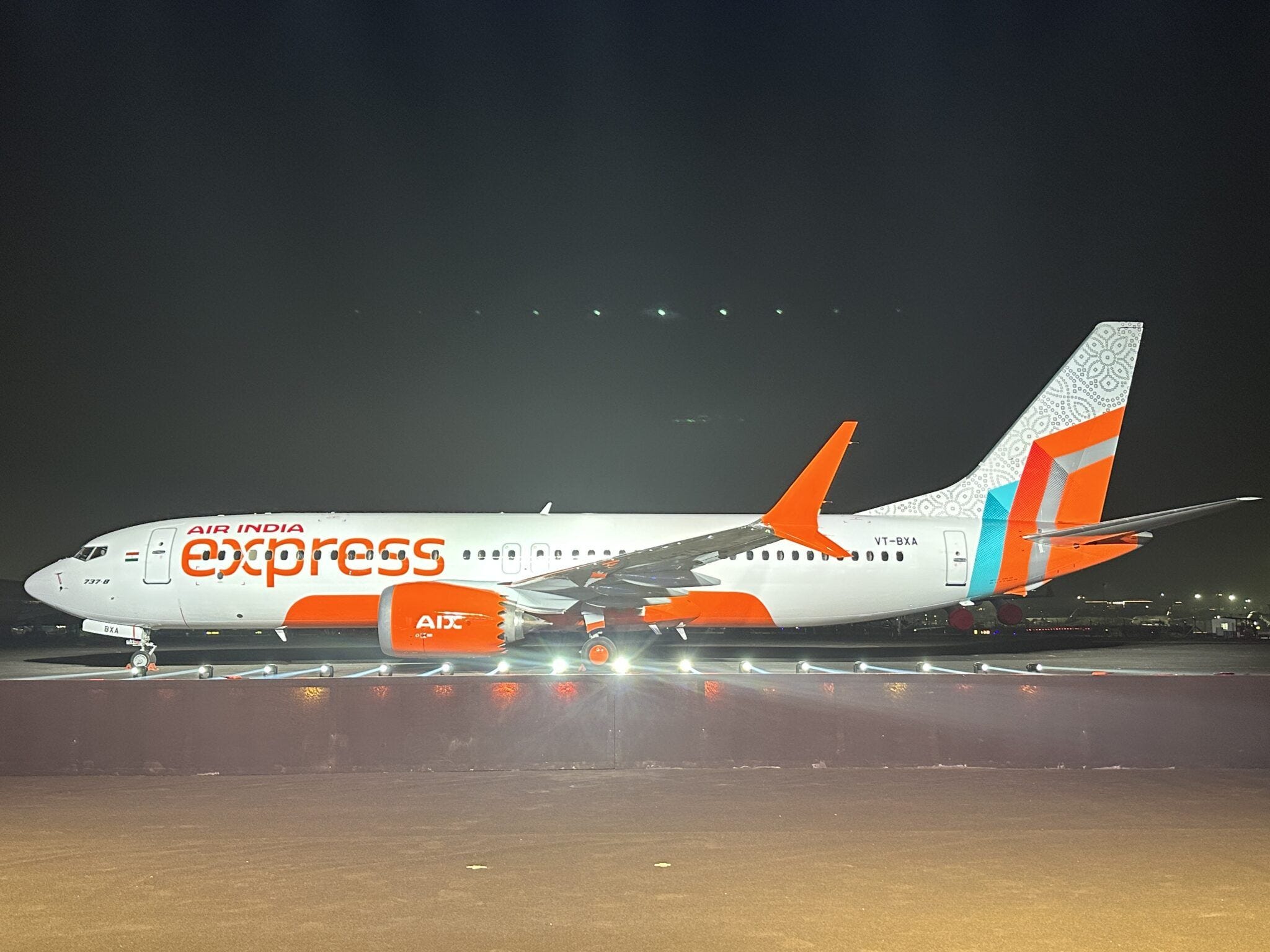
Air India Express is the unified low-cost arm of the Tata-owned Air India Group, formed after the integration of the original Air India Express international operations and the former AIX Connect (previously AirAsia India).
The carrier now functions as the single low-cost vehicle within the four-into-two airline consolidation that the group embarked upon in 2022.
The airline’s headquarters sit in Gurugram, alongside the parent Air India, while its primary operating bases stretch across Bengaluru, Delhi, Hyderabad, Mumbai, Kochi, and Kolkata.
Its operational footprint reaches into the United Arab Emirates, Saudi Arabia, Oman, Qatar, Bahrain, Kuwait, Singapore, Thailand, Malaysia, Bangladesh, and Nepal.
COMPANY SNAPSHOT - AIR INDIA EXPRESS (April 2026)
-------------------------------------------------
Founded                : 29 April 2005 (as Air India Express)
Holding company        : Air India Limited (Tata Sons - Talace Pvt Ltd)
Group umbrella         : Air India Group (under Tata Sons)
Chairman               : Campbell Wilson
Managing Director / CEO: Aloke Singh (transitioning out per 23 Mar 2026)
IATA / ICAO / Callsign : IX / IAD / EXPRESS INDIA
Fleet size             : 110+ aircraft (B737-800, B737 MAX 8, A320-200, A320neo)
Aircraft on order      : 30 additional B737 MAX (20 MAX 8 + 10 MAX 10)
Daily flights          : Over 500
Destinations           : 61 (43 domestic + 18 international)
Headquarters           : Gurugram, Haryana, India
Brand position         : Value-led full-service experience in low-cost wrapper
Group market share*    : ~26.5%-26.7% combined with Air India (Nov-Dec 2025)
*Combined Air India + Air India Express domestic shareThe brand was relaunched in October 2023 with a new livery, refreshed product, and a tagline of “Xplore More, Xpress More”.
The integration milestone reached completion when the Director General of Civil Aviation handed over the updated AOC to managing director Aloke Singh in October 2024.
Business Overview
Corporate Structure
Air India Express began life on 29 April 2005 as a wholly owned subsidiary of the then state-run Air India, set up to carry blue-collar workers and family travellers between southern India and the Persian Gulf at competitive fares.
The carrier ran a relatively static fleet of Boeing 737-800 aircraft for nearly two decades and grew into a profitable, niche international low-cost player.
The defining corporate event came on 8 October 2021, when Air India and Air India Express, along with a fifty-percent stake in AISATS, were sold to Talace Private Limited, a special-purpose vehicle of Tata Sons, for around ₹18,000 crore.
Tata acquired full control in January 2022 and immediately initiated the Vihaan.AI five-year transformation plan that has since reshaped the entire group.
Under that plan, Tata folded its other low-cost airline, AIX Connect (rebranded from AirAsia India in November 2022), into Air India Express.
The full operational and legal consolidation, which involved transferring AOCs, harmonising manuals, and moving aircraft and crew across entities, was closed out on 1 October 2024.
Revenue, Profitability, and the Cost of Transformation
The financial results of the Air India Group for the year ended March 2025 paint a clear picture of an airline in heavy capital expenditure mode.
The parent Air India reported consolidated revenue of ₹78,636 crore for FY25, up roughly 13.5 percent year-on-year, while consolidated net losses widened to ₹10,859 crore.
Looked at on a standalone basis, Air India and Air India Express together reported a combined net loss of ₹9,568.4 crore in FY25, equivalent to roughly USD 1.15 billion.
The bulk of the widening can be attributed to the cost of integrating Vistara into Air India and AIX Connect into Air India Express, plus expensive fleet retrofits, severance, IT consolidation, and brand rebuild expenses.
Within the group, Air India Express has been singled out as the heaviest one-time cost burden. Industry estimates point to a standalone Express loss of ₹5,700-5,800 crore in FY25, driven by the merger execution.
AIR INDIA GROUP FINANCIAL SNAPSHOT (FY25)
-----------------------------------------
Group revenue          : ~Rs 78,636 crore (USD ~9.4 billion)
YoY revenue growth     : ~13.5% (group consolidated)
Group net loss         : ~Rs 10,859 crore (consolidated)
AI + AIX combined loss : ~Rs 9,568.4 crore (~USD 1.15 billion)
Indicative AIX loss    : ~Rs 5,700-5,800 crore (industry estimate)
Air India revenue      : ~USD 7 billion (standalone, +11% YoY)
Group market share     : Closing in on IndiGo on revenue
These numbers, while large, sit against IndiGo’s FY25 revenue of about ₹84,098 crore, suggesting the Tata aviation arm has nearly closed the gap on the market leader at a topline level even while it bleeds during integration.
For airline industry stakeholders, the more important financial signal is unit economics.
The group has stated publicly that Air India achieved standalone operating profitability moments in early FY26, even as Express continued to digest aircraft inductions, white-tail retrofits, and route launches.
Revenue Growth Drivers
The number-one revenue lever for Air India Express has been raw capacity addition.
Since the Tata takeover, the airline has roughly tripled its fleet, doubled flights from 63 to 124 in December 2025 on certain corridors, and pushed monthly aircraft inductions to roughly four units a month at peak.
Network expansion has paralleled the fleet build, with the route count rising from 74 to approximately 171 routes by the time of the merger close.
Passenger volumes have grown by more than 400 percent since the takeover, as Tata pushed Express into Tier-2 and Tier-3 cities and beefed up Gulf, ASEAN, and Indian metro frequencies.
A second driver is unit revenue improvement through the cabin product upgrade. The airline introduced a recliner-style economy seat with leather covers, USB-A and USB-C power, mood lighting, and a paid hot meal product called Gourmair.
This has allowed Express to capture a small but meaningful premium against pure low-cost rivals on similar routes.
Key Services and Products
Air India Express positions itself as a value carrier rather than a barebones budget airline.
The product is built around three pillars: an upgraded narrow-body cabin, an Indian-themed onboard food and retail experience, and seamless interline links into Air India’s wide-body international network.
AIR INDIA EXPRESS PRODUCT STACK
-------------------------------
Cabin classes        : All-economy, refurbished interiors on most B737s
Seat product         : Recliner economy + selected Business-style seats on
                       white-tail MAX 8 retrofits
Inflight catering    : 'Gourmair' hot meal program (paid)
Connectivity         : USB-A and USB-C ports; mood lighting
Loyalty              : Air India Maharaja Club tier benefits applicable
Ancillaries          : Value packs, seat selection, baggage, lounge access
Distribution         : airindiaexpress.com, airindia.com codeshare,
                       major GDS, OTA channels
Interlining          : Full interline with Air India long-haul wide-bodies
                       at Delhi, Mumbai, Bengaluru, and Kochi
The airline brands its experience around the slogan ‘Xplore More, Xpress More’, and has invested in the digital journey end-to-end, from booking flow and chat-based servicing to web check-in.
The interlining play with Air India is critical, since it lets Express feed Tier-2 traffic into long-haul flights to North America, the United Kingdom, Europe, and East Asia.
Fleet: In-depth Analysis
Fleet Size, Composition and Age
The Air India Express fleet today is a deliberate hybrid, mixing Boeing 737s inherited from the legacy Express operation with Airbus A320 family jets transferred from AIX Connect and the parent Air India.
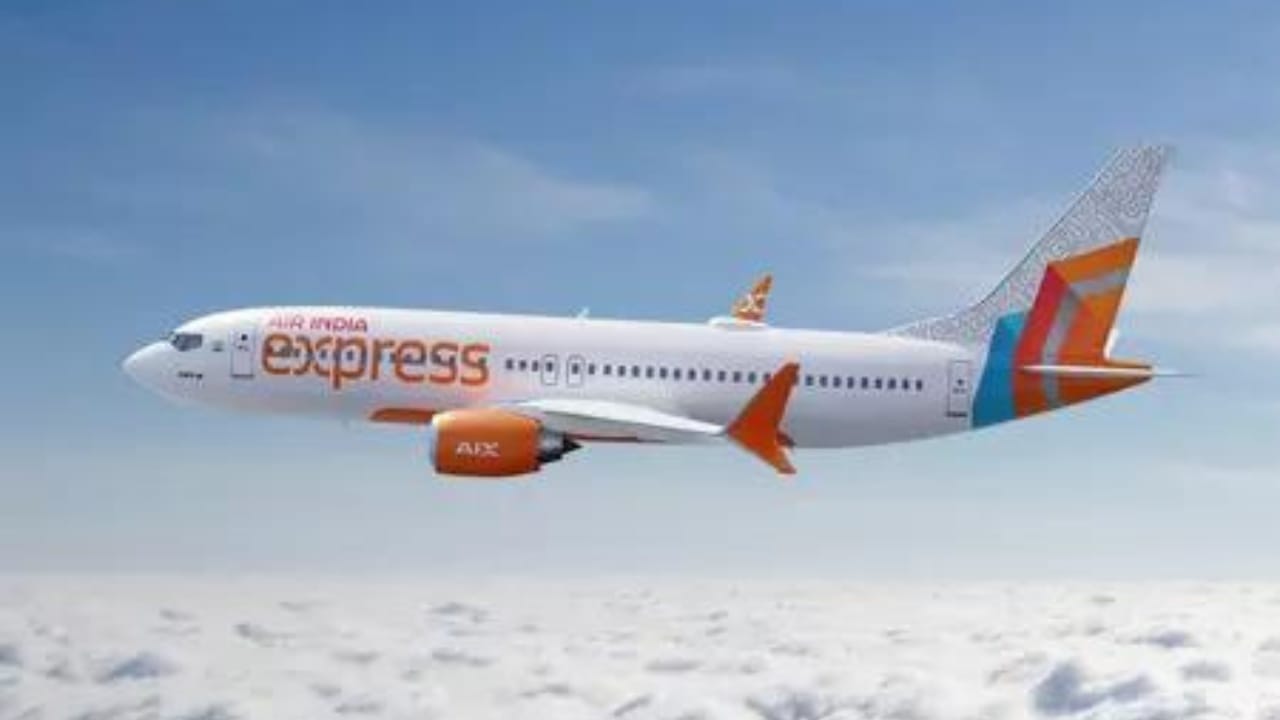
As of early 2026, the airline operates a fleet of around 110 aircraft, encompassing the Boeing 737-800, Boeing 737 MAX 8, Airbus A320-200, and Airbus A320neo.

The reported average age of approximately 8.7 years reflects a mix of older 737-800s and newer 737 MAX and A320neo inductions.
Composition at the merger close stood at 24 Airbus A320-200, 8 Airbus A320neo, 26 Boeing 737-800, and 36 Boeing 737 MAX 8 for a total of 94 aircraft, with another 15 A320-200s flagged for transfer in from Air India and a deep order pipeline for Boeing MAX deliveries.
AIR INDIA EXPRESS FLEET (representative composition)
----------------------------------------------------
Boeing 737-800        : ~26 (legacy Express international workhorse)
Boeing 737 MAX 8      : ~36 (new spine of long-thin and Gulf operations)
Airbus A320-200       : ~24 (ex-AIX Connect; some still being moved in)
Airbus A320neo        : ~8 (efficient narrow-body for hub feeders)
On order              : 30 additional MAX (20x MAX 8 + 10x MAX 10)
Long-term ambition : ~170 aircraft within five years of mergerAircraft Type Strategy and Configuration
The Boeing 737-800 fleet is the historical backbone of Express.
These aircraft were originally configured in a single all-economy layout to maximise seats on dense Gulf and South India sectors. They are progressively being repainted into the new livery and either retired or pushed toward shorter-range domestic routes as MAX 8 deliveries land.
The Boeing 737 MAX 8 has emerged as the strategic platform of choice. It is operated in a dual-class configuration on certain “white-tail” retrofits, with a small Business cabin and the rest in upgraded economy.
The white-tail aircraft were originally built for other carriers and are being retrofitted into single-economy-class layouts at the airline’s bases.
The Airbus A320 family came over from the AIX Connect heritage. The A320-200s are mostly older airframes and are being progressively rotated into the merged fleet, while the A320neos provide a fuel-efficient option for shorter feeder runs into the metro hubs.
EXPRESS NARROW-BODY ROLE MAP
----------------------------
B737-800     : Domestic Tier-2/Tier-3 + selected Gulf
B737 MAX 8   : Long-thin domestic + Gulf + ASEAN; new cabin product
B737 MAX 10  : Future high-density domestic trunk routes (post 2027)
A320-200     : Bridging capacity from former AIX Connect ops
A320neo : Hub feeders, short-haul efficiency roleFleet Strategy: A Boeing-Heavy Future With Airbus Tail
Tata’s strategic decision is to consolidate the long-term fleet around the Boeing 737 MAX family. Air India transferred its original 190-aircraft Boeing 737 MAX order (placed as part of the historic 2023 mega order for 470 aircraft) to Air India Express, creating one of the largest single-airline 737 MAX backlogs in Asia.
In January 2026, Air India placed an additional incremental order for 30 Boeing 737 MAX jets on top of the existing book, comprising twenty 737-8s and ten of the larger 737-10s. The 737 MAX 10s, in particular, will allow Express to deploy higher-density capacity on the densest domestic trunks once they enter service.
Management has guided that all white-tail Boeing 737-8s already inducted will be retrofitted into a single-economy-class layout by mid-2026, aligning seat counts and crew procedures across the fleet to drive simpler operations.
For 2026, the carrier expects to add between 20 and 24 aircraft and to take all of its Boeing 737 MAX backlog by 2030. Combined with the Airbus narrow-bodies still being absorbed from the AIX Connect side, the long-term target is an operating fleet of around 170 aircraft.
FLEET STRATEGY PILLARS
----------------------
1. Consolidate around Boeing 737 MAX 8 and MAX 10 long-term
2. Absorb residual A320 family from former AIX Connect
3. Standardise interiors with leather seats, USB ports, mood lighting
4. Retrofit "white tail" MAX 8s into single-economy layout by mid-2026
5. Use density variants (MAX 10) on trunk routes; MAX 8 on long-thin
6. Phase out oldest B737-800 airframes as MAX deliveries ramp
7. Target ~170 aircraft within five years of the AIX Connect mergerCabin Product and Onboard Experience
Air India Express has invested heavily in cabin standardisation.
Its first retrofitted Boeing 737-8 was unveiled with leather recliner seats, USB ports, and skylighting, aiming to lift the perceived quality of the low-cost product without abandoning the cost discipline of a single-fleet, all-economy operation.
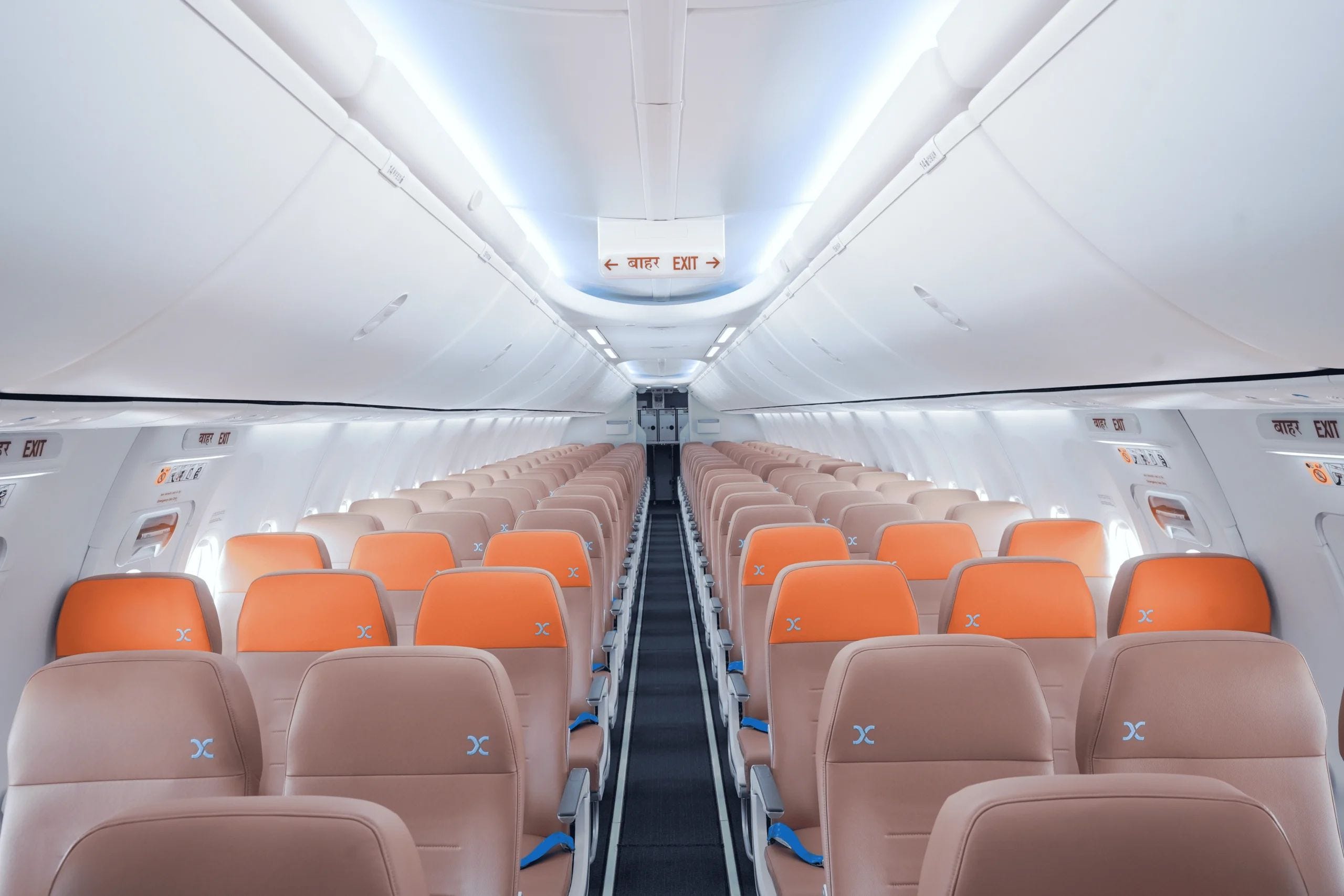
The Boeing 737 MAX 8s feature mood lighting and the new “flying canvas” livery, with one tail variant that doubles as airborne artwork.
The cabin product was showcased to trade partners at SATTE 2026 in Delhi, reinforcing the airline’s commitment to keep visible product investment going during the integration.
A small Business class cabin sits at the front of certain 737 MAX retrofits, mostly intended for the longer Gulf and Southeast Asia sectors.
The rest of the airframe is laid out in high-density economy with the upgraded seat shell and integrated power, marking a meaningful departure from the no-frills approach of the legacy Express operation.