


Executive Summary
Air India operates a mainline passenger fleet of 186 aircraft as of 13 February 2026, supplemented by 105 Air India Express aircraft, taking the group to almost 300 planes with 570 plus on firm order across Airbus and Boeing.
The group reported a combined FY25 pre-tax loss of about ₹9,568 crore, and is expected to post a larger FY26 loss of approximately ₹15,000 crore, pressured by Pakistan airspace closure, the AI171 accident, and integration costs from the Vistara and AIX Connect mergers.
The network now spans 41 non-stop international destinations across five continents from primary hubs at Delhi and Mumbai, with Bengaluru emerging as a long-haul gateway and Kochi, Kozhikode, and Kannur anchoring Air India Express.
Campbell Wilson has stepped down as CEO in April 2026 as the board searches for a successor to steer Phase Two of Vihaan.AI, with the Tata Group intensifying its focus on profitability, fleet renewal, and premium positioning.
Recommended - Read Full Reports


Read All Reports
Table of Contents
Executive Summary
Introduction
Company Profile: Key Facts
Business Overview
From 70 Years of Government Ownership to a Tata Turnaround
The Vihaan.AI Transformation Programme
Financial Analysis and Revenue Drivers
Key Services and Product Portfolio
Leadership Transition
Revenue Growth Drivers Across the Next Three Years
Air India Fleet: In-depth Analysis
Fleet Size and the Big Picture
Mainline Fleet Composition
Fleet Age and Renewal Logic
The 2023 Mega Order and the 2026 Follow-on
Aircraft Types Strategy and Configuration
Fleet Strategy: Single-Aisle and Twin-Aisle Paths
Cabin Retrofit Programme
Fleet Strategy Risks
Route Network, Major Destinations and Strategy
Current Network Footprint
Europe and the United Kingdom
North America
The Middle East Cluster
Far East and Southeast Asia
Australia and Africa
The Indian Subcontinent
Domestic Network
Route Strategy Logic
Partner Network
Major Operational Bases (Hubs)
Delhi, The Heart of the Network
Mumbai, Rebuilding a Long-Haul Gateway
Bengaluru, The Third Leg
Kochi, Kozhikode, and Kannur, Anchoring Air India Express
Infrastructure Expansion at Hubs
Competitive Position
Market Context
IndiGo, The Dominant Rival
Akasa Air, The Scrappy Challenger
SpiceJet, The Recovering Legacy Low-Cost
Middle East Super Connectors
Singapore Airlines and the Singapore Factor
Air India vs. IndiGo
Air India vs. Emirates
Air India vs. Singapore Airlines
Brand, Product, and Customer Experience
The New Brand Identity
Cabins and Onboard Experience
Loyalty and Digital
Maintenance, Engineering, and Safety
AIESL and MRO Strategy
The Air India Flight 171 Accident
Broader Safety Governance
Cargo Operations
Air India Cargo
Human Capital and Training
Sustainability and Fuel Strategy
Digital Transformation
Key Risks with Probabilities and Scenarios
Risk 1: Prolonged Pakistan Airspace Closure
Risk 2: AI171 Final Report and Follow-on Actions
Risk 3: Widening FY26 Losses
Risk 4: Integration Execution Slippage
Risk 5: IndiGo’s Continued International Push
Risk 6: Delivery Slippage from Boeing and Airbus
Risk 7: Regulatory and Geopolitical Volatility
Risk 8: Talent and Succession
Strategic Outlook
What Air India Gets Right
What Remains Unresolved
What To Watch In 2026 And 2027
My Final Thoughts
Official Sources and Data
Introduction
Air India is no longer the sleepy state carrier it was four years ago, and it is also not yet the global premium airline that its owners promised.
It’s something far more interesting, a privatised legacy flag carrier in the middle of the most ambitious five-year turnaround anywhere in aviation, and the numbers in 2026 tell that story with uncomfortable honesty.
The group now operates a combined fleet of close to 300 aircraft after absorbing Vistara and AIX Connect, yet it has just reported a pre-tax loss of roughly 1.15 billion dollars for FY25, is on track for a steeper loss in FY26, and has just lost its chief executive Campbell Wilson, who led the entire Vihaan.AI transformation.
Layer on top of that the tragedy of Air India Flight 171, the ongoing Pakistan airspace closure that has added hours to every westbound long haul, and the ferocious expansion of IndiGo, and you get a company where strategy, fleet, network, and reputation are all being reshaped at once.
This in-depth strategic analysis report pulls all of it together.
Company Profile: Key Facts
Legal name:            Air India Limited
Parent group:          Tata Sons / Tata Group
Chairman:              N. Chandrasekaran
CEO (outgoing):        Campbell Wilson (resigned, April 2026)
HQ:                    Gurugram, Haryana, India
Founded:               15 October 1932 (as Tata Air Services)
Re-privatised:         27 January 2022 (Tata Sons takeover)
Star Alliance member:  Since 11 July 2014
Primary hubs:          Delhi (DEL), Mumbai (BOM)
Secondary hubs:        Bengaluru (BLR), Kochi (COK), Kozhikode (CCJ)
Mainline fleet:        186 aircraft (13 February 2026)
Express fleet:         ~105 aircraft
Firm orders remaining: 500+ aircraft across Airbus and Boeing
Non-stop intl. dests.: 41 cities across 5 continents (25 March 2026)
FY25 group pre-tax loss: approx ₹9,568 crore (~US$1.15 bn)
Brand identity:        "The Vista" logo, unveiled August 2023
Transformation plan: Vihaan.AI (5-year programme, 2022 to 2027)Business Overview
From 70 Years of Government Ownership to a Tata Turnaround
For most of its modern life Air India was a government-owned carrier that struggled to match the cost base of private peers. The sale to Tata Sons in January 2022 was one of the largest privatisations in Indian history, returning the airline to the group that originally founded it as Tata Air Services in 1932.
Tata Sons did not merely buy a loss making airline, it acquired the rights to rebuild a flag carrier at a moment when India was becoming the world’s third largest aviation market.
That explains the audacious scale of its five-year transformation plan, known internally as Vihaan.AI, which was organised into four phases from Taxi to Climb to Cruise to Arrival.
The Vihaan.AI Transformation Programme
Vihaan.AI is the spine of everything the company has done since 2022. Phase one focused on stabilising operations, fixing broken technology, retiring unserviceable aircraft, and hiring thousands of new employees. Phase two was about scale and synergy, driven by two historic mergers.
The legal merger with Vistara completed on 12 November 2024, consolidating full-service operations into a single brand and leaving Singapore Airlines with a 25.1 percent stake in the combined entity. Six weeks earlier, on 1 October 2024, Air India Express had absorbed AIX Connect, the former AirAsia India, giving the group a single unified low-cost subsidiary.
By early 2026, the group exists as two airlines instead of four. Air India is the full-service carrier, Air India Express is the low-cost arm, and they share fleet planning, technology, loyalty, maintenance, and sales platforms.
Financial Analysis and Revenue Drivers
The financial reality of that scaling up is brutal. For the year ended 31 March 2025, Air India and Air India Express together reported a combined pre-tax loss of ₹9,568.4 crore, roughly US$1.15 billion. The loss widened further in the first part of FY26, with independent reporting pointing to a projected full year loss of at least ₹150 billion for the fiscal year ending 31 March 2026.
To put this in scale, Indian airlines collectively posted a net loss of ₹5,290 crore in FY25, and Air India alone accounted for a substantial ₹9,808 crore of group losses once the combined figures are unpacked by the government to parliament.
Three structural forces are driving the red ink.
First, transformation spending remains enormous, with more than USD 400 million committed to aircraft refurbishments alone and hundreds of millions more on new IT systems, training, and cabin retrofits.
Second, the Pakistan airspace closure since April 2025 has added flight time and fuel on almost every westbound long-haul, with reported losses of around ₹4,000 crore attributed just to that factor.
Third, the June 2025 AI171 accident resulted in grounding checks, additional maintenance spending, insurance reset costs, and reputational drag that softened near-term forward bookings on certain routes.
FINANCIAL SNAPSHOT — AIR INDIA GROUP
FY25 pre-tax loss (AI + AIX):  ~ ₹9,568.4 crore (US$1.15 bn)
FY26 expected loss (reports):  ~ ₹150 bn (US$1.6 bn) for FY26
Vihaan.AI spending cycle:      Ongoing through 2027
Key headwinds:                 Pakistan airspace, AI171 aftermath,
                               integration costs, high wide-body lease
                               and fuel costs on elongated routings
Revenue growth drivers:        New international frequencies,
                               retrofitted cabins, premium upsell,
                               Air India Express low-cost expansion,
Lufthansa/Star Alliance codeshare upliftKey Services and Product Portfolio
The group’s revenue is now built on five pillars.
The first is full-service scheduled passenger flying under Air India, covering domestic, short-haul international, and ultra long-haul routes to North America, Europe, and Oceania.
The second is low-cost scheduled flying under Air India Express, mainly to the Middle East, Southeast Asia, and dense domestic markets.
The third pillar is dedicated freighter-style capacity and belly-hold cargo, operated through Air India and boosted by widebody deliveries.
The fourth pillar is maintenance, repair, and overhaul, delivered by AI Engineering Services Limited, known as AIESL.
The fifth pillar is loyalty, enabled by the revamped Maharaja Club programme that went live with substantially reduced redemption levels and faster status progression from 1 April 2026.
Air India’s decision to keep its ground-handling, catering, and MRO subsidiaries close to the core business distinguishes it from lean low-cost rivals.
In practical terms, AIESL’s expansion of MRO facilities at two additional airports with a ₹200 to ₹300 crore investment signals intent to capture third-party maintenance work inside India rather than continue sending narrowbodies to Turkey and Singapore.
Leadership Transition
The most significant management event of 2026 is the departure of Campbell Wilson. The board announced his resignation in early April 2026, with Wilson agreeing to serve a six-month notice period while the board’s committee identifies a successor.
Wilson had conveyed his intention to step down in 2024, and his original term ran until 2027, which means this is a planned early exit rather than a surprise.
That said, the timing coincides with widening losses and continuing regulatory scrutiny after AI171, and it is fair to say the board is likely to pick a successor whose remit is sharper on profitability and safety governance.

Chairman N. Chandrasekaran has emphasised publicly that 2026 will be the airline’s biggest leap in customer experience yet, framing the transition as continuity rather than a pivot.
Revenue Growth Drivers Across the Next Three Years
Three revenue engines stand out going into 2027.
Newly delivered widebodies coming directly from factories, branded as “made-for-Air India” aircraft, allow the carrier to replace wet-leased widebodies that it rushed into service in 2023 and 2024 at very high cost. These new jets are expected to join the fleet at a rate of six widebodies and about twenty narrowbodies during calendar 2026.
Retrofitted legacy widebodies, fitted with new seats and in-flight entertainment, unlock premium revenue on routes like Bengaluru to London. The first upgraded Boeing 787-8 flew back from California in late 2025 after its refresh at a facility in San Bernardino.
Lufthansa Group’s expanded codeshare, sealed through a landmark MoU signed on 17 February 2026, provides feeder traffic out of Frankfurt, Munich, Vienna, and Zurich that Air India could never generate on its own.
Air India Fleet: In-depth Analysis
Fleet Size and the Big Picture
Air India mainline ended the first quarter of calendar 2026 with 186 aircraft. That count, as published on the airline’s own fleet factsheet, is exclusive of Air India Express, and it reflects the combined post-merger line-up with Vistara aircraft fully absorbed.
The airline’s consumer-facing website, which sometimes rounds up to include active plus planned deliveries that have landed in India, speaks of 191 narrow and wide-body aircraft.
Independent tracker Planespotters listed 186 aircraft with an average fleet age of 8.7 years as of 17 April 2026, which tallies with the official factsheet.
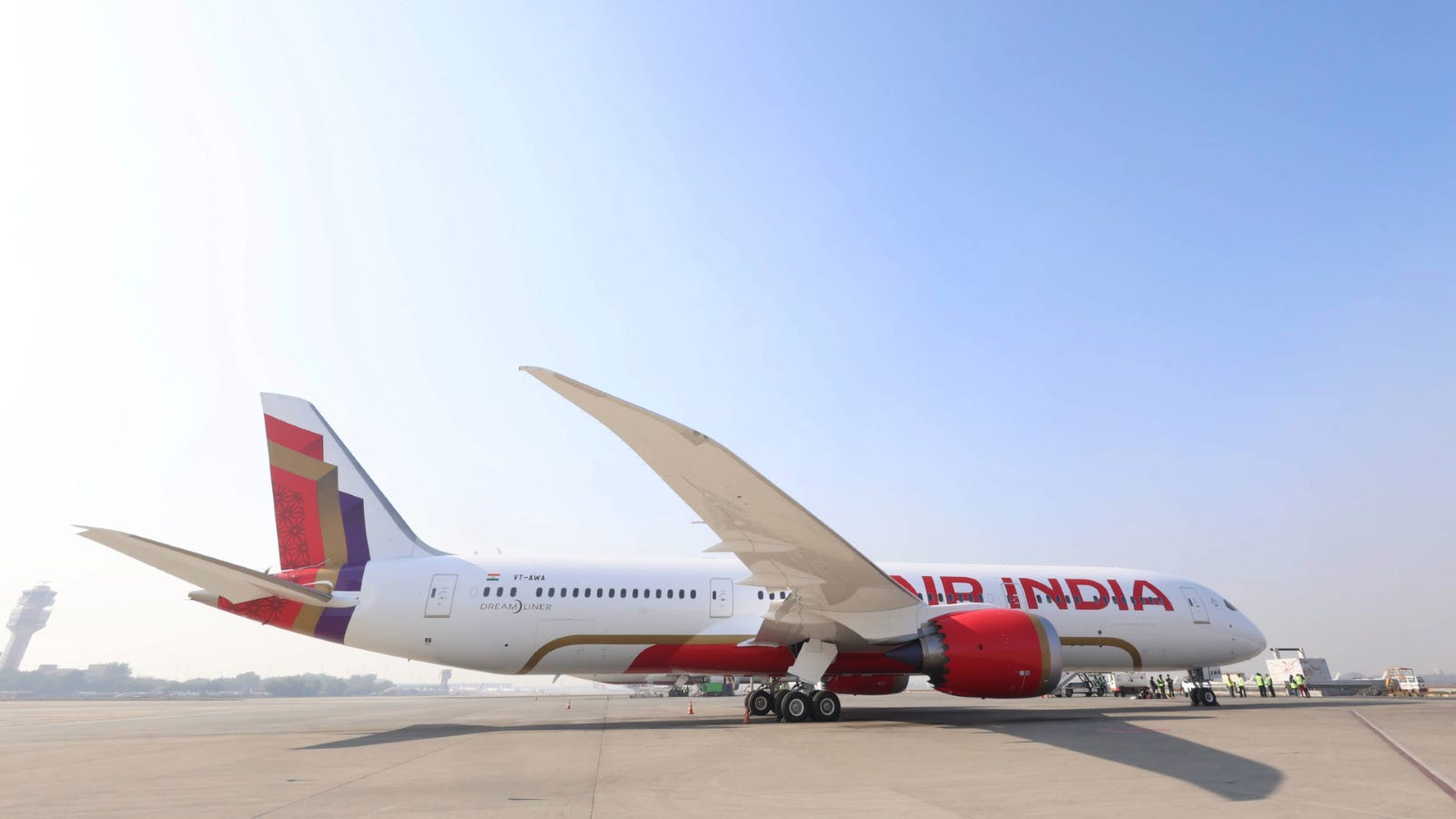
Air India Express separately operates around 105 aircraft. Added together, the Air India Group flies roughly 290 aircraft today, with a committed pipeline of more than 500 additional jets.
Mainline Fleet Composition
The fleet breakdown as of 13 February 2026 is unusually balanced between Airbus narrowbodies and widebodies from both Airbus and Boeing.
AIR INDIA MAINLINE FLEET (13 February 2026)
Airbus A319:             6
Airbus A320ceo:          1
Airbus A320neo:          94
Airbus A321ceo:          13
Airbus A321neo:          10
Airbus A350-900:         6
Boeing 777-300ER:        19
Boeing 777-200LR:        4
Boeing 787-8 Dreamliner: 26
Boeing 787-9 Dreamliner: 7
TOTAL MAINLINE:          186
(Source: Air India 'Our Wings' factsheet)
The single largest sub-fleet is the Airbus A320neo family with 104 aircraft when A321neos are included, putting Air India among the very large narrowbody operators in Asia.
On the widebody side, the 26-strong Boeing 787-8 fleet is the workhorse, complemented by 19 Boeing 777-300ERs for the densest long-haul markets such as New York and London, plus four Boeing 777-200LRs used for ultra long-haul into San Francisco and Toronto.

Six Airbus A350-900s are deployed to London and select North American and European cities, and seven Boeing 787-9s, mostly “made for Air India” line-fit machines, are beginning to plug the long thin routes that require a modern widebody without Dreamliner-scale economics.
Fleet Age and Renewal Logic
At 8.7 years average age, Air India’s mainline fleet is neither the youngest in Asia nor the oldest. IndiGo’s all-Airbus narrowbody fleet is typically a little younger because it churns aircraft fast through sale-and-leaseback, while many legacy European carriers run older widebodies by comparison.
The real age story hides inside the widebody sub-fleets. The Boeing 777-200LRs are over fifteen years old and were procured by the airline in its pre-privatisation era, while the Boeing 787-8s range from eight to thirteen years of age and were due for a mid-life cabin reset.
That reset is now happening through the 787 refurbishment programme.
The 2023 Mega Order and the 2026 Follow-on
Air India’s February 2023 order for 470 aircraft was then, and remains, the single largest order in Indian commercial aviation history. The airline’s own order infographic breaks the total down cleanly across Airbus and Boeing.
Widebody commitments include 40 Airbus A350s of which 34 are A350-1000s and six are A350-900s, plus 20 Boeing 787 Dreamliners, and 10 Boeing 777X aircraft, the 777-9 variant. Narrowbody commitments include 210 Airbus A320 and A321neos, plus 190 Boeing 737-8 aircraft destined for Air India Express.
On 29 January 2026 at the Wings India airshow, Air India Express firmed up a further order for 30 additional Boeing 737 MAX aircraft, with 20 options on top. Including this tranche, the airline’s outstanding backlog is over 500 aircraft, distributed across Airbus and Boeing as outlined in the official communication.
Aircraft Types Strategy and Configuration
The A319 and A320ceo sub-fleets are being retired as the neo generation scales up. The A320neo and A321neo families are the workhorses of the domestic and short-haul international network, flying everything from Delhi to Mumbai to Delhi to Dubai.
The A321neo is particularly strategic because its range reaches the Gulf, West Asia, and most of Southeast Asia comfortably, letting Air India redeploy widebodies away from sub-optimal medium haul duties.
On the widebody side, the Boeing 777-300ER remains the single densest seat-count in the fleet, carrying more than 340 passengers per flight, and is used on high-volume routes to London Heathrow and the US East Coast.

The Airbus A350-900 sits at the other end of the widebody spectrum, offering the lowest trip cost among the widebodies and an exceptional passenger experience that Air India is using to reset the flagship service image.
New cabins include a custom-styled interior on the made-for-Air India Boeing 787-9, with new seats, bigger overhead bins, and wireless in-flight entertainment streaming.
Configuration-wise, the airline has settled on a four-class product for long-haul, offering First, Business, Premium Economy, and Economy on selected widebodies such as the A350-1000 once deliveries begin, with three classes on the Boeing 787 variants and a two-class product on single-aisle international.
The emphasis on a Premium Economy cabin in particular is a deliberate bet on the Indian long-haul corporate traveller who is willing to pay up but cannot always justify business class.
Fleet Strategy: Single-Aisle and Twin-Aisle Paths
Air India’s strategic fleet picture for the coming decade sorts into two parallel storylines.
On single-aisle the plan is to operate a mixed Airbus and Boeing fleet, with A320 and A321neos concentrated in Air India mainline and Boeing 737 MAX 8s concentrated in Air India Express.
The logic of the split is industrial. It keeps bargaining leverage across two OEMs, it matches the two different business models, and it preserves engineering commonality within each subsidiary.
Air India Express is already the single largest Boeing 737 operator in India on a narrowbody basis, with 26 Boeing 737-800s being phased out and 51 Boeing 737 MAX 8 aircraft already in service as of early 2026.
On twin-aisle, the plan is to run three main widebody families.
The Airbus A350 family, initially the A350-900 and eventually the A350-1000, will focus on the longest and most premium routes.
The Boeing 787 family will handle medium to long routes into Europe and Asia, and the Boeing 777 will remain the high-density backbone until retirement around the turn of the next decade, progressively replaced by the 777-9.
Cabin Retrofit Programme
The fleet strategy cannot be discussed without the retrofit programme. On 31 October 2025, Air India confirmed the completion of the first phase of its legacy retrofit, meaning that 104 A320 Family aircraft now feature new or upgraded cabins.
The programme installed new Business, Premium Economy, and Economy seats, updated carpets, curtains, upholstery, and cabin panels with fresh motifs, and applied 8,000 plus kilograms of paint to repaint each airframe in the new red, aubergine, and gold brand livery. This was effectively a re-launch of the narrowbody product.
The Boeing 787-8 retrofit, budgeted at over USD 400 million, is the other transformative slice. The first upgraded 787-8 returned to Delhi from California in late 2025. From 1 August 2026, Bengaluru to London Heathrow flights are scheduled to operate with the retrofitted 787-8, featuring new cabins with lie-flat business seats and premium economy as a dedicated cabin rather than a seat row.
Air India has also committed to long-term serviceability by signing a 12-year 787 Component Services Programagreement with Boeing in February 2026 to cut turnaround time on parts.
FLEET RENEWAL TIMELINE
2023:  Historic 470-aircraft order announced
2024:  Vistara merger absorbs another ~70 aircraft
2025:  First phase of narrowbody retrofit completed (104 A320 family)
2025:  $400M 787-8 retrofit programme launched
2026:  First line-fit B787-9 delivered
2026:  First retrofitted B787-8 re-inducted
2026:  Six widebodies + ~20 narrowbodies expected this calendar year
2026:  30 additional B737 MAX 8s ordered for AI Express
2027+: Ramp up of A350-1000 deliveries, beginning of 777X replacementsFleet Strategy Risks
Nothing about the fleet strategy is frictionless. Boeing’s delivery slippage has pushed parts of the order book to the right, forcing Air India to lean on wet-leased widebodies that carry higher unit costs and variable crew standards. The 787 family grounding reviews post-AI171 also introduced short-term capacity volatility.
The secondary risk is engine maintenance, with the GE GEnx on the 787 and the Rolls-Royce Trent XWB on the A350 both requiring deep MRO infrastructure. AIESL is expanding, but Air India still sends some work overseas, which translates into hard currency outflows and longer aircraft-on-ground cycles.