


Welcome to AviationOutlook: The aviation newsletter built exclusively for decision-makers.
Become an “Annual” member now & get this special discount offer.
As a paid member, you get access to:
200+ Reports - All major airlines + aerospace & defense companies (updated regularly).
Daily / Weekly - Deep-dive analysis & insights.
Monthly - Industry outlook reports.
In case you missed it, here are the latest analysis reports:
Embraer - Company Analysis and Outlook Report 2026 (Updated)
American Airlines’ Six-Route Europe Play: Yield Discipline or Widebody Overreach?
Check Out All Reports
Executive Summary
AirAsia has completed one of Asia’s most complex airline restructurings, consolidating every AirAsia-branded carrier under AirAsia X Berhad on 16 January 2026, creating a single listed entity now referred to as the “Enlarged AirAsia X” or AirAsia Group.
The Enlarged Group operates a fleet of 253 aircraft across five short-haul airlines and one long-haul arm, carrying 68.6 million passengers in 2025 on a pro-forma basis, with a stated ambition to grow to 600 aircraft within a decade.
Financially, pro-forma FY25 revenue reached RM22.2 billion with EBITDA of RM4.6 billion and Net Operating Profit of RM1.3 billion, while the 2026 internal targets push the bar to RM25 billion in revenue and RM5 billion of EBITDA.
A transformative 50+20 Airbus A321XLR agreement valued at USD 12.25 billion, combined with a decision to retire all A330-300s by 2031, signals the group’s pivot toward becoming a narrowbody-only low-cost network carrier spanning Asia, the Middle East, Europe, and Africa.
Recommended - Read Full Reports


Read All Reports
Table of Contents
Executive Summary
Key Facts: Company Profile
Business Overview
A Restructured Corporate Architecture
Revenue Performance and LTM Analysis
Revenue Growth Drivers
Key Services and Products
Fleet: In-depth Analysis
Fleet Size and Composition
Fleet Age and Utilisation
Aircraft Types Strategy and Cabin Configuration
Fleet Strategy: Pivoting to Narrowbody-Only
Fleet Reactivation and Deliveries in 2025
Route Network, Major Destinations and Strategy
Network Scale and Coverage
2025 Network Expansion
Long-haul Route Strategy
Fifth-Freedom and Fly-Thru
India Focus
Major Operational Bases (Hubs)
Kuala Lumpur International Airport (KLIA): The Flagship Mega-Hub
Bangkok Don Mueang (DMK): The ASEAN Stronghold
Secondary Hubs
Competitive Position
List of Major Competitors
AirAsia vs Scoot
AirAsia vs VietJet Air
AirAsia vs Lion Air Group
AirAsia vs Cebu Pacific
AirAsia vs IndiGo
Competitive Position Summary
Technology, Digital Strategy and Ancillary Ecosystem
AirAsia MOVE: The Super-App That Wasn’t Sold
Santan and Onboard Ancillary
Fuel Efficiency and Data-Driven Operations
Sustainability and ESG Positioning
Labour, Safety and Regulatory Environment
Financial Targets and Outlook for 2026
2026 Internal Targets
Capital Structure Post-Consolidation
Thai AirAsia’s 2026 Outlook
Key Risks with Probabilities and Scenarios
1. Fuel Price Volatility
2. Aircraft Delivery Delays
3. China and India Demand Volatility
4. Integration Execution Risk
5. Regulatory and Country Risk
6. Currency Risk
7. New Order Integration Risk
Awards and Brand Equity
The Teleport and Cargo Dimension
Labour, Culture and the Allstar Ethos
ADE: The MRO Advantage That Stayed with Capital A
Historical Context: From 2001 to 2026
Strategic Outlook Through 2030
Product Innovation and Digital Distribution
Fleet Transition Economics
Financial Reset and Balance Sheet Repair
The Post-Capital A Relationship Matrix
Global Context: Why AirAsia’s Pivot Matters
My Final Thoughts
Official Sources and Data
Key Facts: Company Profile
The AirAsia story now reads very differently than it did at the start of 2025.
The aviation operating businesses used to sit under Capital A Berhad, a PN17-classified holding company. After the aviation sale closed in January 2026, all airlines now report into AirAsia X Berhad, which trades on Bursa Malaysia’s Main Market.
COMPANY SNAPSHOT (as of April 2026)
-----------------------------------
Listed entity:       AirAsia X Berhad (the "AirAsia Group")
Stock exchange:      Bursa Malaysia, Main Market
Group CEO:           Bo Lingam
Founder/Advisor:     Tony Fernandes (ex-CEO, Capital A)
Headquarters:        RedQ, KLIA, Sepang, Malaysia
Primary hub:         Kuala Lumpur International Airport (KLIA T2)
Secondary mega-hub:  Bangkok Don Mueang (DMK)
Fleet (Apr 2026):    253 aircraft across the group
Airlines under:      AirAsia Malaysia (AK), Thai AirAsia (FD),
                     Indonesia AirAsia (QZ), Philippines AirAsia (Z2),
                     AirAsia Cambodia (KT), AirAsia X (D7),
                     Thai AirAsia X (XJ)
FY25 passengers:     68.6 million (pro-forma)
FY25 revenue:        RM22.2 billion (pro-forma)
Orderbook:           374 Airbus aircraft firm + ~150 under discussion
Skytrax 2025 award:  World's Best Low-Cost Airline (16th year running)
The group’s lineage traces back to 2001, when the original AirAsia Berhad was acquired by Tune Air for a nominal sum and rebuilt into Asia’s first full low-cost carrier.
Today the entity sitting at the top of the operational chart is AirAsia X Berhad, which absorbed AirAsia Berhad and AirAsia Aviation Group Limited in the January 2026 reverse takeover.
The listed vehicle became the parent of every AirAsia-branded operating carrier following the settlement of 2,307,692,307 new consideration shares and the assumption of RM3.8 billion of intercompany liabilities. Capital A now focuses on its five non-aviation business units: ADE, Teleport, AirAsia MOVE, Santan and AirAsia Next.
Business Overview
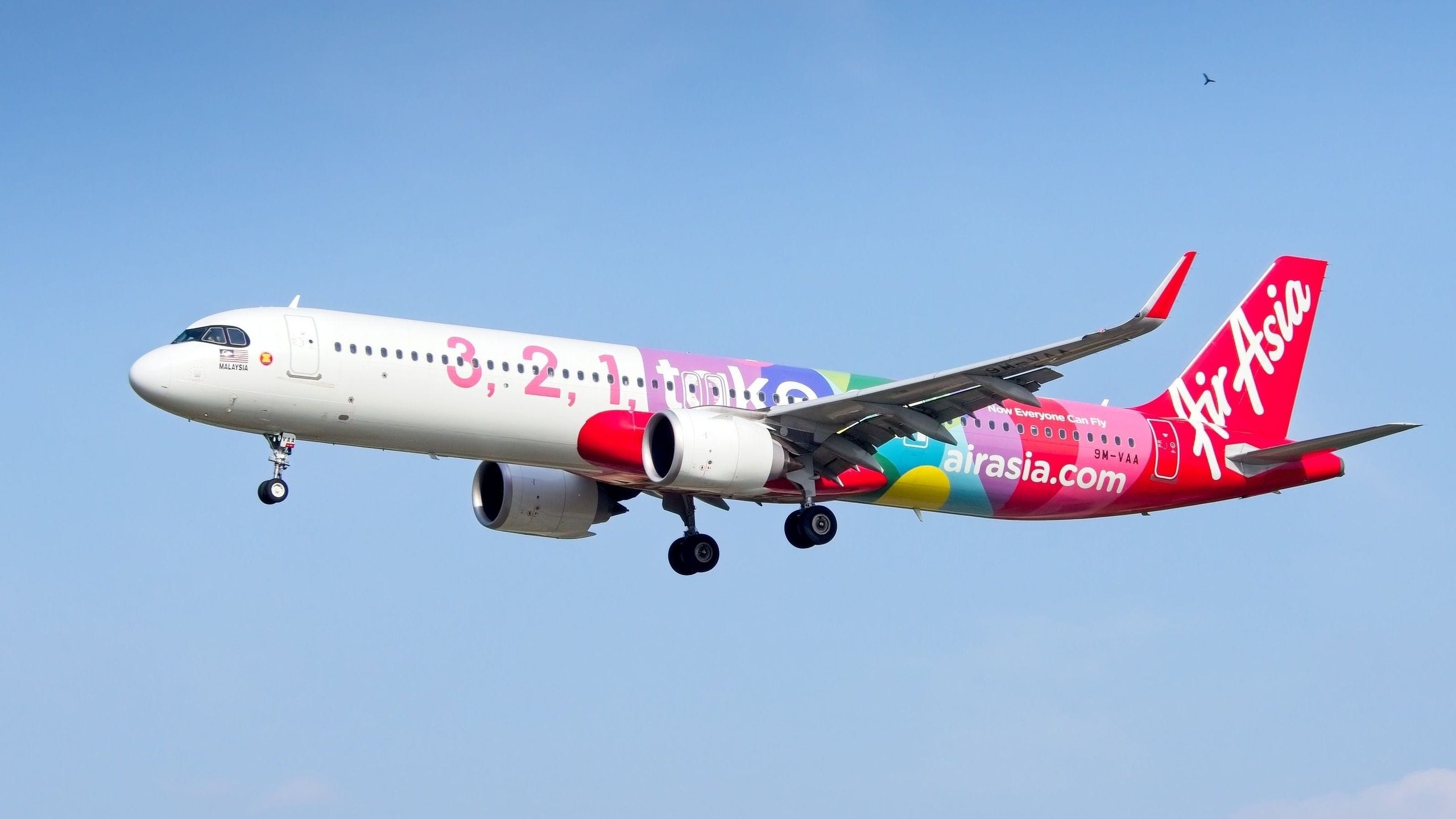
A Restructured Corporate Architecture
The enlarged AirAsia group is effectively two businesses stitched into one. Short-haul operations are anchored by the five AOCs in Malaysia, Thailand, Indonesia, the Philippines and Cambodia, while medium and long-haul flying sits in AirAsia X (with its Thai sister carrier TAAX as an associate).
This dual-structure replaces years of cross-holdings, related-party receivables and regulatory overhang that had pushed Capital A into PN17 status on Bursa Malaysia. The January 2026 closing enabled the group to submit its application to exit PN17, a step that CEO Tony Fernandes described as the completion of a six-year turnaround.
The new governance model puts Bo Lingam in charge as Group CEO of the Enlarged AirAsia X. Tony Fernandes steps back from day-to-day airline operations and continues to lead Capital A and its digital-plus-logistics portfolio, while acting as advisor to the airline group.
Revenue Performance and LTM Analysis
The full-year 2025 pro-forma financials provide the first clean baseline for the consolidated platform. Combined revenue reached RM22.2 billion, essentially flat year on year, with the top line suppressed by slower inbound travel to Thailand in the second and third quarters and a still-partial fleet reactivation.
That flatness conceals a sharp operational improvement underneath. Group EBITDA landed at RM4.6 billion on pro-forma basis, and Net Operating Profit of RM1.3 billion produced a 5.9% margin, ahead of internal targets.
Short-haul operations were the breakout performer. In the fourth quarter alone, the short-haul business contributed Net Operating Profit of RM500 million at a 10% margin, making it the strongest single quarter the short-haul platform has ever posted under the AirAsia name.
On a standalone basis, AirAsia X Berhad (before the reverse takeover) closed 2025 with PAT of RM191.7 million on revenue of RM3.3 billion. That was down from RM229.14 million a year earlier, reflecting higher maintenance spend during fleet reactivation and new route launches.
FY2025 PRO-FORMA FINANCIAL HIGHLIGHTS (Enlarged AirAsia X)
----------------------------------------------------------
Revenue:              RM22.2 billion
EBITDA:               RM4.6 billion
Net Operating Profit: RM1.3 billion
NOP margin:           5.9%
Passengers carried:   68.6 million
Pro-forma equity:     RM767 million
CASK (USc):           4.26 (down 9% YoY)
Ancillary/pax: RM63 (19% of revenue)Revenue Growth Drivers
The largest single driver is still pure passenger volume. Passengers carried grew 2% to 68.6 million on a pro-forma basis, with average stage length lengthening as the group pushed new routes into India, Central Asia, the Middle East and Europe.
Ancillary revenue is the second driver, and arguably the one most under the group’s control. Ancillary spend per passenger for AirAsia X standalone rose 13% year on year to RM302, while on a combined basis ancillary per passenger reached RM63 and contributed 19% of revenue.
The drivers behind that uplift are baggage upsell, seat selection, on-board meals via the Santan brand and, increasingly, digital distribution through the AirAsia MOVE super-app. MOVE is owned by Capital A, not the airline group, but it remains the primary distribution partner.
A third revenue lever is long-haul premium fares. Average base fares on AirAsia X standalone rose 15% year on year in 4Q25 to RM568, as capacity was rebalanced toward longer-haul services such as Istanbul, Tashkent and Karachi.
Key Services and Products
The core product remains the point-to-point low-cost flight, but the group has steadily layered premium elements on top. Flat-bed Premium Flatbed seats on A330s, Value Packs bundling baggage and meals, and the Fly-Thru product that turns KUL and DMK into long-haul connection points are the three most distinctive.
Fly-Thru is worth highlighting. Fly-Thru traffic reached 4.3 million guests in 2024, with a target of over seven million for 2025, or around 10% of total passengers, anchored at KUL and DMK which currently handle 95% of Fly-Thru flows.
On the cargo side, AirAsia now works hand-in-hand with Teleport, Capital A’s logistics arm, which recorded RM1.2 billion in FY25 revenue and moved 167 million parcels. Teleport sits outside the airline entity after consolidation, but it remains the preferred belly-hold cargo partner for every AirAsia-branded AOC.
Digital services continue to expand. AirAsia MOVE’s revenue tripled quarter on quarter to RM300 million in 4Q25, with roughly 55% of that coming from new lines like hotels, rides and financial services rather than flights.
Fleet: In-depth Analysis
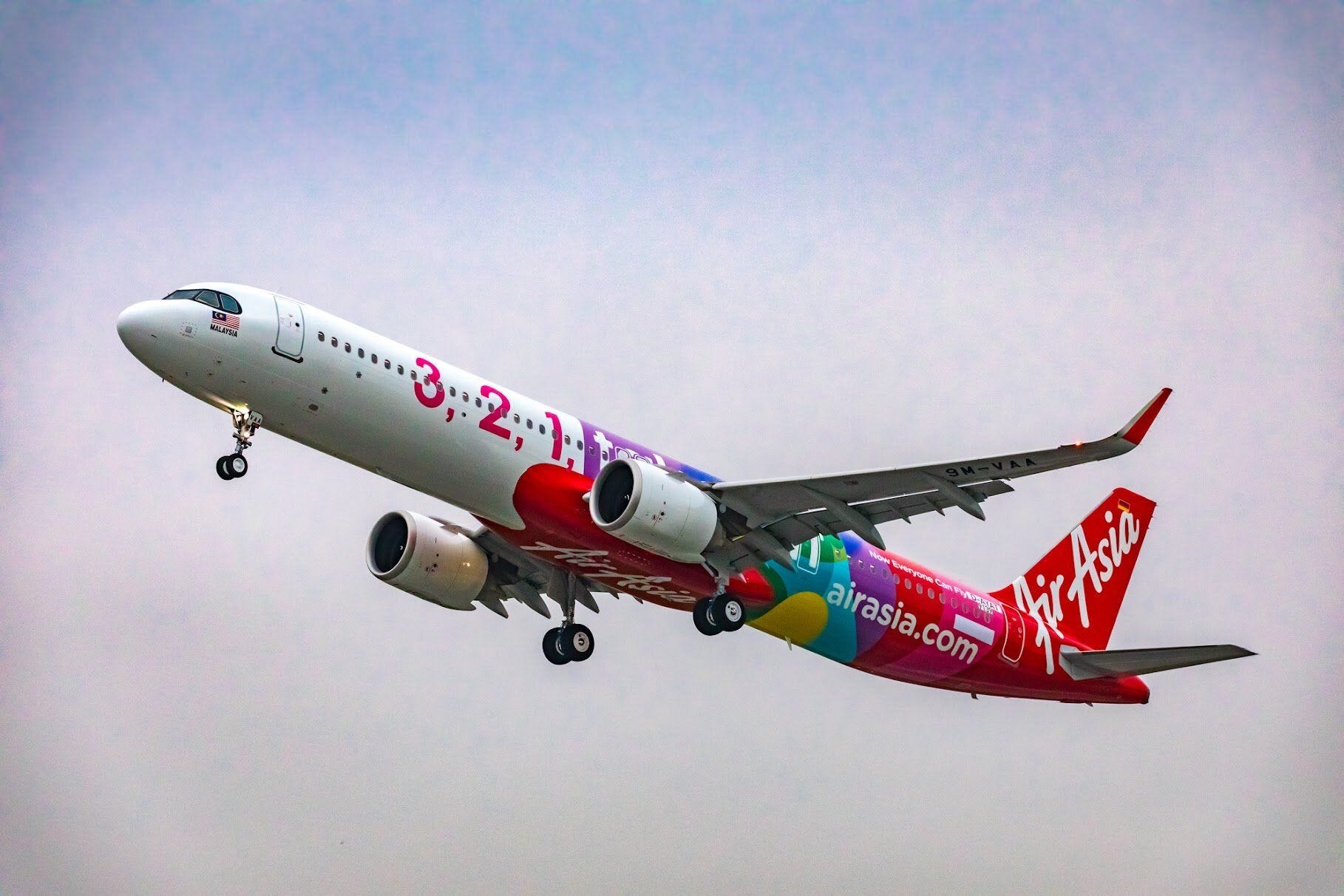
Fleet Size and Composition
The group’s total fleet stood at 253 aircraft as of the FY25 reporting cycle, with a target to keep it at 253 through 2026 as four new A321LRs replace retiring frames.
Within that total, the split is roughly 235 narrowbodies across the five short-haul AOCs and 18 widebodies at AirAsia X (with Thai AirAsia X associate).
Capital A’s third-quarter filing provides the most granular snapshot before consolidation. At the end of 3Q25, the old Capital A aviation segment reported 225 aircraft with 170 operational, reflecting the tail end of a multi-year fleet reactivation.
FLEET COMPOSITION (approximate, April 2026)
-------------------------------------------
AirAsia Malaysia (AK):     ~95 Airbus A320ceo / A320neo / A321neo
Thai AirAsia (FD):         62 Airbus A320-family
Indonesia AirAsia (QZ):    ~27-30 Airbus A320-family
Philippines AirAsia (Z2):  ~25 Airbus A320-family
AirAsia Cambodia (KT):     ~5 Airbus A320
AirAsia X (D7):            18 Airbus A330-300
Thai AirAsia X (XJ):       ~9 Airbus A330-300 (associate)
TOTAL GROUP FLEET:         253 aircraft
By manufacturer, the fleet is 100% Airbus, making AirAsia one of the largest all-Airbus operators in the world. There are no Boeing, Embraer or ATR aircraft in the group inventory today.
Fleet Age and Utilisation
Average fleet age sits in the 7 to 9 year range for the short-haul carriers, with Indonesia AirAsia pulling the average higher because its fleet age is closer to 15 years. Thai AirAsia runs the youngest fleet, helped by steady A320neo introductions.
Utilisation stayed at healthy levels through 2025. Thai AirAsia alone recorded 25.2 million available seats and 21.0 million passengers, for an 83% load factor and a 10% year-on-year capacity increase. Group-wide 3Q25 load factor also came in at 83%.
3Q25 OPERATING STATISTICS (Capital A Aviation segment)
------------------------------------------------------
Passengers carried:   15,720,568
Capacity:             18,998,098 seats
Load factor:          83%
ASK:                  22,489 million
RPK:                  18,457 million
Flights (stages):     102,585
Average stage length: 1,176 kmAircraft Types Strategy and Cabin Configuration
The spine of the short-haul fleet is the Airbus A320 family. The group operates the classic-engined A320ceo, the A320neo and the A321neo, with the A321neo now taking on the bulk of deliveries because of its better unit cost on longer domestic and regional sectors.
The A321neo that AirAsia operates is powered by two CFM International LEAP-1A32 engines, chosen back in 2016 through a landmark USD 2.7 billion CFM engine agreement covering the initial 100 A321neo aircraft. Cabin configuration on the A321neo is 236 seats in a single-class, high-density layout.
On the A320 side, cabin configuration typically runs 180 seats for the ceo and 186 seats for the neo. Seat pitch sits at 29 to 30 inches across the economy cabin, consistent with the low-cost carrier norm.
Widebody cabins at AirAsia X are configured for long-haul low-cost. The A330-300 carries 377 seats in a two-class layout that includes 12 Premium Flatbed seats and 365 economy seats, which is among the highest-density A330 layouts in service anywhere.
Fleet Strategy: Pivoting to Narrowbody-Only
The biggest strategic decision of the last 12 months is the planned phase-out of the A330-300. Tony Fernandes confirmed the widebody exit in November 2025, saying the A330s will leave the fleet over the next five to six years (by 2031) and that AirAsia will operate as a narrowbody-only airline thereafter.
Equally significant, the group cancelled its firm order for fifteen A330-900neos, and public reporting in February 2026 suggests the remaining A330neo commitment was quietly withdrawn as the group repositioned its entire long-haul plan around the A321XLR.
The headline replacement is the A321XLR. In July 2025, AirAsia signed an MoU for 50 firm A321XLRs plus 20 conversion options, with a combined list-price value of USD 12.25 billion, making AirAsia the second-largest customer of the type globally after IndiGo.
The XLR’s 4,700 nmi range is the whole point. It allows the group to fly non-stop to Istanbul, Nairobi, Osaka, and multiple Gulf and African destinations with a narrowbody cost base, something a widebody low-cost platform could never sustain on thinner sectors.
CURRENT AIRBUS ORDERBOOK (April 2026)
-------------------------------------
Firm A321neo/A321LR (balance):  ~200 units remaining
Firm A321XLR:                    50 units (MoU)
A321XLR conversion options:      20 units
Additional A330neo:              12 units (subject to cancellation)
Other options under discussion:  ~150 aircraft
TOTAL FIRM ORDERBOOK:            374 aircraft
Engine: CFM International LEAP-1A on all A320/A321-family frames
Fernandes has also said an additional order of around 150 aircraft is under negotiation, with discussions known to involve the Airbus A220 and the Embraer E2 family for regional missions.
If those talks convert, AirAsia would add its first non-Airbus type since 2005.
Fleet Reactivation and Deliveries in 2025
2025 was largely a fleet reactivation story rather than a fresh-delivery story. Only 14 new aircraft were delivered across the group, four directly from Airbus and ten through lessors, while 16 grounded aircraft were brought back into service.
Each reactivation typically takes 90 to 150 days, because the aircraft need full C-checks, engine shop visits and cabin refurbishment. ADE, the group’s wholly-owned MRO (now part of Capital A), completed its 100th C-check on an AirAsia A321neo in 2025, underscoring how much of this reactivation happens in-house.
The plan for 2026 is to hold fleet size at 253 aircraft while retiring older A320ceos and first-generation A330-300s as the first A321LRs arrive. Net, the cost base should improve as the share of new-generation neos and LRs climbs toward 60% of the fleet.