AviationOutlook Newsletter

AviationOutlook Newsletter

Airbus - Company Analysis and Outlook Report 2026 (Updated)

Dipesh Dhital's avatar
Dipesh Dhital
Mar 30, 2026
∙ Paid

Executive Summary

  • Airbus delivered 793 commercial aircraft in 2025 (up 4% year-on-year), setting a record order backlog of 8,754 aircraft valued at a consolidated order book of €619 billion.

  • Full-year 2025 revenues reached €73.4 billion (+6%), with EBIT Adjusted of €7.128 billion, a 33% improvement over 2024, with a net income of €5.221 billion.

  • Airbus Defence and Space turned EBIT positive (€639 million vs. -€656 million in 2024), while Airbus Helicopters posted 13% revenue growth to €9.0 billion.

  • The 2026 guidance targets approximately 870 deliveries, EBIT Adjusted of ~€7.5 billion, and free cash flow before customer financing of ~€4.5 billion, against a backdrop of persistent supply chain stress, geopolitical disruption, and a major European defense program under threat of collapse.

Get Latest Aviation News Insights and In-Depth Industry Reports Direct to Your Inbox. Don’t Miss Any Key Aviation Updates That Matter.


Recommended - Read Full Reports

United Airlines - Strategic Analysis and Outlook Report 2026 (Updated)

United Airlines - Strategic Analysis and Outlook Report 2026 (Updated)

Dipesh Dhital
·
Mar 16
Read full story
American Airlines - Strategic Analysis and Outlook Report 2026 (Updated)

American Airlines - Strategic Analysis and Outlook Report 2026 (Updated)

Dipesh Dhital
·
Mar 16
Read full story
Boeing - Company Analysis and Outlook Report 2026 (Updated)

Boeing - Company Analysis and Outlook Report 2026 (Updated)

Dipesh Dhital
·
Mar 15
Read full story
SpaceX - Company Analysis and Outlook Report 2026 (Updated)

SpaceX - Company Analysis and Outlook Report 2026 (Updated)

Dipesh Dhital
·
Mar 22
Read full story

Read All Reports


Table of Contents

  • Executive Summary

  • Introduction

  • Key Facts: Company Profile

  • Business Overview: Airbus in 2026

    • A Commercial Aviation Powerhouse Under Pressure to Scale

    • Leadership Transition at the Commercial Top

  • Revenue and Growth Drivers

    • FY2025 Financial Performance: Segment by Segment

    • What Is Driving Revenue Growth?

  • Key Product Lines, Programmes, and Services

    • The A320 Family: Industrial Ramp-Up Underway

    • The A220 Family: Growing Pains and a Stretch in Sight

    • The A350 Family and the Coming Freighter

    • Airbus Helicopters: The Quiet Outperformer

  • Airbus Defence and Space: Turnaround Underway

    • Segment Reversal: From Deep Losses to EBIT Positive

    • Key Military Aircraft Programmes

    • FCAS: Europe’s Most Important (and Most Troubled) Defence Programme

  • The European Space Consolidation Play: Project Bromo

    • Airbus, Thales, and Leonardo: Creating a European Space Giant

  • Competitive Analysis: Airbus vs. Boeing and Beyond

    • Narrowbody Dominance

    • Widebody Positioning

    • Defence Competitive Dynamics

  • Recent Developments: Key Events Shaping Airbus in 2026

    • Spirit AeroSystems Acquisition Completed

    • A321XLR Enters Commercial Service

    • New Final Assembly Lines in China and the United States

    • New H160 Helicopter Deliveries to French Gendarmerie

  • ZEROe and Next-Generation Propulsion: Airbus’s Long-Term Technology Bet

    • Hydrogen Fuel Cell Aircraft: TRL3 Confirmed

    • CFM RISE Open-Fan Engine: The Key Propulsion Decision for the 2030s

  • Supply Chain Challenges: The Biggest Operational Constraint

    • Engines Remain the Chokepoint

    • Quality Control Issues on A320 Fuselage Panels

  • Geopolitical Context and Trade Risks

    • Faury’s Warning: An Unprecedented Number of Crises

    • US-EU Tariff Dynamics

    • European Defense Autonomy: A Multi-Year Strategic Opportunity

  • Financial and Commercial Implications for Industry Stakeholders

    • For Airlines

    • For MRO Providers and Maintenance Organisations

    • For Suppliers and Tier-1 Aerostructure Companies

    • For Defence Contractors and Programme Partners

  • Key Risks: Probabilities and Scenarios

  • SWOT Analysis

  • Primary Sources and Official Raw Data

  • My Final Thoughts

Introduction

Airbus closed 2025 with 793 commercial aircraft deliveries to 91 customers, a record order backlog of 8,754 aircraft, and consolidated revenues of €73.4 billion, and yet it entered 2026 with its CEO warning staff of an “unprecedented number of crises.” That tension between commercial strength and geopolitical fragility defines where Airbus stands today.

From an industrial ramp-up that is the most ambitious in civil aerospace history, to a European defense space merger of historic proportions, to a next-generation fighter program teetering on collapse, Airbus in 2026 is simultaneously executing, restructuring, and navigating turbulence.

This analysis covers the full picture for aviation industry stakeholders who need to understand what Airbus means for the sector over the next three to five years.

Key Facts: Company Profile

Company:          Airbus SE
Headquarters:     Leiden, Netherlands (registered); 
                  Toulouse, France (operational HQ)
Founded:          1970
CEO (Group):      Guillaume Faury
CEO (Commercial): Lars Wagner (effective January 1, 2026)
Employees:        ~165,000 worldwide
Locations:        180+ sites globally
FY2025 Revenue:   €73.4 billion
EBIT Adjusted:    €7.128 billion
Net Income:       €5.221 billion
Free Cash Flow:   €4.753 billion (€4.574B before customer financing)
Order Backlog:    8,754 commercial aircraft (record high, December 2025)
Order Book Value: €619 billion
Dividend:         €3.20 per share (proposed, FY2025)
Segments:         Commercial Aircraft | Helicopters | Defence and Space
Stock Exchange:   Euronext Paris, Frankfurt, Madrid (ticker: AIR)

Business Overview: Airbus in 2026

A Commercial Aviation Powerhouse Under Pressure to Scale

Airbus is the world’s largest commercial aircraft manufacturer by delivery volume, a position it has held consistently over the past several years as its chief rival, Boeing, has worked to recover from well-documented production and safety challenges.

Boeing - Company Analysis and Outlook Report 2026 (Updated)

Boeing - Company Analysis and Outlook Report 2026 (Updated)

Dipesh Dhital
·
Mar 15
Read full story

The company’s commercial aircraft division alone generated €52.6 billion in revenue in 2025, up 4% year-on-year. The division’s product line spans the single-aisle A220 family, the dominant A320 family, the widebody A330 family, and the long-range A350 family.

Beyond commercial aviation, Airbus operates two other strategically important divisions.

  • Airbus Helicopters is the world’s largest civil helicopter manufacturer.

  • Airbus Defence and Space covers military aircraft, air-to-air refueling, space systems, and connected intelligence operations.

Leadership Transition at the Commercial Top

A significant internal shift took effect on January 1, 2026. Lars Wagner became the new CEO of Airbus Commercial Aircraft, succeeding Christian Scherer, who retired after a career spanning over 40 years with Airbus.

Wagner brings a distinctive background: he was previously CEO of MTU Aero Engines AG, which gives him direct experience in the engine supply chain, precisely the area of greatest constraint for Airbus’s production ramp-up. His appointment signals a deliberate focus on operational and industrial execution.

Scherer remains with Airbus in a transition capacity for six months. The two major strategic decisions he championed, the A220-500 stretch and the CFM RISE open-fan engine selection, now fall to Wagner and the broader leadership team.

Revenue and Growth Drivers

FY2025 Financial Performance: Segment by Segment

The financial trajectory across all three Airbus divisions showed positive momentum in 2025. The consolidated picture reflects a company that is delivering on its commitments, even if supply chain turbulence prevented it from reaching its original 823-aircraft delivery target.

AIRBUS FY2025 FINANCIAL HIGHLIGHTS

Total Revenues:         €73.4 billion  (+6% YoY)
  -- Commercial Aircraft:  €52.6 billion  (+4% YoY)
  -- Helicopters:          €9.0 billion   (+13% YoY)
  -- Defence and Space:    €13.4 billion  (+11% YoY)

EBIT Adjusted:          €7.128 billion  (+33% YoY)
EBIT Reported:          €6.082 billion
Net Income:             €5.221 billion  (+23% YoY)
EPS (Reported):         €6.61           (vs. €5.36 in 2024)

Free Cash Flow:         €4.753 billion
FCF (before cust. fin): €4.574 billion
Gross Cash:             €27.2 billion
Net Cash:               €12.2 billion

Self-financed R&D:      €3.153 billion
Dividend Proposed:      €3.20 per share

Source: Airbus FY2025 Full-Year Results Press Release

What Is Driving Revenue Growth?

The primary growth driver across all divisions is volume: more deliveries, more orders, and a growing services base. In commercial aviation, higher deliveries and services growth drove the 4% revenue increase.

For Airbus Helicopters, the 13% revenue jump reflects a strong programme performance across multiple rotorcraft families combined with an accelerating aftermarket services business. In Defence and Space, the 11% revenue rise came after the division shed the large write-down charges from 2024 satellite programme delays.

The order intake momentum is equally important as a forward-looking indicator. Airbus recorded 1,000 gross commercial aircraft orders in 2025 from 57 customers, including 49 A220s, 656 A320-family aircraft, 100 A330neos, two A330 MRTTs, and 193 A350s. That is a book-to-bill ratio well above one, indicating that Airbus is selling aircraft faster than it can deliver them.

The consolidated order intake by value across all divisions reached €123.3 billion in 2025, the highest in the company’s history. The Defence and Space division alone contributed a record €17.7 billion.

Key Product Lines, Programmes, and Services

The A320 Family: Industrial Ramp-Up Underway

The A320 family is the backbone of Airbus’s commercial business and of global aviation. In October 2025, the A320 family became the most delivered airliner type in history, surpassing all previous aircraft programmes.

The current backlog for the A320neo family alone exceeds 7,000 aircraft. Airbus is targeting a production capability of 75 A320-family aircraft per month by 2027, which would be the highest production rate in civil aerospace history.

A320 FAMILY PRODUCTION EXPANSION

Current Production Rate:    ~67/month (2025 average implied)
Target Rate:                75/month by 2027
Current FAL Locations:      Toulouse, Hamburg, Tianjin (x2), Mobile Alabama (x2)
                            + 10 total FALs globally
New FALs Opened (2025):     Second line in Tianjin, China (Oct 2025)
                            Second line in Mobile, Alabama, USA (Oct 2025)
New A321XLR RCFT Facility:  Augsburg, Germany (Sep 2025)
Toulouse Lagardère FAL:     Second line due mid-2026
                            (former A380 production line repurposed)
Backlog (A320neo Family):   7,000+ aircraft

Source: Airbus Newsroom

The A321XLR, the most range-capable variant of the family, is particularly significant.

American Airlines began receiving its first A321XLRs, and the variant is now entering service with multiple carriers. The A321XLR’s combination of up to 8,700 km range and up to 244 seats has no direct comparable aircraft in Boeing’s portfolio.

American Airlines - Strategic Analysis and Outlook Report 2026 (Updated)

American Airlines - Strategic Analysis and Outlook Report 2026 (Updated)

Dipesh Dhital
·
Mar 16
Read full story

The A220 Family: Growing Pains and a Stretch in Sight

The A220 is the youngest and in many ways the most financially complex programme in the Airbus commercial portfolio. Airbus delivered 93 A220-family aircraft in 2025, up sharply from 75 in 2024, but the programme has been held back by production cost challenges, engine durability questions, and supply chain disruptions.

As of December 2025, the A220 programme had 949 firm orders from 32 customers. Airbus had planned to increase monthly A220 production rates in 2026, but those targets have been pushed back to late 2026 due to supply chain issues.

The most significant strategic development around the A220 is the preparation for an A220-500 stretch. Reuters reported in January 2026 that Airbus was beginning to offer the roughly 180-seat A220-500 to airlines and leasing companies, with a formal programme launch possible as early as the Farnborough Airshow in July 2026.

New Commercial Aircraft CEO Lars Wagner backed the concept publicly at the Airlines Economics conference in Dublin in late January 2026. Any launch decision would be subject to securing two or three marquee customers.

The A350 Family and the Coming Freighter

The A350 family, comprising the A350-900 and A350-1000, delivered 57 aircraft in 2025, flat versus 2024 due to ongoing supply chain constraints. Airbus is currently producing around six A350s per month against a longer-term target of 12 per month by 2028.

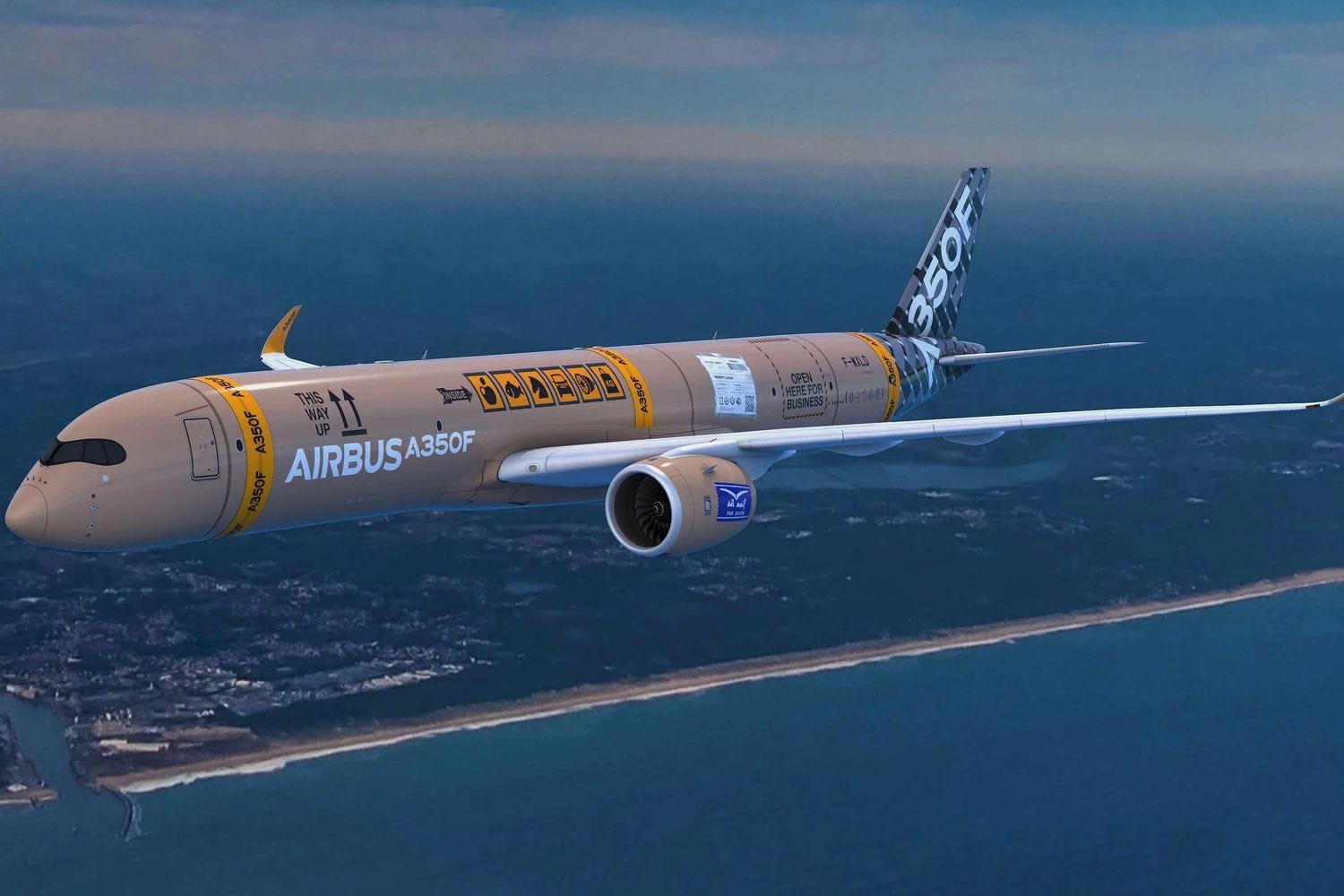
The A350 Freighter (A350F) is the most consequential new variant in the widebody cargo market. Airbus is now targeting the first flight of the A350F in the third quarter of 2026, with entry into service planned for the second half of 2027. Two prototype aircraft will conduct a 400-hour, 10-month flight test campaign.

The A350F will be powered by Rolls-Royce Trent XWB engines and is designed to deliver 30 to 40 percent CO₂ reduction per tonne kilometre compared to previous-generation freighters. The programme was delayed by approximately one year due to supply chain problems, particularly at aerostructures supplier Spirit AeroSystems, which Airbus has since acquired.

First A350F fuselage sections at Toulouse final assembly line
Initial A350F fuselage sections at the Toulouse final assembly line

Airbus Helicopters: The Quiet Outperformer

Airbus Helicopters is frequently overshadowed by the commercial aircraft division in media coverage, but it is one of the highest-performing segments in the entire group. The division generated €9.0 billion in revenue in 2025, up 13%, and its book-to-bill ratio remained above 1 with 544 gross orders (536 net).

The H160 medium twin-engine helicopter is the standout story. In 2025, the H160 reached approximately 50% market share in the civil and parapublic medium twin segment, achieving order parity with the competing Leonardo AW139. Airbus logged around 30 new H160 commitments in 2025 and is planning to ramp H160 production toward 60 aircraft per year.

The militarised H160M variant, named Guépard for the French armed forces, began its flight test campaign in July 2025. France plans to acquire 169 H160M aircraft to replace five different helicopter types currently in service, with first deliveries planned from 2028.

At VERTICON 2025, Airbus unveiled the new H140 light twin-engine helicopter, receiving over 74 commitments at the show, a strong indicator of market appetite for the new platform.

Airbus H160M military helicopter flight test campaign
Image source: airbus.com. Airbus H160M military helicopter during its flight test campaign launch in July 2025

Airbus Defence and Space: Turnaround Underway

Segment Reversal: From Deep Losses to EBIT Positive

Airbus Defence and Space delivered one of the most notable financial turnarounds in the company’s recent history. The segment swung from an EBIT loss of €656 million in 2024 to a profit of €639 million in 2025, a swing of more than €1.3 billion.

The 2024 losses were driven by large write-down charges exceeding €1 billion on certain satellite programmes. The cost mitigation plan implemented from 2024 onward reduced those charges to just €100 million in 2025. CFO Thomas Toepfer stated the segment is on track to achieve a mid- to high-single-digit EBIT margin by 2028.

AIRBUS DEFENCE AND SPACE: FY2025 KEY METRICS

Revenue:         €13.4 billion  (+11% YoY from €12.1B)
EBIT:            +€639 million  (vs. -€656 million in 2024)
Order Intake:    €17.7 billion  (+6% YoY, record high)
EAC Charges:     ~€100 million  (vs. >€1 billion in 2024)
Target Margin:   Mid-to-high single digit by 2028

Key Military Aircraft Programmes

The A330 Multi-Role Tanker Transport (MRTT) remains one of the most commercially successful defence aircraft programmes in the world. With over 60 units delivered, the A330 MRTT dominates more than 90% of the non-US refuelling aircraft market.

Australia, Saudi Arabia, Singapore, and NATO nations continue to operate and procure the platform. The next-generation A330 MRTT+, based on the A330neo airframe, will offer an 8% fuel consumption reduction.

The A400M Atlas military transport continues its gradual progress across export markets. In early 2026, Airbus presented A400M upgrade details at the World Defense Show, and a second Indonesian delivery is expected in 2026. The aircraft was approved for in-flight refuelling operations with the French Air Force in early 2025, significantly enhancing its operational versatility.

The C295 medium transport aircraft remains a strong export performer with more than 230 deliveries globally, serving roles ranging from tactical transport to maritime patrol and surveillance across Asia, the Middle East, Latin America, and Europe.

FCAS: Europe’s Most Important (and Most Troubled) Defence Programme

The Future Combat Air System (FCAS) is the largest military aviation programme in European history, with an estimated investment exceeding €100 billion and a design goal of producing a sixth-generation combat aircraft by 2040. Airbus leads the German and Spanish industrial components, while France’s Dassault leads the French side.

As of March 2026, the programme is in a severe political and industrial crisis. Germany and France set an April 2026 deadline for Airbus and Dassault to reach an agreement on the New Generation Fighter (NGF).

Dassault CEO Eric Trappier has stated publicly that “if Airbus maintains its position of not wanting to work with Dassault, then the project is dead.” German Chancellor Friedrich Merz has publicly questioned whether Germany needs a carrier-capable fighter jet, a requirement that France considers non-negotiable.

Airbus, for its part, has proposed a “two-fighter solution” where Germany, Spain and other willing partners would develop one aircraft, while France proceeds separately. The FCAS programme was scheduled to enter Phase 2 in spring 2026, but no agreement has been reached between Airbus and Dassault as of the time of writing.

The Eurodrone programme, a medium-altitude, long-endurance UAV developed alongside Dassault and Leonardo, represents a parallel but less contentious strand of European defence ambition.

The European Space Consolidation Play: Project Bromo

Airbus, Thales, and Leonardo: Creating a European Space Giant

In October 2025, Airbus, Leonardo, and Thales signed a Memorandum of Understanding to merge their space businesses into a new joint venture. The unnamed entity, internally called “Project Bromo”, would combine the Space Systems and Space Digital businesses of Airbus Defence and Space, Thales Alenia Space and Telespazio from Thales, and Leonardo’s space division.

PROJECT BROMO: EUROPEAN SPACE JV SNAPSHOT

Combined Employees:     ~25,000
Projected Annual Revenue: €6.5 billion (based on 2024 figures)
Ownership Structure:    Airbus: 35% | Leonardo: 32.5% | Thales: 32.5%
Backlog Coverage:       More than three years of projected sales
Expected Start:         2027 (subject to regulatory clearances)
Launch Vehicles:        NOT included (Airbus stake in ArianeGroup excluded)
Antitrust:              EU review underway (up to two years expected)

The strategic rationale is straightforward: European space companies are fragmented and individually lack the scale to compete with U.S. players at the prime contractor level. Faury stated in March 2026 that the merger antitrust approvals and governance arrangements would likely be completed in 2026 or early 2027.

The combined entity would address satellites, space services, and connected intelligence, areas where European governments increasingly want sovereign, non-US-dependent capability. This aligns directly with the broader European strategic autonomy agenda.

Competitive Analysis: Airbus vs. Boeing and Beyond

This post is for paid subscribers

Already a paid subscriber? Sign in
© 2026 Dipesh Dhital · Privacy ∙ Terms ∙ Collection notice
Start your SubstackGet the app
Substack is the home for great culture