


Executive Summary
AJet, the wholly owned low-cost subsidiary of Turkish Airlines, finished 2025 with approximately 23 million passengers carried (including 8 million on international flights), an on-time departure rate near 80%, and an active operating fleet that crossed the 115 aircraft mark in early 2026.
The carrier has transitioned from the AnadoluJet brand it inherited in March 2024 into a digitally driven LCC operating from twin bases at Istanbul Sabiha Gökçen (SAW) and Ankara Esenboğa (ESB), with a stated 70% NewGen fleet target by the end of 2026 anchored on the Boeing 737-8 MAX and Airbus A320neo family.
AJet now serves 36 countries and approximately 106 destinations, with 191 routes (74 domestic and 117 international), and is aggressively densifying around Bodrum, Ankara, and Sabiha Gökçen for the Northern Summer 2026 season, including the launch of 15 new routes out of Bodrum.
Key strategic risks include continued Boeing delivery delays, Turkish lira exposure on a USD-denominated cost base, intensifying competition from Pegasus Airlines and SunExpress, and macro pressures on Turkish outbound and inbound demand.
Recommended - Read Full Reports


Read All Reports
Table of Contents
Executive Summary
AJet Company Profile: Key Facts
AJet Revenue and Financial Analysis
Parent-Level Financial Context
Latest Quarterly Earnings and Guidance Implications
Revenue Growth Drivers
Key Services and Products
AJet Fleet Analysis
Current Fleet Size and Composition
Average Fleet Age
Aircraft Type Strategy and Configuration
In-Depth Fleet Strategy
Delivery Pipeline and Lessor Relationships
AJet Route Network Strategy and Major Destinations Analysis
Network Scale and Footprint
Network Strategy
Major International Destinations and Expansion
Northern Summer 2026 Network Updates
Domestic Network Strategy
Major Operational Bases (Hubs)
Istanbul Sabiha Gökçen International Airport (SAW)
Ankara Esenboğa Airport (ESB)
Secondary Operational Points
AJet Competitive Position
Major Competitors
AJet vs. Pegasus Airlines
AJet vs. SunExpress
AJet vs. Turkish Airlines Mainline
AJet vs. Western European LCCs Operating to Türkiye
Digital Strategy and Customer Experience
Operational Performance and Service Quality
Sustainability and Fleet Modernisation Implications
Regulatory, Geopolitical, and Macroeconomic Context
Key Risks for AJet (2026 and Beyond)
Risk 1
Risk 2
Risk 3
Risk 4
Risk 5
Risk 6
Risk 7
Risk 8
Risk 9
Risk 10
Outlook for 2026 and Beyond
How AJet Fits Within the Turkish Airlines Group Strategy
Industry Context: Türkiye as an Aviation Powerhouse
My Final Thoughts
Official Sources and Data
AJet Company Profile: Key Facts
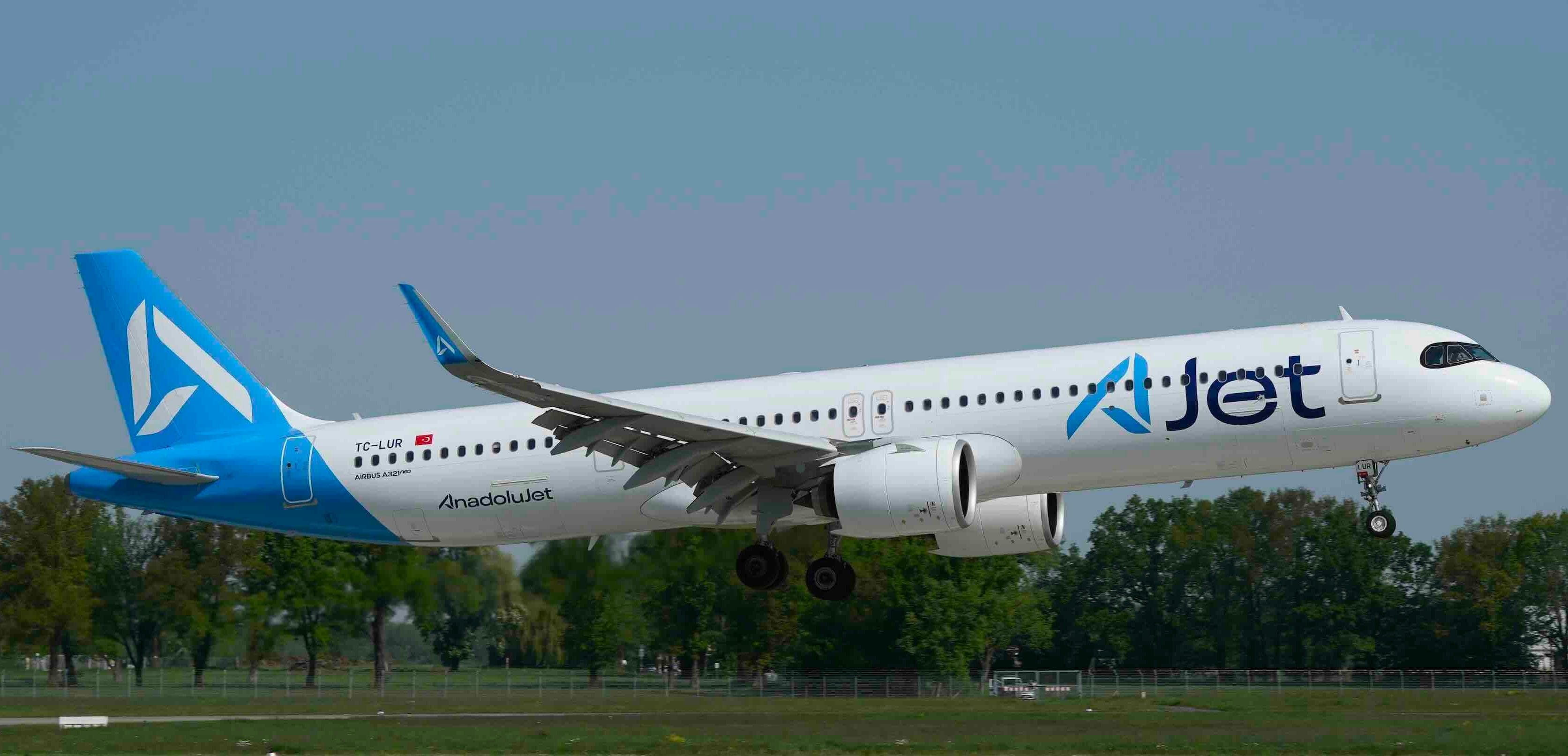
AJet operates as the dedicated leisure and price-led arm of Turkish Airlines, sitting alongside the flagship full-service carrier and the joint-venture leisure carrier SunExpress within the broader Turkish Airlines Group.
The brand was created to consolidate the legacy AnadoluJet identity into a standalone airline with its own Air Operator’s Certificate, enabling more flexible commercial decisions, distinct cost discipline, and an independent commercial model focused on point-to-point traffic.
The carrier inherited the AnadoluJet network and aircraft from its predecessor, which had operated since April 2008 as Turkish Airlines’ Ankara-based regional brand.
The transition to AJet was formalised on March 31, 2024 with the first scheduled service operating under the new VF/TKJ designators from Ankara Esenboğa to Istanbul Sabiha Gökçen.
KEY FACTS — AJet
Legal owner: Türk Hava Yolları A.O. (Turkish Airlines, 100%)
IATA / ICAO / Callsign: VF / TKJ / AJET
Headquarters: Istanbul, Türkiye
Main bases: Istanbul Sabiha Gökçen (SAW), Ankara Esenboğa (ESB)
Service classes: All-economy, with ancillary upsells
Loyalty: Miles&Smiles (via Turkish Airlines integration)
CEO: Kerem Sarp
AJet’s stated vision is to “raise the flight standards of affordable travel with an innovative approach.”
In practice, this translates to a single-class cabin, dense seating configurations, digital-first distribution, ancillary-driven revenue growth, and a relentless focus on point-to-point itineraries that bypass the connecting traffic flowing through Istanbul Airport (IST) on Turkish Airlines mainline.
The airline’s distinct positioning within the Turkish Airlines Group is essential.
Where Turkish Airlines mainline focuses on premium long-haul connectivity through Istanbul Airport (IST), AJet operates from the secondary SAW base on the Asian side of Istanbul and from Ankara, capturing leisure flows, visiting friends and relatives (VFR) traffic, and budget-conscious business travel that the mainline brand is not optimised to serve.
That structural separation gives AJet the freedom to operate higher-density Boeing 737 cabins, use Sabiha Gökçen as a low-cost hub, run aggressive promotional fares, and place pricing pressure on Pegasus Airlines, which has historically dominated the Turkish low-cost market.
The brand has also rapidly built a digital footprint, with mobile bookings, app-based check-in, and a streamlined web journey that mirror the playbook of European LCCs such as Ryanair, easyJet, and Wizz Air, but tailored to Turkish consumer behaviour and pricing expectations.
AJet Revenue and Financial Analysis
Parent-Level Financial Context
AJet does not file standalone audited financial statements separately from Turkish Airlines, as it is a fully consolidated subsidiary.
The most reliable financial lens, therefore, comes from Turkish Airlines Group-level disclosures, where AJet’s revenues are bundled into Passenger Revenue and reported alongside fleet, passenger, and ASK metrics.
For the full year 2025, Turkish Airlines Group reported record consolidated revenue of approximately $24.1 billion, up from $22.7 billion in 2024, with profit from main operations reaching $2.2 billion.
TURKISH AIRLINES GROUP — FY2025 SNAPSHOT
Total revenue: ~$24.1 billion (+6.3% YoY)
Profit from main operations: ~$2.2 billion
Q4 2025 revenue: ~$6.3 billion (+12% YoY)
Net profit (in TRY): 118.2 billion TL
Includes: Turkish Airlines mainline + AJet + Turkish Cargo + subsidiaries
That headline conceals an important sub-trend: AJet has been growing materially faster than the mainline. Independent industry analysis indicates that AJet’s traffic growth has been outpacing its parent’s growth, with 9M2025 traffic up around 10% to 17.5 million passengers.
For the full year 2025, AJet carried approximately 23 million passengers, with 8 million on international routes. That represents roughly a 7.5% increase over the 21.4 million passengers reported in 2024.
Latest Quarterly Earnings and Guidance Implications
In Q3 2025, Turkish Airlines Group reported total revenues of nearly $7 billion, up 5% year-over-year, with EBITDA of approximately $2.1 billion at a 29.6% margin and net income of $1.4 billion.
AJet’s nine-month board activity report indicated 17.5 million passengers and 107,508 landings, operating across 38 international and domestic destinations during that nine-month window.
In Q4 2025, group total revenues rose 12% year-over-year to approximately $6.3 billion, with the LCC subsidiary capturing a disproportionate share of unit growth thanks to capacity additions and route launches into Iraq, the Balkans, and Western Europe.
The implication for AJet is that the carrier is contributing margin support to the group via fleet renewal, lower trip costs on the 737-8 and A320neo, and rising ancillary revenue capture.
Forward guidance, while not separately disclosed for AJet, is consistent with the Group’s intention to grow its overall passenger base towards the 170 million milestone by 2033 outlined in the Turkish Airlines strategic plan.
AJet has been earmarked as the principal vehicle for short-haul leisure and price-sensitive growth within that plan.
Revenue Growth Drivers
The first growth pillar is capacity.
AJet ended 2024 with around 86 aircraft and crossed into 2026 with an active operating fleet exceeding 115 aircraft, an expansion of more than 30% in usable units within roughly twelve months, supported by long-term lease deals with Dubai Aerospace Enterprise and CDB Aviation.
The second pillar is network depth.
AJet has moved beyond Turkey-only services to a meaningful European, Balkan, North African and Middle Eastern footprint, with new routes from Bodrum, Antalya, Ankara, and Istanbul SAW absorbing capacity that would otherwise have sat idle on shoulder days.
The third pillar is ancillary revenue.
AJet’s product is unbundled by design: passengers pay for baggage, seat selection, priority boarding, onboard food and beverage, and other extras, a standard LCC mechanism that lifts revenue per passenger without changing the headline base fare.
The fourth pillar is digital distribution.
AJet’s emphasis on direct sales via its app and website lowers commission costs and creates owned audience funnels that enable dynamic pricing and targeted promotions.
The fifth pillar is the codeshare and frequent flyer integration with Turkish Airlines.
Since June 30, 2025, Miles&Smiles members can earn miles and status miles on AJet operated flights, effectively binding Turkish Airlines loyalty members into the LCC subsidiary and giving AJet a structural cost-of-acquisition advantage versus Pegasus Airlines and SunExpress.
Key Services and Products
AJet operates an all-economy cabin product with three core fare bundles: a basic fare that includes only carry-on, an intermediate fare that adds checked baggage and seat selection, and a premium fare layer that combines baggage allowance with priority services.
These bundles map closely to the European LCC product architecture but are tailored to Turkish demand by including additional baggage options for VFR traffic.
AJet — PRODUCT ARCHITECTURE
Cabin: Single-class economy
Fare families: Light, Comfort, Premium (with bundle variations)
Ancillaries: Baggage, seat selection, on-board F&B, priority,
             travel insurance, ground transfers
Booking channels: ajet.com, AJet mobile app, GDS via codeshare/interline
Loyalty: Miles&Smiles miles accrual on all scheduled AJet flights
Onboard product is consistent with LCC norms: buy-on-board food and beverage, no complimentary services beyond water on shorter sectors, and a focus on quick turnarounds.
The cabin layout maximises seat count on the Boeing 737-8 MAX with a 189-seat configuration, in line with the seat map reference widely used by the airline.
AJet Fleet Analysis
Current Fleet Size and Composition
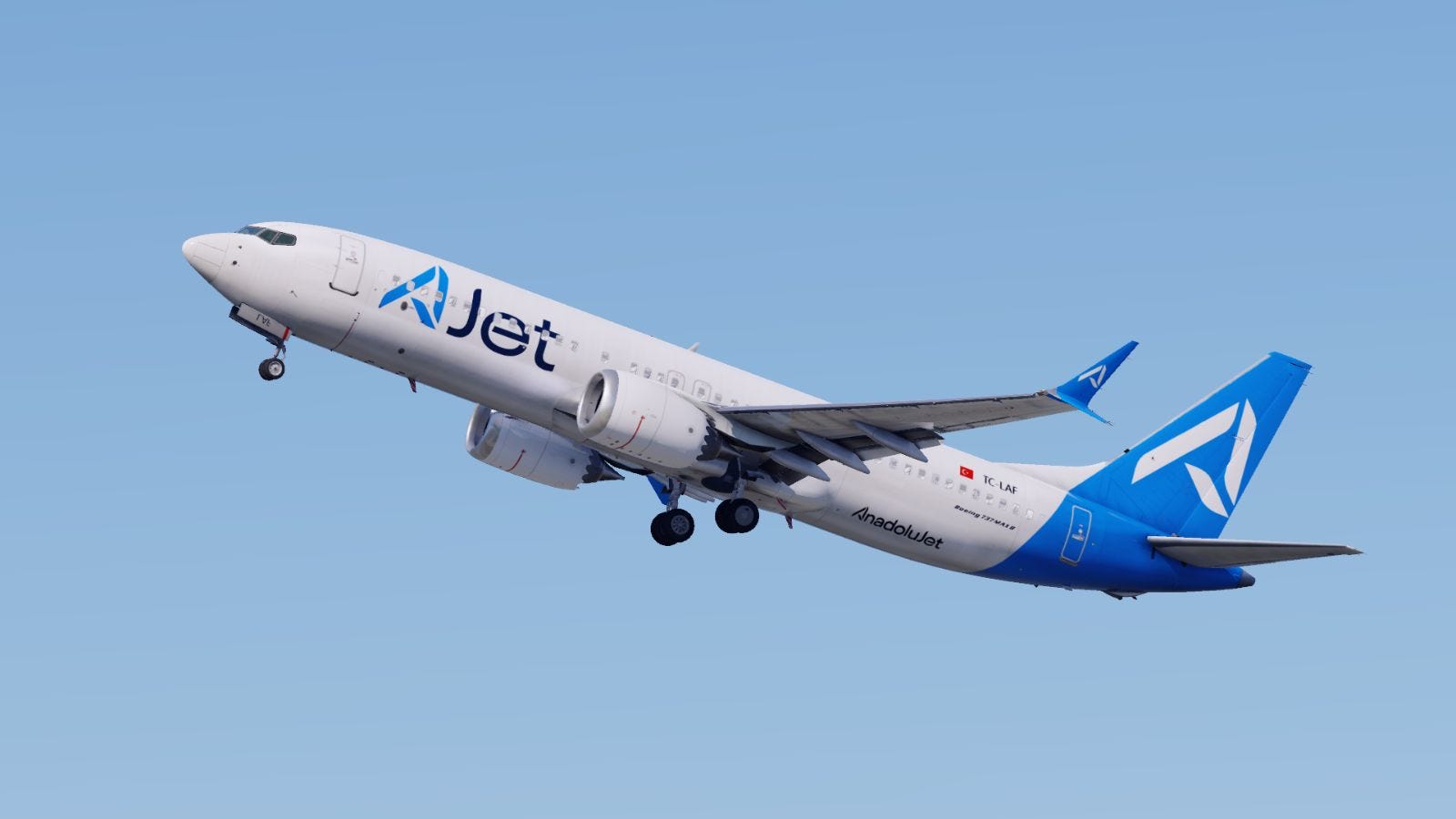
As of mid-May 2026, AJet operates a fleet of approximately 115 aircraft on active duty, with additional deliveries arriving throughout the year. The official AJet website corporate page reports 118 aircraft on the books with the following composition:


AJet — FLEET COMPOSITION (per ajet.com)
Aircraft Type         Count
Airbus A320           5
Airbus A320neo        27
Airbus A321neo        17
Boeing 737-8 MAX      25
Boeing 737-800        44
TOTAL                 118
The Boeing 737-800 remains the workhorse of the fleet, inherited largely from the AnadoluJet operation and from Turkish Airlines mainline transfers.
The 737-8 MAX is the principal next-generation narrowbody being added in volume, supported by a parallel Airbus A320neo family commitment that gives the airline dual-source supply protection.
That dual-fleet design is a deliberate strategic choice. By maintaining both Boeing and Airbus narrowbody types, AJet can absorb Boeing delivery delays that have plagued the industry since 2023 without ceding capacity to competitors.
Average Fleet Age
The average age of AJet’s operational fleet sits around 8.9 years, weighted up by the legacy 737-800 base and weighted down by the rapidly arriving 737-8 MAX and A320neo deliveries. As 737-800s are retired or transferred and as more NewGen aircraft join, the figure is expected to drop sharply through 2026 and 2027.
The airline is targeting a 70% NewGen fleet share by the end of 2026, a sharp jump from the current mix where NewGen aircraft represent roughly two thirds of the fleet on a forward-looking basis.
Aircraft Type Strategy and Configuration
The Boeing 737-800 fleet operates in a high-density single-class layout suitable for short and medium-haul leisure flying within the four-hour band that covers Türkiye, the Balkans, Western Europe, the Caucasus, and the eastern Mediterranean. The 737-800 cabins typically seat 189 passengers in standard LCC pitch.
The Boeing 737-8 MAX configuration matches the 737-800 at approximately 189 seats while delivering double-digit percentage fuel burn savings per ASK, allowing AJet to operate longer thin routes profitably and reduce unit costs on existing trunk routes.
The Airbus A320neo, configured at 180 seats, complements the Boeing fleet on routes with slot constraints and shorter sectors where the A320neo’s superior turnaround economics versus the A321neo are more relevant.
The Airbus A321neo, the largest narrowbody in the fleet, provides capacity for high-frequency trunk routes such as Istanbul SAW–Ankara, Istanbul SAW–Antalya, and selected dense international routes where 230 plus seats are needed at peak times.
TYPICAL SEAT CONFIGURATIONS
B737-800:    189 seats, single-class
B737-8 MAX:  189 seats, single-class
A320neo:     ~180 seats, single-class
A321neo:     ~230+ seats, single-class
A320 ceo: ~180 seats (legacy units)In-Depth Fleet Strategy
AJet’s fleet plan rests on three explicit objectives.
The first is to maintain a competitive cost per available seat kilometre (CASK) against Pegasus Airlines, which operates an all-Airbus fleet of A320 and A321 variants, by mixing NewGen Boeing and Airbus types to extract maximum lessor competition and protect against single-OEM disruption.
The second is to rapidly retire older 737-800 airframes inherited from AnadoluJet and Turkish Airlines, replacing them with the 737-8 MAX, A320neo, and A321neo to lower fuel consumption and reduce maintenance reserves.
This transition is being executed primarily via long-term operating leases rather than direct purchases, preserving balance sheet flexibility for the parent Turkish Airlines Group.
The third is to scale aggressively. AJet’s stated growth roadmap targets approximately 150 aircraft by 2028 and 200 aircraft by 2033, anchored in continuous delivery streams from Boeing and Airbus that flow through the parent’s centralised fleet contracts.
AJET FLEET TRAJECTORY (as guided)
End of 2024: ~100 aircraft (delivered)
Mid 2026: ~115 aircraft (active)
End of 2026: ~120+ aircraft, 70% NewGen
2028 target: ~150 aircraft
2033 vision: ~200 aircraft
The strategic logic is straightforward: AJet captures the cost advantages of operating an all-narrowbody, single-class fleet, while leveraging the procurement scale and lessor relationships of the parent Turkish Airlines Group to secure favourable lease terms unattainable for a standalone LCC of similar size.
Delivery Pipeline and Lessor Relationships
AJet’s most significant 2025 fleet event was the Dubai Aerospace Enterprise lease agreement for 10 new Boeing 737-8 aircraft, with deliveries scheduled across 2026 and 2027.
CDB Aviation has also been a key lessor, with Turkish Airlines receiving its first 737 MAX 8s from CDB in August 2025 from an order of twelve units, the majority of which are slated for AJet operations.
For 2026 overall, the airline expects to take delivery of approximately 46 new aircraft across the 737-8 MAX and A320neo family programmes, according to a fleet update from the airline’s own communications channel. That places AJet among the fastest-growing LCCs globally by fleet additions in 2026.
FLEET DELIVERY HIGHLIGHTS (2025–2027)
DAE: 10 x Boeing 737-8 (2026–2027 deliveries)
CDB Aviation: 12 x Boeing 737 MAX 8 (deliveries ongoing)
2026 planned: ~46 new aircraft (Boeing 737-8 + A320/A321 NEO)
Replacement target: phased retirement of 737-800 NG