


Executive Summary
Alaska Air Group recently reported its Q1 2026 results. The airline earlier closed calendar 2025 with $14.239 billion in full-year operating revenue, a 21% reported jump driven by the first full year of consolidated Hawaiian Airlines operations and the reshaping of the combined network.
The combined carrier now operates a fleet of roughly 413 aircraft across Alaska Airlines, Hawaiian Airlines, and Horizon Air, with a plan to exceed 475 aircraft by 2030 through the largest fleet order in its history.
The January 2026 announcement of 105 Boeing 737-10 jets and five additional 787 Dreamliners cemented a decade-long capacity roadmap tied to the Alaska Accelerate strategic plan and a goal of at least 12 international long-haul destinations from Seattle by 2030.
Hawaiian integration crossed a major threshold in October 2025 with a single operating certificate, followed by a unified passenger service system scheduled for April 22, 2026, positioning Alaska Air Group as the United States’ fourth-largest global airline.
Recommended - Read Full Reports


Read All Reports
Table of Contents
Executive Summary
Key Facts: Company Profile
Business Overview
Corporate Structure and Brand Architecture
Full-Year 2025 Financial Performance
Unit Economics, Capacity and Operating Metrics
Balance Sheet and Liquidity Position
2026 Guidance and Early Q1 Signals
Revenue Growth Drivers
Alaska Accelerate Strategic Plan
Alaska Airlines Fleet: In-Depth Analysis
Combined Fleet Size and Composition
Fleet Age and Modernization Pipeline
The Historic January 2026 Boeing Order
Aircraft Type Strategy and Configuration
Fleet Strategy: Commonality, Flexibility and Fuel Efficiency
Cargo Fleet and Operations
Route Network, Major Destinations and Strategy
Network Size and Scope
Seattle as Global Gateway
California Hub Strategy
Pacific Network via Honolulu
Alaska and the Pacific Northwest
International and Oneworld Integration
Major Operational Bases (Hubs)
Seattle-Tacoma International Airport (SEA)
Daniel K. Inouye International Airport (HNL)
Portland International Airport (PDX)
Ted Stevens Anchorage International Airport (ANC)
Los Angeles International Airport (LAX)
San Diego and San Francisco Focus Cities
Competitive Position
Major Competitors
Alaska Airlines vs Delta Air Lines
Alaska Airlines vs Southwest Airlines
Alaska Airlines vs United Airlines
Alaska Airlines vs American Airlines
Competitive Advantages
Strategic Initiatives: Deeper Dive
Hawaiian Integration Milestones
Global Expansion Strategy
Atmos Rewards and Loyalty Economics
Sustainability and Fleet Efficiency
Key Risks with Probabilities and Scenarios
Fuel Price Volatility
Demand Softness and Macroeconomic Risk
Integration Execution Risk
Competitive Pressure at Seattle
Regulatory and Labor Risk
Aircraft Delivery Delays
My Final Thoughts
Official Sources and Data
Key Facts: Company Profile
Parent company:         Alaska Air Group, Inc.
NYSE ticker:            ALK
Headquarters:           SeaTac, Washington (Seattle metro)
CEO and President:      Ben Minicucci
Subsidiaries:           Alaska Airlines, Hawaiian Airlines,
                        Horizon Air, McGee Air Services
Full-year 2025 revenue: $14.239 billion
Combined fleet (2026):  ~413 aircraft
Destinations served:    140+ across North America, Latin
                        America, Asia, the Pacific (Europe
                        added spring 2026)
Major hubs:             Seattle, Honolulu, Portland,
                        Anchorage, Los Angeles, San Diego,
                        San Francisco
Alliance:               oneworld (Hawaiian joining spring 2026)
Loyalty program:        Atmos Rewards
Alaska Air Group is the holding company behind two distinct passenger brands and a regional feeder carrier.
Its operating philosophy is grounded in West Coast origins that go back to 1932, yet its 2026 posture is unmistakably global.
The company remains listed on the New York Stock Exchange, trades under the ticker ALK, and reports its combined results quarterly with detailed pro-forma disclosures that reflect the September 2024 Hawaiian merger close.
The combined entity connects more than 140 destinations and is positioning itself as the fourth-largest global United States carrier by most network measures.
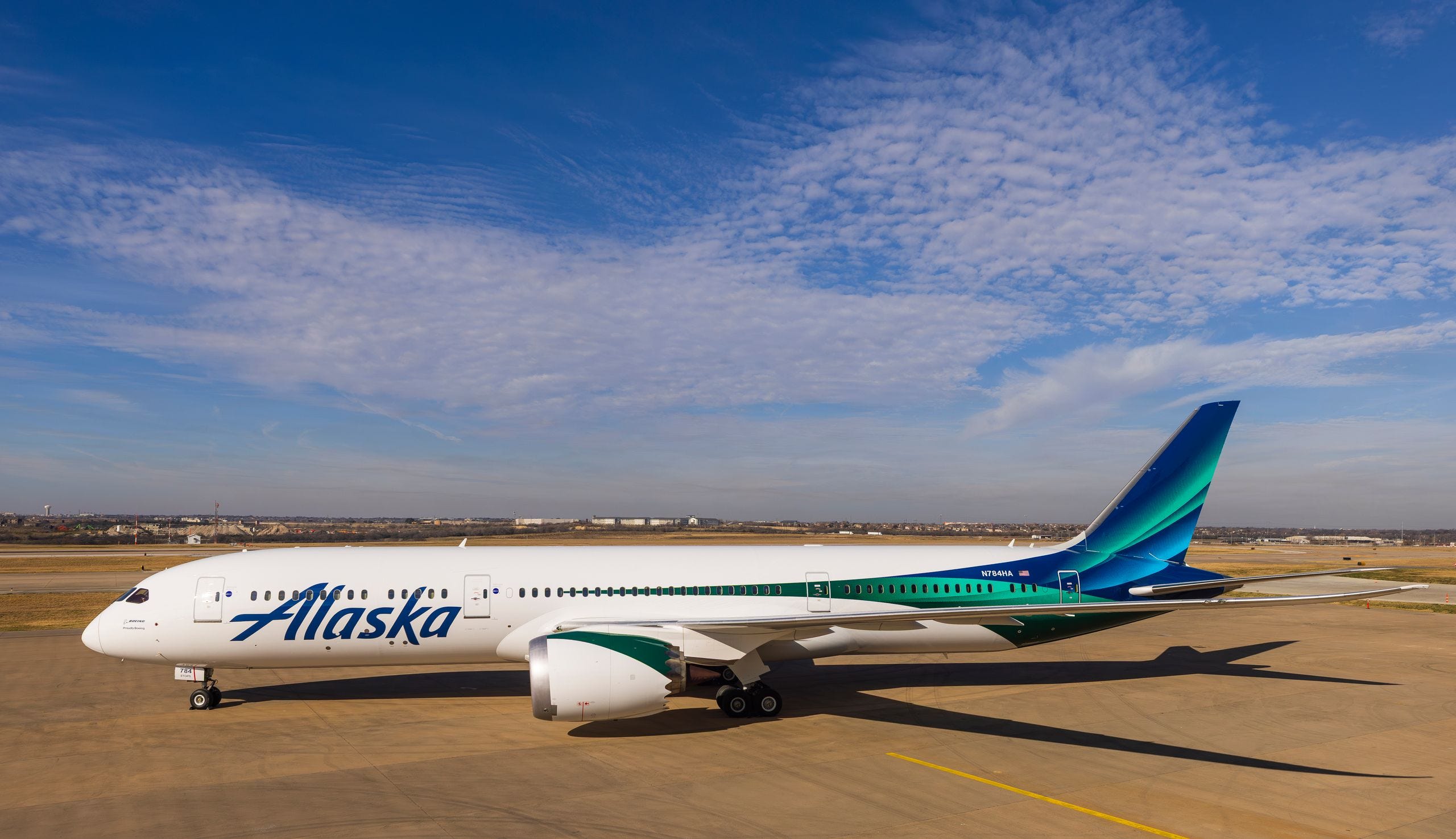
The brand architecture keeps the Alaska Native tail art on mainland Boeing 737s, the Pualani on Airbus and Boeing 717 fleets serving the Hawaiian Islands, and a new aurora-inspired global livery for the 787 Dreamliner and widebody expansion.
Business Overview
Corporate Structure and Brand Architecture
Alaska Air Group sits at the top of a four-subsidiary structure.
Alaska Airlines operates the all-Boeing 737 mainline fleet,
Hawaiian Airlines flies the Airbus widebody and inter-island Boeing 717 operation,
Horizon Air runs the regional Embraer 175 feeder, and
McGee Air Services provides ground handling.
After the October 2025 single operating certificate milestone, all three passenger subsidiaries fly under a single call sign (AS) while retaining distinct brand identities.
Leadership under CEO Ben Minicucci has prioritized keeping both customer-facing brands visible.
The Hawaiian Airlines identity continues throughout the Hawaiian Islands, across the Pacific, and on every flight operated by A321neo, A330-200 and Boeing 717 aircraft. Alaska’s Eskimo parka-hooded “Chester” remains on 737 tails, while the new aurora-inspired global livery debuts on 787s serving international long-haul routes.
The dual-brand approach has been a deliberate response to regulator and community concerns during the 2024 merger review. It preserves local identity in Honolulu and keeps Hawaiian’s ho’okipa service signature intact on leisure-heavy island markets.
Air Group subsidiaries at a glance:

Alaska Airlines  -> Mainline Boeing 737 operations
Hawaiian Airlines -> Airbus and Boeing 717; Pacific widebody
Horizon Air      -> Embraer 175 regional jets (AS express)
McGee Air Services -> Ground handling and customer servicesFull-Year 2025 Financial Performance
Full-year 2025 operating revenue reached $14.239 billion, a 21% increase over the reported $11.735 billion for 2024, reflecting the first full year of Hawaiian consolidation.
On a GAAP basis, net income came in at $100 million ($0.83 per diluted share), while adjusted net income excluding special items was $293 million, or $2.44 per diluted share.
Operating income for the year was $303 million, down from $570 million in 2024, reflecting integration costs, fuel price volatility, a mid-year demand softness tied to broader industry turbulence, and one-time expenses from harmonizing collective bargaining agreements and training programs.
Despite the reset, the company generated $1.2 billion in operating cash flow during 2025.
The fourth quarter stood out.
Revenue of $3.632 billion was the highest Q4 in company history, and unit revenue rose 0.6% year-over-year despite a government-shutdown drag in November. Premium revenue grew 7%, cargo revenue rose 22%, and loyalty revenue climbed 12%, signaling the diversified monetization strategy is paying off.
Unit Economics, Capacity and Operating Metrics
Consolidated capacity for 2025 was 92,962 million available seat miles (ASMs), with 77,110 million revenue passenger miles (RPMs).
System load factor was 82.9% for the year, a respectable figure considering the integration complexity and the number of new long-haul markets being stood up.
Unit revenue (RASM) finished the year at 15.32 cents, while unit cost excluding fuel (CASMex) was 11.42 cents. The economic fuel price per gallon averaged $2.52 across the year, with Q4 elevated to $2.57 on tight West Coast refining conditions. Total fuel expense for 2025 was $2.879 billion on 1.146 billion gallons consumed.
Alaska Air Group full-year 2025 key metrics:

Operating Revenue        $14,239 million
GAAP Net Income          $   100 million
Adjusted Net Income      $   293 million
Operating Cash Flow      $ 1,200 million
ASMs (capacity)           92,962 million
RPMs (traffic)            77,110 million
Load Factor               82.9%
RASM                      15.32 cents
CASMex                    11.42 cents
Economic Fuel Cost/Gal    $2.52
Fuel Consumed             1.146 billion gal
These numbers reflect a company still finishing its merger integration, so clean comparability will really start in 2026.
The adjusted EPS figure of $2.44 is the number most relevant for a clean look through the transition year.
Balance Sheet and Liquidity Position
Air Group finished 2025 with $2.151 billion in total cash, restricted cash and marketable securities.
Long-term debt and finance leases net of current portion stood at $4.834 billion, and the current portion added another $721 million. The company’s unencumbered asset base totals approximately $20 billion, which provides significant collateral flexibility for future capex financing.
Share count closed the year at 115,530,889 shares outstanding, down from 123,119,199 in 2024, reflecting the resumption of buybacks earlier in the year before management turned more cautious amid the fuel environment.
Capital allocation priorities rank deleveraging first, fleet reinvestment second, and shareholder returns third over the Alaska Accelerate horizon.
2026 Guidance and Early Q1 Signals
At the January 2026 earnings release, Air Group provided a wide full-year 2026 adjusted EPS range of $3.50 to $6.50, capacity growth of 2% to 3% year-over-year, and capital expenditures of roughly $1.4 billion to $1.5 billion. Management publicly tied the upper half of the range to a sustained macro recovery and stable fuel.
By the April 20, 2026 Q1 release, however, the company suspended full-year guidance due to fuel volatility driven by geopolitical events. Q1 2026 revenue was approximately $3.3 billion, with unit revenue up 3.5% year-over-year. Managed corporate travel increased 19% year-over-year, and international long-haul expansion continued on plan.
For Q2 2026, management flagged fuel of approximately $4.50 to $4.75 per gallon, introducing roughly $600 million of incremental fuel expense and an estimated $3.60 EPS headwind versus prior assumptions.
That pressure turns an otherwise solidly profitable quarter into an expected adjusted loss per share of approximately $1.00.
Revenue Growth Drivers
Five revenue engines are doing most of the heavy lifting in 2026.
Premium cabin revenue is the biggest single growth lever; Alaska is adding 1.3 million First and Premium Class seats annually through 2026, targeting the corporate and long-haul demand pool.
International widebody flying is the second pillar. Seattle to London Heathrow begins daily year-round service on May 21, 2026 aboard the 787-9 Dreamliner, with Rome and Reykjavik following, and the existing Tokyo Narita and Seoul Incheon operations now scaled up through the merger.
Cargo, loyalty and ancillary revenue make up the balance.
Cargo revenue growth of 22% in Q4 2025 reflects strong demand on Boeing 737-800 freighters and the A330-300P2F freighter fleet operated on behalf of Amazon Air.
The Atmos Rewards program, rebranded from Mileage Plan, was ranked number one airline loyalty program by U.S. News and World Report for 2025-26.
Alaska Accelerate Strategic Plan
Alaska Accelerate is the internal name for the five-year strategic roadmap that ties together fleet, network, product, loyalty and integration synergies. The headline target is $10 earnings per share in 2027 backed by $1 billion in incremental operating profit compared with a 2024 base.
The plan has four pillars.
First, build Seattle into a true international gateway with at least 12 long-haul destinations.
Second, capture $500 million of merger synergies by 2027.
Third, modernize the mainline fleet to deliver the lowest cost per seat in the single-aisle class.
Fourth, deliver a premium, loyalty-driven customer experience that lifts yield mix across both brands.
The new Atmos Rewards premium credit card launched with Bank of America in Q3 2025 is an early proof point.
Nearly one quarter of all Q4 credit card sign-ups went to the new Summit-tier card, the sort of high-annual-fee product that generates materially higher per-account economics.
Alaska Airlines Fleet: In-Depth Analysis
Combined Fleet Size and Composition
As of early 2026, Alaska Air Group’s combined operating fleet totals approximately 413 aircraft across the three subsidiaries. That figure spans mainline narrowbody, widebody, regional jet and cargo variants.
The company projects this number will grow to more than 475 aircraft by 2030 and more than 550 by 2035, making it one of the largest planned capacity build-outs among US carriers.
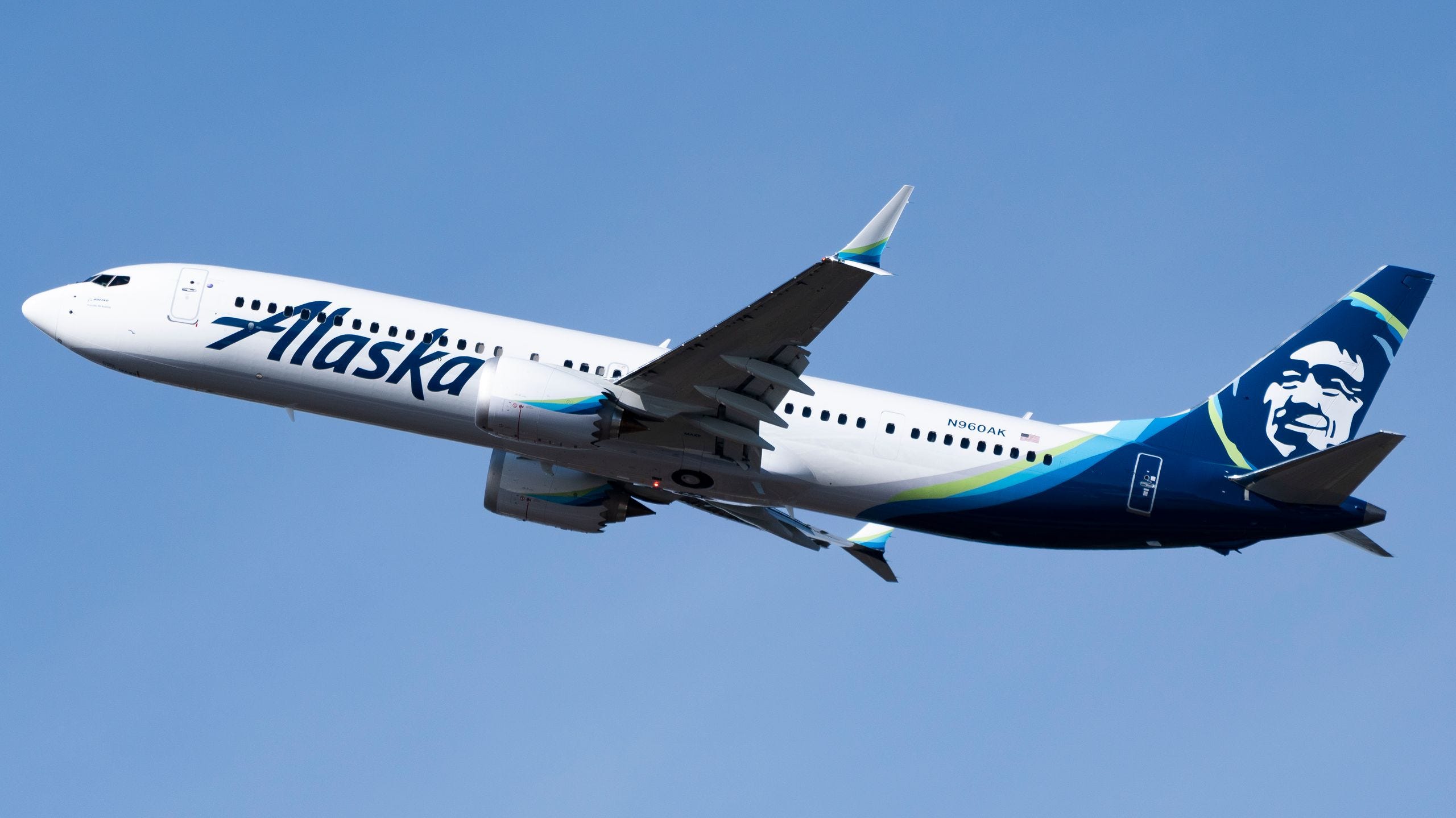
Alaska Airlines mainline flies an all-Boeing 737 fleet.
At the end of 2025, that included roughly 59 Boeing 737-800s, 79 Boeing 737-900ERs, 14 Boeing 737-8 MAXs, 80 Boeing 737-9 MAXs, and five Boeing 737-800F and 737-700F freighters operated by Alaska Air Cargo.
The 737-900 base model completed its scheduled retirement in late 2025.

Hawaiian Airlines operates a mixed Boeing and Airbus lineup.
As of March 2026, the Hawaiian subsidiary counts 18 Airbus A321neos, 24 Airbus A330-200s, 19 Boeing 717-200s for inter-island flying, and 10 A330-300P2F cargo aircraft.
Five Boeing 787-9s originally ordered under Hawaiian’s own program are now operating under Alaska’s global livery on long-haul international routes.
Horizon Air flies roughly 41 Embraer 175 regional jets, painted in Alaska livery and operating as Alaska SkyWest feeder capacity from hubs in Seattle, Portland and Los Angeles.
SkyWest Airlines also operates Alaska-branded Embraer 175s under a capacity purchase agreement, expanding Alaska’s regional reach.
Alaska Air Group combined fleet snapshot (early 2026):

Alaska Airlines (mainline):
  Boeing 737-800       ~59
  Boeing 737-900ER     ~79
  Boeing 737-8 MAX     ~14
  Boeing 737-9 MAX     ~80
  Boeing 737-700F / -800F cargo   5

Hawaiian Airlines:
  Airbus A321neo       18
  Airbus A330-200      24
  Boeing 717-200       19
  Boeing 787-9          5 (global livery)
  Airbus A330-300P2F  10 (Amazon Air)

Horizon Air:
  Embraer 175         ~41

Approximate group total: ~413 aircraftFleet Age and Modernization Pipeline
Alaska’s mainline 737 fleet had an average age in the low-to-mid teens at year-end 2025, pulled up by the older 737-800s and down by the relatively new MAX 8s and MAX 9s.
With accelerated retirements of the 737-900 (non-ER variant) complete and a significant 737-800 tranche eligible for replacement later in the decade, the average age is on a clear path downward.
The five Boeing 787-9s now in Alaska service are less than two years old on average, making them the youngest core aircraft in the fleet.
Hawaiian’s A321neos average around six to seven years old, while the A330-200s trend older at roughly twelve years.
Boeing 717s, which have been the workhorse of inter-island flying since 2001, are the oldest subfleet and a clear candidate for eventual replacement.
Horizon’s Embraer 175 fleet is relatively young, with most units delivered since 2017 as part of the carrier’s gradual retirement of older Bombardier Q400 turboprops.
Alaska management has repeatedly positioned the group as operating “one of the youngest fleets in the industry” once current orders start delivering in volume.
The Historic January 2026 Boeing Order
The defining fleet event of 2026 was the January 7 joint announcement of a massive Boeing order.
The firm deal includes 105 Boeing 737-10 aircraft, five additional Boeing 787 Dreamliners, and purchase options for 35 more 737-10 aircraft, all to be delivered through 2035.
This purchase brings Alaska’s total 737 MAX order book to 174 airplanes.
Combined with the 94 MAX aircraft already in service, the total 737 orderbook with Boeing now stands at 245 airplanes. The 787 order is equally strategic: exercising all previously held options brings the firm future 787 fleet to 17, with five already in operation.
Ben Minicucci framed the announcement in a statement released the same day. He emphasized that “these planes will fuel our expansion to more destinations across the globe and ensure our guests travel aboard the newest, most fuel-efficient and state-of-the-art aircraft,” underscoring the strategic link between capital plan and route plan.
Aircraft Type Strategy and Configuration

The 737-10 is Alaska’s workhorse-to-be for high-density, high-frequency routes.
It seats more passengers than the 737-9 in the same general cabin architecture, delivering the lowest cost per seat of any single-aisle airplane. On transcontinental and longer domestic flights, the extra range and payload flexibility are genuinely useful.
The 737-9 MAX is already Alaska’s primary transcontinental and premium narrowbody workhorse, configured with 178 seats across 16 First Class, 24 or 30 Premium Class, and 132 to 138 Main Cabin seats depending on cabin layout. The 737-8 MAX is used on thinner routes and for international missions like Seattle-Reykjavik at 159 seats.
The 787-9 Dreamliner anchors the long-haul plan.
Alaska’s Dreamliners are configured with 300 seats, including 34 lie-flat Business Class suites, a premium economy cabin, and a main cabin optimized for 15-to-17-hour missions.
Management has stated intent that the five newly ordered units will be delivered as -10 variants, stretching the 787 family to a larger capacity profile.
Fleet Strategy: Commonality, Flexibility and Fuel Efficiency
The unifying theme is flight deck commonality.
An all-737 mainline means a single type-rating for pilots, common maintenance, predictable spare pooling, and operational flexibility to swap aircraft between missions.
That advantage is why Alaska decided to keep its mainline structure all-Boeing even after inheriting Airbus A321neos through the Hawaiian merger.
Hawaiian’s Airbus fleet will continue as a dedicated Hawaiian operation, keeping a separate type base but concentrated in missions where it has natural advantages. The A321neo is ideal for West Coast-to-Hawaii routes where range and fuel burn matter more than commonality. The A330-200 is a proven twin-aisle platform for Hawaii-to-Asia-Pacific flights.
On fuel efficiency, the 737-10 delivers roughly a 14% improvement over the 737-900ER and more than 20% over the 737-800. The 787-9 is roughly 25% more fuel-efficient per seat than the A330-200 it partially replaces on long-haul routes.
Together, these aircraft are key inputs into Alaska’s decarbonization commitments.
The purchase also retains flexibility. The 737-10 order “retains the flexibility to adjust to a different model if necessary,” a signal that Alaska reserves the right to swap some units into 737-9 or 737-8 variants should network needs shift.
Cargo Fleet and Operations
Alaska Air Cargo is a meaningful revenue contributor. The unit operates three Boeing 737-700 freighters and, by end of 2025, had completed its Boeing 737-800 freighter conversion program, adding roughly 40% more cargo capacity per aircraft versus the -700F.
Hawaiian Airlines separately operates ten Airbus A330-300P2F freighters on behalf of Amazon Air, a capacity purchase contract that provides stable revenue and contribution margin. This Amazon operation was reaffirmed as part of the merger integration and now sits alongside Alaska’s own freighter operation.
Combined, the cargo operation delivered 22% revenue growth in Q4 2025. Cargo will continue to be strategically important as a countercyclical revenue stream, especially during periods of passenger demand softness.