


Executive Summary
American Airlines posted record full-year 2025 revenue of $54.6 billion, while cutting total debt by $2.1 billion to $36.5 billion, setting a credible path toward a 2026 free cash flow target of more than $2 billion.
The airline is executing a major premium pivot, anchored by the Flagship Suite rollout across its new Boeing 787-9P fleet and the deployment of the Airbus A321XLR on transcontinental and transatlantic routes, where it is the only U.S. operator of the type.
Network expansion for 2026 includes six new long-haul international routes to Europe and South America, more than 15 new domestic routes, and up to 7,000 peak daily departures this summer, more than any airline in the world.
Despite record revenues, the airline faces serious headwinds: a profit gap versus Delta and United that is measured in billions, significant unhedged jet fuel exposure, and escalating labor union pressure on CEO Robert Isom’s leadership.
Recommended - Read Full Reports


Read All Reports
Table of Contents
Executive Summary
Introduction
Key Facts: Company Profile
Key Services and Products - American Airlines
Mainline Passenger Operations
Regional Operations (American Eagle)
Cargo Operations
The AAdvantage Loyalty Program
Flagship Suite: The Premium Cabin Transformation
Admirals Club and Flagship Lounges
In-Flight Connectivity (Wi-Fi)
American Airlines Major Operational Hubs
Dallas/Fort Worth International Airport (DFW): The Flagship Hub
Charlotte Douglas International Airport (CLT)
Chicago O’Hare International Airport (ORD)
Miami International Airport (MIA)
Phoenix Sky Harbor International Airport (PHX)
Philadelphia International Airport (PHL)
Los Angeles International Airport (LAX)
American Airlines - Route Network, Major Destinations, and Strategy
The Domestic Network: Scale and Coverage
Transatlantic Network and Strategy
Latin America and South America
Pacific Network
FIFA World Cup 2026: A Network Catalyst
American Airlines - Fleet Strategy
Current Fleet Composition
The Airbus A321XLR: A Game-Changer for American
The Boeing 737 MAX Program
Boeing 787-9 Premium Fleet Retrofit
Wide-Body Retrofit: Boeing 777
Boom Overture: The Supersonic Bet
Competitive Position - American Airlines
American vs. Delta Air Lines
American vs. United Airlines
CEO Robert Isom’s Turnaround Strategy
“Supermajor Super Cycle” Thesis
Financial Performance and 2026 Outlook
Full-Year 2025 Results
Debt Reduction Progress
2026 Financial Guidance
The Centennial: 100 Years of American Airlines
The Anniversary Milestone
Centennial Campaign Highlights
One Hundred Years of Industry Firsts
Key Risks: Scenarios and Probabilities
Risk 1: Unhedged Jet Fuel Exposure
Risk 2: Labor Relations and Union Pressure
Risk 3: Debt Burden and Financial Flexibility
Risk 4: Boeing Production Delays and Fleet Gaps
Risk 5: Competitive Catch-Up Timeline Risk
Risk 6: External Macroeconomic and Geopolitical Disruption
Primary Sources and Official Data
My Final Thoughts
Also Read
Introduction
On April 15, 2026, American Airlines reached its 100th year of operation, a milestone fewer than a handful of commercial carriers globally have ever achieved.
Yet the anniversary arrives at a defining inflection point: a record $54.6 billion in full-year 2025 revenue sits alongside a net profit of just $111 million, a number dramatically overshadowed by Delta’s $5 billion and United’s $3.3 billion, despite American flying comparable capacity.
The airline that invented the airport lounge, created the first frequent flyer program, and is now the first U.S. carrier to operate the Airbus A321XLR is pressing hard on a premium transformation that will determine whether it reclaims its position at the top of the U.S. aviation industry, or cedes even more ground to its Big Three rivals.
Key Facts: Company Profile
Airline Name:         American Airlines Group, Inc. (NASDAQ: AAL)
Founded:              April 15, 1926
Headquarters:         Fort Worth, Texas, USA
CEO:                  Robert Isom (since March 2022)
Employees:            ~130,000 aviation professionals
Annual Customers:     200+ million
Daily Flights:        6,000+ (mainline)
Peak Daily Flights:   Up to 7,000 (summer 2026)
Destinations:         350+ in 60+ countries (6 continents)
Fleet Size:           1,017+ mainline aircraft (as of Dec 2025)
Alliance:             oneworld (founding member)
Loyalty Program:      AAdvantage® (world's first, since 1981)
FY2025 Revenue:       $54.6 billion (record)
FY2025 Net Income:    $111 million (GAAP)
Total Debt (End 2025):$36.5 billion
2026 EPS Guidance:    $1.70 to $2.70 (adjusted, full-year)
Key Services and Products - American Airlines
Mainline Passenger Operations
American Airlines’ core business is mainline passenger air travel, connecting over 350 destinations across more than 60 countries on six continents. The airline serves more than 200 million customers annually, making it the world’s largest airline by several capacity measures.
Domestically, American’s network is built around a classic hub-and-spoke model that has increasingly shifted toward the “Sunbelt,” with Dallas/Fort Worth and Charlotte as primary anchors.
The airline’s domestic reach is unmatched in raw numbers, offering more travel options between U.S. cities than any other carrier.
Domestic Network Highlights (2026):
- More than 300 domestic destinations served
- Up to 7,000 peak daily departures (summer 2026)
- 100 new daily departures added for the centennial spring season
- 15+ new domestic routes launched for summer 2026
- Key markets: Chicago, Dallas, Charlotte, Miami, Phoenix, LA
Regional Operations (American Eagle)
American Airlines operates regional services through its branded American Eagle platform, using regional carriers to feed passengers from smaller markets into its mainline hubs. This regional network is essential to the airline’s hub-and-spoke economics, funneling traffic from cities that could not sustain mainline jet service on their own.
New routes from Chicago O’Hare to Allentown, Pennsylvania, and Columbia, South Carolina, for example, are operated by Embraer 170 regional jets, enabling connectivity to cities well beyond what a narrow-body or wide-body could profitably serve directly.
Cargo Operations
American’s cargo division leverages the belly capacity of its extensive passenger fleet to move freight across its global network. While not as large as dedicated freighter operators, American Cargo provides a critical revenue stream, particularly on long-haul routes where wide-body aircraft offer significant belly space.
The addition of wide-body 787-8 aircraft on routes like Chicago to Honolulu, starting December 2026, adds meaningful belly cargo capacity to leisure markets that have historically been underserved on that front.
The AAdvantage Loyalty Program
The AAdvantage program, launched in 1981, was the world’s first commercial airline frequent flyer program. Decades later, it remains one of American’s most strategically important assets, generating loyalty revenue that is increasingly valued by Wall Street independently of the airline’s operating performance.
For 2026, the program introduced the “Ready, set, jet” promotion, offering up to 5,000 Loyalty Points to kick off the new program year. American also raised the Loyalty Point bonus with select partners from 20% to 25% starting March 1, 2026, incentivizing spending within the AAdvantage ecosystem.
AAdvantage Program Key Facts (2026):
- Founded: 1981 (world's first airline loyalty program)
- Earning currency: Loyalty Points (AAdvantage® miles)
- Partner network: Hundreds of airlines, hotels, credit cards, retail
- Key credit card partner: Citi / AAdvantage Executive World Elite Mastercard
- 2026 partner bonus rate: 25% Loyalty Point bonus (up from 20%)
- Status tiers: Gold, Platinum, Platinum Pro, Executive Platinum, ConciergeKey
- oneworld status alignment: Emerald, Sapphire, Ruby
AAdvantage generates a significant portion of American’s non-flying revenue through co-branded credit card arrangements, primarily with Citi.
This revenue stream is essentially uncorrelated with seat mile economics, providing a stable cash contribution even when airline margins compress.
Flagship Suite: The Premium Cabin Transformation
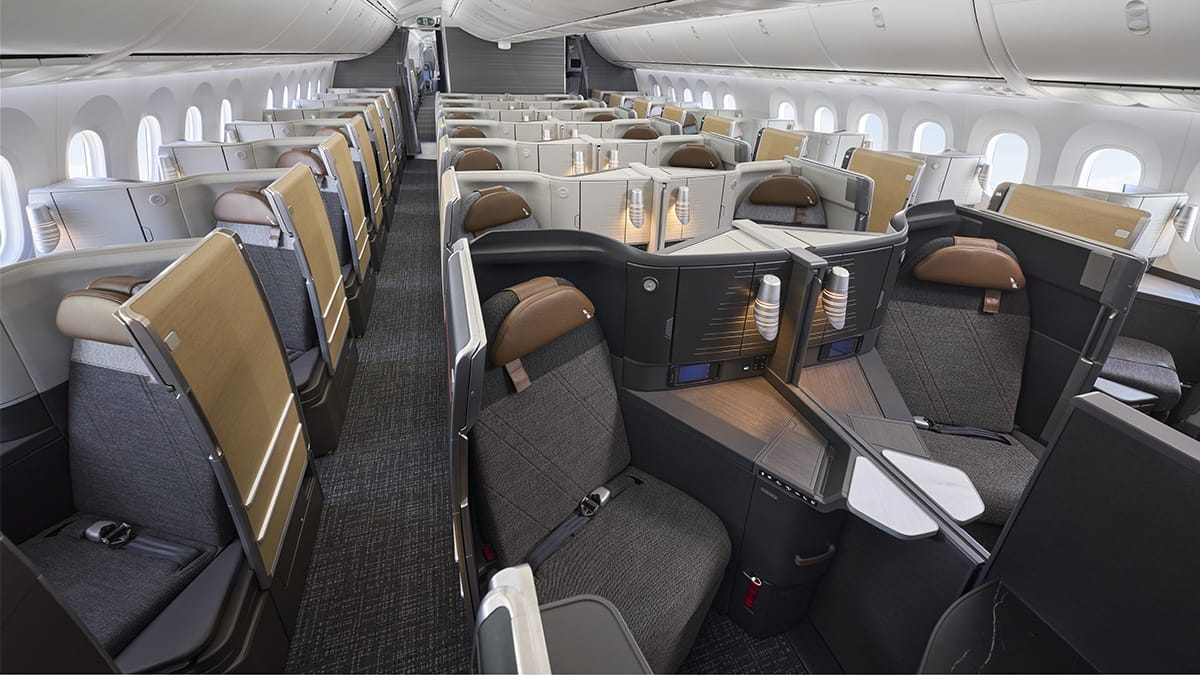
The Flagship Suite is the centerpiece of American’s 2026 premium product strategy. Featuring a 1-2-1 seat layout with direct aisle access for every passenger, sliding privacy doors, personal storage, and Bluetooth connectivity, the new suite represents a meaningful upgrade from the airline’s prior business class product.
The new Boeing 787-9P (premium variant) features 51 Flagship Suite business class seats, a significant increase from just 30 on the older 787-9 configuration, alongside 32 Premium Economy seats. American has been deploying these premium aircraft on key transatlantic routes from Chicago, Dallas, and London.
Flagship Suite Key Specs (Boeing 787-9P):
- Business Class: 51 Flagship Suite seats (1-2-1 layout)
- Premium Economy: 32 seats
- Privacy: Sliding door on every suite
- Connectivity: Bluetooth enabled
- Dining (premium): Lavazza coffee, Champagne Bollinger
- Centennial menus: Caviar, Beef Wellington (long-haul)
- Bedding: Dual-sided cool-touch pillows, duvets, slippers, pajamas
The Airbus A321XLR also features the Flagship Suite across four cabin classes in its 155-seat configuration, making it the first narrow-body aircraft ever to offer this level of premium product on transcontinental and transatlantic routes.
American intends for Flagship Suite seats to appear on all newly delivered 787-9 aircraft going forward, systematically upgrading its long-haul offering.
Admirals Club and Flagship Lounges
American’s lounge network is undergoing its most significant expansion and renovation cycle in years. The airline opened a new Flagship Lounge in Philadelphia in 2025 and has announced plans for a new Flagship Lounge in Charlotte.
At Chicago O’Hare, construction is already underway on a new Admirals Club spanning more than 10,000 square feet in Concourse L, featuring floor-to-ceiling windows with airside views and Chicago-inspired design elements. In Washington D.C., the Admirals Club at Reagan National is being renovated to add 50% more seating capacity.
In Austin, a brand-new 12,000-square-foot Admirals Club with an outdoor terrace is under construction.
Lounge Investment Pipeline (2025-2026):
- Philadelphia (PHL): New Flagship Lounge - opened 2025
- Charlotte (CLT): New Flagship Lounge - announced, under planning
- Chicago O'Hare (ORD): New Admirals Club, 10,000+ sq ft, under construction
- Washington DCA: Admirals Club renovation, +50% seating, 2026
- Austin (AUS): New 12,000 sq ft Admirals Club, outdoor terrace
In-Flight Connectivity (Wi-Fi)
Starting in January 2026, American began offering complimentary Wi-Fi on 90% of its aircraft, a product move that directly responds to competitive pressure from Delta, which has been rolling out free Wi-Fi more aggressively.
This is a significant shift for a carrier that has historically charged for connectivity, and reflects the broader premium repositioning underway across the airline.
American Airlines Major Operational Hubs

Dallas/Fort Worth International Airport (DFW): The Flagship Hub
DFW is unequivocally American Airlines’ most important operational asset.
The airline operates more departures from this hub than from any other single airport in the world, making it the backbone of both its domestic and international network. American and DFW Airport have a long-term use and lease agreement in place that sets the stage for continued future growth.
The hub connects North America with Europe, Latin America, Asia, and the Pacific. For summer 2026, American is launching new seasonal long-haul routes from DFW to Athens, Zurich, and an extended season to Buenos Aires, reinforcing Dallas as a gateway for both leisure and business travel.
DFW Hub Snapshot (2026):
- Role: Primary ("Flagship") domestic and international hub
- Routes (examples): London, Paris, Tokyo, Sydney, Athens, Zurich
- New 2026 routes: Athens (May 21), Zurich (May 21), Buenos Aires extension
- Premium capacity to Tokyo: Increased by 45%+ from DFW
- Peak daily schedule: Record departures planned for summer 2026
- Flagship Lounge: Operational (multiple terminals)
Charlotte Douglas International Airport (CLT)
Charlotte is American’s second-largest hub and one of the most strategically valuable in the U.S. East Coast corridor. It serves as a critical connection point for passengers traveling between smaller southeastern cities and major domestic and international destinations.
Charlotte handles a significant volume of American’s daily domestic departures, and serves as a conduit for passengers flowing to and from American’s transatlantic network. The planned new Flagship Lounge at CLT will further cement the airport’s role as a premium gateway.
CLT Hub Snapshot (2026):
- Role: Primary East Coast domestic / connecting hub
- Key function: Connecting Southeast regional cities to mainline network
- New investment: Flagship Lounge announced for Charlotte
- Coverage: Strong domestic connectivity across the U.S. Southeast
Chicago O’Hare International Airport (ORD)
Chicago O’Hare is one of the most competitive battlegrounds in U.S. aviation. American and United both operate major hubs at ORD, and the scale difference is stark: United generates roughly $10 billion in revenue at O’Hare compared to American’s approximately $5 billion.
In 2026, American is aggressively building its Chicago presence. The airline added 29 new destinations from ORD in 2025 and added new routes to Allentown, Columbia (SC), and Kahului (Hawaii) in 2026.
American now offers more than 500 peak daily departures from ORD for spring break and summer, and is building a new 10,000+ sq ft Admirals Club.
ORD Hub Snapshot (2026):
- Role: Major Midwest domestic / European connecting hub
- Peak Departures: 500+ daily (spring/summer 2026)
- 2026 new routes: ORD-ABE (May 21), ORD-CAE (May 21),
  ORD-OGG (Dec 17, Boeing 787-8)
- Destinations served: 180+
- New Admirals Club: 10,000+ sq ft, under construction
- Flagship Lounge: Between Concourses H and K
- Competitive context: United earns ~$10B vs AA's ~$5B at ORD
Miami International Airport (MIA)
Miami is American’s gateway to Latin America and the Caribbean, a position the airline has held for decades.
The hub connects Florida-based and connecting passengers to destinations throughout Central America, South America, and the Caribbean that few other U.S. carriers can match in breadth or frequency.
For 2026, Miami gains year-round nonstop service to Milan (MXP), launching March 29, 2026, expanding the hub’s transatlantic reach beyond its traditional Latin American stronghold.
The hub is also a potential base for the A321XLR in future years, given its proximity to secondary Brazilian markets.
MIA Hub Snapshot (2026):
- Role: Primary Latin America and Caribbean gateway
- New 2026 route: Miami to Milan Malpensa (MXP), year-round from March 29
- Key markets: Brazil, Argentina, Colombia, Mexico, Caribbean islands
- A321XLR future: Potential basing for Brazil secondary market routes
Phoenix Sky Harbor International Airport (PHX)
Phoenix serves as American’s western Sunbelt hub, connecting passengers from the southwestern U.S. to destinations across the country and into Mexico. It is particularly important for domestic connectivity between the West Coast and the rest of the American network.
The hub reflects American’s broader Sunbelt strategy, which has seen the airline concentrate more of its domestic capacity in growing southwestern and southeastern markets where population and travel demand have grown substantially.
Philadelphia International Airport (PHL)
Philadelphia is American’s primary gateway to Europe, particularly from the U.S. Northeast. The hub supports a significant transatlantic portfolio, with routes to London, Paris, and beyond, and is now taking on additional importance as American deploys new routes to Central European secondary markets.
In 2026, American launched seasonal nonstop service from Philadelphia to both Prague and Budapest, with the Budapest service representing the only nonstop connection between the United States and Hungary. The planned Porto, Portugal service would further expand PHL’s European footprint, though that route awaits government approval.
PHL Hub Snapshot (2026):
- Role: Primary Northeast U.S. European transatlantic gateway
- New 2026 routes: PHL-Prague (May 21, seasonal),
  PHL-Budapest (May 21, seasonal, only US-Hungary nonstop)
- Planned: PHL-Porto (pending government approval, A321XLR candidate)
- New Flagship Lounge: Opened in 2025
Los Angeles International Airport (LAX)
Los Angeles is American’s primary West Coast operational base and Pacific gateway. American and its partners fly to more than 85 destinations from LAX, offering the most comprehensive network of any major carrier from the airport in terms of AAdvantage earning opportunities.
For summer 2026, American will offer more than 145 peak daily departures from LAX, boosted by new routes to Cleveland and Washington Dulles. The A321XLR is deployed from LAX on transcontinental routes, with premium Flagship Suite service to New York JFK and, from later in 2026, to Boston.
LAX Hub Snapshot (2026):
- Role: West Coast and transpacific operational base
- Peak Departures: 145+ daily (summer 2026)
- New 2026 routes: LAX-CLE (April 7), LAX-IAD (April 7)
- A321XLR: Deployed on LAX-JFK and LAX-BOS transcontinental routes
- Pacific: Premium capacity to Tokyo increased by 45%+
- FIFA World Cup: 145+ peak daily flights supporting tournament travelers