


Welcome to AviationOutlook: The aviation newsletter built exclusively for decision-makers.
Become an “Annual” member now & get this special discount offer.
As a paid member, you get access to:
200+ Reports - All major airlines + aerospace & defense companies (updated regularly).
Daily / Weekly - Deep-dive analysis & insights.
Monthly - Industry outlook reports.
In case you missed it, here are the latest analysis reports:
Embraer - Company Analysis and Outlook Report 2026 (Updated)
American Airlines’ Six-Route Europe Play: Yield Discipline or Widebody Overreach?
Check Out All Reports
Executive Summary
American Airlines posted record Q1 2026 revenue of $13.9 billion, up 10.8% year over year, but still recorded a GAAP net loss of $382 million as a multi-billion-dollar fuel-cost step-up and winter-storm disruptions weighed on margins.
The 2024 mega-order for 260 narrowbody and regional aircraft is now flowing into deliveries, and CEO Robert Isom confirmed in June 2026 that an RFP for new widebodies is active with both Airbus and Boeing.
The carrier is restructuring DFW into a 13-bank operating day and pouring capital into Terminal F (opening phased between 2027 and 2030), while simultaneously launching six new transatlantic and South American routes for summer 2026.
Labor relations and a persistent profitability gap with Delta and United remain the central commercial risks; American’s pre-tax margin trailed both peers by 500+ basis points in 2025 even as it broke revenue records.
Recommended - Read Full Reports


Read All Reports
Table of Contents
Executive Summary
American Airlines Company Profile: Key Facts
American Airlines Revenue and Financial Analysis
Q1 2026 Earnings: Record Top Line, Cost Headwinds Underneath
Revenue Components and Mix
Last Twelve Months and Full-Year 2025 Anchor
Q2 2026 Guidance and Full-Year Outlook
Revenue Growth Drivers
Key Services and Product Lines
Cost Trajectory and Balance Sheet
American Airlines Fleet Analysis
Fleet Size and Composition
Fleet Age and Modernization Cadence
The 2024 Mega-Order: Strategic Anchor
Widebody Strategy: The Next Big Decision
Boom Overture and the Supersonic Option
Aircraft Configurations and Cabin Strategy
Fleet Strategy: The Big Picture
American Airlines Route Network Strategy
Network Footprint and Scale
Summer 2026: The Transatlantic Push
Pacific and Premium Mix
Latin America and Caribbean: The MIA Engine
Domestic Network Economics
Major Operational Bases (Hubs)
Dallas-Fort Worth (DFW): The Flagship Hub
Charlotte (CLT): The Eastern Connection Factory
Chicago O’Hare (ORD)
Philadelphia (PHL): The Transatlantic Gateway
Miami (MIA)
Los Angeles (LAX), Phoenix (PHX), JFK, LGA, DCA
American Airlines Competitive Position
Major Competitors
American vs. Delta Air Lines
American vs. United Airlines
American vs. Southwest, Alaska, JetBlue, and the ULCCs
oneworld Alliance: A Structural Asset
Loyalty: The AAdvantage Engine
Premium Revenue Strategy
Labor and Operations: The Internal Headwind
Sustainability and Fleet Efficiency
Capital Allocation and Liquidity
Key Risks
Risk 1
Risk 2
Risk 3
Risk 4
Risk 5
Risk 6
Risk 7
Risk 8
Risk 9
Risk 10
Risk 11
Risk 12
Strategic Outlook for 2026 and Beyond
Recent Strategic Moves and Centennial Context
My Final Thoughts
Official Sources and Data
Introduction
As American Airlines closes the first half of its 100th year of operations, the carrier is moving through one of the most consequential transition periods in its modern history.
A record revenue performance has run head-on into rising fuel costs, internal labor tension, and a widening profitability gap with Delta and United. Yet the company is simultaneously deploying the largest aircraft order book in U.S. aviation, restructuring its flagship hub, and pushing aggressively into premium travel.
This report unpacks the carrier’s commercial posture for 2026 and beyond.
The objective is to give a clear view of where American stands today, what’s driving its decisions, and which structural risks could shape outcomes over the next 12 to 24 months.
Let’s get started.

American Airlines Company Profile: Key Facts
American Airlines Group Inc. is headquartered in Fort Worth, Texas, and trades on Nasdaq under the symbol AAL. The group is the parent of American Airlines and several wholly owned regional carriers operating under the American Eagle brand.
The airline is a founding member of the oneworld alliance and, together with partners, reaches more than 900 destinations globally.
As of June 2026, American serves 350+ destinations in more than 60 countries with mainline and regional operations combined.
American Airlines Group Inc. - At a Glance

Headquarters:           Fort Worth, Texas, USA
Ticker / Exchange:      AAL / Nasdaq (S&P 500 component)
CEO:                    Robert Isom
CFO:                    Devon May
Mainline fleet:         ~930 active aircraft (Planespotters data)
Hubs:                   9 (CLT, ORD, DFW, LAX, MIA, JFK/LGA, PHL, PHX, DCA)
Destinations:           350+ in 60+ countries (with partners: 900+)
Alliance:               oneworld (founding member)
Loyalty program:        AAdvantage
FY 2025 revenue:        $54.6 billion (record)
FY 2025 GAAP net income:$111 million
FY 2025 adjusted NI:    $237 million
Total debt (end 2025):  $36.5 billion
Net debt (end 2025):    $30.7 billion
The company is also approaching a centennial milestone, with the airline’s lineage traceable to the 1926 founding of Robertson Aircraft, a predecessor that flew its first route between Chicago and St. Louis on April 15 of that year.
American Airlines Revenue and Financial Analysis
Q1 2026 Earnings: Record Top Line, Cost Headwinds Underneath
The first quarter of 2026 produced record first-quarter revenue of $13.9 billion, a year-over-year increase of 10.8%. Total unit revenue rose 7.6%, while Atlantic passenger unit revenue surged 16.7%.
The headline GAAP net loss came in at $382 million, or $0.58 per diluted share.
Excluding net special items, the adjusted net loss narrowed to $267 million, or $0.40 per diluted share.
American Airlines - Q1 2026 Financial Snapshot

Total revenue:                $13.9 billion (record)
Revenue growth YoY:           +10.8%
Total unit revenue (TRASM):   +7.6% YoY
Atlantic PRASM:               +16.7% YoY
GAAP net loss:                $(382) million
GAAP EPS:                     $(0.58)
Adjusted net loss:            $(267) million
Adjusted EPS:                 $(0.40)
Winter storm revenue impact:  ~$320 million
Total debt at quarter-end:    $34.7 billion (lowest since mid-2015)
Revenue Components and Mix
Demand strength was concentrated in three buckets: premium cabins, managed corporate, and loyalty.
Managed corporate revenue grew 13% year over year in Q1 2026, while co-branded credit card spend was up 9% and AAdvantage enrollments hit a record at +25% year over year.
The carrier also noted that it recorded the nine highest revenue intake weeks in its 100-year history during the quarter, a useful proxy for booking velocity heading into the summer peak.
Last Twelve Months and Full-Year 2025 Anchor
Full-year 2025 closed with record revenue of $54.6 billion, GAAP net income of $111 million, and adjusted net income of $237 million. Q4 2025 alone delivered a record $14.0 billion in quarterly revenue.
That said, the fourth quarter absorbed roughly $325 million in lost revenue from the federal government shutdown, with domestic passenger unit revenue falling 2.5% year over year.
Stripping out the shutdown effect, domestic unit revenue would have been positive for the quarter.
American Airlines - FY 2025 + LTM Snapshot

FY 2025 revenue:              $54.6 billion (record)
FY 2025 GAAP net income:      $111 million
FY 2025 adjusted net income:  $237 million
Q4 2025 revenue:              $14.0 billion (record)
Q4 2025 GAAP net income:      $99 million
Government shutdown impact:   ~$325 million in Q4
2025 debt reduction:          $2.1 billion
End-2025 total debt:          $36.5 billion
End-2025 net debt:            $30.7 billion

LTM revenue (Q2'25-Q1'26 prox.): ~$54.7 billion
Q2 2026 Guidance and Full-Year Outlook
Management’s Q2 2026 guidance projects available seat miles (ASMs) up 4.0% to 6.0%, total revenue up 13.5% to 16.5%, CASM ex-fuel up 2.0% to 4.0%, and adjusted EPS between ($0.20) and $0.20.
For full-year 2026, the company expects adjusted earnings per diluted share in a wide ($0.40) to $1.10 range. The midpoint sits approximately flat versus 2025 despite an expected jet-fuel expense increase of more than $4 billion.
The fuel headwind is the defining macro variable for 2026. American is assuming roughly $4.00 per gallon for the second quarter, a level that effectively requires the carrier to recapture costs through pricing and mix to hold margins flat.
Revenue Growth Drivers
Four commercial priorities are doing the heavy lifting: customer experience upgrades, network growth (especially transatlantic), premium revenue, and loyalty.
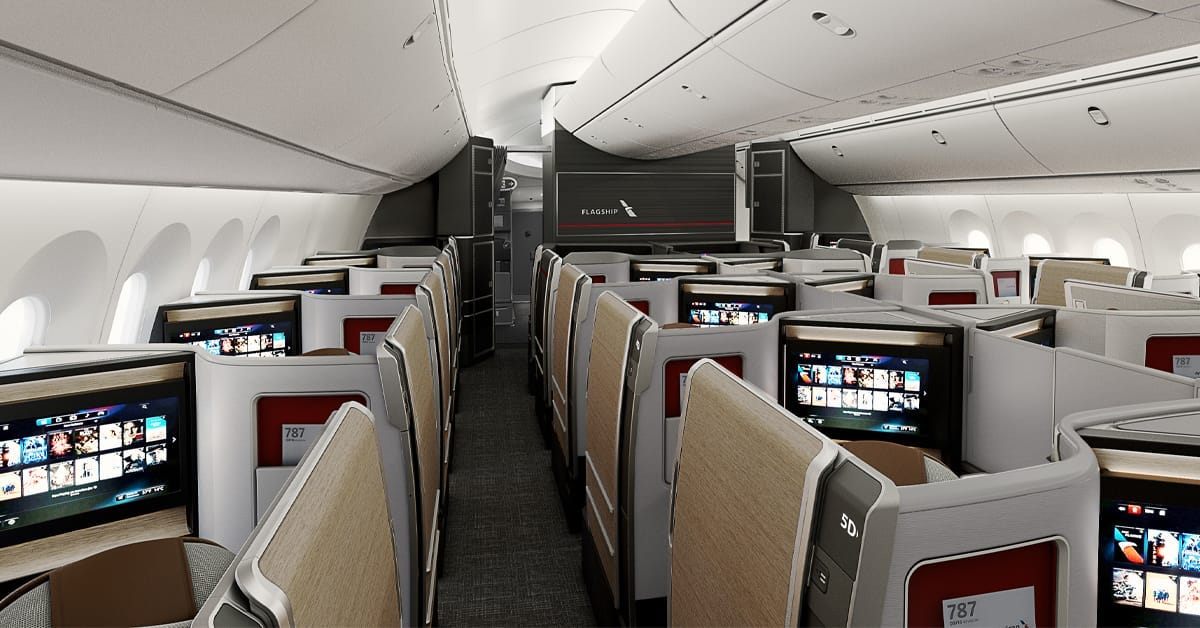
The Flagship Suite product, introduced in June 2025 on the 787-9P, anchors the premium push.
The company has paired this with a record-setting AAdvantage enrollment trajectory, supported by the migration of its co-brand credit card acquisition channels to Citi in Q4 2025.
American Airlines - Four Commercial Priorities (2026)

1. Customer Experience:  Free Wi-Fi rollout, lounge expansion (PHL, JFK, DFW),
                         premium cabin retrofits, IT and app investments.

2. Global Network:       6 new international routes for summer 2026,
                         expanded Pacific premium capacity, PHL transatlantic
                         expansion to 19 destinations.

3. Premium Revenue:      Flagship Suite on 787-9P, A319/A320 retrofits to
                         add domestic first-class seats, +20% premium seating
                         growth target by 2026 vs 2024.

4. Loyalty Leadership:   AAdvantage enrollments up 25% YoY in Q1 2026,
                         co-brand spend up 9%, Citi acquisition channel
transition completed in Q4 2025.Key Services and Product Lines
American’s revenue base sits on four legs: passenger revenue (the dominant share), cargo, AAdvantage and other loyalty-related revenue, and ancillary services.
The Flagship product family (Flagship First, Flagship Business, Flagship Suite) covers long-haul premium, while domestic first-class capacity is being expanded through narrowbody retrofits.
The cargo division operates as a complement to passenger widebody capacity rather than as a standalone freighter network.
American does not currently operate dedicated freighters, a strategic choice that differentiates it from cargo-heavy competitors and ties cargo earnings closely to widebody utilization.
Cost Trajectory and Balance Sheet
Cost discipline remains a central theme.
End-of-quarter total debt of $34.7 billion is the lowest since mid-2015 and reflects $2.1 billion of debt reduction during 2025. Management has telegraphed that the company can achieve its sub-$35 billion total-debt target in 2026, a year ahead of the previous schedule.
That balance sheet path matters because the carrier still operates with the highest debt load among the U.S. Big Three.
Continued deleveraging gives American optionality on a new widebody order without overextending capital expenditure commitments.