


Executive Summary
ANA Holdings posted record-high revenue of ¥2,261.8 billion for FY2024 (ended March 2025), with operating income reaching ¥196.6 billion, driven by strong international passenger demand and Japan’s record 42.7 million inbound visitors in 2025.
The airline placed a company-record 77-aircraft order worth approximately $14 billion with Boeing, Airbus, and Embraer in February 2025, targeting a total fleet of roughly 320 aircraft by FY2030.
ANA Group is transitioning to a dual-brand strategy composed of ANA and Peach, discontinuing the AirJapan brand starting FY2026 to consolidate resources and expand its international network more aggressively.
The newly announced FY2026-2028 Medium-term Corporate Strategy targets record operating income of ¥250 billion by FY2028 and ¥310 billion by FY2030, backed by a ¥2.7 trillion investment plan over five years.
Recommended - Read Full Reports


Read All Reports
Table of Contents
Executive Summary
Key Facts: Company Profile
Business Overview
Financial Performance: Record Revenue and Profit Growth
Revenue Growth Drivers
International Passenger Demand and the Inbound Tourism Boom
Domestic Passenger Services
Cargo and Logistics
Airline-Related, Travel, and Retail Segments
Medium-Term Corporate Strategy: FY2026-2028
ANA Fleet: In-depth Analysis
Fleet Size and Composition
Boeing 787 Dreamliner: The Core of ANA’s Long-Haul Strategy
Boeing 787-8
Boeing 787-9
Boeing 787-10
The 787’s Technical Advantages
Boeing 777 Fleet: The Flagship and Domestic Workhorse
Boeing 777-300/300ER
Boeing 777-200
Boeing 767 and 737 Fleets
Airbus A380 “FLYING HONU”
Airbus A320 and A321 Narrowbody Family
DHC8-400 (Q400) Regional Operations
The $14 Billion Fleet Order: 77 Aircraft from Three Manufacturers
The Embraer E190-E2: A First for Japan
The Airbus A321XLR: Expanding Peach’s Reach
Fleet Strategy Targets for FY2030
Cabin Product Innovation: THE Room, THE Suite, and THE Room FX
ANA Route Network, Major Destinations, and Strategy
International Route Network Overview
European Network Expansion
North American Network
Asia-Pacific, India, and Oceania
Hawaii: The FLYING HONU Operation
Domestic Route Network
Peach Aviation: The Low-Cost Growth Engine
Dual-Brand Strategy: From Three Brands to Two
Major Operational Bases (Hubs)
Tokyo Haneda Airport (HND): The Primary Hub
Tokyo Narita Airport (NRT): International and Cargo Gateway
Osaka Kansai (KIX), Itami (ITM), and Chubu Centrair (NGO)
Nippon Cargo Airlines Integration and Cargo Strategy
NCA Acquisition and Merger Plan
Integration Milestones Starting April 2026
Competitive Analysis - ANA
ANA vs. Japan Airlines: Japan’s Aviation Duopoly
International Competitive Dynamics
ANA’s Competitive Advantages
Awards, Service Quality, and Brand Recognition
Star Alliance Membership and Partnerships
Sustainability and Environmental Strategy
Workforce and Labor Strategy
Digital Transformation and Innovation
The 2029 Narita Expansion: The Biggest Growth Catalyst?
Key Risks: Scenarios and Probabilities
Fuel Cost Volatility
Yen Depreciation and Currency Risk
Aircraft Delivery Delays
Boeing 787 Engine and Maintenance Issues
Geopolitical and Trade Policy Risks
Competition and Yield Pressure
Natural Disaster and Disruption Risk
My Final Thoughts
Official Sources and Data
Key Facts: Company Profile
Company Name:         ANA HOLDINGS INC.
Airline Brand:        All Nippon Airways (ANA)
ICAO/IATA Code:       ANA / NH
Founded:              December 27, 1952
Holding Structure:    Transitioned to holding company on April 1, 2013
Headquarters:         Shiodome City Center, 1-5-2 Higashi-Shimbashi,
                      Minato-ku, Tokyo 105-7140, Japan
CEO:                  Koji Shibata (President & Chief Executive Officer)
Group Companies:      73 companies
Employees:            44,019 (consolidated, as of March 31, 2025)
Paid-in Capital:      ¥467,601 million
Net Sales (FY2024):   ¥2,261,856 million
Alliance:             Star Alliance (member since 1999)
Fleet Size (ANA):     278 aircraft (as of March 31, 2025)
Primary Hubs:         Tokyo Haneda (HND), Tokyo Narita (NRT)
SKYTRAX Rating: 5-Star (13 consecutive years since 2013)Business Overview
Financial Performance: Record Revenue and Profit Growth
ANA Holdings has posted consecutive record-breaking financial results, confirming the carrier’s strong recovery trajectory and growth momentum following the pandemic years.
For the fiscal year ended March 31, 2025 (FY2024), the group reported record-high revenue of ¥2,261.8 billion, surpassing the previous fiscal year by ¥205.9 billion.
Operating income for that same period reached ¥196.6 billion. This figure exceeded the company’s revised February forecast by ¥16.6 billion, prompting the board to increase the annual dividend to ¥60 per share.
The international passenger segment was a standout performer. It posted record international revenue of ¥805.5 billion, fueled by three new European routes launched from late 2024 and robust inbound demand to Japan.
Total air transportation revenue reached ¥2,058.7 billion, up 10.1% from the previous year. Both international and domestic passenger services contributed positively to this growth.
The momentum has continued strongly into the current fiscal year. For the nine months ended December 31, 2025, ANA Holdings achieved another record with revenue of ¥1,877.3 billion and operating income of ¥180.7 billion.
Operating income had progressed to approximately 90% of the full-year plan by the end of the third quarter alone. CFO Kimihiro Nakahori stated these results “clearly demonstrate the effectiveness of our strategic initiatives.”
Financial Snapshot (Consolidated)
-------------------------------------------------
FY2024 (Ended March 2025):
  Revenue:             ¥2,261.8 billion (record high)
  Operating Income:    ¥196.6 billion
  Int'l Passenger Rev: ¥805.5 billion (record high)
  Air Transport Rev:   ¥2,058.7 billion (up 10.1% YoY)
  Dividend:            ¥60 per share

9 Months Ended Dec 2025 (Q3 FY2025):
  Revenue:             ¥1,877.3 billion (record high)
  Operating Income:    ¥180.7 billion
Progress vs Plan: ~90%Revenue Growth Drivers
International Passenger Demand and the Inbound Tourism Boom
The single largest contributor to ANA’s revenue surge has been international passenger services. Japan welcomed a record 42.7 million visitors in 2025, a 15.8% increase over the previous high of 36.9 million set in 2019.
These visitors spent a record ¥9.5 trillion in Japan during 2025, up from ¥8.1 trillion the year before. The persistently weak yen has made Japan one of the most attractive travel destinations globally.
Five of Japan’s ten largest source markets posted double-digit visitor growth in 2025, with South Korea, Taiwan, and Southeast Asian nations contributing substantially. Visits from China declined during this period, representing a potential upside catalyst if that market recovers.
European routes have performed particularly well following the launch of three new routes from Haneda to Milan, Stockholm, and Istanbul since late 2024. Outbound Japanese leisure demand has also risen, with growth on routes to Hawaii and Europe.

Domestic Passenger Services
Domestic passenger numbers and revenue also exceeded prior-year levels during the nine months ended December 2025. ANA stimulated leisure demand through early booking promotions and strategic fare adjustments across its network.
Despite the effect of severe weather conditions during parts of the year, the airline posted positive domestic performance. ANA increased frequencies on key domestic corridors, including the Haneda to Shin-Chitose (Sapporo) and Haneda to Fukuoka routes beginning October 2025.
Regional revitalization initiatives added a unique dimension to the domestic strategy. In December 2025, ANA launched the “ANA FURUSATO JET,” a specially designed aircraft promoting regional tourism.
This initiative, guided by the “Connecting Hometowns” concept, strengthens collaboration with local governments to encourage travel to regional areas. It represents a distinctive marketing approach that aligns brand identity with social impact.
Cargo and Logistics
International freight volumes grew year-over-year during the nine-month period, supported by stronger demand for shipments from Asia to North America. ANA’s cargo operation benefited from its strategic positioning as a transit hub for freight moving between Asia and Western markets.
Cargo demand from China to North America via Japan, which had previously declined due to U.S. tariff policies, began showing signs of recovery in late 2025. This recovery is significant because it represents high-yield transit cargo that leverages ANA’s geographic advantage and NCA’s dedicated freighter capacity.
However, overall cargo revenue declined year-over-year despite higher volumes. Reduced automotive-related shipments and softer e-commerce demand weighed on unit revenue, highlighting the ongoing volatility in air cargo markets.
ANA adjusted freighter routes and capacity throughout the period. On North American routes, the airline enhanced profitability by operating charter flights for other carriers, demonstrating fleet utilization flexibility.
Revenue Breakdown by Segment (9 Months Ended Dec 2025):
-------------------------------------------------
Air Transportation Total:     Strong YoY growth
  - Int'l Passenger (ANA):    Record passenger numbers and revenue
  - Domestic Passenger (ANA): Revenue exceeded prior year levels
  - Cargo Service (ANA):      Int'l freight volumes up YoY
                               (revenue down on weaker unit rates)
  - Peach/AirJapan:           Peach passengers up; AirJapan revenue up
Other Air Transport Rev:      ¥140.3 billion (up 1.8% YoY)
(includes mileage program, in-flight sales, maintenance)Airline-Related, Travel, and Retail Segments
Beyond core air transportation, ANA Holdings generates revenue through three additional business segments that complement the airline operation.
The airline-related services division posted higher net sales. This was driven by expanded airport ground handling services for foreign airlines and increased international cargo handling volumes at Japanese airports.
Travel services reported mixed results. Overseas travel transactions increased with strong bookings to Hawaii and Europe. However, domestic travel saw a decline in transaction volumes for its core “Dynamic Package” products, though stringent cost management helped the division achieve an operating profit regardless.
The trade and retail segment posted particularly strong results. The souvenir wholesaler “FUJISEY” was significantly boosted by the positive impact of Expo 2025 Osaka, Kansai. Growth also came from increased transaction volumes in food businesses, particularly banana imports, and in security-related equipment sales to logistics companies.
Medium-Term Corporate Strategy: FY2026-2028
ANA Holdings unveiled its Medium-term Corporate Strategy for FY2026-2028 in January 2026. Management positions this three-year period as a preparation phase before the major expansion of Narita Airport expected in 2029.
The strategy centers on three pillars. The first pillar focuses on expanding the international passenger and air cargo businesses, targeting a 1.3-fold increase in scale for both segments. International expansion and cargo growth are designated as the primary profit drivers for the medium term.
The second pillar involves transforming organizational capabilities. This means leveraging both “the power of people” and digital transformation (DX) to improve productivity. The approach recognizes that technology alone cannot deliver results without skilled, empowered employees.
The third pillar is the execution of a record-high ¥2.7 trillion investment over five years. Approximately 50% of this investment is allocated to international passenger and cargo operations, with ¥270 billion dedicated specifically to DX initiatives.
Medium-Term Financial Targets:
-------------------------------------------------
FY2028 Target:
  Operating Income:    ¥250.0 billion (record high target)
  Operating Margin:    9%

FY2030 Target:
  Operating Income:    ¥310.0 billion
  Operating Margin:    10%

Investment Plan:
  Total (5 years):     ¥2.7 trillion
  Int'l + Cargo share: ~50%
  DX Investment:       ¥270 billion
  Int'l/Cargo Scale:   1.3x growth target
The overarching vision is captured in the “ANA Group Value Creation Roadmap 2030.” This roadmap identifies the 2029 Narita Airport expansion as the group’s most significant business opportunity. It focuses on “expanding the connection between people and product” and building the ANA Group fan base to fulfill the management vision of “Uniting the World in Wonder.”
ANA Fleet: In-depth Analysis
Fleet Size and Composition
As of March 31, 2025, ANA (the mainline carrier) operated a fleet of 278 aircraft across 17 different aircraft types. This makes ANA one of the largest airline fleets in the Asia-Pacific region and the biggest in Japan.
The fleet is heavily weighted toward Boeing aircraft, with the 787 Dreamliner family forming the backbone of international operations. ANA was the global launch customer for the Boeing 787 program and currently operates all three variants of the type. It is the only airline in the world operating significant numbers of all three 787 variants simultaneously.
The average fleet age stands at approximately 12 years, which is relatively young by global airline standards. This positions ANA well for fuel efficiency and passenger comfort compared to carriers with older fleets.
ANA Fleet Composition (As of March 31, 2025):
-------------------------------------------------
Wide-Body Aircraft:
  Boeing 777-300:        18 aircraft (212-514 seats)
  Boeing 777-200:        10 aircraft (392/405 seats)
  Boeing 777F:            2 freighters
  Boeing 787-10:          5 aircraft (294/429 seats)
  Boeing 787-9:          43 aircraft (215-395 seats)
  Boeing 787-8:          36 aircraft (184-335 seats)
  Boeing 767-300:        15 aircraft (202/270 seats)
  Boeing 767-300F:        9 freighters
  Airbus A380:            3 aircraft (520 seats)

Narrow-Body Aircraft:
  Boeing 737-800:        39 aircraft (166 seats)
  Airbus A321neoLR:       3 aircraft (218 seats)
  Airbus A321neo:        22 aircraft (194 seats)
  Airbus A321-200:        4 aircraft (194 seats)
  Airbus A320neo:        26 aircraft (146/188 seats)
  Airbus A320-200:       19 aircraft (180 seats)

Regional Aircraft:
  DHC8-400 (Q400):       24 aircraft (74 seats)

TOTAL:                  278 aircraft
Average Fleet Age:      ~12 years
ANA also operates special livery aircraft that have become cultural touchstones.
These include Star Alliance painted jets across multiple types, Star Wars themed 787-9 and 777-200 aircraft, the iconic FLYING HONU A380 fleet with Hawaiian sea turtle liveries, Pokemon-themed aircraft, and the EXPO 2025 jet commemorating the Osaka World Expo.

Boeing 787 Dreamliner: The Core of ANA’s Long-Haul Strategy
The Boeing 787 family is the most important aircraft type in ANA’s fleet, totaling 84 aircraft across three variants: 36 x 787-8, 43 x 787-9, and 5 x 787-10.
ANA holds the distinction of being the first airline globally to receive the 787, taking delivery of its first 787-8 in November 2011.

Boeing 787-8
The 787-8 was the first Dreamliner variant introduced to ANA’s fleet. With seating configurations ranging from 184 to 335 seats, it offers flexibility for different route profiles. The aircraft is powered by Rolls-Royce Trent 1000A engines and has served both domestic and international routes for over 14 years.
The 787-8 features a wingspan of 60.1 meters and a range well-suited for regional international and domestic trunk routes. Its lighter weight relative to the 787-9 makes it efficient for mid-density operations.
Boeing 787-9
The 787-9, introduced in August 2014, has become the workhorse of ANA’s international expansion. With 43 aircraft already in service and additional orders pending, this variant will form the core of ANA’s long-haul fleet for years to come.
Seating on ANA’s 787-9s ranges from 215 to 395 seats, depending on the cabin configuration. International versions feature a premium-heavy layout, while some configurations are optimized for higher-density domestic or charter operations.
The 787-9 is powered by Rolls-Royce Trent 1000-A2 engines and has a range of 10,130 km. Its additional fuselage length over the 787-8 provides more revenue-generating capacity while maintaining the type’s fuel efficiency advantage.
ANA has continued to invest heavily in this variant. In March 2026, the airline converted three 787-10 orders to the 787-9, reflecting the strategic priority to expand international service where the 787-9’s longer range provides more value than the 787-10’s larger capacity.
Boeing 787-10
The 787-10, the largest variant, entered ANA’s fleet in April 2019 with five aircraft currently in service. These are primarily deployed on high-density domestic routes, where their larger passenger capacity (294 to 429 seats) maximizes revenue on Japan’s busiest corridors.
Of the original 11 787-10s ordered in 2020, seven had been delivered between 2023 and 2025, with an eighth due in 2026. The three converted to 787-9 orders will be delivered in 2027.
The 787’s Technical Advantages
The 787’s composite material structure (50% of the primary airframe) provides significant weight savings. Improved fuel efficiency, approximately 20% better than comparable previous-generation aircraft, reduces both operating costs and carbon emissions.
For passengers, the 787 offers enhanced comfort with larger windows (65% bigger than traditional aircraft windows with electronic dimming), higher cabin humidity (approximately 6% vs. 4% on older types), and lower cabin altitude (6,000 feet vs. 8,000 feet). These features reduce fatigue on long flights.
Boeing 787 Fleet Strategy:
-------------------------------------------------
Current 787 Fleet:     84 aircraft
  787-8:               36 (introduced Nov 2011)
  787-9:               43 (introduced Aug 2014)
  787-10:               5 (introduced Apr 2019)

FY2030 Target:         ~120 Boeing 787 series aircraft
New 787-9 Orders:      18 (Feb 2025) + 3 converted from 787-10
Engine (new 787-9s):   GE engines
New Cabin Product:     "THE Room FX" Business Class
First Delivery: August 2026 (new cabin 787-9s)Boeing 777 Fleet: The Flagship and Domestic Workhorse
ANA operates 28 passenger Boeing 777s split between the 777-300 (18 aircraft) and 777-200 (10 aircraft), plus two 777F freighters. The fleet serves two distinct roles based on configuration.
Boeing 777-300/300ER
The 777-300ER serves as the flagship of ANA’s premium long-haul service, particularly on the highest-demand routes to North America and Europe. It is home to ANA’s acclaimed “THE Room” Business Class and “THE Suite” First Class.
With configurations ranging from 212 seats (high premium-class mix for international) to 514 seats (domestic high-density), the 777-300 fleet demonstrates remarkable versatility. The international variant features First Class, Business Class, Premium Economy, and Economy, while domestic versions maximize seating density.
Boeing 777-200
The 777-200 fleet of ten aircraft handles high-density domestic trunk routes and select international services. With 392 to 405 seats, these aircraft provide essential capacity on Japan’s busiest corridors such as Haneda-Sapporo and Haneda-Fukuoka.
Both 777 types are aging relative to the 787 fleet and will gradually see their roles evolve as newer aircraft enter service. The 777-300ER remains valuable for its premium cabin product and range capability.
Boeing 767 and 737 Fleets
The Boeing 767-300 passenger fleet of 15 aircraft serves mid-range international and domestic routes with 202 to 270 seats. Nine 767-300F freighters handle dedicated cargo operations on Asian routes, complemented by two 767-300(BCF) converted freighters.
The Boeing 737-800 fleet of 39 aircraft covers the bulk of ANA’s short-haul domestic routes. With 166 seats, these single-aisle jets provide efficient capacity on routes that do not require wide-body deployment.
The 737-800s will gradually be supplemented and eventually replaced by new Boeing 737-8 deliveries. The first 737-8 joins the fleet in June 2026, beginning a multi-year domestic fleet renewal program.
Airbus A380 “FLYING HONU”
ANA is the only Japanese airline to operate the Airbus A380. All three superjumbos are deployed exclusively on the Narita-Honolulu route, each painted in a distinctive Hawaiian sea turtle (“Honu”) livery in blue, green, and orange.
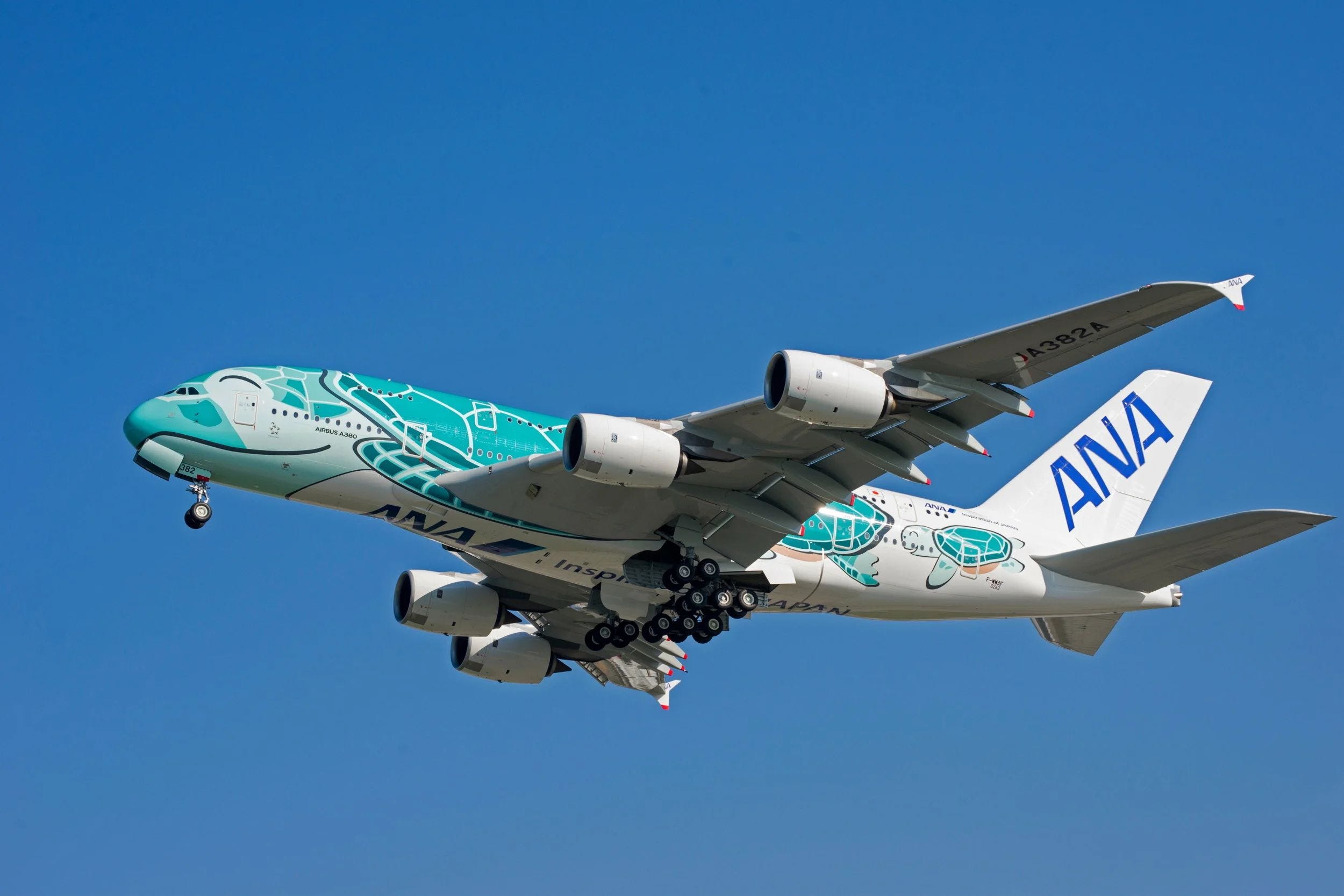
With 520 seats across four classes (First, Business, Premium Economy, and Economy), the A380 is ANA’s highest-capacity aircraft. Its specifications include a wingspan of 79.8 meters, a maximum speed of 910 km/h, a range of 13,330 km, and four Rolls-Royce Trent 970 engines each producing 34,088 kg of thrust.
The FLYING HONU operation has become a powerful brand icon. The distinctive liveries make the aircraft instantly recognizable and have generated significant media attention and customer loyalty.
However, the A380 route has faced periodic load factor challenges given the 520-seat capacity per flight. ANA has continued to invest in the Hawaii product, including special in-flight services and amenities available only aboard FLYING HONU flights.
Airbus A320 and A321 Narrowbody Family
ANA operates a substantial Airbus narrowbody fleet spanning five sub-types: 26 A320neos, 19 A320-200s, 22 A321neos, 4 A321-200s, and 3 A321neoLRs. Combined, these 74 aircraft represent a significant portion of the domestic and short-haul international capacity.
The neo-generation variants (A320neo, A321neo) feature new-generation engines that deliver substantial fuel savings over their older counterparts. The A321neoLR variant offers extended range capability, allowing ANA to profitably operate longer thin routes that do not justify wide-body deployment.
DHC8-400 (Q400) Regional Operations
ANA operates 24 De Havilland Canada Dash 8-400 turboprops with 74 seats each. These aircraft connect smaller Japanese cities to ANA’s hub airports, playing a vital role in maintaining domestic connectivity to communities that lack demand for jet service.
Routes served include connections between regional airports in Hokkaido, Tohoku, and Japan’s island communities. Without these turboprop services, many of these communities would lose direct air access.
The $14 Billion Fleet Order: 77 Aircraft from Three Manufacturers
In February 2025, ANA Holdings announced a company-record order for 77 aircraft from Boeing, Airbus, and Embraer. Valued at approximately $14 billion according to Reuters, this order represents the largest single fleet commitment in ANA’s 73-year history.
CEO Koji Shibata stated that this order would be “the catalyst for improving the profitability of domestic flights and the expansion of international flights, which is an area of future growth of our airline business.”
The order spans five different aircraft models from three manufacturers, diversifying ANA’s supplier base while targeting specific operational needs.
77-Aircraft Order Breakdown (February 2025):
-------------------------------------------------
For ANA International Routes:
  18 x Boeing 787-9 (GE engines)   - confirmed orders

For ANA Domestic Routes:
  20 x Embraer E190-E2              - 15 confirmed + 5 options
  12 x Boeing 737-8                 - 8 confirmed + 4 options

For ANA Fleet Renewal:
  14 x Airbus A321neo (additional)  - confirmed orders

For Peach Aviation:
  10 x Airbus A321neo               - confirmed orders
   3 x Airbus A321XLR               - confirmed orders

TOTAL: 68 confirmed orders + 9 options = 77 aircraft
Delivery Period: FY2028 to FY2033
Estimated Value: ~$14 billion (at list prices)

Source: ANA Holdings Press Releases
The Embraer E190-E2: A First for Japan
The introduction of 20 Embraer E190-E2 aircraft is especially significant. It marks the first time this regional jet type will operate in Japan. The 100-seat class aircraft gives ANA a flexible tool for managing domestic supply and demand on routes where larger jets are oversized.
With the latest Pratt & Whitney GTF engines, the E190-E2 offers low fuel consumption and reduced noise emissions. Deliveries are expected to begin in FY2028.
This aircraft will allow ANA to serve thinner domestic routes profitably while maintaining service quality and frequency. It fills a gap between the 74-seat Q400 turboprop and the 166-seat Boeing 737-800.
The Airbus A321XLR: Expanding Peach’s Reach
The three Airbus A321XLR aircraft ordered for Peach carry strategic importance beyond their small number. With superior fuel efficiency and extended range of approximately 8,700 km, the A321XLR allows ANA’s low-cost brand to serve medium- to long-haul routes.
This opens new market opportunities that were previously uneconomical for narrowbody operations. Potential routes could include Kansai to destinations in Southeast Asia, Australia, or even Hawaii.
In addition to the new orders, ANA finalized outstanding options for five Boeing 787-9 aircraft (from a February 2020 announcement) and ten Boeing 737-8 aircraft (from a January 2019 announcement).
Fleet Strategy Targets for FY2030
ANA’s fleet strategy targets approximately 320 aircraft across the group by FY2030, including roughly 120 Boeing 787 series jets. The ratio of fuel-efficient aircraft is projected to reach 91%.
Available seat kilometers (ASK) on international routes are expected to increase by approximately 1.5 times from FY2023 levels by FY2030. This substantial capacity growth reflects the aggressive international expansion agenda.
Fleet Strategy Targets (FY2030):
-------------------------------------------------
Total Group Fleet:          ~320 aircraft
Boeing 787 Series:          ~120 aircraft
Fuel-Efficient Ratio:       91%
Int'l ASK Growth (vs FY23): ~1.5x
Key New Types:              Embraer E190-E2 (from FY2028)
                            Boeing 737-8 (from June 2026)
                            Airbus A321XLR (for Peach)
New 787-9 Deliveries: August 2026 (new cabin product)Cabin Product Innovation: THE Room, THE Suite, and THE Room FX
ANA has invested substantially in premium cabin products to differentiate itself from competitors.
“THE Room,” the airline’s signature Business Class on the Boeing 777-300ER, features wide seats with closing doors, direct aisle access from every seat, and high-quality Japanese-inspired bedding. It is widely regarded as one of the finest Business Class products in the world.
“THE Suite,” ANA’s First Class product on select 777-300ER aircraft, delivers a fully private experience. Square shell seats with individual doors, customizable seating positions, luxury amenities, and multi-course Japanese and Western dining define the experience. ANA is also known for offering some of the most expensive whiskey selections found on any airline.
Beginning in August 2026, new Boeing 787-9 aircraft will debut “THE Room FX,” an evolution of the original concept designed specifically for the 787 platform. These aircraft will also feature redesigned Premium Economy and Economy Class seats, representing ANA’s most significant cabin product refresh in recent years.