


Welcome to AviationOutlook: The aviation newsletter built exclusively for decision-makers.
Become an “Annual” member now & get this special discount offer.
As a paid member, you get access to:
200+ Reports - All major airlines + aerospace & defense companies (updated regularly).
Daily / Weekly - Deep-dive analysis & insights.
Monthly - Industry outlook reports.
In case you missed it, here are the latest analysis reports:
Embraer - Company Analysis and Outlook Report 2026 (Updated)
American Airlines’ Six-Route Europe Play: Yield Discipline or Widebody Overreach?
Check Out All Reports
Executive Summary
Anduril Industries has officially begun serial production of its YFQ-44A “Fury” Collaborative Combat Aircraft at Arsenal-1 in Ohio, three months ahead of schedule, marking a turning point for autonomous airpower manufacturing in the U.S.
The U.S. Army awarded Anduril a landmark $20 billion enterprise contract in March 2026, consolidating over 120 existing technology orders and centering the Lattice AI platform as the backbone of America’s counter-drone defense architecture.
Revenue reached approximately $2.1 billion in 2025, up 110% from $1 billion in 2024, with the company projecting roughly $4.3 billion for 2026 as major programs scale.
Anduril is simultaneously pursuing a $4 billion funding round at a $60+ billion valuation, nearly doubling its June 2025 valuation of $30.5 billion, funded by Thrive Capital and Andreessen Horowitz.
Recommended - Read Full Reports


Table of Contents
Executive Summary
Key Facts: Company Profile & Business Overview
Revenue and Growth Drivers
Key Product Lines and Programs: In-Depth Analysis
YFQ-44A “Fury” - Collaborative Combat Aircraft
Altius Loitering Munition and ISR Drone Series
Roadrunner - Reusable VTOL Interceptor and Strike Drone
Barracuda-500 - Autonomous Cruise Missile Program
Lattice AI Platform - The Software Foundation
Ghost Shark - Autonomous Undersea Vehicle
IVAS - Integrated Visual Augmentation System
Arsenal-1: A New Kind of Defense Factory
The $20 Billion Army Enterprise Contract: A Structural Shift in Procurement
Competitive Analysis: Challenging the Traditional Defense Industrial Base
Anduril vs. Traditional Prime Contractors
Anduril vs. Defense Tech Peers
Major Recent Developments (2025-2026)
Fury CCA Achieves Serial Production Three Months Ahead of Schedule
Air Force Begins AIM-120 Captive Carry Tests on Fury
Anduril Seeking $4 Billion Funding Round at $60 Billion-Plus Valuation
Ghost Shark Factory Opens in Sydney Ahead of Schedule
$1 Billion Long Beach Campus Announced
UK Project NYX Teaming Agreement with GKN Aerospace
Financial and Commercial Implications
Key Risks: Scenarios and Probabilities
1. Drone Systems Technical Failures
2. Fixed-Price Contract Risk
3. CCA Production Contract Not Won
4. Profitability Timeline Risk
5. Legislative and Export Control Risk
6. Adversarial Electronic Warfare Countermeasures
SWOT Analysis
My Final Thoughts
Primary Sources and References
Key Facts: Company Profile & Business Overview
Company Name:       Anduril Industries, Inc.
Founded:            2017
Headquarters:       Costa Mesa, California, USA
CEO:                Brian Schimpf (Co-Founder)
Founder:            Palmer Luckey (Oculus VR founder)
Co-Founders:        Trae Stephens, Matt Grimm, Joseph Chen
Employees:          ~7,000 (as of 2026)
Revenue (2024):     ~$1 billion
Revenue (2025):     ~$2.1 billion (est.)
Revenue Forecast:   ~$4.3 billion (2026 projection)
Latest Valuation:   $30.5 billion (June 2025; pursuing $60B+ in 2026)
Total Funding:      $6.2+ billion (cumulative across all rounds)
Key Investors:      Founders Fund (Peter Thiel), Thrive Capital, a16z
Primary Customers:  U.S. Army, U.S. Air Force, U.S. Navy, U.S. Marine Corps,
                    Royal Australian Navy, UK Ministry of Defence
Core Segments:      Autonomous aircraft, counter-UAS, command & control,
                    autonomous undersea vehicles, soldier augmentation systems
Manufacturing:      Arsenal-1 (Ohio), Long Beach campus (2027), Sydney (Australia)
Anduril is not a traditional defense prime contractor. From the day it was founded in 2017, it pursued a fundamentally different model: self-fund research and development using venture capital, build production-ready systems, and then sell them to governments.
Palmer Luckey, who previously sold Oculus VR to Meta, built Anduril around the conviction that software-first, autonomous systems would define the next generation of warfare.
The company’s name itself comes from Aragorn’s sword in J.R.R. Tolkien’s “The Lord of the Rings”, a deliberate signal of the founders’ worldview about technology and power. The company now operates across autonomous aircraft, unmanned maritime systems, AI-driven command and control, loitering munitions, cruise missiles, and soldier augmentation platforms.
Revenue and Growth Drivers
Anduril’s revenue doubled from roughly $500 million in 2023 to $1 billion in 2024, and then roughly doubled again to an estimated $2.1 billion in 2025. For 2026, Anduril’s internal projections point toward approximately $4.3 billion in revenue, which would represent continued year-over-year doubling.
Several specific programs are driving this acceleration. The Collaborative Combat Aircraft (CCA) contract with the U.S. Air Force, shared with General Atomics and with a combined ceiling of up to $9 billion, is the single largest aviation-specific growth driver. The Altius loitering munition series, the Roadrunner VTOL drone, and the Barracuda cruise missile family are contributing additional government orders.
The $20 billion Army enterprise deal announced in March 2026 creates a decade-long procurement vehicle that allows federal agencies across the U.S. government to purchase Anduril products without navigating individual acquisition processes each time. That structural change alone could accelerate Anduril’s contract capture rate substantially.
International revenues are growing too. Australia’s A$1.7 billion Ghost Shark contract for autonomous undersea vehicles, partnerships in the UK around the British Army’s Project NYX, and new agreements in Poland and Germany are all broadening Anduril’s revenue base beyond U.S. borders.
Key Product Lines and Programs: In-Depth Analysis
YFQ-44A “Fury” - Collaborative Combat Aircraft
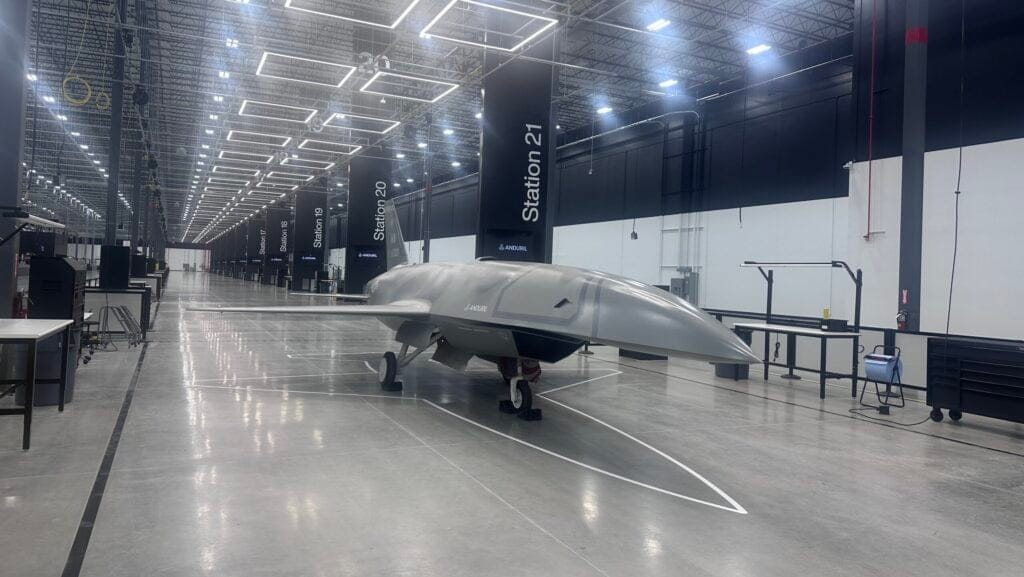
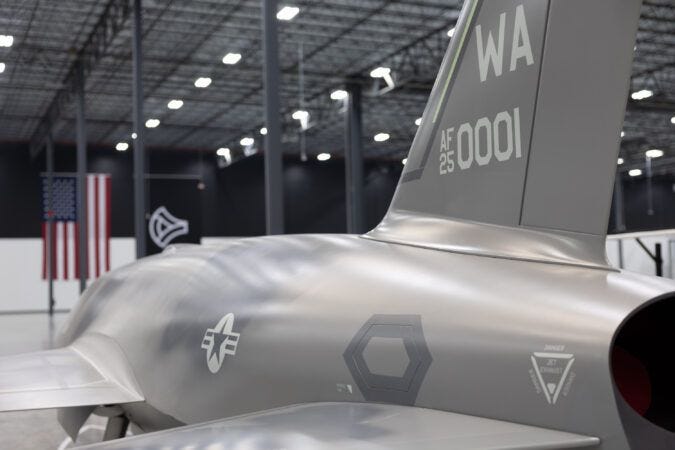
The YFQ-44A “Fury” is arguably the most significant aerospace program in Anduril’s portfolio right now. It is a high-speed, autonomous combat aircraft designed to fly alongside crewed fighters under the U.S. Air Force’s Collaborative Combat Aircraft program, commonly described as a “loyal wingman” concept.
The aircraft completed its first flight on October 31, 2025, going from clean-sheet design to wheels-up in just 556 days. That timeline is remarkable by any standard in military aviation. By February 2026, the Air Force had already begun captive carry tests with an AIM-120 AMRAAM strapped to the Fury’s airframe.
YFQ-44A "Fury" — Key Specifications and Facts
------------------------------------------------
Designation:        YFQ-44A (USAF prototype designation)
Role:               Collaborative Combat Aircraft (loyal wingman)
First Flight:       October 31, 2025
Autonomy:           Lattice AI (Anduril) + Shield AI Hivemind (tested)
Weapons:            External loads; AIM-120 AMRAAM captive carry tested
Propulsion:         Commercial business jet engine
Components:         ~5,000 line items; 94% commercially available parts
Production Target:  50 aircraft/year (initial); 150 aircraft/year (target)
Manufacturing:      Arsenal-1, Pickaway County, Ohio
Architecture:       Open architecture (A-GRA compliant); modular payloads
The Fury is specifically engineered to be affordable and producible at scale. With 94% of its parts being commercially available, Anduril intentionally avoided exotic, custom-manufactured components that would slow production and raise costs. The aircraft is powered by a commercially available business jet engine, which further simplifies supply chain logistics.
What sets the Fury apart technically is its open AI architecture. In a key milestone test, the YFQ-44A flew controlled simultaneously by Anduril’s own Lattice software and Shield AI’s Hivemind autonomy stack, demonstrating the Autonomous-Government Reference Architecture (A-GRA) in action. This modular AI approach means the Air Force is not locked into a single autonomous flight software vendor.
Fury competes directly against General Atomics’ YFQ-42A for the CCA Increment 1 production contract. The Air Force has not yet announced how many aircraft it ultimately plans to buy, but the scale of Arsenal-1’s planned production capacity signals Anduril’s expectation of a substantial order.
Altius Loitering Munition and ISR Drone Series
The Altius series originated from Anduril’s 2021 acquisition of Area-I, an Atlanta-based UAV specialist. Altius stands for Agile Launched, Tactically-Integrated Unmanned System. It is a family of fixed-wing, tube-launched unmanned aerial vehicles that can be deployed from ground vehicles, helicopters such as the UH-60 Black Hawk, transport aircraft including the C-130, and even other drones such as the MQ-1C Grey Eagle.
The Altius-600 loitering munition variant carries a modular warhead payload and has a range of 280 miles and up to four hours of flight endurance. Swarms of Altius systems can operate in a mesh network, enabling coordinated multi-node strikes or ISR coverage without centralized bottlenecks. A Flying Air Recovery System (FLARES) allows the drone to be intercepted and recovered mid-flight by another UAV, making it recoverable when a strike mission is not executed.
Ukraine is the highest-profile operational user of the Altius. Anduril founder Palmer Luckey stated in March 2025 that Altius drones had “taken out hundreds of millions of dollars worth of Russian targets.” Taiwan has also acquired the Altius-600M loitering munition variant, and both the U.S. Army and Air Force operate the system.
Roadrunner - Reusable VTOL Interceptor and Strike Drone
Roadrunner is a reusable autonomous air vehicle powered by twin turbojet engines. Unlike most drones, Roadrunner can take off and land vertically (VTOL), operates at high-subsonic speeds, and supports modular payloads for both defensive interception and offensive strike roles.
Its design makes it particularly well-suited for protecting fixed infrastructure, forward operating bases, and naval vessels from drone swarms or incoming aerial threats. It can be launched quickly without a runway and recovered after a mission for reuse, which substantially reduces per-sortie operational cost compared to single-use munitions.
Arsenal-1 in Ohio is expected to begin producing Roadrunners by the end of 2026, alongside the Fury CCA and the Barracuda cruise missile. The flexible, modular factory layout at Arsenal-1 is designed to accommodate all these products on a single production floor.
Barracuda-500 - Autonomous Cruise Missile Program
The Barracuda-500 is Anduril’s autonomous cruise missile, designed to be produced at volume and sold at a cost point that makes it viable for large-scale stockpiles.
The system was originally designed as an air-launched weapon, but Anduril announced a ground-launched variant (Barracuda-500) at the Air Force Association conference in September 2025.
Barracuda-500 — Program Status (as of Q1 2026)
-----------------------------------------------
Original Design:        Air-launched autonomous cruise missile
New Variant:            Surface-launched Barracuda-500
Production Target:      Up to 5,000 units by end of 2026 (if orders secured)
Manufacturing:          Arsenal-1 (planned, alongside Fury and Roadrunner)
Key Partnerships:       Rheinmetall (co-development), PGZ Poland (licensed mfg)
International Users:    Taiwan (Altius-based adapted variant tested Sept 2025)
Enterprise Test:        Barracuda-500 selected for ETV Prototype Project (2025)
A partnership with Germany’s Rheinmetall is supporting the co-development of the surface-launched variant, and Poland’s state defense group PGZ has signed an agreement to manufacture Barracuda-500M missiles domestically.
Taiwan unveiled its own adapted cruise missile derived from the Barracuda design in September 2025, signaling both the platform’s international appeal and Anduril’s willingness to license and localize production with allied nations.
Lattice AI Platform - The Software Foundation
The Lattice AI platform is the connective tissue running through nearly every Anduril product. It is an open-architecture, AI-enabled command and control (C2) system that integrates sensors, weapons, and communication networks into a unified operational picture. The U.S. Army’s $20 billion enterprise contract is fundamentally a contract to make Lattice the C2 backbone of America’s counter-UAS network.
Lattice integrates acoustic sensors, RF sensors, radar, visual systems, and kinetic effectors into a single interface. It can track, classify, and coordinate engagement responses against drone threats in real time, and it enables distributed, networked operations in which warfighters at different locations share a common air domain awareness picture.
The system’s open architecture is commercially significant. Rather than requiring customers to use only Anduril hardware, Lattice is designed to integrate a broad range of legacy and newly fielded sensors and effectors. This “platform play” creates recurring software revenue and makes Anduril harder to displace once embedded into a customer’s operational infrastructure.
Ghost Shark - Autonomous Undersea Vehicle
While Ghost Shark is a maritime rather than aerial platform, it is directly relevant to Anduril’s overall defense posture and aerospace-level technological ambitions. The Ghost Shark factory opened in Sydney, Australia in October 2025, ahead of schedule.
Australia’s Department of Defence awarded Anduril Australia a A$1.7 billion (approximately US$1.12 billion) Program of Record to deliver a fleet of Ghost Sharks, with the first vehicles scheduled for delivery in January 2026. The vehicle’s “Dive-XL” design reportedly offers a “multi-thousand mile range,” making it a credible strategic deterrent platform for Indo-Pacific operations.
IVAS - Integrated Visual Augmentation System
In February 2025, Anduril and Microsoft announced a partnership to advance the Integrated Visual Augmentation System (IVAS) for the U.S. Army. Anduril effectively took over operational leadership of what was previously a troubled Microsoft-led program worth up to $22 billion.
IVAS is a body-worn augmented reality headset designed to give soldiers real-time battlefield data, navigation, and threat identification capabilities. Anduril has since joined forces with Meta on a next-generation heads-up display program, competing against a new entrant called Rivet, to develop the Army’s next-generation soldier display system.
This positions Anduril at the intersection of wearable defense hardware and AI software.
Arsenal-1: A New Kind of Defense Factory
Arsenal-1, located near Rickenbacker International Airport in Pickaway County, Ohio, is Anduril’s central manufacturing investment. The company originally announced the facility with a planned production start in July 2026. It began production of the YFQ-44A Fury three months ahead of that schedule in March 2026.
The factory currently has 22 workstations dedicated to Fury production and will eventually span over 5 million square feet. Unlike conventional defense manufacturing plants, Arsenal-1 contains no large robotics, no fixed gantry cranes, and minimal permanent fixtures. The entire design philosophy centers on “fungibility” - the ability to rapidly shift production capacity between product lines as demand changes.
Arsenal-1 — Factory Overview (March 2026)
------------------------------------------
Location:           Pickaway County (near Columbus), Ohio
Investment:         $1 billion
Current Production: YFQ-44A Fury CCA (started March 2026)
Planned Products:   Roadrunner, Barracuda-500, classified program (by Q4 2026)
Initial Capacity:   50 Fury aircraft/year
Target Capacity:    150 Fury aircraft/year (with additional shifts)
Workforce:          250 employees by end of 2026; 4,000 over next decade
Design Philosophy:  No fixed monuments; fully flexible, modular workstations
Proximity:          Adjacent to Rickenbacker International Airport (testing hangar)
The Anduril Long Beach, California campus represents a second $1 billion investment: a 1.18-million-square-foot, six-building complex adjacent to Long Beach Airport, combining 750,000 square feet of office and engineering space with prototype manufacturing capacity. It is scheduled to open in mid-2027 and is projected to support approximately 5,500 direct jobs.
The $20 Billion Army Enterprise Contract: A Structural Shift in Procurement
On March 13, 2026, the U.S. Army publicly announced an enterprise contract with Anduril valued at up to $20 billion over 10 years. The deal was structured through the Army-led Joint Interagency Task Force 401 (JIATF 401), the counter-drone task force Secretary of Defense Pete Hegseth established in August 2025.
The contract does not guarantee that $20 billion will be spent. Instead, it functions as an “ordering guide” consolidating roughly 120 to 130 existing Anduril orders under a single procurement vehicle and streamlining how the Army (and potentially other federal agencies) can purchase Anduril’s commercially built hardware and software going forward.
The first task order issued under the contract, worth $87 million, selected Anduril’s Lattice platform as JIATF 401’s tactical C2 solution for counter-drone operations. The context matters: Iranian forces launched more than 2,000 drones against U.S. and allied targets during Operation Epic Fury in early 2026, and six American troops were killed by an Iranian drone strike in Kuwait on March 1.
As Fortune noted in its analysis of the deal, this type of enterprise vehicle mirrors what the Army did with Palantir in a 10-year, $10 billion software services contract. But Anduril’s deal doubles the ceiling and wraps hardware into the agreement alongside software. It signals that the Pentagon is ready to treat at least a handful of defense tech startups as tier-one, enterprise-scale suppliers.