


Executive Summary
Azul S.A. emerged from Chapter 11 restructuring on February 20, 2026, after less than nine months in court protection, cutting approximately US$2.5 billion in debt and lease obligations while receiving US$850 million in fresh equity, including investments from both United Airlines and American Airlines.
Full-year 2025 revenue reached R$21.8 billion (approximately US$4.1 billion), with a record R$2.1 billion EBITDA in Q4 2025 alone, while the carrier transported a record 32 million passengers during the year.
The fleet strategy is now centered on the Embraer E195-E2 as the core growth aircraft, with 42 units operational and 25 on order, while the Airbus A330neo handles long-haul and the A321XLR has been dropped entirely from future plans.
Azul holds the position of Brazil’s largest airline by cities served (137+ destinations), operating as the sole carrier on roughly 80% of its routes, though its domestic passenger market share by RPKs sits at around 27%, trailing both LATAM (38%) and GOL (33%).
Recommended - Read Full Reports


Read All Reports
Table of Contents
Executive Summary
Key Facts: Company Profile
Business Overview
Founding and Corporate History
Financial Analysis: 2025 Full-Year Performance
Record-Breaking Fourth Quarter 2025
Revenue Growth Drivers
Passenger Revenue
Azul Cargo Express
Azul Fidelidade (Loyalty Program)
Azul Viagens (Tour Operator)
The Chapter 11 Restructuring: A Defining Event
Azul Fleet: In-depth Analysis
Fleet Size and Composition
Fleet Age and Modernization
The Embraer E195-E2: Azul’s Core Growth Aircraft
Why Azul Dropped the Airbus A321XLR
Widebody Fleet Strategy: All-In on the A330neo
Market-Maturity Fleet Progression Model
Route Network, Major Destinations, and Strategy
Network Overview
Domestic Network Strength
International Routes and 2026 Expansion
Summer 2025/2026 Capacity Push
Major Operational Bases (Hubs)
Campinas-Viracopos International Airport (VCP)
Belo Horizonte-Confins International Airport (CNF)
Recife-Guararapes International Airport (REC)
Competitive Position
Overview of Brazil’s Airline Market
Azul vs. LATAM Airlines Brazil
Fleet and Scale Comparison
Strategic Differences
Azul vs. GOL Linhas Aereas
Fleet and Scale Comparison
The Failed Merger and Codeshare Termination
Competitive Outlook
Strategic Partnerships and Equity Alliances
United Airlines Partnership
American Airlines Partnership
2026 Outlook and Financial Guidance
Capacity Growth Strategy
Recurring Savings from Restructuring
Margin and Profitability Expectations
Customer Experience and Brand Positioning
Service Philosophy
On-Time Performance
Key Risks, Probabilities, and Scenarios
1. Fuel Price Volatility
2. Brazilian Real Depreciation
3. Intensifying Competition from LATAM and GOL
4. Macroeconomic Slowdown in Brazil
5. Fleet Transition Execution Risk
6. Regulatory and Antitrust Risk
Azul’s Position in the Brazilian Aviation Recovery
Brazil’s Aviation Market Growth Trajectory
Azul’s Strategic Differentiation
My Final Thoughts
Key Facts: Company Profile
Company Name:          Azul S.A. (Azul Linhas Aereas Brasileiras)
Founded:               January 3, 2008
Operations Started:    December 15, 2008
Founder:               David Neeleman
CEO:                   John Rodgerson
Headquarters:          Barueri, Sao Paulo, Brazil
Stock Ticker:          B3: AZUL53 | OTC: AZLUY
Employees:             15,000+ (referred to as "CrewMembers")
Fleet Size:            ~170-191 aircraft (depending on counting method)
Average Fleet Age:     ~8 years (youngest major fleet in Brazil)
Destinations:          137+ (domestic and international)
Daily Flights:         ~800
Non-Stop Routes:       250
Passengers (2025):     32 million (company record)
Revenue (FY2025):      R$21.8 billion (~US$4.1 billion)
Hubs:                  Campinas-Viracopos, Belo Horizonte-Confins, Recife
Loyalty Program:       Azul Fidelidade (18+ million members)
Cargo Unit:            Azul Cargo Express (R$1.1 billion revenue in 2024)
Tourism Unit:          Azul Viagens
S&P Credit Rating: B- (upgraded from D, post-restructuring)Azul emerged from Chapter 11 protection on February 20, 2026, with US$2.5 billion less in debt and two of the world’s largest airlines as equity partners.
This is a Brazilian carrier that serves more cities than any competitor, operates the youngest fleet in the country, and just posted record quarterly EBITDA of R$2.1 billion while simultaneously navigating a full-scale financial restructuring.
But the road ahead requires surgical precision.
With LATAM growing aggressively and GOL now venturing into widebody international service, Azul must leverage its unique fortress network, its fleet modernization plan built around the E195-E2, and R$2.2 billion in annual restructuring savings to carve out a sustainable, profitable path forward.

Business Overview
Founding and Corporate History
Azul was founded on January 3, 2008, by David Neeleman, the Brazilian-born serial airline entrepreneur who also created JetBlue Airways, WestJet, Morris Air, and Breeze Airways. Commercial operations launched on December 15, 2008.
The company conducted its initial public offering (IPO) in 2017, listing on B3’s Level 2 Corporate Governance segment. Azul is publicly traded under the ticker AZUL53 on the Brazilian B3 exchange and AZLUY on the U.S. OTC market.
Neeleman’s vision was to replicate the JetBlue model of differentiated customer service at accessible fares, tailored for a country where the vast majority of intercity travel depended on buses and cars.
Within seven years of launch, Azul had established itself as one of the top three airlines in Brazil.
Key Corporate Milestones:
- 2008: Founded by David Neeleman; operations begin December 15
- 2012: Acquired TRIP Linhas Aereas, Brazil's largest regional carrier
- 2015: Became the sole operator to over 100 Brazilian cities
- 2017: IPO on B3 (Brazilian Stock Exchange)
- 2019: First South American airline to operate A330-900neo
- 2020: Named Best Airline in the World by TripAdvisor
- 2024: Ranked 4th most on-time airline globally by Cirium
- 2025: Filed Chapter 11 in May; served record 32 million passengers
- 2026: Emerged from Chapter 11 on February 20 with restructured balance sheetFinancial Analysis: 2025 Full-Year Performance
Azul’s full-year 2025 financials reflect a carrier that maintained strong operational output while undergoing a complete financial overhaul. Total revenue for the year reached R$21.8 billion (approximately US$4.1 billion), with operating expenses of R$18.2 billion.
The operating profit came in at R$3.6 billion, representing a 3.8% increase year-over-year and an operating margin of 16.6%. While this margin was slightly lower than 2024’s 18.0%, the improvement on the bottom line was dramatic.
The net loss for 2025 was R$224.7 million (US$42.6 million), a staggering improvement from the R$8.1 billion (US$1.5 billion) net loss in 2024. This translated to a net margin of -1%, compared to -41.6% the prior year, a 40-percentage-point improvement.
FY2025 Financial Highlights:
- Total Revenue:       R$21.8 billion (~US$4.1 billion)
- Operating Profit:    R$3.6 billion (16.6% margin)
- Net Loss:            R$224.7 million (-1% margin)
- Net Margin Change:   Improved from -41.6% to -1.0%
- Capacity Growth:     +10% YoY (ASKs)
- Load Factor:         83.2% (up 1.6 ppts)
- Average Fare:        R$633.9 (~US$120), up 8% YoY
- Passengers: 32 million (record)Record-Breaking Fourth Quarter 2025
The fourth quarter was particularly impressive. Total operating revenue hit R$5,799.9 million, a 4.6% increase year-over-year. EBITDA reached a record R$2,138.2 million with a 36.9% margin, and operating income was an all-time-high R$1,420.3 million with a 24.5% operating margin.
The load factor in Q4 2025 reached 85.0%, while RASK (revenue per available seat kilometer) was 46.55 R$ cents. CASK (cost per ASK) was 35.15 R$ cents. The quarter demonstrated that Azul could deliver record operational results even while in the middle of a major restructuring.
4Q25 Operating Metrics:
- Revenue:       R$5,799.9 million (+4.6% YoY)
- EBITDA:        R$2,138.2 million (36.9% margin) - RECORD
- Operating Income: R$1,420.3 million (24.5% margin) - RECORD
- Passengers:    8 million
- Load Factor:   85.0%
- RASK:          46.55 R$ cents
- Yield:         50.40 R$ cents
- CASK: 35.15 R$ centsRevenue Growth Drivers
Passenger Revenue
Passenger ticket sales remain the primary revenue engine. During 2025, the average fare rose 8% year-over-year to R$633.9, while passenger revenue per ASK improved by 1.5%.
The capacity expansion of 10% in ASKs was absorbed by the market, with load factors climbing 1.6 percentage points to 83.2%. International load factors were 85.5%, though slightly below 2024 levels.
Azul Cargo Express
Azul Cargo is the company’s logistics arm, which reached R$1.1 billion in net revenue in 2024. The unit currently serves approximately 7,000 cities and communities across Brazil, with more than 17,000 routes where delivery within 48 hours is possible.
The cargo division was expected to grow 25% to 30% in 2025, fueled by new A321P2F dedicated freighter aircraft. Azul Cargo’s extensive reach is directly tied to the airline’s unmatched domestic network coverage.
Azul Fidelidade (Loyalty Program)
The Azul Fidelidade loyalty program had more than 18 million members at the end of 2024, with 1.1 million active members per month. In 2024, the program saw a 27% increase in gross billings compared to the prior year.
The program is fully owned by Azul (unlike some competitors that have sold stakes in their loyalty divisions). It was recognized as the fastest-growing airline loyalty program in Brazil over the past nine years in terms of member additions.
Azul Viagens (Tour Operator)
Azul Viagens is the airline’s vacation business and an increasingly important margin driver. In 2024, Azul Viagens posted a 48% increase in travel packages sold compared to 2023.
A key advantage is how the division leverages underutilized weekend capacity. During weekends, when business travel drops, Azul dedicates roughly 25% of its capacity to exclusive nonstop leisure routes, feeding the Viagens unit with customers.
Revenue Diversification (Ancillary Business Units):
- Azul Cargo: R$1.1 billion net revenue (2024), 7,000+ cities served
- Azul Fidelidade: 18+ million members, 27% billings growth (2024)
- Azul Viagens: 48% growth in packages sold (2024)
- Combined share: ~23% of total RASK, 37.5% of EBITDA (per analyst estimates)The Chapter 11 Restructuring: A Defining Event
Azul filed for Chapter 11 protection in May 2025 in the United States, weighed down by massive debt accumulated through the COVID-19 pandemic and the subsequent weak Brazilian real. CEO Rodgerson described the pre-restructuring period as “swimming with a piano on our back.”
The U.S. Bankruptcy Court confirmed the Plan of Reorganization on December 19, 2025. Azul formally emerged from Chapter 11 on February 20, 2026, completing the entire process in under nine months.
The restructuring achieved several milestones. Azul received US$850 million in new equity, including US$100 million from United Airlines and a committed US$100 million from American Airlines (subject to antitrust approval). The carrier also raised US$1.375 billion in new exit notes.
Total debt and lease liabilities were cut by approximately US$2.5 billion. Annual interest payments were reduced by over 50%. Fleet-related debt was reduced by 36%, and aircraft leasing costs were lowered by roughly one-third, all without reducing operating capacity.
Chapter 11 Restructuring Summary:
- Filed:                    May 2025
- Plan Confirmed:           December 19, 2025
- Emerged:                  February 20, 2026
- Duration:                 < 9 months
- New Equity Raised:        US$850 million
- United Airlines:          US$100 million equity investment
- American Airlines:        US$100 million committed (pending antitrust)
- New Exit Notes:           US$1.375 billion
- Debt/Lease Reduction:     ~US$2.5 billion
- Interest Cost Reduction:  > 50%
- Lease Cost Reduction:     ~33%
- Pro-Forma Net Leverage:   < 2.5x
- Pro-Forma Total Debt:     R$21.0 billion (down from R$35.8 billion)
- S&P Rating (Post-Exit):   B- (upgraded from D)
Azul Fleet: In-depth Analysis
Fleet Size and Composition
Azul operates one of the most diverse fleets among major airlines globally. The total fleet stands at approximately 191 aircraft, with the operating fleet (excluding Cessna Caravans used by subsidiaries) at around 170 aircraft.
The fleet spans turboprops, regional jets, narrowbody workhorses, and widebody aircraft. This diverse mix is by design, as it allows Azul to match the right aircraft to the right market, from small interior towns to transatlantic routes.
Azul Fleet Composition (As of Early 2026):

Turboprops:
- ATR 72-600              (regional/short-haul)

Regional/Narrowbody Jets:
- Embraer ERJ-195         (being phased out)
- Embraer E195-E2         42 in service, 25 on order
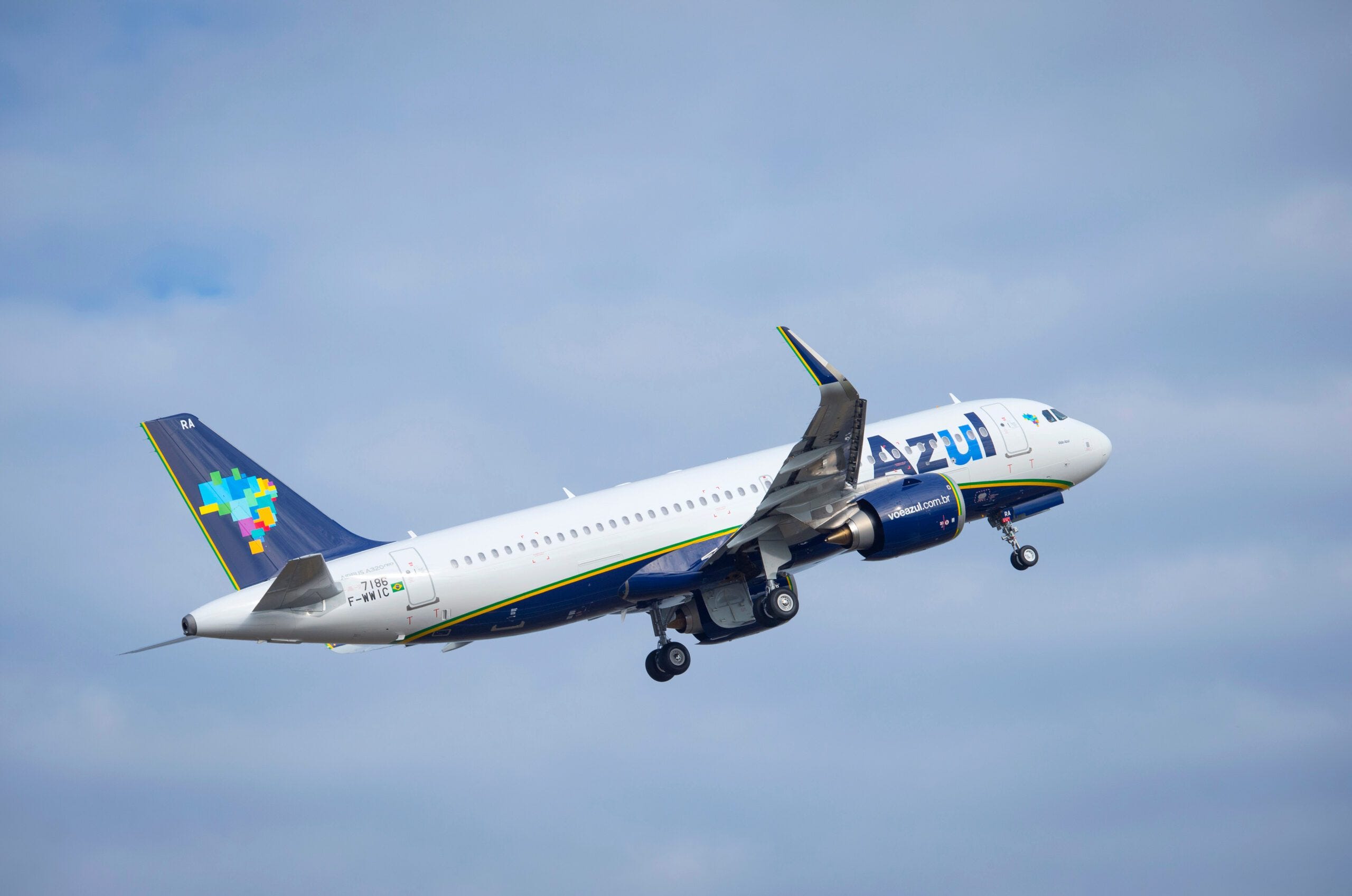
- Airbus A320neo family   (high-density domestic)
- Airbus A321neo          (domestic trunk routes)

Cargo:
- Airbus A321P2F          (dedicated freighter)

Widebody/Long-Haul:
- Airbus A330-200         5 aircraft
- Airbus A330-900neo      5 aircraft
- Boeing 767-300ER        2 aircraft
- Boeing 777-200ER        1 aircraft

Average Fleet Age: ~8 years (youngest among Brazil's Big Three)
Next-Gen Aircraft Share: ~80%Fleet Age and Modernization
Azul operates the youngest fleet in Brazil at an average age of approximately 8 years. This compares favorably to GOL at roughly 10.8 years and LATAM at approximately 12.3 years.
By the end of 2024, Azul had taken delivery of 20 new aircraft, including 11 Embraer E195-E2s. The airline reports that approximately 80% of its fleet consists of next-generation aircraft, a figure that continues to rise with each E2 delivery.
The Embraer E195-E2: Azul’s Core Growth Aircraft
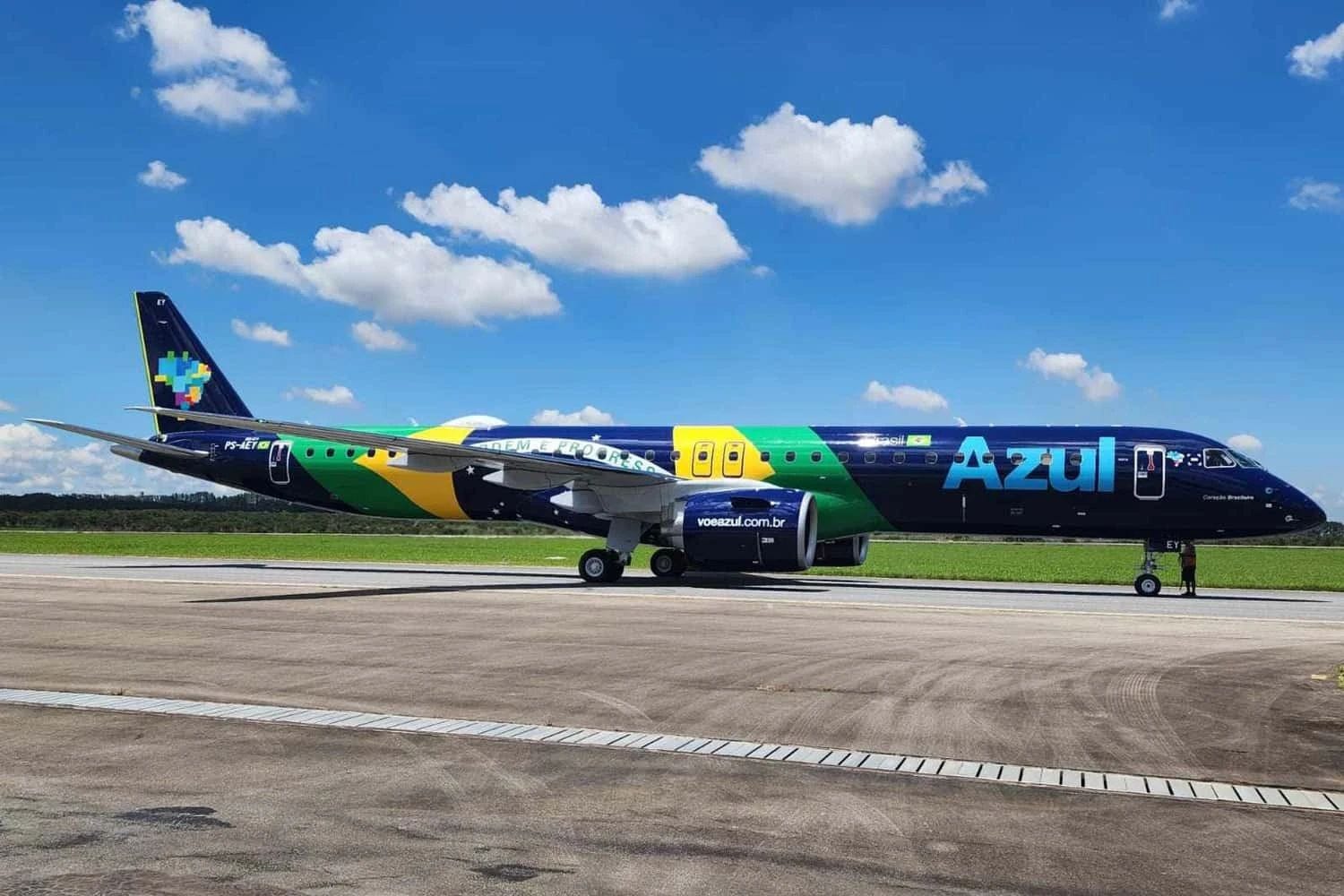
Azul CEO John Rodgerson has called the E195-E2 “the most important aircraft in the carrier’s future fleet.” The reasoning is straightforward: compared to the first-generation E195 (E1), the E2 offers 18 additional seats and about 20% less fuel burn.
In March 2026, Azul received its 42nd E195-E2, the first delivery of the type in 2026. The aircraft offers a capacity of up to 136 passengers and a 26% reduction in cost per seat kilometer (CASK) versus its predecessor, along with up to 29% lower CO2 emissions.
The improved economics of the E2 are unlocking routes that were previously unprofitable with older-generation regional jets. At the Routes Americas 2026 conference, Rodgerson highlighted a new Confins to Montevideo route as “a perfect E2 route” and noted that the aircraft enables point-to-point operations that bypass traditional hub connections.
Investor appetite for financing the E2 has surged post-restructuring. According to Rodgerson, the airline went from five financing offers in Q4 2025 to 27 offers in January 2026 alone.
Embraer E195-E2 Key Specs for Azul:
- Capacity:                   Up to 136 passengers
- CASK Reduction vs E1:       ~26%
- Fuel Burn Reduction:        ~20% less than E1
- Additional Seats vs E1:     +18
- CO2 Emissions Reduction:    Up to 29%
- In Service (March 2026):    42 aircraft
- On Firm Order:              25 aircraft (reduced from 51 in Dec 2025)
- Amenities:                  Onboard Wi-Fi, individual screens at every seat
Why Azul Dropped the Airbus A321XLR
Azul had a previously undisclosed obligation to acquire the Airbus A321XLR, an extra-long-range narrowbody that would have been suited for thinner transatlantic routes. However, the carrier has officially removed the A321XLR from its fleet plans.
CEO Rodgerson explained the decision at Routes Americas 2026: “When we looked at it, we were seeing prices that were bumping up against a widebody.” At near-widebody pricing, the A321XLR’s value proposition eroded against the A330neo, which offers greater capacity and range.
The removal aligns with Azul’s broader fleet simplification push during restructuring. The airline is now pursuing a clear three-tier fleet architecture: ATR turboprops for thin regional routes, Embraer E2s and A320neo family for domestic/medium-haul, and A330neo for intercontinental.
Widebody Fleet Strategy: All-In on the A330neo
With the A321XLR dropped and the A350-900 retired in early 2024, Azul’s long-haul operations will rely exclusively on the A330 family. The current widebody inventory includes five A330-200s, five A330-900neos, two Boeing 767-300ERs, and one Boeing 777-200ER.
The A330-900neo is the designated long-term widebody. Azul became the first airline in South America to operate the type in 2019, and the company has signed for three additional A330neos for future delivery. These aircraft will handle trunk routes to the U.S. and Europe.
The Boeing 767-300ERs and 777-200ER are legacy widebodies that are expected to phase out as A330neo deliveries increase. This simplification will reduce maintenance complexity and training costs across the long-haul fleet.

Fleet Strategy Summary (Post-Restructuring):
- Short-Haul/Regional:   ATR 72-600 turboprops
- Domestic/Medium:        Embraer E195-E2 (growth priority), A320neo family
- Long-Haul:              A330-900neo (standardized widebody)
- Cargo:                  A321P2F freighter
- DROPPED:                A321XLR
- RETIRED:                A350-900 (early 2024)
- Focus: Simplification, standardization, cost reductionMarket-Maturity Fleet Progression Model
Azul employs a distinctive approach to fleet deployment that is relatively unique among major carriers. Rather than assigning aircraft types statically, the airline uses a market-maturity model where aircraft are upsized as demand grows.
As Rodgerson explained: “We’ve started with a Cessna Caravan, moved it to an ATR, then to an E-Jet and then to an A320.” This progression lets Azul incubate new routes with minimal risk using smaller aircraft, then graduate markets to larger equipment as they prove viable.
This strategy is particularly effective in Brazil, where many mid-sized cities have no air service alternatives. Azul can start with an ATR in an unserved market, build demand, and eventually introduce a larger jet, all while competitors cannot economically justify entering with their larger narrowbodies.