


Dear Readers, Welcome to AviationOutlook.
Let’s analyze the topic in detail.
Executive Summary
Capital Airlines (also known as Beijing Capital Airlines) is a Hainan Airlines Group subsidiary operating an all-Airbus fleet of approximately 82 to 83 aircraft, headquartered at Beijing Daxing International Airport, where it moved its hub operations after Daxing opened in 2019.
The carrier serves around 75 destinations through a hybrid low-cost and full-service model, with a domestic backbone of roughly 197 routes and a much smaller but strategically important international portfolio of about 19 routes across 10 countries, including a new Beijing-Lisbon route launching June 22, 2026.
Parent Hainan Airlines Holding returned to profitability in 2025 with revenue of RMB 68.47 billion and net profit of RMB 1.98 billion, providing a stabilized financial base for Capital Airlines as it expands into Sri Lanka, Portugal, and other long-haul markets.
The airline faces structural pressure from China’s aviation overcapacity, a relatively aged fleet averaging around 12 years, and intense competition from Spring Airlines, China Eastern, and Hainan Airlines itself, but benefits from China’s expanded visa-free regime covering more than 50 countries.
Recommended - Read Full Reports


Read All Reports
Table of Contents
Executive Summary
Introduction
Beijing Capital Airlines Company Profile: Key Facts
Corporate Ownership and Restructuring History
Brand Positioning
Beijing Capital Airlines Revenue and Financial Analysis
The Reporting Framework
Latest Hainan Airlines Holding Group Financial Performance
Revenue Growth Drivers
Key Services and Products
Pricing and Revenue Management
Beijing Capital Airlines Fleet Analysis
Fleet Size and Composition
Fleet Age and Renewal Considerations
Aircraft Configurations and Cabin Strategy
Cargo Fleet Strategy
Engine Strategy
Beijing Capital Airlines Route Network Strategy and Major Destinations
Overall Network Structure
Domestic Network Strategy
International Network Strategy
New Route Launches for 2026
Codeshare and Interline Strategy
Network Optimization Considerations
Major Operational Bases (Hubs)
Primary Hub: Beijing Daxing International Airport (PKX)
Secondary Hub: Hangzhou Xiaoshan International Airport (HGH)
Focus City: Qingdao Jiaodong International Airport (TAO)
Overnight Operational Bases
Beijing Capital Airlines Competitive Position
Major Competitors
Capital Airlines vs Spring Airlines
Capital Airlines vs Hainan Airlines (Parent)
Capital Airlines vs Air China
Capital Airlines vs Juneyao Airlines
Capital Airlines vs Tianjin Airlines
Capital Airlines vs China Eastern and China Southern
Competitive Positioning Summary
Beijing Capital Airlines Operational and Service Differentiation
Cabin Experience
Ancillary Revenue Strategy
Safety Record
Brand and Marketing
Beijing Capital Airlines Within the Broader Hainan Airlines Group
Group Structure Overview
Group Synergies for Capital Airlines
Group Financial Recovery Dynamics
Strategic Outlook for 2026 and Beyond
International Expansion Pipeline
Fleet Strategy Considerations
Daxing Hub Maturation
Visa Policy Tailwinds
Key Risks
Risk 1
Risk 2
Risk 3
Risk 4
Risk 5
Risk 6
Risk 7
Risk 8
Risk 9
Risk 10
Industry Context: Chinese Aviation in 2026
Macro Recovery Pattern
Beijing Two-Airport System Maturation
Airbus vs Boeing Competitive Dynamics
My Final Thoughts
Official Sources & Data
Introduction
Beijing Capital Airlines occupies a peculiar position in Chinese aviation.
It is officially classified as a low-cost carrier, yet it operates widebody Airbus A330s with full business class cabins on routes to Lisbon, Moscow, and across Southeast Asia.
This dual identity makes it a useful case study for how Chinese airlines are blending hybrid models, leveraging parent group networks, and adapting their fleet strategies in a post-pandemic recovery period that has favored international growth over domestic capacity.
The carrier also sits at the intersection of two of the most consequential developments in Chinese aviation: the maturation of Beijing Daxing International Airport as a second mega hub for the capital, and the slow, painful restructuring of the former HNA Group that gave Capital Airlines its corporate parentage in the first place.
Understanding Capital Airlines means understanding the broader Hainan Airlines Holding ecosystem and how Beijing’s twin-airport system is reshaping carrier strategy.

Beijing Capital Airlines Company Profile: Key Facts
Beijing Capital Airlines, branded externally as Capital Airlines, was officially established on 2 May 2010. The carrier traces its corporate lineage back to 1995, when its predecessor, Deer Jet Airlines (Jinlu Hangkong) began operations as a business aviation provider.
In 2010, Deer Jet was split into two entities. The corporate jet and charter operation kept the Deer Jet name, while the scheduled passenger operation was rebranded as Beijing Capital Airlines and equipped with an all-Airbus fleet starting with A319s and later A320 family aircraft.
The carrier’s legal headquarters is in Beijing, with operational bases distributed across multiple Chinese provinces. The airline holds an IATA designator of JD and ICAO code CBJ, with the registered company capital reported at RMB 2.315 billion.
- Legal name: Beijing Capital Airlines Co., Ltd.
- Chinese name: 首都航空 (Shoudu Hangkong)
- Operating classification: Low-cost / hybrid carrier
- Main hub: Beijing Daxing International Airport (PKX/ZBAD)
- Secondary hub: Hangzhou Xiaoshan International Airport (HGH)
- Focus city: Qingdao Jiaodong International Airport (TAO)
- Frequent flyer program: Fortune Wings Club (shared with Hainan group)
- Fleet size: 82 to 83 aircraft (all Airbus)
- Destinations: approximately 75
- Average fleet age: roughly 12 years
- Parent company: Hainan Airlines / HNA Aviation
Corporate Ownership and Restructuring History
The ownership picture for Capital Airlines is unusually complex even by Chinese aviation standards.
Originally, the carrier was majority owned by HNA Group through HNA Aviation. After HNA Group’s well-documented liquidity crisis and subsequent restructuring, ownership was reorganized.
A Beijing state-owned enterprise acquired shares from the cash-strapped HNA Group, and in the second phase of the restructuring, Hainan Airlines took on operational control of Capital Airlines along with several other former HNA carriers. The current arrangement places Capital Airlines firmly within the Hainan Airlines Group ecosystem.
This restructuring matters operationally because it consolidated Capital Airlines into a larger group of Chinese carriers, including Hainan Airlines, Tianjin Airlines, West Air, Lucky Air, Grand China Air, and several smaller operators.
The Fortune Wings Club frequent flyer program is shared across all of these airlines.
Brand Positioning
Capital Airlines markets itself as a low-cost carrier, but the operational reality is more nuanced. Its narrowbody fleet operates with high-density single-class configurations consistent with budget operations, but its widebody A330s feature dedicated business class cabins of 18 to 36 seats, which is inconsistent with pure low-cost economics.
The carrier therefore operates what aviation analysts often call a hybrid model, combining low-fare domestic flying with higher-yield long-haul international services.
This positioning gives Capital Airlines flexibility but also creates strategic ambiguity that complicates its competitive identity.
Beijing Capital Airlines Revenue and Financial Analysis
The Reporting Framework
Beijing Capital Airlines is not a separately listed public company. Its financial performance is consolidated within its parent, Hainan Airlines Holding Co., Ltd., which is publicly traded on the Shanghai Stock Exchange under ticker 600221.
This means standalone revenue disclosure for Capital Airlines is limited, and the most reliable financial visibility comes through Hainan Airlines Holding’s consolidated reporting.
Capital Airlines does file Civil Aviation Administration of China (CAAC) operational data, but detailed segment financials are typically not broken out.
Latest Hainan Airlines Holding Group Financial Performance
Hainan Airlines Holding, the listed parent that consolidates Capital Airlines, reported a return to profitability in 2025 after a difficult prior year.
Revenue grew 4.96% year over year to RMB 68.47 billion, while net profit attributable to shareholders reached RMB 1.98 billion, reversing a net loss of approximately RMB 921 million reported in the prior year.
HAINAN AIRLINES HOLDING - 2025 FULL YEAR HIGHLIGHTS
- Total operating revenue: RMB 68.47 billion (+5.0% YoY)
- Total operating costs: RMB 63.21 billion
- Net profit attributable to shareholders: RMB 1.98 billion
- Comparison vs 2024 net loss of RMB 921 million
- Source: Shanghai Stock Exchange disclosure (600221)
The first half of 2025 saw revenue of RMB 33.08 billion, up 4.22% year over year, with net profit attributable to shareholders of approximately RMB 56.95 million. The narrow H1 profit indicates that profitability was concentrated in the second half of the year, consistent with Chinese aviation’s seasonal pattern of stronger Q3 results.
For Q1 2026, Hainan Airlines Holding reported net profit growth of 533.6% year over year, a dramatic improvement driven by the gradual normalization of international flying and stronger yield management following capacity discipline.
Revenue Growth Drivers
Several drivers are shaping the group’s revenue trajectory in 2025 and 2026, and these flow directly into Capital Airlines’ financial picture.
International capacity recovery has been the dominant theme. China’s international air traffic grew more than 20% in the first half of 2025, creating pricing power on routes where Capital Airlines competes. The carrier’s widebody utilization on routes such as Hangzhou-Madrid, Beijing-Moscow, and the upcoming Beijing-Lisbon and Beijing-Colombo services benefits directly from this recovery.
Visa policy is another significant lever. China expanded visa-free entry to more than 50 countries, with visa-free entries growing nearly 50% year over year. This has stimulated inbound tourism that benefits Chinese carriers with international flying, including Capital Airlines.
HAINAN AIRLINES HOLDING - Q1 2026 SNAPSHOT
- Total assets at Q1 2026 end: RMB 150.17 billion
- Change vs year-end 2025: -1.39%
- Shareholders' equity (attributable): +32.09% from year-end 2025
- Net profit growth: +533.6% YoY
- Source: 600221 quarterly disclosures
Key Services and Products
Capital Airlines’ service portfolio breaks down into three main commercial categories.
Domestic scheduled passenger flying constitutes the bulk of the operation. The airline operates roughly 144 active routes, with 129 of these being domestic routes within mainland China, Hong Kong, Macau, and Taiwan. These flights are operated primarily with A319, A320, A320neo, A321, and A321neo aircraft in high-density configurations.
International scheduled passenger flying is smaller in count but operationally significant. The international portfolio includes services to Southeast Asia (Thailand, Sri Lanka), Northeast Asia (Japan, Russia), Europe (Portugal, Spain), and previously North America and Oceania. These are operated with A330-200 and A330-300 widebodies featuring two-cabin layouts.
Cargo and freighter operations form the third category.
Capital Airlines operates Airbus A330-200P2F and A330-300P2F converted freighters, with the carrier having received China’s eighth A330-200P2F. The freighter fleet supports the broader Hainan group cargo network and provides revenue diversification beyond passenger operations.
Pricing and Revenue Management
Capital Airlines uses Accelya’s BIDT audit platform for agency revenue management and recovery, helping the airline optimize agency performance and recover lost revenue from booking abuse. This is a relatively technical area but speaks to the carrier’s continued investment in commercial systems integration.
The carrier’s revenue management strategy aligns with the broader Hainan Airlines Group approach, leveraging the Fortune Wings Club program to drive ancillary revenue and retain higher-frequency travelers within the Chinese market.
Beijing Capital Airlines Fleet Analysis
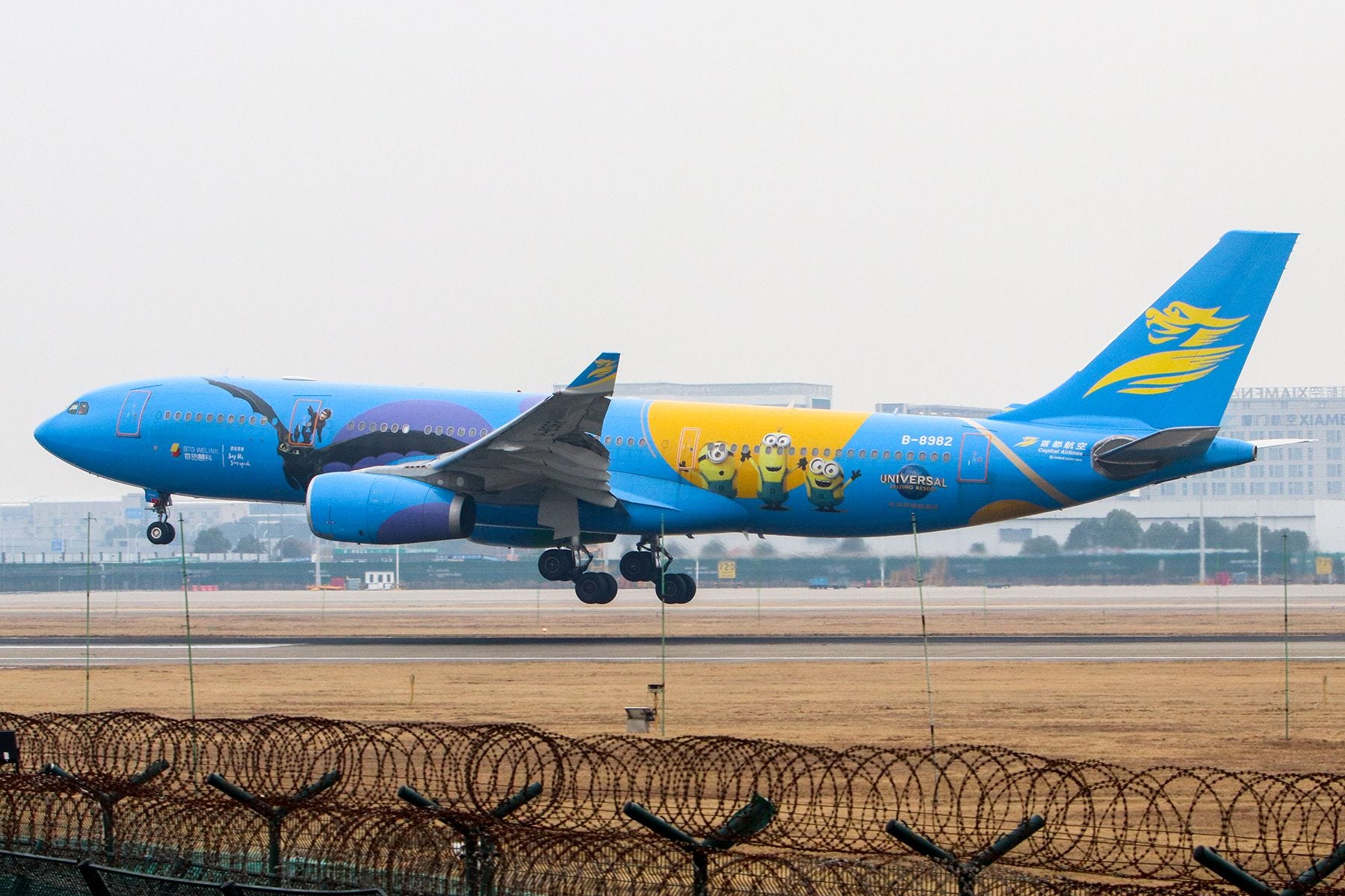
Fleet Size and Composition
Capital Airlines operates one of the largest all-Airbus fleets in China, with 83 aircraft in service as of mid-2025.
This makes it one of the most significant Airbus operators in the Asia-Pacific region, and is occasionally cited as one of the biggest dedicated Airbus operators globally.

Every aircraft in the active fleet is built by Airbus. The carrier never operated significant Boeing or other manufacturer types after its early Boeing 737 fleet was retired in favor of A319s starting in October 2007.

According to fleet records, the composition break down as follows.
BEIJING CAPITAL AIRLINES FLEET
- Airbus A319-100:        10 aircraft (138 seats, all-economy)
- Airbus A320-200:        34 aircraft (174 seats, all-economy)
- Airbus A320neo:          7 aircraft (180 seats, all-economy)
- Airbus A321-200:        15 aircraft (212 seats, all-economy)
- Airbus A321neo:          3 aircraft (234 seats, all-economy)
- Airbus A330-200:         6 aircraft (36J + 186Y = 222 seats)
- Airbus A330-300:         5 aircraft (18J + 288Y = 306 seats)
- Airbus A330-200P2F:      1 aircraft (cargo)
- Airbus A330-300P2F:      1 aircraft (cargo)
- TOTAL:                   82 aircraft
Data shows the fleet at 83 aircraft with an average age of approximately 12 years, suggesting that the fleet has aged steadily without an aggressive recent renewal program.
Fleet Age and Renewal Considerations
A 12-year average fleet age places Capital Airlines in the older half of Chinese mainline carriers. By comparison, leading Chinese flag carriers such as Air China and China Eastern operate fleets averaging around 8 to 10 years.
This relative aging matters for several reasons. Maintenance costs typically rise as aircraft age beyond their first heavy check cycles. Older aircraft also tend to be less fuel efficient than the latest-generation neo and Boeing 787 families, putting pressure on unit costs in a market where fuel remains a major input.
Capital Airlines has been gradually adding A320neo and A321neo aircraft, with 7 A320neos and 3 A321neos in the active fleet. These represent the modernization track for the narrowbody segment, but at small numbers relative to the overall A320ceo and A321ceo population.
For widebodies, the airline operates only A330ceo variants. The A330-200 in particular is a less common configuration in modern airline fleets, and the carrier’s widebody renewal pathway is not publicly defined as of mid-2026. There is no public order book disclosed for new A330neo, 787, or A350 aircraft to Capital Airlines as a standalone customer.
Aircraft Configurations and Cabin Strategy
The narrowbody configurations are aggressive in their density. The A319 seats 138 in an all-economy layout, the A320-200 seats 174, and the A321-200 seats 212. These are high-density layouts that maximize unit revenue on short and medium-haul domestic routes.
NARROWBODY CABIN STRATEGY
- A319-100: 138Y (all-economy)
- A320-200: 174Y (all-economy)
- A320neo: 180Y (all-economy)
- A321-200: 212Y (all-economy)
- A321neo: 234Y (all-economy)
- Observation: No business class on any narrowbody, consistent with LCC positioning
The widebody configurations are more conservative and reflect the hybrid LCC approach. The A330-200 carries 36 business seats and 186 economy seats for a total of 222, while the A330-300 carries 18 business seats and 288 economy seats for a total of 306. Both configurations are designed for long-haul international flying where premium revenue contributes meaningfully.
The differential between the A330-200 (16% business by seat count) and A330-300 (6% business by seat count) suggests deliberate fleet routing where the smaller widebody is positioned on routes with stronger premium demand, while the larger A330-300 is deployed on price-sensitive leisure or VFR routes.
Cargo Fleet Strategy
Capital Airlines has built a modest but strategically meaningful cargo capability with its A330P2F conversions. The carrier was the eighth Chinese operator to take an A330-200P2F converted freighter, demonstrating the trend among Chinese carriers to repurpose existing widebodies for dedicated freight roles.
This strategy makes sense given the relatively young secondary market for A330ceo passenger aircraft, which has produced affordable feedstock for P2F conversion programs led by EFW and ST Engineering.
The A330-200P2F offers approximately 60 tonnes of payload and is well suited to intra-Asia and select intercontinental cargo routes.
Engine Strategy
The widebody A330 fleet operates with Rolls-Royce Trent 700 engines based on the listed variants.
The narrowbody fleet operates a mix of CFM56 and IAE V2500 engines on the A320ceo aircraft, with CFM LEAP-1A on the A320neo and A321neo aircraft.

This engine diversity is typical for an airline that has grown its fleet incrementally over more than a decade, accepting different engine selections from leasing companies. It creates some maintenance complexity but is manageable given the operator’s scale.