


Executive Summary
China Eastern Airlines generated RMB 139.94 billion in revenue for fiscal year 2025, a 5.92% increase year-on-year, while narrowing its net loss by 61.36% to RMB 1.633 billion.
The airline operates 823 passenger aircraft for the 2026 summer/autumn season, including 14 domestically produced C919 jetliners, and flies over 3,200 daily flights across 950+ routes.
A landmark $15.8 billion Airbus order for 101 A320neo-family aircraft, announced in March 2026, signals aggressive fleet renewal through 2032, including China’s first A321XLR commitment.
Rising jet fuel costs from the Iran conflict, domestic fare pressure from oversupply, and ongoing high-speed rail competition represent the airline’s most pressing challenges heading into the remainder of 2026.
Recommended - Read Full Reports


Read All Reports
Table of Contents
Executive Summary
Introduction
Key Facts: Company Profile
Business Overview
Financial Performance: A Recovery Still in Progress
Revenue Growth Drivers
Cargo and Logistics Operations
Key Services and Digital Transformation
China Eastern Airlines Fleet: In-depth Analysis
Fleet Size and Composition
Detailed Aircraft Type Breakdown
The COMAC C919: China Eastern as Global Launch Customer
Fleet Strategy: The $15.8 Billion Airbus Order
Wide-Body Fleet and Long-Haul Strategy
Route Network, Major Destinations, and Strategy
Network Scale and Scope
International Expansion Strategy for 2026
European Network Expansion
Feasibility Studies for Future Routes
The “Southern Corridor” and Belt and Road
Major Operational Bases (Hubs)
Shanghai: The Core Dual-Hub System
Beijing: The Northern Gateway
Xi’an: The Emerging Europe Gateway
Kunming: The South and Southeast Asia Hub
Other Secondary Hubs
Competitive Position
China’s “Big Three” Airlines: A Structural Overview
Market Share Trends
China Eastern vs. Air China
China Eastern vs. China Southern Airlines
Competition from Smaller Carriers and High-Speed Rail
Subsidiary Operations and Corporate Structure
Shanghai Airlines
China United Airlines
OTT Airlines Integration
Partnerships and Alliances
SkyTeam Alliance Membership
Delta Air Lines Partnership
Air France-KLM Equity Stake
Sustainability and Green Aviation
Key Risks
1. Fuel Cost Escalation from the Iran Conflict
2. Domestic Market Oversupply and Fare Pressure
3. High-Speed Rail Competition
4. Geopolitical Risks
5. COMAC C919 Delivery and Operational Risks
6. Cost Inflation
Corporate Governance and Ownership Structure
Brand and Awards
Passenger Experience and Cabin Products
The Road Ahead: 2026 and Beyond
Short-Term Outlook (2026)
Medium-Term Outlook (2027-2030)
Long-Term Strategic Direction
Official Sources and Data
My Final Thoughts
Introduction
China Eastern Airlines carried 150 million passengers in 2025, served 93 overseas destinations across 40 countries, and placed an order worth $15.8 billion with Airbus in a single transaction.
Yet it still posted a net loss for the second consecutive year, even as it reversed pre-tax results into profit. That tension between aggressive expansion and elusive bottom-line profitability defines the airline’s story heading into 2026.
This report breaks down every dimension of China Eastern’s operations, from its fleet composition and C919 launch customer role, to its multi-hub network strategy and the financial pressures shaping its competitive posture among China’s Big Three carriers.
Key Facts: Company Profile
Company Name:         China Eastern Airlines Corporation Limited
Stock Listings:       Shanghai Stock Exchange (600115), Hong Kong Stock Exchange (0670)
Headquarters:         Changning District, Shanghai, China
Founded:              June 25, 1988
Parent Group:         China Eastern Air Holding Company (state-owned)
Alliance:             SkyTeam (member since 2011)
CEO/Chairman:         Wang Zhiqing (Party Secretary and Chairman)
Fleet Size (2026):    823 passenger aircraft (summer/autumn season)
Fleet Age (2024):     Average 9.2 years
Passengers (2025):    150 million
Revenue (2025):       RMB 139.94 billion (~USD 20.2 billion)
Net Loss (2025):      RMB 1.633 billion
Primary Hubs:         Shanghai Pudong (PVG), Shanghai Hongqiao (SHA)
Secondary Hubs:       Beijing Daxing, Xi'an, Kunming, Chengdu Tianfu
Destinations:         1,000+ via SkyTeam network in 160 countries/regions
Key Subsidiaries:     Shanghai Airlines, China United Airlines, China Cargo Airlines
Website: ceair.comBusiness Overview
Financial Performance: A Recovery Still in Progress
China Eastern’s financial trajectory over the past two years tells a story of recovery that has not yet crossed the finish line. In 2024, the airline generated RMB 132.12 billion in revenue, a 16.11% jump year-on-year, while carrying 141 million passengers, an increase of 21.58%.
Despite those strong top-line gains, the airline recorded a net loss of RMB 4.226 billion in 2024. That loss, however, was significantly smaller than the previous year, declining by RMB 3.964 billion.
FINANCIAL SNAPSHOT: 2024 vs. 2025

                        2024                2025
Revenue:                RMB 132.12B         RMB 139.94B
YoY Growth:             +16.11%             +5.92%
Net Loss (to shareholders): RMB -4.226B     RMB -1.633B
Passengers Carried:     141 million         150 million
Total Transport Turnover: 25.25B ton-km     27.98B ton-km
Flights Operated:       N/A                 1.05 million
For fiscal year 2025, revenue climbed to RMB 139.94 billion, a 5.92% increase. The net loss attributable to shareholders narrowed dramatically to RMB 1.633 billion, a reduction of 61.36% year-on-year.
Pre-tax profit reached RMB 2.74 billion, marking the first time the airline reversed into pre-tax profitability.
However, total operating expenses of RMB 143.53 billion exceeded total revenue, with rising staff costs, depreciation, and airport charges driving cost inflation.
Revenue Growth Drivers
The airline’s top-line growth comes from multiple channels working in parallel. Passenger transport remains the core revenue stream, powered by domestic volume recovery and international route expansion.
International operations were a standout performer in 2025. China Eastern’s international capacity recovered to 112.9%of pre-pandemic 2019 levels. International passenger traffic reached 117.5% of 2019 figures, with an international load factor of 83.2%, a 3.2 percentage point improvement over pre-pandemic performance.
The airline launched 24 new international routes in 2025, bringing its total international and regional routes to 249, covering 40 countries and 93 overseas destinations. That figure makes it the Chinese carrier with the most international destinations.
INTERNATIONAL PERFORMANCE HIGHLIGHTS (2025)

- International capacity: 112.9% of 2019 levels
- International RPK: 117.5% of 2019 levels
- International load factor: 83.2% (+3.2pp vs. pre-pandemic)
- International passenger traffic growth: +22.7% YoY
- New international routes launched: 24
- Total international/regional routes: 249
- Countries served: 40
- Overseas destinations: 93
Cargo and Logistics Operations
Cargo represents a meaningful but secondary revenue stream. The airline’s bellyhold cargo operations generated RMB 5.457 billion in revenue in 2025, an increase of 2.36% year-on-year.
China Eastern Logistics, the airline’s listed logistics subsidiary, reported RMB 24.2 billion in total revenue for 2025, up 0.8% year-on-year. Net profit attributable to the parent company reached RMB 2.69 billion, roughly flat from the prior year.
The logistics arm operates through China Cargo Airlines, which expanded its freighter fleet to 18 aircraft by the end of 2025 after adding four Boeing 777F freighters during the year. Full-cargo aircraft capacity rose 16% year-on-year, while bellyhold capacity on passenger aircraft grew 8%.
Key Services and Digital Transformation
China Eastern has invested heavily in digital capabilities. Smart cabin control now covers 60% of domestic flights, using automated pricing and capacity adjustment systems.
The airline’s “Aviation+” strategy extends its reach beyond traditional air transport. Innovative products like “China PASS” and “Shanghai PASS” were launched as part of the Civil Aviation Service Consumption Boost Year campaign.
Multimodal transport services, including air-rail, air-bus, and air-water connections, served over 2.65 million intermodal passengers in 2025, placing the carrier among industry leaders in multi-modal integration.
DIGITAL AND SERVICE INITIATIVES

- Smart cabin control: covers 60% of domestic flights
- Automated pricing systems: deployed across network
- "Air Express" premium routes: 47 domestic + 4 international
- Multimodal passengers served: 2.65 million annually
- In-flight Wi-Fi: expanding to all wide-body classes on Oceania routes
- "Eastern Miles" loyalty program: integrated across SkyTeam
The Eastern Miles loyalty program operates across the SkyTeam alliance network, giving members access to over 750 VIP airport lounges worldwide.
The program underwent one of the largest loyalty system migrations in airline history when Shanghai Airlines’ frequent flyer program was integrated into Eastern Miles.
China Eastern Airlines Fleet: In-depth Analysis
Fleet Size and Composition
China Eastern boasts one of the largest and youngest fleets among Asian carriers. As of December 31, 2024, the airline operated 804 passenger aircraft with an average fleet age of just 9.2 years. For the 2026 summer/autumn season beginning March 29, that number has grown to 823 passenger aircraft.
The fleet divides into three main categories. Wide-body aircraft numbered 108 units at end-2024 with an average age of 8.6 years. Narrow-body aircraft totaled 672 units with an average age of 9.5 years. Regional aircraft accounted for 24 units with an average age of just 2.2 years.
FLEET STRUCTURE (End of 2024)

Category              Aircraft Count     Average Age
Wide-body             108                8.6 years
Narrow-body           672                9.5 years
Regional              24                 2.2 years
TOTAL                 804                9.2 years
Detailed Aircraft Type Breakdown
The mainline China Eastern fleet (as of late 2025) is composed of aircraft from three manufacturers: Airbus, Boeing, and COMAC. Airbus dominates the narrow-body segment, while the wide-body fleet features both Airbus and Boeing types.
NARROW-BODY FLEET

Airbus A319-100:          32 aircraft
Airbus A320-200:         140 aircraft
Airbus A320neo:          121 aircraft
Airbus A321-200:          74 aircraft
Airbus A321neo:           25 aircraft
Boeing 737-700:           36 aircraft
Boeing 737-800:          100 aircraft
Boeing 737 MAX 8:          5 aircraft

WIDE-BODY FLEET

Airbus A330-200:          30 aircraft
Airbus A330-300:          26 aircraft
Airbus A350-900:          20 aircraft
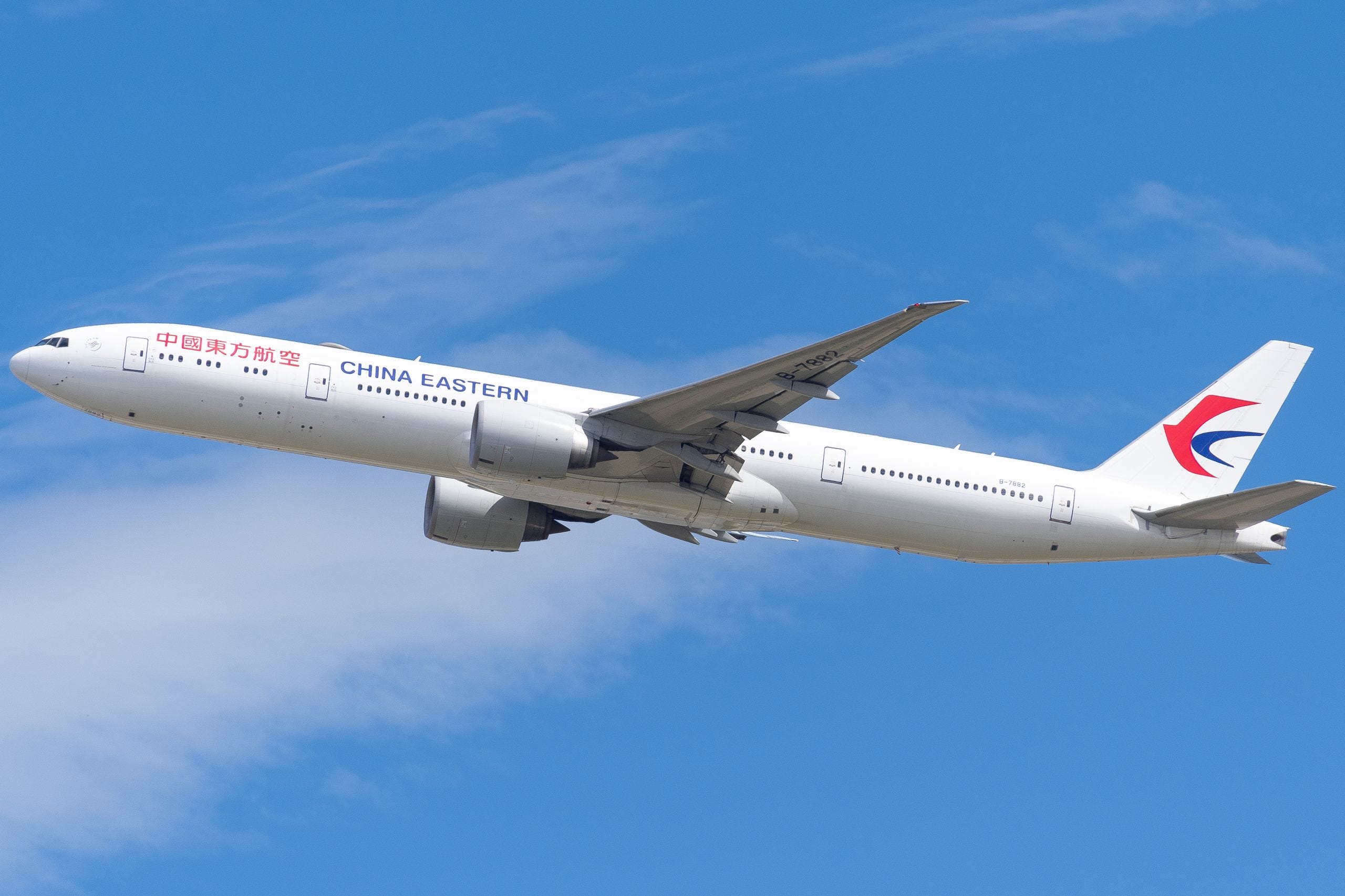
Boeing 777-300ER:         20 aircraft
Boeing 787-9:              5 aircraft

DOMESTIC AIRCRAFT

COMAC C909 (ARJ21):       28 aircraft
COMAC C919-100STD:        11 aircraft
The Airbus A320 family (including the A319, A320, A321, and their neo variants) forms the backbone of the fleet, accounting for well over half of all aircraft. The wide-body fleet is split between the older A330 series, the newer A350-900 for long-haul premium routes, and Boeing’s 777-300ER and 787-9 for trans-Pacific and other intercontinental services.

The COMAC C919: China Eastern as Global Launch Customer
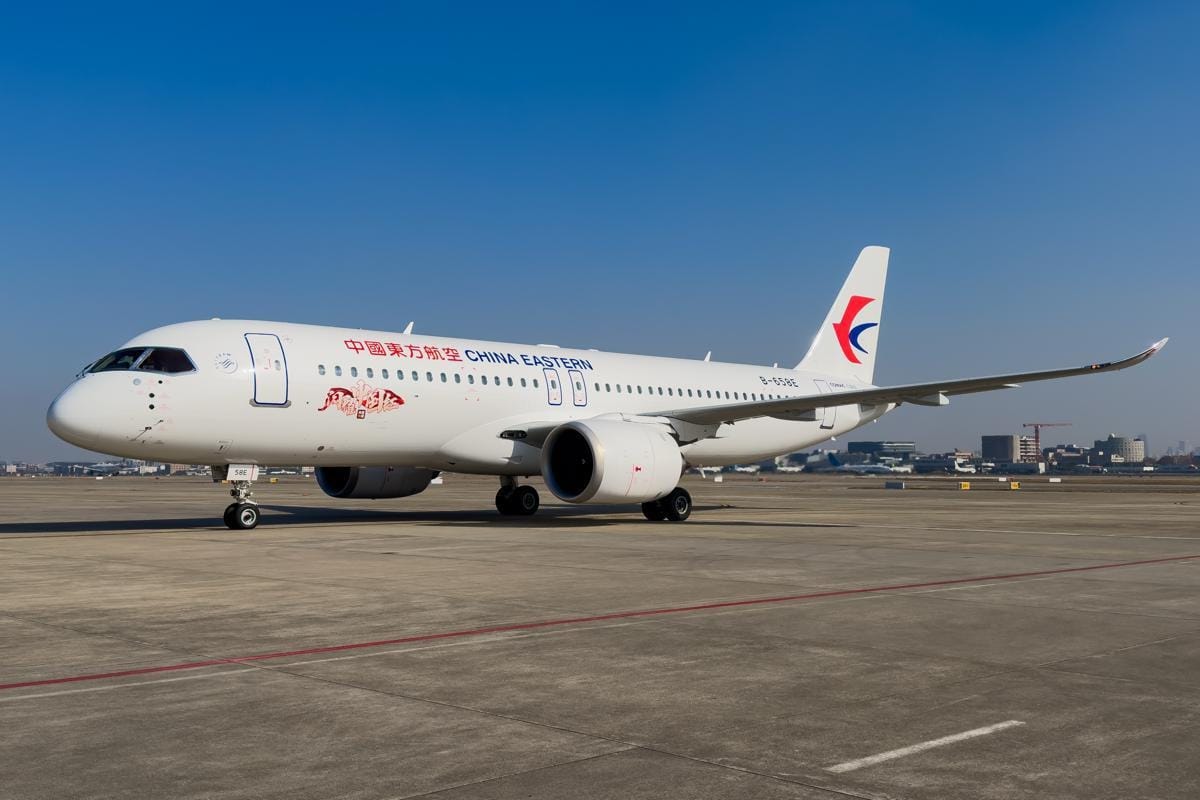
Perhaps the most closely watched element of China Eastern’s fleet is its role as the global launch customer for the COMAC C919. The domestically produced narrow-body entered commercial service with China Eastern on May 28, 2023, operating the Shanghai Hongqiao to Beijing Daxing route.
By the end of 2025, COMAC had delivered a total of 32 C919 aircraft to Chinese carriers. China Eastern received approximately 11 of those aircraft, making it the operator of the world’s largest C919 fleet. Air China operates between three and five units of the extended-range variant, while China Southern flies approximately four to six standard models.
C919 FLEET STATUS (China Eastern, as of early 2026)

Aircraft in fleet:                      ~14 (for 2026 summer season)
Total C919 routes (2026 season):        19
Airports served by C919:                16
Order backlog:                          100 aircraft (placed Sep 2023)
Delivery timeline:                      2024 through 2031
Expected 2026 deliveries:              10 aircraft
For the 2026 summer/autumn season, China Eastern will operate 14 C919 jetliners serving 19 routes across 16 airports. The C919 network expansion has progressed from trial operation to what the airline describes as large-scale operation.
In September 2023, China Eastern placed an order for 100 additional C919s, with deliveries scheduled between 2024 and 2031. All three of China’s Big Three carriers collectively expect 33 C919 deliveries in 2026, a significant increase from the 15 aircraft they received in 2025. China Eastern specifically expects 10 deliveries.
However, production ramp-up challenges persist. COMAC’s original target of 75 deliveries for 2025 was missed by a wide margin, with only approximately 16 aircraft actually delivered.
A five-week suspension of U.S. engine exports (the CFM International LEAP-1C powers the C919) in mid-2025 exposed deep supply-chain vulnerabilities.
Fleet Strategy: The $15.8 Billion Airbus Order
On March 25, 2026, China Eastern signed a blockbuster agreement with Airbus for 101 A320neo-family aircraft at a list price of approximately $15.8 billion. The deal, filed with the Shanghai Stock Exchange, covers deliveries in batches from 2028 to 2032.
This order includes three aircraft variants: the A320neo, A321neo, and, notably, the A321XLR. This marks the first commitment for the A321XLR among China’s three state-owned carriers. The A321XLR offers extended range capability, enabling narrow-body operations on routes previously requiring wide-body equipment.
The order follows a previous deal signed in 2022 for 100 A320neo jets, planned for delivery between 2024 and 2027. Together, these two orders alone represent over 200 new-generation Airbus narrow-bodies entering the fleet over the next six years.
MAJOR FLEET ORDERS (Active)

Order                    Aircraft Count    Delivery Period    Value (List)
Airbus A320neo family    100               2024-2027          ~$12B (est.)
(2022 order)
Airbus A320neo family    101               2028-2032          $15.8B
(2026 order)
COMAC C919               100               2024-2031          N/A
(2023 order)
Airbus A350-900          20                Ongoing            N/A
Boeing 787-9             15                Ongoing            N/A
China Eastern stated that the new jets will “replace and update its existing fleet and expand future capacity, boosting aircraft efficiency, cutting fuel use and operating costs.”
This signals that a significant portion of the older A320ceo and Boeing 737 Classic/NG fleet will be phased out through the late 2020s and early 2030s.
Wide-Body Fleet and Long-Haul Strategy
The wide-body fleet is central to China Eastern’s international ambitions. With 20 Airbus A350-900s, 56 Airbus A330s (split between the -200 and -300 variants), 20 Boeing 777-300ERs, and 5 Boeing 787-9s, the airline commands what it describes as the largest-scale widebody fleet with leading commercial and technical models in China.
The A350-900 is the flagship long-haul type, deployed on premium routes such as Shanghai to London, Sydney, and major European destinations. China Eastern has an order for 20 A350-900s and 15 Boeing 787-9s to further expand the long-haul fleet.
New A350-900 routes for summer 2026 include a 3x-weekly Shanghai Pudong to Zurich service. The type is also operating the airline’s marquee routes to cities like Paris, Moscow, and Barcelona.