


Dear Readers, Welcome to AviationOutlook.
Let’s analyze the topic in detail.
Executive Summary
Citilink Indonesia entered 2026 with around 56 aircraft on certificate, but only about 31 were operational in late 2025 due to deferred maintenance and engine availability constraints; restoring the remainder is the airline’s top operational priority following GMF AeroAsia’s reactivation programme.
Sovereign wealth fund Danantara funnelled around Rp14.9 trillion to Citilink in the November 2025 capital exercise, equivalent to 63% of the total injection into Garuda Indonesia, with 47% earmarked for working capital and 16% for Pertamina fuel debt.
The airline carried just 2.2 million passengers in 3Q2025, a 31.3% year-on-year decline reflecting reduced capacity, yet load factor improved 0.9 points to 82.6%, signalling disciplined yield management.
A consolidated state airline holding structure is targeted for 2026, placing Citilink and Pelita Air under Garuda Indonesia as parent, which will reshape route rights, hub allocation, and group-wide booking integration.
Recommended - Read Full Reports


Read All Reports
Table of Contents
Introduction
Executive Summary
Citilink Indonesia Company Profile: Key Facts
Citilink Revenue and Financial Analysis
Revenue Profile and Group Contribution
Latest Quarterly Earnings Report and Guidance
Revenue Growth Drivers
Key Products and Services
Citilink Fleet Analysis
Fleet Size and Composition
Fleet Age and Renewal Outlook
Aircraft Types Strategy and Configuration
Fleet Strategy: Reactivation Over Expansion
Engine Strategy and Maintenance Supply Chain
Citilink Route Network Strategy and Major Destinations
Domestic Network Architecture
International Network and Regional Strategy
Slot Strategy and Route Optimisation
Major Operational Bases (Hubs)
Jakarta Soekarno-Hatta International Airport (CGK)
Surabaya Juanda International Airport (SUB)
Halim Perdanakusuma International Airport (HLP)
Other Operational Bases
Citilink Competitive Position
List of Major Competitors
Citilink vs Lion Air
Citilink vs Indonesia AirAsia
Citilink vs Super Air Jet
Citilink vs Batik Air
Citilink vs Pelita Air
Indonesian LCC Market Structure
Strategic Initiatives and Corporate Actions
Sovereign Wealth Fund Capital Injection
State Airline Holding Company
Network Rationalisation with Garuda
Distribution Expansion
Operational Performance and Service Quality
Citilink and the Indonesian Aviation Recovery
Citilink Cargo and Diversification
Loyalty and Customer Programmes
Sustainability and Operational Efficiency
Fuel Efficiency and Emissions
Operational Punctuality
Key Risks for Citilink
Risk 1
Risk 2
Risk 3
Risk 4
Risk 5
Risk 6
Risk 7
Risk 8
Risk 9
Risk 10
Strategic Outlook for 2026 and Beyond
Short-Term Priorities (Next 12 Months)
Medium-Term Strategy (2026 to 2028)
Long-Term Considerations (Post 2028)
Industry Context: Indonesia’s Aviation Trajectory
Domestic Demand Fundamentals
Regulatory Environment
Tourism Recovery and Bali Effect
My Final Thoughts
Official Sources and Data
Introduction
Citilink Indonesia is operating with roughly half of its fleet parked while its parent simultaneously asks shareholders for a fresh capital infusion bigger than the airline’s annual operating revenue.
The CEO’s chair changed hands in mid-2025, sovereign wealth fund Danantara routed Rp14.9 trillion of state money directly into the low-cost carrier in November 2025, and Garuda Indonesia is now expected to formally absorb Citilink and Pelita Air into a single state airline holding company by mid-2026.
For an airline that once branded itself as the fastest-growing low-cost operator in Southeast Asia, the 2026 picture is unusual: balance sheet rescue, deep route rationalisation with Garuda, and a forced pivot away from fleet expansion toward fleet reactivation.
This report unpacks where Citilink stands operationally and commercially as of mid-2026, what its fleet and network strategy actually looks like under the new ownership architecture, and how it compares with Lion Air Group, Indonesia AirAsia, and the rising Super Air Jet.
Snapshot: Citilink Indonesia as of May 2026
- Parent: PT Garuda Indonesia (Persero) Tbk (98.65%)
- Fleet under AOC: 56 aircraft (31 active in late 2025)
- Operating bases: Soekarno-Hatta (CGK), Juanda Surabaya (SUB), Halim (HLP)
- Network: ~37 domestic + 4 international destinations
- Current corporate event: State holding consolidation, H1 2026
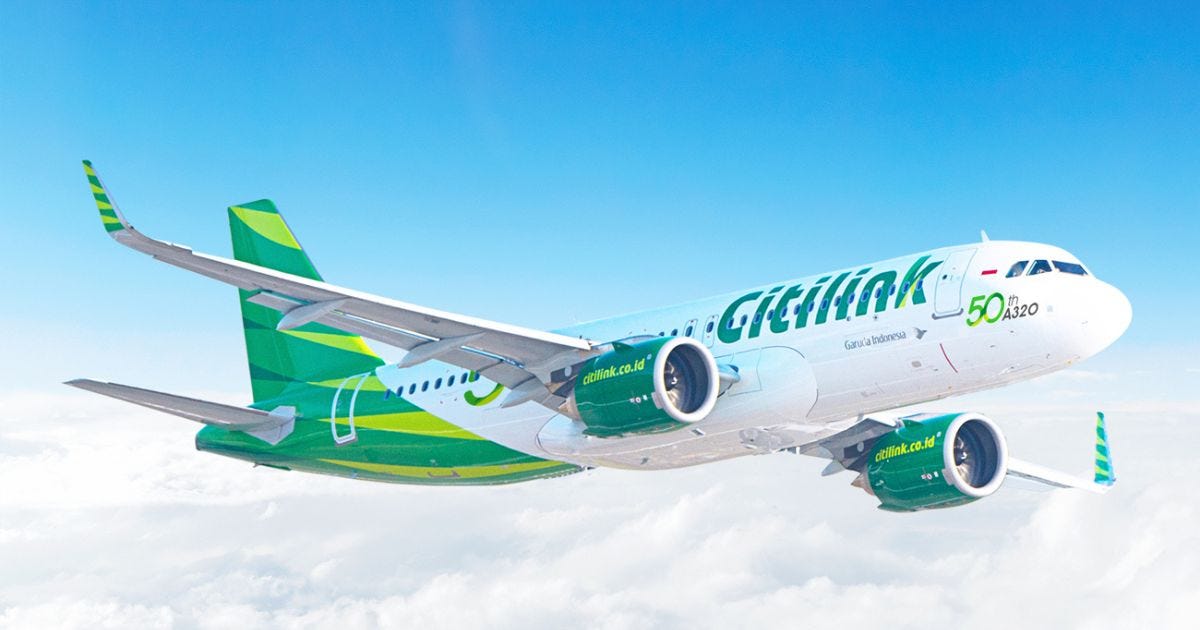
Citilink Indonesia Company Profile: Key Facts
PT Citilink Indonesia is the budget-segment subsidiary of flag carrier Garuda Indonesia.
The company was first launched in 2001 as a Strategic Business Unit and was relaunched as an independent operator in July 2012 with its own AOC, call sign “Supergreen”, and IATA code “QG”.
The airline is headquartered in Tangerang, with major operating bases at Jakarta Soekarno-Hatta International Airport and Surabaya Juanda International Airport. Citilink positions itself as a full low-cost carrier offering a single all-economy product, complemented by ancillary upsells.
Shareholding has shifted over time. Following the October 2017 amendment to the articles of association, 98.65% of the airline is owned by PT Garuda Indonesia (Persero) Tbk, with the remaining 1.35% held by PT Aerowisata.
Citilink Indonesia: Key Facts (May 2026)
- Legal entity:        PT Citilink Indonesia
- AOC issued:          AOC 121-046 (22 June 2012)
- IATA code:           QG
- ICAO code:           CTV
- Call sign:           Supergreen
- Slogan:              "Better fly, Citilink"
- President Director:  Darsito Hendroseputro
- Aircraft on AOC:     ~56 (31 operational, late 2025)
- Average fleet age:   ~12 years
- Destinations:        ~37 domestic + 4 international
- Credit rating:       idBBB-/Stable (Pefindo, 28 Jul 2025)
- Skytrax tier:        4-Star Low Cost Airline
The management reshuffle in mid-2025 brought in former Thai Lion Air chief executive Darsito Hendroseputro as President Director, replacing Dewa Kadek Rai.
Bringing in a competitor’s former operations leader was a deliberate signal from the parent company that Citilink’s cost base and turnaround speed needed external benchmarking.
Citilink operates under the umbrella of the Garuda Indonesia Group. From a regulatory perspective, the airline is also part of the Skytrax four-star low-cost airline tier and maintains European Union aviation safety clearance after passing audit thresholds in 2016.