


Executive Summary
Elbit Systems Ltd. closed 2025 with $7.94 billion in revenue, a 16.3% year over year increase, alongside a record $28.1 billion order backlog, of which roughly 72% is attributable to non-Israeli customers.
The Aerospace segment delivered $151.9 million in operating income on segment revenues of approximately $2.05 billion, with margins improving slightly to 7.4% even as Q4 segment revenue dipped 14% on contract phasing.
Order momentum remains exceptional. Recent wins include a $1.635 billion European deal (publicly tied to Serbia), a $750 million Hellenic PULS contract, a $120.5 million U.S. Army OTA for Soldier Borne Mission Command, and contracts for an Airborne High Power Laser pod and helicopter laser system from the Israel Ministry of Defense.
For 2026 and beyond, management has guided capex up to roughly $300 million from $225 million in 2025, reflecting a deliberate capacity push across munitions, ammunition, electro-optics, drones, lasers, and AI-enabled systems.
Recommended - Read Full Reports


Read All Reports
Table of Contents
Executive Summary
Key Facts: Elbit Systems Company Profile
Why Elbit Systems Matters in 2026
Elbit Systems Company Overview
A 60-Year Trajectory From Avionics House to Multi-Domain Prime
Corporate Structure and Reporting Segments
Headquarters, Footprint, and Workforce
Leadership Continuity Through Geopolitical Volatility
Aerospace, Aviation, and Defense Segments: Deep Dive
Aerospace Segment Headline Numbers
Aerospace Strategic Positioning
Key Product Lines: Aerospace and Aviation Programs
Hermes Family of Unmanned Aircraft Systems
Recent Hermes Contracts and Order Flow
Hermes StarLiner: The Civil Airspace Variant
Helmet-Mounted Systems and the F-35 Franchise
Beyond the F-35: Rotorcraft and Soldier Display
Direct Infrared Countermeasures: J-MUSIC and Variants
Airborne High Power Laser: The Next Frontier
Training Systems and Light Combat Aircraft
Aerostructures: The Cyclone Subsidiary
Key Product Lines: ISTAR & Electronic Warfare and Adjacent Aviation Systems
Spectro Camera Family and Airborne Electro-Optics
Space Systems and the Optical Payload Milestone
Electronic Warfare for Commercial Aircraft
Key Product Lines: Elbit Systems of America Aerospace Footprint
Enhanced Night Vision Goggle Binocular
Industrial Footprint and U.S. Politics
Financial Analysis: Elbit Systems
Top Line: Record Revenue and Sustained Growth
Profitability: Operating Margin Expansion
Earnings: 59% GAAP EPS Growth
Free Cash Flow: $550 Million and 100% Conversion
Capex Plan: $300 Million in 2026
Revenue and Growth Drivers, Revenue LTM
LTM Revenue and Growth Algorithm
Backlog as a Forward Revenue Engine
Geographic Mix: The 72% International Reality
Major 2025-2026 Contract Wins Driving the Backlog
Aerospace-Specific Growth Drivers
R&D Investment: The Forward-Looking Lever
Major Competitors and In-Depth Comparisons
List of Major Competitors
Elbit Systems vs. Lockheed Martin
Elbit Systems vs. RTX (Collins Aerospace)
Elbit Systems vs. Northrop Grumman
Elbit Systems vs. L3Harris Technologies
Elbit Systems vs. BAE Systems
Elbit Systems vs. Thales
Elbit Systems vs. Leonardo
Elbit Systems vs. Saab
Elbit Systems vs. General Atomics Aeronautical Systems
Elbit Systems vs. Israel Aerospace Industries
Elbit Systems vs. Rafael Advanced Defense Systems
Competitive Analysis and Strategic Moat: Elbit Systems
Where Elbit Systems Wins
Where Elbit Systems Faces Limits
How the Moat Translates Into Margins
Outlook for 2026 and Beyond
What Management Has Said
Capacity Investment as the Forward Lever
Geographic Expansion: Where Growth Will Come From
M&A Optionality
Financial and Commercial Implications for 2026 and Beyond
Revenue Trajectory: Mid-Teens Growth Sustainable Into 2026
Margin Trajectory: Continued Expansion Likely
Cash Flow: 100% Conversion Likely Sustainable
Capital Allocation: Dividend, R&D, and Strategic Capex
Commercial Implications for the Customer Base
Key Risks With Probabilities and Scenarios
Geopolitical Risk
Israel-Specific Export Controls
Iran Conflict Escalation or De-escalation
Operational Risk: Production Capacity Constraints
Market Risk: Defense Budget Normalization Post-Ukraine
Customer Concentration Risk
Reputational and Activist Risk
Currency and Translation Risk
Other Strategic Considerations
AI and Autonomy Integration
Cyber and C4I Cross-Sell
Space and High Altitude
Sustainability and ESG Profile
Digital Engineering and Model-Based Systems
Workforce and Talent
Elbit Systems SWOT Analysis
Strengths
Weaknesses
Opportunities
Threats
My Final Thoughts
Official Sources and Data
Key Facts: Elbit Systems Company Profile
Legal name:        Elbit Systems Ltd.
Founded:           1966 (incorporated 1996 form)
Headquarters:      Haifa, Israel
CEO:               Bezhalel (Butzi) Machlis (President & CEO)
CFO:               Yaacov Kagan
Listings:          NASDAQ: ESLT | TASE: ESLT
2025 Revenue:      $7,938.6 million (+16.3% YoY)
2025 GAAP EPS:     $11.39 (diluted)
2025 Non-GAAP EPS: $12.75 (diluted)
2025 Free cash flow: $550+ million (~100% conversion)
Order backlog:     $28.1 billion (~72% international)
Quarterly dividend: $1.00 per share
SIPRI Top 100:     Ranked #25 globally (2024 arms revenue)
Employees:         ~20,000+ globally
Reporting segments:Aerospace; C4I & Cyber; ISTAR & EW;
                   Land; Elbit Systems of America
Why Elbit Systems Matters in 2026
Elbit Systems is no longer a regional specialty contractor.
The Haifa-based group has quietly become one of the most diversified mid-tier defense electronics suppliers in the world, embedded inside platforms operated by NATO members, Indo-Pacific allies, Latin American air forces, and U.S. ground formations.
Its products sit on the canopies of every operational F-35, on the roofs of CV90 infantry fighting vehicles being upgraded across Europe, and inside the cabin of nearly every Hermes 900 medium-altitude long-endurance drone delivered to Western customers.
For aerospace and defense stakeholders, the company offers a rare combination: high single-digit Aerospace margins, tactically relevant niche dominance, and a multi-year backlog that already covers more than three years of revenue at the current pace.
Elbit Systems Company Overview
A 60-Year Trajectory From Avionics House to Multi-Domain Prime
Elbit Systems traces its modern corporate lineage to the 1996 carve-out of Elbit Ltd., though the underlying defense electronics business in Haifa dates back to 1966 under the Elron group.
That founding identity, defense electronics first, still drives the company’s competitive personality.
Over six decades, the group absorbed dozens of Israeli specialty firms, including IMI Systems (now ammunition and rocket propulsion), Tadiran Communications (tactical radios), El-Op (electro-optics), and Cyclone (aerostructures).
Each acquisition deepened the in-house technology stack, allowing Elbit to ship complete subsystems instead of components. That vertical integration is the foundation of how the company prices, bids, and competes today.
Corporate Structure and Reporting Segments
Elbit Systems reports financial results across five operating segments:
Aerospace;
C4I and Cyber;
ISTAR and Electronic Warfare;
Land, and
Elbit Systems of America.
Each carries a distinct customer profile, margin shape, and capital intensity.
For the aviation, aerospace, and defense stakeholders, three segments dominate the storyline: Aerospace (manned aircraft systems, UAS, training), ISTAR & EW (sensors, EW pods, airborne self-protection), and the U.S. subsidiary Elbit Systems of America (which is itself heavily aerospace-leaning through helmet displays, helicopter HUDs, and night vision).
2025 Segment Revenue Mix (approximate)
--------------------------------------
Aerospace:                ~26% of group revenue
C4I and Cyber:            ~13%
ISTAR and EW:             ~21%
Land:                     ~29%
Elbit Systems of America: ~21%

Note: Segment percentages are approximate and reflect the LTM mix disclosed in the August 2025 investor presentation, adjusted for full year 2025 growth rates.
Headquarters, Footprint, and Workforce
The corporate center remains in Haifa, but the operational footprint is global. Elbit Systems of America runs design and manufacturing campuses in Fort Worth, Merrimack, and Roanoke. Elbit Systems UK operates plants in Bristol, Kent, and Leicester.
Elbit Systems Deutschland produces optronics and protection systems in Ulm, while Elbit Systems Australia builds armored vehicle electronics in Adelaide.
This distributed manufacturing base is increasingly material for European customers seeking on-shore industrial offsets. The August 2025 contract from Serbia and the German Bundeswehr’s PULS purchase both required local content commitments that the company could only deliver because of those overseas plants.
Leadership Continuity Through Geopolitical Volatility
Bezhalel “Butzi” Machlis has led Elbit Systems as President and CEO since 2013, providing more than a decade of leadership continuity through the Russian invasion of Ukraine, the October 2023 Gaza war, and the U.S.-Israeli campaign against Iran that began in February 2026.
In his Q4 2025 commentary, Machlis emphasized that Elbit had reached the $28 billion backlog mark while sustaining roughly 100% free cash flow conversion, a capital efficiency rare in defense primes of this size.
CFO Yaacov Kagan, who joined the company in 2009 and stepped into the CFO role in 2017, has been the architect of the working capital discipline that supports that conversion ratio.
Aerospace, Aviation, and Defense Segments: Deep Dive
Let’s focus on the aviation, aerospace, and defense pillars of the company. Those translate operationally into the Aerospace segment, the air and space portion of ISTAR & EW, and the airborne mission systems that anchor Elbit Systems of America.
The next several sections walk through each major product family in turn, with an emphasis on the technology, customer set, and contract economics most relevant to industry stakeholders.
Aerospace Segment Headline Numbers
Aerospace segment revenues rose roughly 2% in 2025 versus 2024, while operating income increased to $151.9 millionat a 7.4% segment margin from $149.1 million at 7.3%.
The Q4 2025 segment revenue print, however, slipped 14% year over year. Management attributed the decline to lumpy delivery schedules on training aircraft and aerostructures programs rather than any structural weakness.
The full-year picture is more representative. Aerospace remains the most program-diverse segment of the group, tying together precision munitions, electro-optics, simulators, helmet-mounted systems, and an expanding family of unmanned aircraft.
Aerospace Segment Snapshot, FY 2025
-----------------------------------
Segment revenue:        ~$2.05 billion
Operating income:       $151.9 million
Operating margin:       7.4% (vs. 7.3% in FY 2024)
Q4 2025 revenue change: -14% YoY (lumpy deliveries)
Key product families:   Hermes UAS, helmet systems,
                        DIRCM, training aircraft,
precision munitions, aerostructuresAerospace Strategic Positioning
The Aerospace business is structured around three defensible niches.
The first is helmet-mounted systems for fast jets, where the company’s joint venture with Collins Aerospace ships the F-35 Gen III HMDS globally.
The second is direct infrared countermeasures (DIRCM), where the J-MUSIC family has won protection contracts on the German A400M fleet and on European wide-body executive transports.
The third is medium-altitude long-endurance unmanned aircraft, where the Hermes 900 and Hermes 450 combine in a tiered offering that few Western competitors match outside of General Atomics and Turkish Aerospace.
Key Product Lines: Aerospace and Aviation Programs
Hermes Family of Unmanned Aircraft Systems
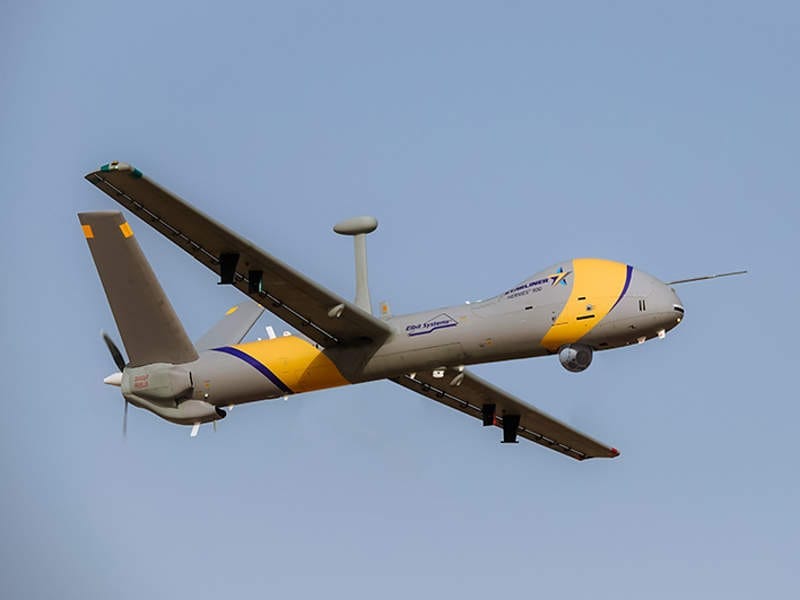
The Hermes family is the most globally recognizable Elbit aerospace product. The flagship Hermes 900 carries up to 350 kg of payload, sustains roughly 36 hours of endurance, and operates in surveillance, maritime patrol, and fire-control configurations.
The Hermes 450 is the tactical sibling, with more than 300,000 cumulative flight hours across global operators and a long history with the Israeli Air Force and the British Army’s Watchkeeper program.
Recent Hermes Contracts and Order Flow
In September 2025, Elbit announced a $120 million Hermes 900 contract for an unnamed international customer, with deliveries scheduled across multi-year tranches.
In April 2026, Reuters reported that Elbit was finally starting Hermes deliveries to Romania under a 2022 framework worth roughly $350 million. The delay reflected NATO certification work rather than production constraints.
Hermes order activity is the cleanest read on European reconnaissance demand. The Romanian, Greek, and Cyprus orders together imply that the Hermes 900 has crossed an inflection point as a standardized European MALE asset.
Hermes 900 Quick Specifications
-------------------------------
Wingspan:        ~15 m (49 ft)
Maximum takeoff: ~1,180 kg
Payload:         Up to 350 kg
Endurance:       ~36 hours typical mission
Service ceiling: ~30,000 ft
Datalink:        Beyond-line-of-sight satellite link
Mission set:     ISTAR, maritime patrol, EW,
communications relayHermes StarLiner: The Civil Airspace Variant
The Hermes 900 StarLiner is the certified civil airspace variant, equipped with anti-icing systems, redundant avionics, and a robust detect-and-avoid suite designed to meet ICAO requirements.
StarLiner is the spearhead of the company’s push into European border security and coast guard markets, where flight operations in non-segregated airspace are non-negotiable.
The StarLiner is also the platform of choice for Israel’s HENSOLDT-supported Frontex demonstration flights over the Mediterranean and the Aegean, which have created an important operational reference for European procurement officials.
Helmet Mounted Systems and the F-35 Franchise

The Collins Elbit Vision Systems joint venture, with Collins Aerospace as the U.S. industrial partner, supplies every operational F-35 with its Gen III Helmet Mounted Display System. In February 2024, the partnership delivered its 3,000th unit.
The Gen III helmet provides a 40 by 30 degree biocular field of view, integrated digital night vision, and live sensor fusion from the F-35’s distributed aperture system. It allows pilots to look through the airframe in any direction, an interface that has reshaped fast-jet cockpit design.
For Elbit, the F-35 helmet is more than a single-program annuity. It anchors a broader head-mounted display franchise that extends into rotary aircraft, training jets, and the U.S. Army’s Soldier Borne Mission Command program awarded in March 2026.
Beyond the F-35: Rotorcraft and Soldier Display
In March 2026, the U.S. Army awarded Elbit America a $49.9 million indefinite-delivery contract for rotorcraft heads-up displays, sustaining the U.S. helicopter HUD pipeline.
Days earlier, the same subsidiary had been awarded a $120.5 million OTA contract to develop Soldier Borne Mission Command, a head-borne capability that fuses multi-spectral sensors into a real-time tactical picture.
CEO Luke Savoie at Elbit America summarized the strategic logic in plain terms during the announcement, noting that the company has been “the lead at sending data directly into the eye of the Warfighter” for years across the night vision and F-35 helmet programs.
Direct Infrared Countermeasures: J-MUSIC and Variants
Elbit Systems’ J-MUSIC family of DIRCM systems defends transport, tanker, and rotary aircraft against shoulder-fired heat-seeking missiles.
In July 2025, the German Federal Office of Bundeswehr Equipment selected J-MUSIC for the Luftwaffe A400M fleet. In January 2026, Elbit publicly announced $150 million in additional contracts covering further European fleets.
J-MUSIC is built around an advanced fiber laser jamming source, a high-frame-rate IR tracker, and an open architecture mission computer. The system is qualified for the C-130, A400M, KC-390, and selected business jet types in head-of-state configuration.
Why DIRCM Demand is Growing
---------------------------
- Proliferation of MANPADS in conflict zones
- Renewed transport aircraft procurement (KC-390, A400M)
- Head-of-state aircraft renewal cycle
- Civil aviation interest after Iraq, Sahel, and Red
  Sea threat events
- Insurance underwriters tightening flight clearancesAirborne High Power Laser: The Next Frontier
The Israel Ministry of Defense awarded Elbit Systems a development contract in 2025 for an Airborne High Power Laser combat jet pod and a separate program for a helicopter-mounted HPL.
CEO Machlis flagged this work as one of the most strategically important programs of the year, citing range advantages over ground-based directed-energy systems in the company’s Q4 2025 earnings transcript.
The airborne laser pod targets close-in defense against drones and rockets, with the long-term promise of a credible counter-cruise-missile role. Elbit’s land-based Iron Beam program, jointly developed with the Israel MOD and Rafael, validates the photonics chain that the airborne pod inherits.
For 2026 and beyond, the HPL franchise carries optionality. International interest, particularly from Gulf customers, was specifically cited by Machlis in the Reuters interview following the annual results.
Training Systems and Light Combat Aircraft
Elbit operates in pilot training through avionics integration on the M-346 Master, the T-X (now T-7A Red Hawk) program, and a series of full mission simulators sold globally.
The company supplies the Boeing T-7A with its glass cockpit, and provides the simulator backbone that the U.S. Air Force is using to retire its T-38 Talon trainers.

In 2025, Elbit Systems Australia was selected to upgrade the Pilatus PC-21 fleet trainers in service with several allied air forces, extending the segment’s training aircraft footprint into the Indo-Pacific.
Aerostructures: The Cyclone Subsidiary
Cyclone, a wholly-owned Elbit subsidiary, manufactures composite and metallic aerostructures for Boeing, Lockheed Martin, and Embraer.
While aerostructures is the lowest-margin element inside the Aerospace segment, it provides ballast against project lumpiness on training and electronic systems, and grants the company a credible commercial aerospace identity that helps export licensing in select jurisdictions.
The Cyclone exposure to Boeing 737 MAX work and to Lockheed F-35 wing components positions the unit to benefit from the steady ramp in narrow-body rates and the F-35 production restart through 2026.
Key Product Lines: ISTAR & Electronic Warfare and Adjacent Aviation Systems
The ISTAR and EW segment is a pure-play defense electronics business, but a meaningful share of its revenue is airborne. Synthetic aperture radar pods, electronic intelligence suites, and signals intelligence platforms all live inside this division.
ISTAR and EW segment revenues grew 16% in 2025, with Q4 segment growth of 39%. Operating income reached $129.1 million at an 8.5% margin, up from 7.3% the prior year.
Spectro Camera Family and Airborne Electro-Optics
Elbit’s electro-optic payloads, branded under the SPECTRO family, equip the Hermes UAS line, Apache and Black Hawk helicopters, and a wide range of fixed-wing reconnaissance aircraft.
The CONDOR-2 long-range oblique photography pod, originally developed for the Israeli Air Force, has been exported to multiple customers and is one of the few Western LOROP systems still in active production.
These payloads are the eyes of the Hermes franchise, and they account for the natural cross-sell that supports the company’s aerospace narrative.
Space Systems and the Optical Payload Milestone
In September 2025, Elbit’s ISTAR & EW Division announced that its latest optical payload had entered orbit, marking a fresh milestone for the company’s space program.
The space business is small in absolute revenue terms but strategically meaningful. Defense ministries are increasingly co-purchasing space sensors alongside airborne systems, and Elbit’s ability to package both is a differentiator versus pure-play space primes.
Electronic Warfare for Commercial Aircraft
Elbit Systems was awarded contracts in 2024 and 2025 to upgrade commercial aircraft for electronic warfare duties, including signals intelligence and electronic attack roles.
This conversion business is highly profitable because the company captures the full sensor, mission system, and integration revenue stream while leveraging existing certified airframes.
Key Product Lines: Elbit Systems of America Aerospace Footprint
Elbit Systems of America, the company’s U.S. subsidiary, posted 9% revenue growth in Q4 2025 and 7% growth for the full year.
The subsidiary’s three aerospace anchors are the F-35 helmet program, the U.S. Army rotorcraft heads-up display franchise, and the Enhanced Night Vision Goggle Binocular family that the U.S. Army is fielding across infantry units.
Elbit Systems of America Aerospace Highlights
---------------------------------------------
F-35 HMDS:               3,000+ units delivered through CEVS JV
ENVG-B:                  U.S. Army primary night vision binocular
Rotorcraft HUDs:         AH-64, UH-60, CH-47 deliveries
Soldier Borne Mission
Command (SBMC):          $120.5 million OTA awarded March 2026
Recent rotorcraft HUD:   $49.9 million IDIQ (March 2026)
Enhanced Night Vision Goggle Binocular
The ENVG-B fuses thermal and image-intensified channels into a single binocular, with wireless connectivity to the Family of Weapon Sights. Elbit America has been on contract for the U.S. Army since 2018, with successive low-rate and full-rate production lots running through 2026.
The platform’s continued adoption sets up a natural transition path into the SBMC capability, which embeds tactical situational awareness directly into a head-borne display.
Industrial Footprint and U.S. Politics
The U.S. operations matter strategically because they insulate the parent group from a portion of the political risk attached to Israeli content.
Several U.S. defense programs require Buy American Act compliance, and the Elbit America industrial base in Texas, New Hampshire, and Virginia provides the eligibility that the parent’s Haifa operations cannot.
Financial Analysis: Elbit Systems
Top Line: Record Revenue and Sustained Growth
Total revenues for 2025 reached $7,938.6 million, up 16.3% from $6,827.9 million in 2024. The full year print marked the company’s first crossing of the $7.5 billion threshold and was achieved without any meaningful M&A contribution.
The Q4 2025 revenue of $2,148.6 million crossed the $2 billion quarterly milestone for the first time in company history.
Full year revenue growth was driven by Land (38%), C4I and Cyber (16%), ISTAR and EW (16%), and Elbit Systems of America (7%). Aerospace grew a more modest 2%, weighed down by Q4 program timing.
Profitability: Operating Margin Expansion
GAAP gross profit was $1,935.3 million at a 24.4% margin, up from 24.0% in 2024. Non-GAAP gross profit of $1,961.8 million implied a 24.7% non-GAAP gross margin.
GAAP operating income reached $671.4 million at an 8.5% margin, a 130 basis point expansion from the 7.2% recorded in 2024. Non-GAAP operating margin of 9.3% was also a clear step up.
Profitability Bridge, FY 2024 to FY 2025
----------------------------------------
GAAP gross margin:    24.0% -> 24.4% (+40 bps)
Non-GAAP gross margin:24.5% -> 24.7% (+20 bps)
GAAP op. margin:      7.2%  -> 8.5%  (+130 bps)
Non-GAAP op. margin:  8.1%  -> 9.3%  (+120 bps)
GAAP net income:      $321M -> $534M (+66%)
Non-GAAP net income:  $391M -> $598M (+53%)
The 130 basis point operating margin expansion captures three forces: higher absorption of fixed manufacturing overhead, improved pricing on follow-on contracts, and a favorable mix shift toward higher-margin Land and ISTAR & EW programs.
Earnings: 59% GAAP EPS Growth
GAAP diluted earnings per share of $11.39 were up 59% from $7.18 in 2024. Non-GAAP diluted earnings per share of $12.75 were up 46% from $8.76.
For Q4 2025 alone, non-GAAP EPS reached $3.56, trouncing consensus of roughly $2.82.
The earnings leverage reflects both the operating margin step-up and the modest interest income tailwind that follows the company’s strong cash generation.
Free Cash Flow: $550 Million and 100% Conversion
Elbit Systems generated more than $550 million of free cash flow in 2025, equating to roughly a 100% cash conversion rate against non-GAAP net income.
That figure is particularly notable because the company simultaneously increased capex meaningfully on capacity expansion. Working capital discipline and customer milestone billing structures together drove the result.
The group declared a $1.00 per share quarterly dividend, reflecting the board’s confidence in the cash flow trajectory.
Capex Plan: $300 Million in 2026
Management has guided 2026 capex up to roughly $300 million, from $225 million in 2025. The increase is targeted at munitions and rocket-motor capacity, additional clean room space for electro-optics, and dedicated lines for laser sources.
Capex intensity at the new level remains under 4% of revenue, well below the level at which fixed cost absorption would be threatened.
The investment pattern signals that the company is preparing for sustained delivery scale rather than a temporary order surge.
Revenue and Growth Drivers, Revenue LTM
LTM Revenue and Growth Algorithm
LTM revenue at the end of Q4 2025 was equal to the full year figure of $7,938.6 million, given the 31 December fiscal close.
The compounded mid-teens growth rate is being sustained by three structural drivers: backlog conversion, new contract wins, and the share gain that mid-tier Israeli primes are taking from Russian and Chinese exporters in markets where Western alternatives are now politically required.
Backlog as a Forward Revenue Engine
The order backlog stood at $28.1 billion at year-end 2025, up $5.5 billion from 2024. Approximately 54% of that backlog is scheduled for performance during 2026 and 2027.
Stated differently, the company has already booked about 1.9 years of revenue at the 2025 run rate, before booking a single new order in 2026. The remainder is scheduled into 2028 and beyond.
This is the single most important fact for any aerospace and defense reader weighing Elbit’s outlook. The backlog provides revenue visibility that is unusually long for a mid-cap defense contractor.
Backlog Composition, 31 December 2025
-------------------------------------
Total backlog:               $28.1 billion
Year-over-year change:       +$5.5 billion
International share:         ~72%
Israel domestic share:       ~28%
To be performed 2026-2027:   ~54% of total
To be performed 2028+: ~46% of totalGeographic Mix: The 72% International Reality
The disclosure that 72% of backlog is now international should reframe how stakeholders think about the Elbit story.
Roughly a decade ago, the international share was closer to 60%. The structural rebalancing has been driven by Western European rearmament, Indo-Pacific expansion of allied air defense, and the U.S. Army’s continued procurement through Elbit America.
For 2026, management has stated explicitly in the Reuters interview that “interest in many countries who are suffering from the same enemy” is creating new traction, particularly among Abraham Accords signatories.
Major 2025-2026 Contract Wins Driving the Backlog
The headline contracts captured during 2025 and the first quarter of 2026 illustrate the breadth of the demand environment.
Selected 2025-2026 Contract Awards
-----------------------------------
Aug 2025: $1.635B European country defense systems
          (publicly tied to Serbia)
Apr 2025: $750M Hellenic PULS rocket artillery
Mar 2025: $305M PULS for Royal Netherlands Army
Feb 2025: $57M PULS for German Bundeswehr
Sep 2025: $120M Hermes 900 UAS, international
Oct 2025: $228M Iron Fist APS for U.S. Army Bradley
Jul 2025: $150M Iron Fist for European CV90 fleets
Jul 2025: A400M J-MUSIC DIRCM for Germany
Aug 2025: $60M ReDrone C-UAS for NATO country
Feb 2026: $200M IMOD airborne munitions
Mar 2026: $120.5M U.S. Army SBMC OTA
Mar 2026: $49.9M U.S. Army rotorcraft HUDs
Apr 2026: $435M international defense systems
The $1.635 billion European deal is the largest single contract in Elbit’s history.
Aerospace-Specific Growth Drivers
Within the aerospace storyline, four levers will drive 2026 and 2027 segment revenue.
First, F-35 helmet shipments will track the Lockheed Martin production schedule, which has now restarted at full rate following Truncated Mission Capable software certification.
Second, Hermes deliveries to Romania, Greece, the Philippines, and unnamed customers will move from milestone-driven to delivery-driven recognition through 2027.
Third, J-MUSIC DIRCM installations on European A400M and KC-390 fleets will progressively convert booked orders into recognized revenue.
Fourth, the airborne high-power laser pod will move from development phase to limited production, generating early revenue in 2026 and 2027 with potential international upside.
R&D Investment: The Forward-Looking Lever
Elbit Systems invested more than $500 million in R&D in 2025, with a deliberate emphasis on AI-enabled mission systems across multiple platforms.
That R&D number is approximately 6.3% of revenue, which is meaningfully higher than the 3% to 4% typical of large U.S. primes. The intensity reflects the technology-led positioning that the company has built over decades.
The AI focus is most visible in the Hermes 900 mission system, where computer-vision-driven target classification is now part of the standard payload software, and in the SBMC head-borne display awarded in March 2026.
Major Competitors and In-Depth Comparisons
Elbit Systems competes against a rotating roster of primes depending on the segment, country, and customer. The most relevant peers for the aerospace and defense readership are listed below.
List of Major Competitors
Lockheed Martin Corporation (NYSE: LMT)
RTX Corporation (NYSE: RTX), including the Collins Aerospace business
Northrop Grumman Corporation (NYSE: NOC)
L3Harris Technologies (NYSE: LHX)
BAE Systems plc (LSE: BA.)
Thales SA (Euronext: HO)
Leonardo S.p.A. (BIT: LDO)
Saab AB (STO: SAAB-B)
General Atomics Aeronautical Systems (private)
Israel Aerospace Industries (state-owned, Israel)
Rafael Advanced Defense Systems (state-owned, Israel)
HENSOLDT AG (FSE: HAG)
Elbit Systems vs. Lockheed Martin
Lockheed Martin is not a head-to-head Elbit competitor at the platform level, but the two firms intersect inside the F-35 program, where Elbit supplies the helmet display.
Lockheed Martin reported 2025 net sales of $73.0 billion versus Elbit’s $7.9 billion, illustrating the order-of-magnitude difference between platform primes and specialty electronics suppliers.
Where Elbit competes with Lockheed Martin is in subsystems.
Both companies offer mission computers, helmet systems, and EW pods, and Elbit has occasionally displaced Lockheed legacy avionics in foreign upgrade campaigns.
Elbit Systems vs. RTX (Collins Aerospace)
RTX, parent of Collins Aerospace and Raytheon, is simultaneously a partner and a competitor. The Collins Elbit Vision Systems joint venture for the F-35 HMDS is the most visible cooperative relationship in the company’s portfolio.

In other niches, the two firms compete directly. Collins Aerospace offers competing helmet displays for non-F-35 platforms, while Raytheon’s APKWS guided rocket competes with the Elbit precision rocket family at the lower end of the air-to-ground market.
The structural difference is exposure. Elbit is more concentrated in airborne self-protection and ISR, while RTX has stronger positions in air defense, missiles, and propulsion.
Elbit Systems vs. Northrop Grumman
Northrop Grumman competes with Elbit primarily in unmanned systems, where the Northrop MQ-4 and MQ-8 sit at the high end of the maritime and naval drone markets.

Elbit’s Hermes 900 sits below the MQ-4 in payload, endurance, and price. This positioning has allowed the Hermes 900 to capture a different customer segment, including export users who cannot afford or politically support a Triton-class platform.
In counter-UAS, Northrop’s Mode 5 IFF and AN/TPS family compete with Elbit’s ReDrone family of C-UAS systems, although on a much smaller cost basis.
Elbit Systems vs. L3Harris Technologies
L3Harris is arguably the most direct U.S. analogue to Elbit at the subsystem level. Both firms emphasize tactical communications, electro-optics, EW, and night vision.

L3Harris reported 2025 revenue of $21.6 billion, about 2.7 times Elbit’s, but with materially lower growth. Elbit’s 16% growth in 2025 outpaced L3Harris’s 5.6% top-line increase.
Where the two firms compete head-to-head is in foreign military sales for night vision, tactical communications, and SIGINT. Elbit increasingly wins these competitions on the basis of price-performance and willingness to transfer technology to local partners.
Elbit Systems vs. BAE Systems
BAE Systems is a partner more often than a competitor. BAE’s Hägglunds business has selected Elbit’s Iron Fist APS for the CV90 fleet, and BAE has integrated Elbit electro-optics into multiple platforms.

In the U.S. Bradley fighting vehicle competition, however, the Iron Fist deployment puts Elbit in the position of a critical subsystem supplier on a vehicle that BAE produces, illustrating how interdependent the supply chains have become.
In airborne self-protection, BAE’s Compass Call and Praetorian systems compete with Elbit’s J-MUSIC and SPEAR EW family in some campaigns.
Elbit Systems vs. Thales
Thales is the most direct European analogue to Elbit. Both firms are mid-tier, technology-led primes with strong positions in airborne self-protection, sensors, and tactical EW.

Thales reported 2025 sales of approximately €21.7 billion, nearly three times Elbit’s revenue, with growth in the high single digits.
The two firms compete most directly in DIRCM, where Thales’s Vesta and Elbit’s J-MUSIC are perennial finalists in head-of-state and transport aircraft competitions. Elbit has won the German A400M campaign, while Thales retains the French Air and Space Force.
Elbit Systems vs. Leonardo
Leonardo, through its Selex and DRS subsidiaries, is another close European peer. The Italian prime competes most directly in helicopter electro-optics and aerostructures.
Leonardo reported 2025 revenue of approximately €18.6 billion, reflecting steady mid-single-digit growth. The company is a partner on the M-346 trainer, where Elbit supplies cockpit avionics.
In radar and EW, Leonardo’s RAT-31 and KRONOS air defense families compete with Israeli systems in the broader allied procurement market.
Elbit Systems vs. Saab
Saab is the most aggressive European competitor in the export ground combat space, with the CV90 platform and the Carl-Gustaf system both competing for defense budget share against Elbit-equipped alternatives.
Saab reported 2025 sales of SEK 75.6 billion (about $7.0 billion), placing it almost on par with Elbit in revenue terms. Both companies are growing in the mid-teens.
In the airborne arena, Saab’s Erieje radar and Globaleye platforms compete with Elbit’s airborne SIGINT and EW offerings, although the systems are usually positioned at different price points.
Elbit Systems vs. General Atomics Aeronautical Systems
In medium-altitude long-endurance unmanned aircraft, Elbit’s most direct global competitor is General Atomics, manufacturer of the MQ-9 Reaper and SkyGuardian.
General Atomics dominates the high end of the MALE market, particularly in U.S. service. Elbit’s Hermes 900 and StarLiner compete in the middle band, where exportability, lower price, and faster delivery offset General Atomics’s reputational halo.
European Reaper customers (UK, France, Italy, Spain, Netherlands) have largely chosen General Atomics, but Greek, Romanian, Cypriot, Filipino, and Thai customers have selected Hermes, illustrating a clear bifurcation by tier.
Elbit Systems vs. Israel Aerospace Industries
Israel Aerospace Industries (IAI), state-owned, is the most direct domestic competitor. IAI reported 2025 revenue of approximately $6.5 billion (preliminary disclosure), up 21% versus 2024.
IAI’s Heron family of UAS competes with Hermes; its ELTA radar division competes with Elbit’s airborne radar offerings; and its missile defense business overlaps with selected Elbit air defense radar work.
Within Israel, the two firms cooperate on national programs as often as they compete, with the Israel MOD typically partitioning roles to avoid duplication.
Elbit Systems vs. Rafael Advanced Defense Systems
Rafael, also state-owned, was the standout 2025 performer among Israeli primes with sales growth of 30% to NIS 21.7 billion, outpacing both Elbit (16%) and IAI (21%).
Rafael’s Spike anti-tank missile and Iron Dome interceptor families overlap less directly with Elbit’s portfolio, but the two firms share work on the airborne high power laser program and on selected munitions.
For aerospace stakeholders, Rafael is most relevant as a competitor in airborne self-protection (LiteShield versus J-MUSIC) and in advanced air-to-ground munitions.