


Welcome to AviationOutlook: The aviation newsletter built exclusively for decision-makers.
Become an “Annual” member now & get this special discount offer.
As a paid member, you get access to:
200+ Reports - All major airlines + aerospace & defense companies (updated regularly).
Daily / Weekly - Deep-dive analysis & insights.
Monthly - Industry outlook reports.
In case you missed it, here are the latest analysis reports:
Embraer - Company Analysis and Outlook Report 2026 (Updated)
American Airlines’ Six-Route Europe Play: Yield Discipline or Widebody Overreach?
Check Out All Reports
Executive Summary
Emirates Group posted a record pre-tax profit of US$6.2 billion in FY2024-25, making it the world’s most profitable aviation group; its H1 FY2025-26 result of US$3.3 billion pre-tax profit (up 17% year-on-year) confirms the momentum continues.
The airline is executing a US$4 billion retrofit program across approximately 219 aircraft, deploying free Starlink Wi-Fi fleet-wide and extending Premium Economy to 99 destinations by year-end 2026, directly monetizing its ageing but strategically valuable A380 and B777 fleet.
With a 367-aircraft orderbook (including 270 Boeing 777Xs and 52 Airbus A350-900s) but no new-generation jet deliveries before Q2 2027, Emirates faces a critical capacity bridging period that its retrofit strategy and A380 reactivation plan must cover.
However, a sharp Middle East geopolitical escalation in early 2026 has driven jet fuel costs to unprecedented levels, representing the most significant near-term risk to Emirates’ FY2025-26 full-year profitability.
Recommended - Read Full Reports


Table of Contents
Executive Summary
Introduction
Key Facts: Company Profile and Business Overview
Revenue and Growth Drivers
Key Services, Routes, and Products
Network and Fleet Strategy
Current Fleet Composition
Boeing - Company Analysis and Outlook Report 2026 (Updated)
The A350 Entry and Rapid Deployment
The 777X Delay: A Structural Bridge Problem
The Al Maktoum International Airport (DWC) Decade-Long Transition
Competitive Analysis and Structural Moat
What Differentiates Emirates From All Peer Carriers?
1. The Dubai Sixth Freedom Hub Model
2. Scale and Unit Cost Advantages
3. State Backing Without Operational Interference
4. The Product Differentiation Premium
Emirates vs. Qatar Airways: The Primary Rivalry
Emirates vs. Singapore Airlines and Cathay Pacific
Recent Developments: Key Strategic Moves in 2025 and 2026
The US$4 Billion Retrofit Program Accelerates
Premium Economy Reaches 99 Destinations by Year-End 2026
Free Starlink Wi-Fi Across the Entire Fleet
Emirates SkyCargo: Scaling for a New Growth Phase
The Dubai Airshow 2025 Superorder: Boeing and Airbus Commitments
dnata: Ground Services and Travel Deliver Record Revenue
IPO Readiness: A Conditional Milestone
Key Risks: Probabilities and Scenarios
Risk 1: Middle East Geopolitical Escalation and Fuel Shock
Risk 2: Boeing 777X Delivery Delays
Risk 3: Overcapacity When 777X Deliveries Commence
Risk 4: DXB Capacity Constraints Before DWC Opens
Risk 5: USD/AED and Emerging Market Currency Volatility
Primary Sources and Links to Company Releases, Filings, and Raw Data
My Final Thoughts
Introduction
Emirates just posted the single largest annual profit in commercial aviation history for FY2024-25: a US$6.2 billion group pre-tax profit. That’s a structurally different business from almost every peer airline operating in the world right now.
Yet as of March 24, 2026, Emirates is also navigating two simultaneous headwinds: a Middle East conflict that has sent jet fuel prices surging to between $150 and $200 per barrel, and persistent Boeing 777X delivery delays that have pushed its next-generation fleet replacement into 2027 at the earliest.
The tension between record financial momentum and near-term operational disruption is the central story for Emirates stakeholders to watch closely in 2026 and beyond.
Key Facts: Company Profile and Business Overview
Headquarters: Dubai, United Arab Emirates
Founded: 1985
Ownership: 100% owned by the Investment Corporation of Dubai (Government of Dubai)
Chairman and CEO: HH Sheikh Ahmed bin Saeed Al Maktoum
Fiscal Year: April 1 to March 31
Primary Hub: Dubai International Airport (DXB)
Revenue and Growth Drivers
The following snapshot covers the Emirates Group’s most recently completed full fiscal year:
Emirates Group FY2024-25 Financial Snapshot
--------------------------------------------
Group Revenue:           AED 145.4B  (US$ 39.6B)  +6% YoY
Group Profit Before Tax: AED 22.7B   (US$ 6.2B)   +18% YoY
Group EBITDA:            AED 42.2B   (US$ 11.5B)  +6% YoY
Group Cash Assets:       AED 53.4B   (US$ 14.6B)  +13% YoY

Emirates Airline Revenue:    AED 127.9B (US$ 34.9B)  +6% YoY
Emirates Airline Profit BT:  AED 21.2B  (US$ 5.8B)   +20% YoY
Emirates Airline Cash:       AED 49.7B  (US$ 13.5B)  +16% YoY
Passengers Carried:          53.7 million             +3% YoY

dnata Revenue:           AED 17.5B   (US$ 4.7B)  (Full Year)
dnata Profit Before Tax: AED 1.6B    (US$ 430M)
Revenue growth for FY2024-25 was supported by sustained demand across all cabin classes, improved passenger yield, and an 18% surge in cargo revenue. Fuel costs dropped as a proportion of operating expenses from 34% to 31%, which contributed significantly to the profitability improvement.
For the most recent reporting period available (H1 FY2025-26, ending September 30, 2025):
Emirates H1 FY2025-26 Financial Snapshot
-----------------------------------------
Emirates Airline Revenue:  AED 65.6B (US$ 17.9B)  +6% YoY
Emirates Airline Profit BT: AED 11.4B (US$ 3.1B)  +17% YoY
Group Revenue:             AED 75.4B (US$ 20.6B)  +4% YoY
Group Profit Before Tax:   AED 12.2B (US$ 3.3B)   +17% YoY
Group Cash (Sept 2025):    AED 56.0B (US$ 15.2B)
Group EBITDA (H1):         AED 21.1B (US$ 5.7B)
Key Services, Routes, and Products
Emirates operates as a premium full-service carrier with four cabin classes across most widebody aircraft: First Class, Business Class, Premium Economy, and Economy Class.
As of March 2025, the airline served 148 cities in 80 countries and territories, operating exclusively from its Dubai International Airport (DXB) hub. DXB handled a record 95.2 million passengers in 2025, cementing its position as the world’s busiest airport for international travel.
Beyond passenger services, Emirates operates Emirates SkyCargo (freight division), the Emirates Skywards loyalty program with over 37 million members, and dnata (ground handling, catering, travel, and logistics). These diversified revenue streams provide meaningful protection against passenger demand fluctuations in any single corridor.
Network and Fleet Strategy
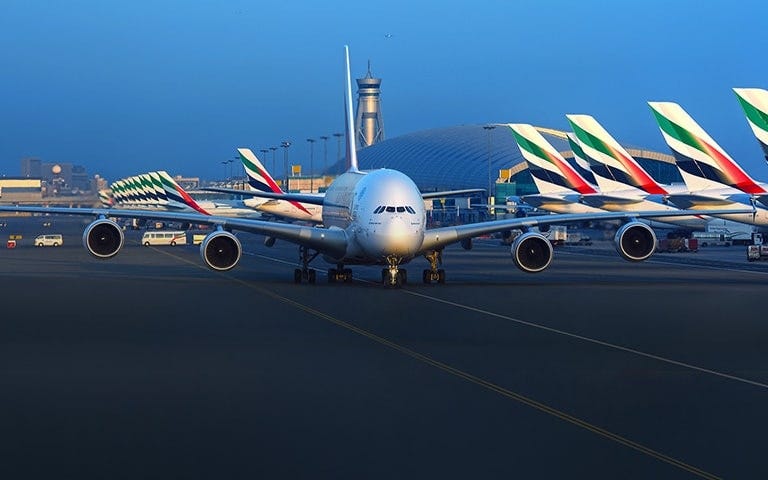
Current Fleet Composition
Aircraft Type           In-Fleet   On Order
------------------------------------------
Airbus A380             116        0
Airbus A350-900         13         52
Boeing 777-300ER        119        0
Boeing 777-200LR        10         0
Boeing 777 Freighters   11         10
Boeing 777-9 (777X)     0          270
Boeing 787              0          35
------------------------------------------
TOTAL                   269        367
This orderbook represents one of the largest aircraft procurement commitments in commercial aviation history.
At the Dubai Airshow in November 2025, Emirates placed an additional order for 65 Boeing 777-9 aircraft worth US$38 billion at list prices, taking its total 777X orderbook to 270 aircraft. Emirates also ordered 8 additional Airbus A350-900s worth US$3.4 billion at the same show.
The total Boeing commitment now stands at 315 widebody aircraft including freighters, with deliveries running through 2038. Emirates is also Boeing’s largest single GE9X engine customer, with 540 GE9X units on order.
The A350 Entry and Rapid Deployment
Emirates received its first Airbus A350-900 in January 2025 and had 16 in service by year-end. The aircraft is configured in a three-class layout (First, Business, Economy) and is being deployed across a growing list of routes.
By 2026, the A350 network has expanded to five new nonstop destinations: Cape Town, Copenhagen, Phuket, Rome Fiumicino, and Taipei. The carrier also added the A350 to summer 2026 routes including Tunis, Amman, Istanbul, Dammam, Ho Chi Minh City, Baghdad, and Oslo.
With 52 additional A350s still to be delivered, the A350 will gradually absorb thinner long-haul routes where the A380’s 500-seat capacity is commercially inefficient.
The 777X Delay: A Structural Bridge Problem
The most operationally consequential issue for Emirates’ fleet planning is the ongoing Boeing 777X delivery delay. Emirates originally expected to be operating approximately 90 Boeing 777-9s by now. Instead, no 777X aircraft have been delivered to any airline as of this report date.
Emirates President Tim Clark has stated he remains cautiously optimistic about first deliveries arriving by Q2 2027. Reuters reported in October 2025 that even the 2027 timeline carries risk, with some sources suggesting deliveries could slip to 2028.
To bridge the capacity gap, Emirates is executing its $5 billion fleet retention and retrofit strategy. The airline is keeping its A380 fleet operational and is targeting 110 active A380s by year-end 2026, up from approximately 95-96 in late 2025. This A380 reactivation effort is paired with the cabin retrofit program discussed below.
The Al Maktoum International Airport (DWC) Decade-Long Transition
Emirates’ long-term hub strategy is tied to the AED 128 billion ($35 billion) expansion of Al Maktoum International Airport (DWC). When complete, DWC will have five runways and a theoretical capacity exceeding 150 million passengers per year, making it the largest airport in the world by planned capacity.
Contracts have already been awarded, and work is underway. Sheikh Ahmed confirmed in April 2025 that the ORAT (Operational Readiness and Airport Transfer) program alone will require approximately 12 months of preparation. Emirates is not expected to move its passenger operations to DWC before the early-to-mid 2030s.