


Executive Summary
Finnair posted Q1 2026 revenue of €778.1 million, a 12.1% year-on-year increase, with passenger numbers reaching 2.8 million and Asian traffic load factors climbing to 86.8%, signalling a structural recovery from the Russian airspace closure shock.
The carrier signed a March 2026 agreement with Embraer for 18 firm E195-E2 jets, plus 16 options and 12 purchase rights, marking the most consequential narrow-body decision in two decades and a pivot away from an all-Airbus narrow-body fleet.
Finnair operates roughly 80 aircraft anchored by 17 Airbus A350-900s and 8 A330-300s, with Helsinki-Vantaa serving as a one-roof transfer hub linking 12 new European destinations introduced for summer 2026 to a re-engineered Asian network that culminates in the airline’s first-ever Australian service to Melbourne in October 2026.
Management guides 2026 revenue at €3.3–3.4 billion with a comparable operating result of €120–190 million, targeting a 6–8% EBIT margin by 2029 under a strategy plan focused on disciplined long-haul redeployment, narrow-body modernization and sustained Asian leadership.
Recommended - Read Full Reports


Read All Reports
Table of Contents
Executive Summary
Finnair Company Profile: Key Facts
Finnair Revenue & Financial Analysis
Full-Year 2025 Revenue Performance
Q1 2026 Earnings: An Inflection Point
2026 Full-Year Guidance and Outlook
Revenue Growth Drivers
Cargo Business
Finnair Fleet Analysis
Fleet Size and Composition
Aircraft Types Strategy and Configuration
Fleet Age and Modernization
The Embraer E195-E2 Decision
Fleet Strategy Through 2029
Regional Fleet via Norra
Finnair Route Network Strategy, Major Destinations and Analysis
New 2026 Destinations: 14 Additions
Asia-Pacific: From Crisis to Reinvention
North Atlantic Rebuild
Network Architecture: The HEL Connecting Engine
Major Operational Bases (Hubs)
Helsinki-Vantaa Airport (HEL)
Secondary Finnish Bases
Stockholm Arlanda as a Tactical Spoke
Finnair Competitive Position
Finnair vs SAS (Scandinavian Airlines)
Finnair vs Lufthansa Group
Finnair vs Air France-KLM
Finnair vs Norwegian Air Shuttle
Finnair vs Qatar Airways (Partner and Competitor)
Finnair vs Gulf and Turkish Carriers
Oneworld Alliance and Partnership Architecture
Sustainability and Sustainable Aviation Fuel (SAF) Strategy
Customer Product Strategy and Cabin Experience
Strategic Plan 2026–2029: Financial Targets and Roadmap
Key Risks for Finnair
Risk 1
Risk 2
Risk 3
Risk 4
Risk 5
Risk 6
Risk 7
Risk 8
Risk 9
Risk 10
Outlook for 2026 and Beyond
My Final Thoughts
Official Sources and Data
Finnair Company Profile: Key Facts
Finnair Plc is Finland’s flag carrier and one of the oldest continuously operating airlines in the world, founded in 1923. The company is majority-owned by the Finnish State and is headquartered in Vantaa, on the grounds of Helsinki-Vantaa Airport.
The carrier serves more than 80 destinations across Finland, Europe, Asia, the Middle East and North America, with Asia historically representing its most strategically important long-haul market.
Membership in the Oneworld Alliance since 1999 anchors a partnership architecture that includes British Airways, Iberia, Qatar Airways, Japan Airlines, Cathay Pacific and Qantas.
FINNAIR AT A GLANCE (snapshot)
Founded:            1923 (one of the world's oldest operating airlines)
Headquarters:       Vantaa, Finland (at Helsinki-Vantaa Airport)
CEO:                Turkka Kuusisto (appointed April 2024)
IATA / ICAO:        AY / FIN
Hub:                Helsinki-Vantaa (HEL / EFHK)
Alliance:           Oneworld (founding member, joined 1999)
Fleet (approx.):    ~80 aircraft (mainline + regional Norra)
Employees:          ~5,800 (average headcount, Q1 2026)
2025 Revenue:       €3,106.2 million
2026 Guidance:      €3.3–3.4 billion revenue; €120–190m operating result
Ownership:          Finnish State majority shareholder
Listed:             Nasdaq Helsinki (FIA1S)
The airline’s leadership transition in April 2024 brought Turkka Kuusisto to the top, the former head of the Finnish postal service, who has framed the next phase of Finnair’s evolution around profitable growth, fleet modernization and a recalibrated Asia-Europe positioning.
Kuusisto’s mandate has been shaped by the geopolitical shock of February 2022, when Russia closed its airspace to European Union carriers and erased Finnair’s defining commercial advantage: the shortest great-circle routings between Northern Europe and Northeast Asia.
The post-2022 reset has compelled the airline to redeploy long-haul capacity, deepen partnerships with Qatar Airways, expand North Atlantic flying and now broaden its Asia-Pacific footprint by adding Australia.
The company’s regional arm, Nordic Regional Airlines (Norra), is a joint venture with Danish Air Transport that operates ATR 72 turboprops and Embraer 190 jets on Finnair’s behalf, performing roughly half of the carrier’s domestic and intra-European frequencies.
Finnair Revenue & Financial Analysis
Finnair’s financial performance in the post-Russian-airspace era can be divided into three distinct phases: a deep operating loss during 2022–2023, a stabilization year in 2024–2025, and a renewed growth trajectory starting in late 2025 and accelerating through 2026.
Full-Year 2025 Revenue Performance
For the financial year ended 31 December 2025, Finnair reported revenue of €3,106.2 million, a 1.9% increase from the €3,048.8 million recorded in 2024.
The comparable operating result for the full year came in at €60.1 million, well below the €151.4 million achieved in 2024. The year’s reported earnings per share were €0.09, compared with €0.18 the previous year.
The Q4 2025 quarter was a relative bright spot, with revenue of €789.5 million (up 0.8%) and a comparable operating result of €61.7 million, which Finnair described as the strongest fourth quarter on record.
FINNAIR FULL-YEAR 2025 KEY FIGURES
Revenue:                          €3,106.2 million (+1.9% YoY)
Comparable operating result:      €60.1 million (vs. €151.4m in 2024)
Earnings per share:               €0.09 (vs. €0.18 in 2024)
Cargo revenue (Finnair Cargo):    €204.5 million
Cargo tonnage:                    ~139,000 tons
Q4 2025 revenue:                  €789.5 million (+0.8%)
Q4 2025 operating result:         €61.7 million (record Q4)
2025 ASK capacity growth (plan):  ~2%
Average headcount (Q3 2025): 5,886The unit revenue dynamics in 2025 were uneven.
Although the airline grew passenger volumes and added capacity in late 2025, yield pressure on certain Asian routes and currency headwinds capped earnings growth.
Full-year net profit slipped to €18.4 million, roughly half of the 2024 figure, reflecting higher cost inflation, wet-lease expenses tied to Qatar Airways cooperation, and depreciation of new cabin investments.

Q1 2026 Earnings: An Inflection Point
The first quarter of 2026 represented a clear turning point.
Finnair’s Q1 2026 revenue surged 12.1% to €778.1 million, while the comparable operating result improved dramatically from a loss of €62.6 million in Q1 2025 to a near-breakeven loss of just €0.6 million.
Passenger numbers in Q1 2026 climbed 7.3% to 2.8 million, and the group passenger load factor rose to roughly 78%. The most striking signal came from Asia, where revenue grew 20.1% year-over-year to €309.5 million, with Asian load factors reaching 86.8% and unit revenue (RASK) climbing 10.2% on a 9% capacity increase.
FINNAIR Q1 2026 RESULTS (vs Q1 2025)
Revenue:                          €778.1m (+12.1%)
Comparable operating result:      -€0.6m (vs -€62.6m in Q1 2025)
Operating expenses:               +3.6%
Operating expenses ex-fuel:       +2.6%
Passenger numbers:                2.8 million (+7.3%)
Asian traffic revenue:            €309.5m (+20.1%)
Asian traffic load factor:        86.8%
Asian traffic capacity (ASK):     +9%
Fuel hedging at start of year:    86% hedged
The Q1 2026 result was achieved despite a forced suspension of Middle East operations that trimmed planned full-year capacity growth from approximately 5% to about 3%.
The company emphasised that the underlying demand environment in Asia is structurally strengthening as Chinese, Japanese and Korean travellers return to Europe in larger numbers.
2026 Full-Year Guidance and Outlook
For full-year 2026, Finnair has reiterated guidance of revenue between €3.3 and €3.4 billion and a comparable operating result of €120–190 million. The midpoint of that operating-result range would represent a doubling of the 2025 figure.
The guidance is anchored on three pillars: continued strength in Asia, full-year contribution from new long-haul routes (including Melbourne), and disciplined cost control.
Management has flagged that operating-environment risks have increased due to fuel volatility, Middle East airspace disruption and currency exposure.
Revenue Growth Drivers
Several structural drivers underpin Finnair’s revenue trajectory for 2026 and beyond.
The first is Asia normalization: Japanese, South Korean and Chinese outbound demand into Europe is rebounding strongly, and Finnair retains a powerful brand position with Asian travellers thanks to decades of cultural marketing and Oneworld partnerships.
The second is North American thickening: Finnair has progressively rebuilt its U.S. transatlantic flying and added new connections from Helsinki to Dallas, Seattle and the existing New York JFK, Chicago and Los Angeles markets.
The third is European intra-network densification, particularly the 12 new European destinations launching in summer 2026, which improve Helsinki’s connectivity coefficient and feed long-haul cabins.
Cargo Business
Finnair Cargo recorded revenue of €204.5 million in 2025, carrying close to 139,000 tons of freight. Cargo capacity is essentially tied to belly-hold space on widebody flights, meaning the trajectory of Finnair Cargo is mechanically linked to the long-haul widebody schedule.
The relaunch of long-haul routes through 2026, including the daily Bangkok-Melbourne tag, will mechanically add belly capacity, and Finnair Cargo’s commercial team has emphasized e-commerce and pharmaceuticals as priority categories for the expanded network.
Finnair Fleet Analysis

Finnair’s fleet strategy is undergoing its most consequential transformation in two decades. The carrier has historically been a near-pure Airbus operator, with all mainline aircraft sourced from Toulouse. That has now changed.
Fleet Size and Composition
Finnair operates 80 aircraft in total across its mainline operation, with additional capacity provided through Norra. The widebody backbone consists of 17 Airbus A350-900s and 8 Airbus A330-300s.


The narrow-body mainline fleet comprises Airbus A319, A320 and A321 jets used on European trunk routes and feeder services. Norra contributes 12 Embraer E190 first-generation jets and 12 ATR 72-500 turboprops, which perform short domestic and regional segments.
FINNAIR FLEET COMPOSITION (2026)
Widebody (long-haul):
  Airbus A350-900            17 aircraft (~290–326 seats)
  Airbus A330-300             8 aircraft (~279 seats)

Narrow-body (mainline):
  Airbus A319-100             5 aircraft
  Airbus A320-200            10 aircraft
  Airbus A321-200            14 aircraft

Regional (operated by Norra):
  Embraer E190-E1            12 aircraft
  ATR 72-500                 12 aircraft

On order (announced March 2026):
  Embraer E195-E2            18 firm + 16 options + 12 purchase rights
  Used Airbus A320/A321ceo   To be acquired as bridge capacity
Aircraft Types Strategy and Configuration
The Airbus A350-900 is Finnair’s flagship aircraft, used on virtually all long-haul rotations to Asia, North America, the Middle East and starting in October 2026, Australia.
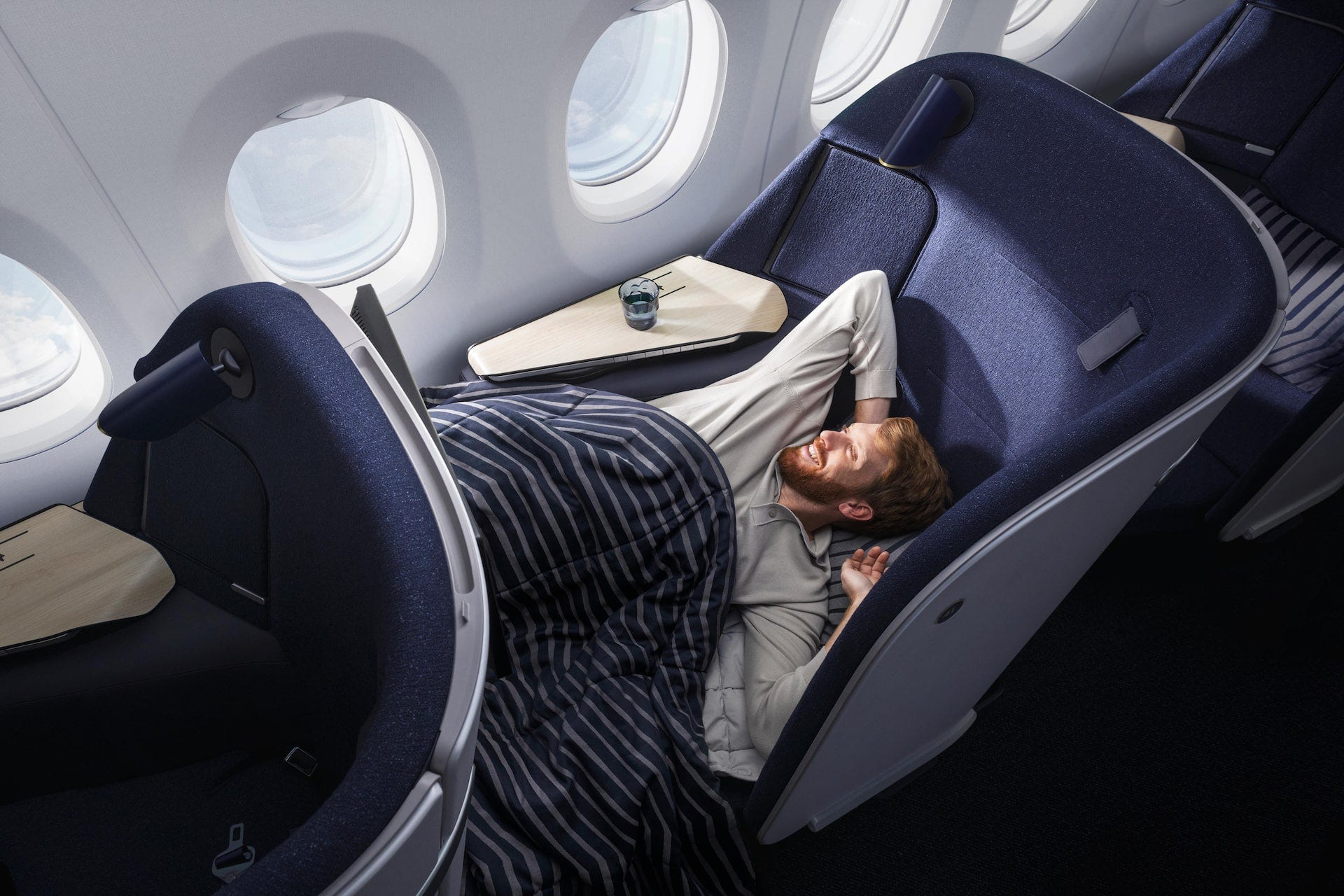
Following a fleet-wide cabin retrofit completed in 2024, every widebody now offers the new AirLounge business class with a fixed-shell, fully flat seat, an updated Premium Economy cabin and refreshed Economy.
The A330-300s have been progressively redeployed since the Russian airspace closure, with some flying domestic-feeder roles between Helsinki and Stockholm to free A350s for long-haul.
Following the conclusion of certain Qatar Airways wet-lease arrangements, Finnair plans to redeploy A330-300 capacity onto core trunk routes from 2026 onward.
On the narrow-body side, the existing A319, A320 and A321ceo aircraft are now in their later operating years.
The fleet is increasingly being addressed via a two-track replacement approach: order new E195-E2s for the long term, and acquire selected used A320/A321ceo airframes as bridge capacity until E-Jet deliveries scale.
Fleet Age and Modernization
The long-haul fleet remains one of the youngest in Europe by widebody average age, anchored by A350s that have been delivered between 2015 and the early 2020s.
The narrow-body fleet, by contrast, has been aging visibly, which is the principal reason the airline accelerated its fleet renewal in 2026.
The Embraer E195-E2 Decision
The most consequential fleet announcement of 2026 came on 23 March, when Finnair confirmed an order for up to 46 Embraer E195-E2 aircraft, structured as 18 firm orders, 16 options and 12 purchase rights, with first deliveries scheduled for 2027.
The choice of Embraer over Airbus represented a material break from Finnair’s all-Airbus mainline tradition.
The E195-E2 offers a single-class layout of roughly 132 seats and is sized precisely for the thin-but-frequent European missions that increasingly characterize Finnair’s intra-European network out of Helsinki.
EMBRAER E195-E2 ORDER (announced 23 March 2026)
Firm orders:                18 aircraft
Options:                    16 aircraft
Purchase rights:            12 aircraft
Maximum potential fleet:    46 E195-E2 aircraft
First delivery:             2027
Replacement target:         Older A319/A320 aircraft
Mission profile:            Thin, frequent European routes from HEL
Cabin layout:               ~132 seats (single-class configuration)
Bridge capacity strategy:   Used A320/A321ceo introductions
CEO Kuusisto framed the E2 selection as a practicality choice: the airframe is right-sized for Helsinki’s catchment, offers significant unit-cost improvements over the legacy narrow-bodies, and provides the operational flexibility to fly secondary European routes that cannot economically support an A320.
Fleet Strategy Through 2029
Finnair’s long-term fleet roadmap, articulated alongside its 2026–2029 strategy, centers on three pillars.
First, complete the narrow-body transition: phase out the oldest A319/A320 airframes, introduce E195-E2s from 2027 onward, and bridge the gap with selectively acquired used A320/A321ceo capacity.
Second, preserve the widebody premium. Finnair has explicitly resisted near-term widebody growth orders, choosing instead to maximize the return on the existing A350/A330 fleet through utilization gains, retrofit upgrades and route redeployment.
Third, support sustainability targets. The E2 offers a substantially lower fuel burn per seat-kilometre than the A319s it replaces, helping the carrier track its emissions reduction roadmap and Sustainable Aviation Fuel (SAF) commitments.
Regional Fleet via Norra
The Norra-operated ATR 72-500 fleet is supported by a 10-year ATR Global Maintenance Agreement that improves dispatch reliability on domestic Finnish routes serving destinations such as Kemi, Joensuu, Kuopio and Vaasa.
The E190-E1 jets are progressively undergoing upgrades to extend their service life through the end of the decade.