


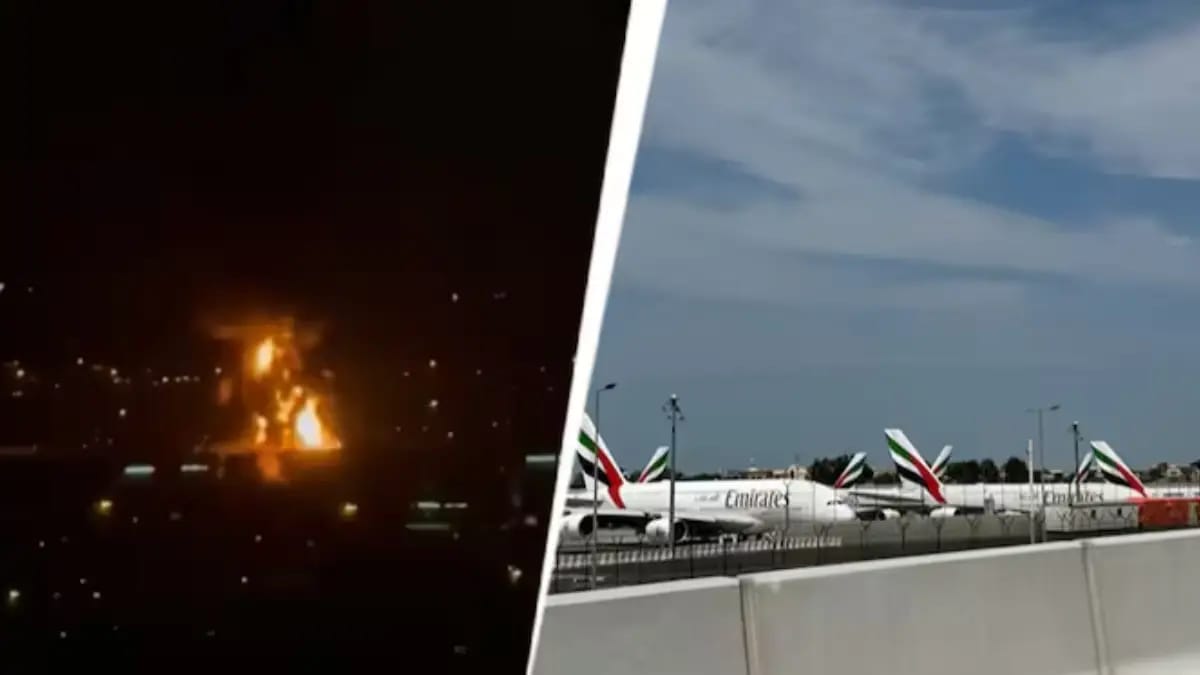
In the early hours of Monday, March 16, a drone struck a fuel tank in the vicinity of Dubai International Airport (DXB), triggering a significant fire and forcing authorities to suspend all flight operations as a precautionary measure.
The Dubai Media Office confirmed via X that the incident affected one of the airport’s fuel tanks. Crucially, no injuries were reported, and civil defence teams brought the blaze under control relatively quickly.
Dubai International Airport officially suspended flights at 6:30 am local time. Emirates airline announced it planned to operate a limited schedule after 10 am, while also noting that some flights from the day’s schedule had been cancelled.
The Cascade of Diverted and Cancelled Flights
DIVERTED TO AL MAKTOUM INTERNATIONAL AIRPORT (DWC):
  - EK307  (Beijing to Dubai)
  - EK319  (Tokyo Narita to Dubai)
  - EK407  (Melbourne to Dubai)
  - EK381  (Hong Kong to Dubai)
  - FZ1840 (Warsaw, flydubai)
  - FZ844  (Riyadh, flydubai)
  - FZ192  (Cairo, flydubai)

RETURNED TO ORIGIN:
  - EK24   (Edinburgh)
  - EK525  (Hyderabad)
  - EK20   (Manchester)
  - EK523  (Thiruvananthapuram)
  - EK164  (Dublin)
  - EK619  (Sialkot)

DELAYED DEPARTURES:
  - FZ441  (Dubai to Delhi)
  - FZ333  (Dubai to Karachi)
  - FZ883  (Dubai to Dammam)
  - FZ353  (Dubai to Islamabad)
According to The National News, flights scheduled to depart after 1 pm were still expected to run on time, indicating authorities were working toward a structured, phased recovery.
This Is Not the First Time: A Pattern of Repeated Attacks
Today’s strike is the third attack on Dubai International Airport since Iran launched its assault on Gulf nations beginning February 28, 2026.
The sequence has been relentless:
FEBRUARY 28, 2026 ── Initial Iranian assault. DXB sustains damage
                      on the first day of conflict.

MARCH 7, 2026 ────── Drone attack forces temporary suspension of
                      operations. Eyewitness reports of explosions
                      heard across Dubai.

MARCH 11, 2026 ───── Two drones fall near the airport.
                      Four people injured.

MARCH 16, 2026 ───── Drone strikes a fuel tank.
                      Fire contained. Flights suspended.
Reuters confirmed this is part of a broader pattern, noting that Gulf Arab states have collectively faced more than 2,000 missile and drone attacks since February 28.
Why Dubai Airport Is So Strategically Significant
To fully appreciate the weight of this disruption, context on what DXB represents to global aviation is essential.
Dubai International Airport is the world’s busiest airport for international travel, having recorded a record 95.2 million passengers in 2025, a 3.1% increase year-on-year. It serves 108 airlines flying to 291 cities across 110 countries.
DXB is the home base of Emirates airline, the world’s largest long-haul carrier by international passengers. The airport sits at the crossroads of east-west air travel, funnelling connecting flights between Europe, Asia, and Africa.
Paul Griffiths, CEO of Dubai Airports, stated that “record traffic is no longer an exception, but part of its operating reality.” That operating reality is now being stress-tested in an unprecedented way.
The Geopolitical Trigger Behind the Attacks
The attacks on Gulf infrastructure stem directly from the U.S.-Israel war against Iran, which began on February 28, 2026. U.S. and Israeli strikes killed Iranian Supreme Leader Ayatollah Ali Khamenei, triggering a large-scale retaliatory campaign.
Iran has specifically targeted civilian infrastructure in the UAE, including airports, hotels, ports, and oil facilities. This is attributed to the UAE’s hosting of U.S. military facilities and its historic 2020 normalisation of relations with Israel.
Iran International reported that Iran’s IRGC has been responsible for the drone and missile campaigns across the region. The UAE has intercepted over 1,000 drones since the start of the conflict.
The Aviation Industry’s Cascading Losses
The broader industry damage goes well beyond single-flight delays. The scope of disruption is significant:
FLIGHTS AFFECTED SINCE FEB 28, 2026:
  Total flights cancelled:       52,000+
  Total seat cancellations:       6 million+
  Gulf carrier revenue losses:    ~$1 billion USD

KEY ROUTE LOSSES:
  - Iranian and Iraqi overflight routes: CLOSED
  - UAE, Qatar, Kuwait airspace: Severely restricted
  - Israeli, Bahraini airspace: Closed or heavily restricted
According to Bloomberg, flight cancellations at Middle East hubs surpassed 27,000, with over half of 51,600 scheduled flights affected at one point. It’s reported that the flight disruptions cost Gulf carriers like Emirates approximately $1 billion in lost revenue.
Emirates confirmed reduced operations through March 28, 2026, having initially aimed for a full network restoration. The path to full recovery remains uncertain.
Global Ripple Effects Far Beyond the Gulf
The consequences of the conflict’s aviation disruption are not limited to the Middle East. Reuters described it as “one of the sharpest aviation shocks in recent years.”
Passengers were stranded from Bali and Kathmandu to Frankfurt. Air India cancelled long-haul departures from Delhi, Mumbai, and Amritsar. Germany’s Lufthansa extended its suspension of Middle East flights to March 8. Departure boards at Dhaka’s Hazrat Shahjalal International Airport showed extensive cancellation lists.
Aviation analyst John Strickland put it bluntly: “It is not only customers, it is the crews and aircraft all over the place.” Airlines now face the logistical challenge of repositioning hundreds of aircraft and coordinating crews scattered across multiple continents.
Fuel costs have compounded the problem further. Brent crude jumped 10% to $80 a barrel amid the conflict, with analysts warning of prices potentially reaching $100 per barrel.
What This Means for Airport Security and Operational Continuity?
The repeated targeting of DXB raises hard questions that aviation stakeholders need to confront directly.
Airports are designed for open access by their nature, but that openness creates a significant vulnerability to low-cost drone threats. Aviation Week noted that aircraft and crews being dispersed worldwide creates complex logistical challenges when trying to resume operations, making recovery from attacks non-linear and slow.
Semafor reported that Gulf airlines are gradually picking up capacity, but that a fresh barrage of drones can quickly force airports to close again, making any published timetable for recovery provisional at best.
Drone interception systems are active across the UAE, but as today’s fuel tank strike demonstrates, even a partial penetration of air defences can halt operations at one of the world’s most important aviation nodes.
The Road Ahead for Dubai and Gulf Aviation
The UAE has pledged continued operations and DXB’s gradual resumption is already underway. Dubai has also activated its contingency infrastructure, with Al Maktoum International Airport serving as the diversion hub, approximately 20 miles from DXB.
Long-term, the UAE has been planning to shift all DXB operations to Al Maktoum by 2032, following a roughly $35 billion upgrade. That transition may now take on new urgency in the context of regional security planning.
For aviation industry stakeholders, the lesson of March 16, 2026 is clear: even the world’s busiest international airport is not immune to the direct operational consequences of regional geopolitical conflict.
Resilience planning must now factor in repeated drone and missile threats as a structural, not exceptional, risk.