


Executive Summary
Garmin’s Aviation segment posted record FY2025 revenue of $987 million, up 13% YoY, with Q4 2025 aviation revenue growing 16% on contributions from both OEM platforms and aftermarket retrofits, per the fiscal 2025 results release.
G3000 PRIME has become a category-defining flight deck, locked into the Pilatus PC-12 PRO, the Daher TBM 980, and the Pilatus PC-7 MKX military trainer selected by France’s air force.
Autoland’s first real-world deployment in December 2025 validated a decade of autonomy investment; the system is now installed on roughly 1,700 aircraft and expanding into piston singles such as the Cirrus SR Series G7+.
2026 consolidated guidance points to ~$7.9 billion in revenue, implying ~9% growth with continued aviation contribution from OEM ramps, retrofit autopilots and autonomy royalties.
Recommended - Read Full Reports


Read All Reports
Table of Contents
Executive Summary
Introduction
Key Facts: Company Profile
Garmin Company Overview
From Marine GPS to Integrated Cockpits: A Brief Strategic History
Corporate Structure and the Aviation Segment
A Different Cost Structure than Defense Primes
Key Product Lines, Programs and Services
Integrated Flight Decks: The G3000 PRIME Inflection
Pilatus PC-12 PRO: A Headline OEM Win
Daher TBM 980: French Premium Turboprop
Pilatus PC-7 MKX: The Defense Beachhead
Autonomi: Autoland, Smart Glide and the Autonomy Stack
Retrofit Avionics: The Hidden Annuity Engine
Weather, Surveillance and Mission Sensors
Helicopter and Rotorcraft Solutions
Government and Defense Avionics
Financial Analysis: Garmin
Consolidated Performance: A Record 2025
Aviation Segment Revenue Composition
Profitability Profile
Capital Allocation: Buybacks, Dividends and a Disciplined Balance Sheet
Q1 2026 Outlook and Guidance Path
Revenue and Growth Drivers
Driver 1: G3000 PRIME OEM Deliveries
Driver 2: Autoland Penetration into New Platforms
Driver 3: Retrofit Autopilots and Glass Cockpits
Driver 4: Database, Subscription and Connectivity Services
Driver 5: Defense and Government Programs
Driver 6: International OEM Adoption
Revenue Last Twelve Months and Trajectory
Major Competitors
Garmin vs. Honeywell
Garmin vs. Collins Aerospace
Garmin vs. Avidyne
Garmin vs. Dynon
Competitive Analysis and Moat: Garmin
Installed Base as the Dominant Moat
Service Network and Brand
Vertical Integration
Open Architecture as a Forward Moat
Regulatory Certification as a Cost-of-Entry Moat
Strategic Themes Shaping 2026 and Beyond
Theme 1: The Autonomy Ladder
Theme 2: Connected Aircraft Services
Theme 3: Defense Trainer Adoption
Theme 4: Business Aviation Demand Cycle
Theme 5: International and EASA-Driven Demand
Financial and Commercial Implications
Implication 1: Aviation as a Steady Growth Engine, Not a Single-Year Bet
Implication 2: Margin Expansion Through Software Mix
Implication 3: Strong Free Cash Flow Funds Capital Returns
Implication 4: Strategic Optionality Through Mesa Test Capacity
Key Risks with Probabilities and Scenarios
Risk 1: Business Aviation OEM Cycle Downturn
Risk 2: Honeywell Anthem Certification and OEM Wins
Risk 3: Regulatory Cycle Risk
Risk 4: Supply Chain and Component Availability
Risk 5: Defense Procurement Variability
Risk 6: Litigation or Liability from Autonomy
Risk 7: Foreign Exchange Movement
Risk 8: Concentration in Key OEM Customers
SWOT Analysis: Garmin
Outlook for 2026 and Beyond
The Near-Term Picture
The Medium-Term Picture
The Long-Term Picture
Financial Implications of the Outlook
Other Strategic Considerations
Garmin Aviation Product Roadmap: What to Watch in 2026
Garmin Pilot App and the Consumer-Pilot Stack
Garmin and the Future of Single-Pilot Operations
Aircraft Manufacturing Partners and Garmin OEM Ecosystem
My Final Thoughts
Official Sources and Data
Introduction
On December 20, 2025, a Beechcraft King Air 200 cruising near the Rocky Mountains lost cabin pressure with an incapacitated pilot. The airplane then did something no commercial transport aircraft had ever done in a real emergency: it landed itself.
Pressing a single red button activated Garmin Emergency Autoland, which brought the turboprop safely down at a Colorado airport with passengers untouched.
That moment, captured on radar and replayed in cockpits worldwide, was the loudest validation yet of a quiet thesis the Olathe-based avionics maker has spent two decades building: that software-defined autonomy belongs not just in defense drones or autonomous cars, but in the general aviation cabin.
The company’s aviation segment generated $987 million in fiscal 2025, growing 13% year over year, and has now topped Aviation International News’ Product Support Survey for 22 consecutive years.
This in-depth analysis report dissects the aerospace & defense businesses inside Garmin Ltd. for 2026 and beyond, including the OEM wins, the retrofit annuities, the autonomy roadmap, the defense pipeline, and the competitive walls being built and tested.

Key Facts: Company Profile
COMPANY:           Garmin Ltd.
TICKER / EXCHANGE: NYSE: GRMN
INCORPORATED:      Schaffhausen, Switzerland (operational HQ: Olathe, Kansas, USA)
FOUNDED:           1989 (by Gary Burrell and Min Kao)
CEO:               Clifton A. Pemble (President & CEO)
EMPLOYEES:         ~21,000 (global, year-end 2025)
FY2025 REVENUE:    $7.25 billion (consolidated, +15% YoY)
FY2025 OP. INCOME: $1.88 billion (op. margin 25.9%)
AVIATION REVENUE:  $987 million FY2025 (+13% YoY)
AVIATION SHARE:    ~13.6% of consolidated revenue
SEGMENTS:          Fitness, Outdoor, Aviation, Marine, Auto OEM
LIFETIME UNITS:    300+ million products delivered
AIN SURVEY:        #1 Flight Deck Avionics — 22 consecutive years
The aviation segment, while not the largest by revenue, is one of the highest-margin and most strategically defensible parts of the portfolio.
It’s also the segment with the longest product life cycles and the deepest installed-base lock-in.
Garmin Company Overview
From Marine GPS to Integrated Cockpits: A Brief Strategic History
Garmin began life as a GPS hardware specialist, but by the early 2000s its engineers were already prototyping an integrated cockpit that would eventually displace mechanical instruments across general aviation. The launch of the G1000 platform became the inflection point that turned a consumer-electronics brand into an avionics OEM.
That single architectural decision, putting flight, navigation, communications and engine data on a unified bus with shared displays, defined the product playbook the company has run ever since. Every subsequent flight deck, G3000, G5000, G3000 NXi, and most recently G3000 PRIME, is an evolution of that thesis.
The Olathe, Kansas campus has scaled in step with this expansion. A $200 million campus expansion opened a 750,000-square-foot manufacturing and distribution facility that more than doubled aviation product manufacturing and distribution capacity, and additional renovations and incentives followed in 2024.
GARMIN AVIATION FOOTPRINT (2026)
- Olathe, Kansas (HQ): Aviation R&D, manufacturing, certification
- Salem, Oregon: Aviation product line, engineering, integration testing
- Mesa, Arizona: Aircraft integration & flight test (acquired 2024)
- Cary, North Carolina: Aviation engineering
- Chandler, Arizona: Aviation engineering
- International: Schaffhausen (CH), Southampton (UK), and othersCorporate Structure and the Aviation Segment
Garmin reports five segments: Fitness, Outdoor, Aviation, Marine, and Auto OEM.
The aviation segment encapsulates everything from portable handhelds carried by student pilots to the integrated flight decks installed in head-of-state turboprops.
Inside aviation, the company breaks revenue informally into two streams: OEM (sold to aircraft manufacturers and integrated on the production line) and aftermarket (retrofitted into existing aircraft via dealer networks and authorized installation centers).
Both grew in the fourth quarter of 2025, a configuration management is keen to highlight because it indicates the segment is not over-indexed on a single channel.
A Different Cost Structure than Defense Primes
Unlike a Honeywell or Collins Aerospace division, Garmin’s aviation business benefits from being inside a larger consumer-electronics company.
That means shared semiconductor sourcing, common display panels, and amortization of certain core platform investments across millions of units in unrelated categories.
The result is a cost curve that competitors who sell only into aviation cannot easily replicate.
It is also why the company can credibly target turbofan and military trainer markets while still pricing aggressively in the piston single retrofit space.
Key Product Lines, Programs and Services

Integrated Flight Decks: The G3000 PRIME Inflection
The flagship of the 2026 product portfolio is the G3000 PRIME integrated flight deck, announced in late 2024 and now sweeping through OEM platforms.
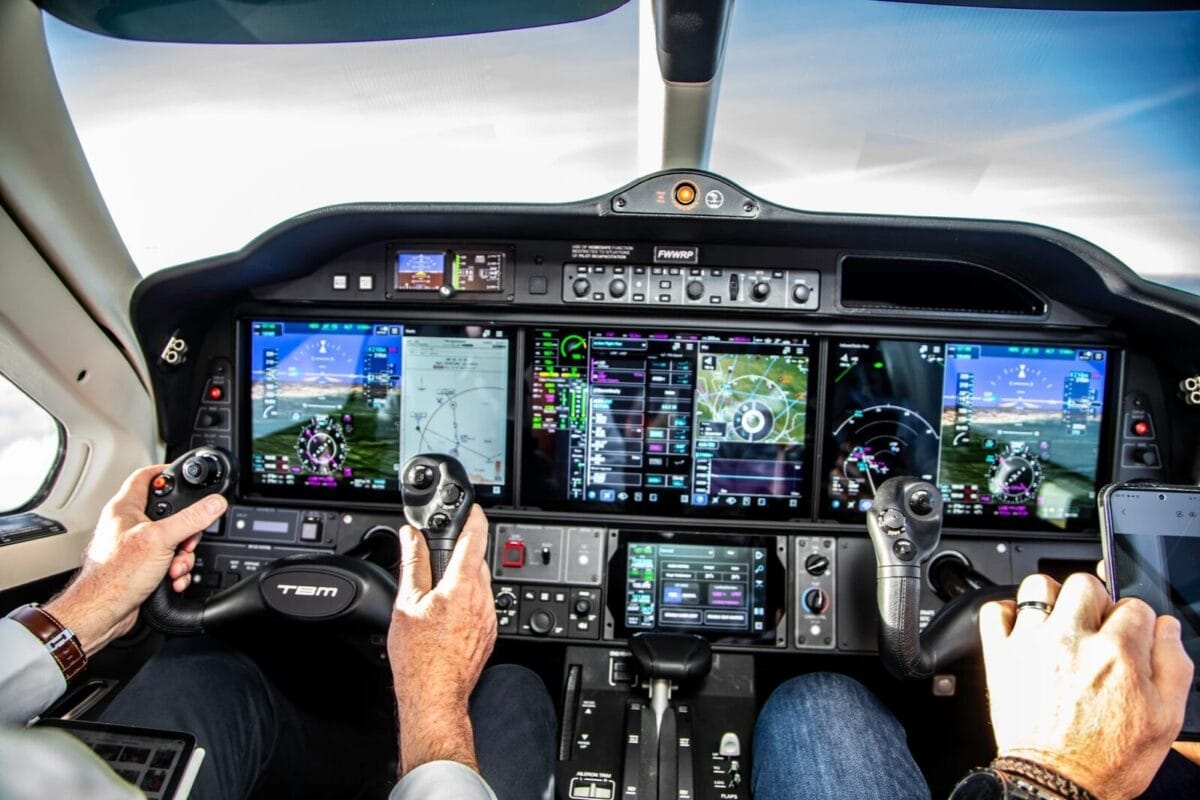
PRIME builds on the G3000 family with all-touchscreen edge-to-edge displays, an open system architecture, and processing power described as roughly twice the CPU and four times the memory of the prior generation.
Crucially, PRIME is not a new product: it’s a new platform.
By design, it is intended to host third-party software, open APIs and modular avionics functions for years to come, making it more like a smartphone OS than a static hardware suite.
G3000 PRIME — KEY DESIGN POINTS
- Edge-to-edge touchscreen displays (up to 14 inches per panel)
- Open system architecture for third-party app integration
- ~2x CPU / 4x memory uplift vs. legacy G3000
- Designed to host future Autoland and autonomy modules
- Available in standard and tandem (military trainer) configurations
The first OEM platforms confirmed on PRIME include the Pilatus PC-12 PRO single-engine turboprop, the Daher TBM 980 turboprop, and the Pilatus PC-7 MKX tandem trainer.
Each represents a distinct competitive win, and together they define the PRIME ramp-up trajectory through 2026 and 2027.
Pilatus PC-12 PRO: A Headline OEM Win
Pilatus chose Garmin G3000 PRIME for its next-generation PC-12 PRO, the latest evolution of the world’s best-selling single-engine turboprop. The cockpit features five high-resolution touchscreen displays, and the simulator was certified for pilot training before deliveries began.
The selection was strategically significant because Pilatus had a Honeywell Anthem flight deck flying as a test article on a PC-12.
Choosing Garmin over a yet-to-be-certified competitor reaffirmed that certified, in-service maturity still beats brochure features in business aviation procurement.
Daher TBM 980: French Premium Turboprop
Daher unveiled the TBM 980 with G3000 PRIME avionics featuring three 14-inch edge-to-edge displays. The TBM family has flown almost exclusively on Garmin glass for two decades, but the move to PRIME on the 980 cements the relationship through the next product cycle.
The TBM 980 made its U.S. debut at Sun ‘n Fun 2026, giving Garmin a high-visibility platform during the spring airshow season just ahead of Q1 earnings.
Pilatus PC-7 MKX: The Defense Beachhead
The third PRIME program is the Pilatus PC-7 MKX military training aircraft, which features a tandem PRIME flight deck plus a head-up display. France ordered 22 PC-7 MKX aircraft for its pilot training pipeline, with the official defense procurement disclosed in March 2025.
This win matters disproportionately because military trainers tend to cascade into adjacent platforms.
A pilot who learns on a PRIME-equipped trainer is a pilot who feels at home in a PRIME-equipped business jet a decade later, anchoring the brand into the next generation of cockpit muscle memory.
Autonomi: Autoland, Smart Glide and the Autonomy Stack
The most strategically valuable franchise inside Garmin’s aviation portfolio is the Autonomí family of autonomous flight solutions.
At its core is Emergency Autoland, which can take full control of an aircraft, pick a runway, brake to a stop and shut down the engine without pilot input.
As mentioned earlier, after years of demonstrations and certification work, Autoland was deployed for the first time in a real emergency on December 20, 2025, when a King Air 200 with an incapacitated pilot landed safely at Rocky Mountain Metropolitan Airport.
The system was at that point installed on approximately 1,700 aircraft.
AUTONOMÍ STACK — 2026 SCOPE
- Emergency Autoland: full autonomous descent, approach, landing, shutdown
- Smart Glide: engine-out best-glide guidance for single-engine aircraft
- Autothrottle: workload-reducing thrust management, paired with Autoland
- Runway Occupancy Awareness (ROA): runway intrusion alerting
- Surface Indications & Alerts: taxi safety on G3000 PRIME platforms
The Smart Glide system extends the same philosophy to non-Autoland aircraft by automatically engaging the autopilot at best glide speed and identifying suitable airports following a power loss.
This is meaningful because it puts intelligent autonomy into the much larger general-aviation fleet where Autoland would be cost-prohibitive.
Retrofit Avionics: The Hidden Annuity Engine
While headlines tend to track OEM wins, a large part of the aviation segment’s profitability comes from the aftermarket retrofit business. The GFC 500 and GFC 600 digital autopilots have systematically displaced legacy mechanical autopilots across the general aviation fleet.
Each year the company adds new aircraft model approvals via Supplemental Type Certificates. Recent examples include the Piper PA-31T Cheyenne and Cheyenne II and additional Beechcraft models, broadening the addressable installed base every quarter.
GARMIN RETROFIT ECOSYSTEM — CORE PRODUCTS
- GFC 500 / GFC 600: digital autopilots for piston and turboprop aircraft
- GTN Xi navigators (650 Xi / 750 Xi): touchscreen IFR navigators
- GPS 175 / GNX 375 / GNC 355: compact panel-mount navigators
- GI 275 electronic flight instruments (3.125-inch round retrofit)
- G500 TXi / G600 TXi: glass primary flight displays
- GDL 60 datalink with PlaneSync (connected aircraft management)
The GDL 60 datalink with PlaneSync is a particularly important 2026 product because it pulls Garmin into the recurring-services layer. PlaneSync automatically updates aviation databases, logs flight and engine data, and lets owners check fuel and systems remotely from a smartphone.
That recurring digital services layer matters strategically because it lays the groundwork for a software annuity attached to hardware. Even modest connectivity ARPU across a six-digit installed base would meaningfully shift the segment’s profile.
Weather, Surveillance and Mission Sensors
Beyond flight decks and autopilots, the segment includes a portfolio of mission-critical sensors. The GWX 8000 StormOptix weather radar is a Doppler-enabled system with automated threat analysis, displaying cells in 16 colors versus the 4 of legacy radars.
Surveillance products span ADS-B In/Out transponders, datalink receivers, traffic computers and radar altimeters serving both commercial and government/defense operators.
These tend to be lower revenue per unit but high in attach rate, embedding Garmin deep into the cockpit electronics ecosystem.
Helicopter and Rotorcraft Solutions
The helicopter portfolio includes ADS-B, transponders, radar altimeters, and a scaled version of the G1000 (G1000H) and G3000 (G3000H) for rotor platforms. Helicopter operators are a steady, if smaller, contributor to the aviation segment.
Rotor markets demand additional certification work because of the unique flight regimes and vibration environments, but the products are ultimately variants of the fixed-wing platforms, allowing significant cost amortization.
Government and Defense Avionics
The government and defense aviation business has historically been an underappreciated part of the aviation segment.
It encompasses integrated flight decks for trainers, GPS receivers, ADS-B, datalinks and mission systems sold to defense organizations and defense contractors.
Notable defense activity has included the F-5 Sustainment Program, which references Garmin G3000 Integrated Avionics System product support, and the broader expansion into the trainer and special-mission segment via PRIME on the PC-7 MKX.
Financial Analysis: Garmin
Consolidated Performance: A Record 2025
Fiscal 2025 was the strongest year in the company’s history. Consolidated revenue reached $7.25 billion, up 15% year over year, with all five segments posting record annual revenue. Operating income hit $1.88 billion, up 18%.
The full-year operating margin expanded to 25.9%, from 25.3% in 2024, evidence that revenue growth translated efficiently into operating leverage. Gross margin came in at 58.7% for the year.
GARMIN FY2025 CONSOLIDATED SNAPSHOT
- Revenue:           $7.25 billion (+15% YoY)
- Gross margin:      58.7%
- Operating income:  $1.88 billion (+18% YoY)
- Operating margin:  25.9%
- Q4 revenue:        $2.12 billion (+17% YoY, first $2B+ quarter)
- Q4 gross margin:   59.2%
- Lifetime products: 300+ million; ~20 million in FY2025 alone
The full-year aviation segment posted revenue of $987 million, up 13% year over year, with growth contributions from both OEM and aftermarket categories. Q4 aviation revenue grew 16%, an acceleration that suggests the PRIME ramp is beginning to layer on top of steady aftermarket demand.
Aviation Segment Revenue Composition
The aviation segment’s mix is roughly balanced between OEM line-fit and aftermarket retrofit, with the company avoiding precise channel disclosure but highlighting both as growth contributors.
That balance has been central to the segment’s resilience through aerospace cycles.
In quarters when business jet deliveries soften, retrofit upgrades typically pick up because owners hold onto aircraft longer and invest in cockpit refreshes. In quarters when OEM deliveries surge, line-fit revenue scales with each delivered aircraft.
Profitability Profile
Aviation has historically been one of the highest-margin segments in the portfolio, reflecting certified-product pricing power, low commoditization risk, and an installed base that pays for software updates, database subscriptions and parts support over decades.
Although the company does not disclose segment-level operating margin in real time, the 2025 Form 10-K makes clear that aviation contributes meaningfully to the consolidated 25.9% operating margin profile.
That margin is among the highest in the broader avionics peer set.
Capital Allocation: Buybacks, Dividends and a Disciplined Balance Sheet
Garmin entered 2026 with a fortress balance sheet, no meaningful debt, and a sizable cash and marketable securities position.
The board approved an increased dividend and continued buybacks following the Q4 2025 print.
CAPITAL ALLOCATION SIGNALS HEADING INTO 2026
- 2026 revenue guidance: ~$7.9B (~9% growth)
- Pro forma EPS guidance: ~$9.35
- Dividend: increased post FY2025 results
- Buyback: extended; additional authorization
- Net cash: substantial; no material long-term debt
The aviation segment is a contributor to that cash generation engine. Long product life cycles, multi-year warranty arrangements and recurring database subscriptions all stabilize cash flow even when consumer-facing segments are seasonal.
Q1 2026 Outlook and Guidance Path
The company scheduled its first quarter 2026 earnings call for April 29, 2026. Full-year 2026 consolidated revenue is guided to about $7.9 billion, with management emphasizing consolidated rather than segment-level guidance going forward.
The shift toward consolidated guidance is itself a signal: management is increasingly comfortable letting individual segment mix shift quarter to quarter as long as the overall growth and margin profile holds.
For aviation, that creates more flexibility to invest in the PRIME ramp and autonomy roadmap without short-term segmental pressure.
Revenue and Growth Drivers
Driver 1: G3000 PRIME OEM Deliveries
The single biggest medium-term driver of aviation revenue is the rollout of G3000 PRIME on the new PC-12 PRO, TBM 980 and PC-7 MKX. Each delivered airframe carries a high-value avionics shipset that flows into Garmin’s revenue.
Pilatus and Daher together represent the most important single-engine turboprop pipelines in business aviation, and both have committed to PRIME for their flagship next-generation aircraft.
As deliveries ramp through 2026 and 2027, the OEM revenue contribution from PRIME alone could become a noticeable inflection.
Driver 2: Autoland Penetration into New Platforms
Each new aircraft type that adds Autoland represents both an OEM line-fit attach and a retrofit opportunity for the existing fleet. The Cirrus SR Series G7+ became the first piston-powered aircraft with Autoland, and Autoland is also now certified for retrofit on select Beechcraft King Air aircraft.
The post-incident publicity from the December 2025 deployment is likely to accelerate buyer interest. Insurance considerations and family-buyer preferences both push owner-pilots toward configurations that include emergency autonomy.
Driver 3: Retrofit Autopilots and Glass Cockpits
The aftermarket business benefits from a structural tailwind: the global piston and turboprop fleet is aging, and retrofitting modern avionics extends useful life at a fraction of new-aircraft cost. Each STC-approved aircraft model is essentially a new addressable subset.
GFC 500 and GFC 600 autopilots, paired with G500 TXi or G600 TXi displays and GTN Xi navigators, form a complete cockpit refresh pipeline. The frequency of new STC approvals announced by the company suggests the addressable market is still expanding meaningfully.
Driver 4: Database, Subscription and Connectivity Services
The Guided Visual Approaches database is an example of a software product turning into a recurring service. Each newly added airport with guided visual procedures is a sales hook for additional database subscriptions across the GTN Xi installed base.
Connected aircraft services through PlaneSync layer on top, generating revenue independent of new hardware sales. While the company does not break out service revenue specifically, the growing software footprint is a persistent positive for segment margins.
Driver 5: Defense and Government Programs
The PC-7 MKX selection is the most visible recent defense win, but the broader government and defense aviation business continues to generate steady contracts. Trainer programs are particularly attractive because of long production tails and decades of sustainment revenue.
Sustainment is itself a growing line of business. The Venom F-5 sustainment notice referencing G3000 product support shows how Garmin avionics on legacy airframes generate recurring revenue years after initial fielding.
Driver 6: International OEM Adoption
Pilatus is a Swiss OEM, Daher is French, and several other PRIME prospects are international airframers. This geographic mix matters because it positions Garmin to ride global business aviation demand even when U.S. domestic demand softens.
European and Asia-Pacific demand for next-generation cockpits has been steady in business aviation, and the AERO Friedrichshafen presence highlighted in the Garmin AERO 2026 microsite shows the company actively pursuing those markets through localized promotions and dealer support.
Revenue Last Twelve Months and Trajectory
On a consolidated last-twelve-month basis as of fiscal year-end 2025, revenue was approximately $7.25 billion. Aviation specifically was approximately $987 million on the same basis.
Looking forward, the 2026 consolidated guidance of about $7.9 billion implies a respectable growth trajectory, with aviation expected to continue contributing.
SEGMENT CONTRIBUTION CONTEXT (FY2025)
- Fitness:   highest growth segment in 2025 (+42% in Q4)
- Marine:    +18% in Q4
- Aviation:  +16% in Q4 (+13% full year, $987M)
- Outdoor:   solid growth, premium adventure tilt
- Auto OEM: growing on long-cycle program rampsMajor Competitors
The aviation, aerospace, and defense competitive set is concentrated in a small number of well-resourced firms. The principal direct competitors include:
Honeywell Aerospace Technologies - the closest peer in integrated flight decks (Anthem, Primus Epic) and a diversified avionics, mechanical and connectivity supplier
Collins Aerospace (RTX) - Pro Line Fusion, advanced cockpit systems and broader aerospace electronics for commercial and military aircraft
Thales Group - strong in commercial transport avionics, communications and select military programs
Avidyne Corporation - niche competitor in light aircraft and business jet avionics, including IFR GPS navigators and integrated displays
Dynon Avionics - experimental and Part 23 certified retrofit competitor in lower price tiers
L3Harris Technologies - defense avionics and communications systems
BAE Systems plc -military flight controls and mission systems
Moog Inc. - flight controls and motion components
The competitive landscape varies significantly by product line.
In retrofit autopilots for general aviation, Garmin’s principal competition is Avidyne and Dynon.
In integrated flight decks for business jets, the head-to-head matchup is Honeywell and Collins Aerospace.
In military trainers, Collins Aerospace and Thales are the primary alternatives.
Garmin vs. Honeywell
Honeywell is Garmin’s most direct integrated-flight-deck competitor. The Honeywell Anthem cloud-native cockpit was unveiled as a next-generation, customizable, connected platform aimed squarely at the same OEMs that buy G3000 PRIME.

The Pilatus PC-12 PRO selection is a useful real-world data point: Pilatus had Anthem flying as a test article on a PC-12 but chose Garmin’s certified PRIME for the production aircraft.
The takeaway is that Honeywell has compelling architecture but still needs to convert that into certified, installed-base credibility against Garmin’s existing two-decade head start.
Honeywell brings a much broader aerospace systems portfolio (mechanical systems, propulsion accessories, satellite communications, connected aircraft services) and is the larger, more entrenched supplier on commercial transport.
In business aviation cockpits specifically, however, Garmin has moved from challenger to incumbent.
Garmin vs. Collins Aerospace
Collins Aerospace, part of RTX Corporation, competes via the Pro Line Fusion family and a deep portfolio of avionics, communications and connectivity products.
Collins has historically been stronger on the mid-to-large business jet end of the market and on commercial transport.

Garmin has steadily moved upmarket from light single-engine aircraft into the territory Collins traditionally owned.
The certification of GFC 600 on turbofan platforms marks a meaningful upmarket push, and PRIME on the PC-7 MKX military trainer brings a defense-tinged credibility Collins cannot easily counter on a per-airframe cost basis.
Collins’ advantage is institutional: scale, breadth, defense relationships and sustainment infrastructure across thousands of aircraft.
Garmin’s advantage is agility, vertical integration and a platform philosophy that delivers more predictable software updates over time.
Garmin vs. Avidyne
Avidyne competes mostly in the general aviation IFR navigator and integrated avionics space, with products like the IFD550 and IFD440 series targeting essentially the same retrofit pilot demographic as Garmin’s GTN Xi family.
Avidyne’s appeal historically has been a slip-in form factor and somewhat different user interface preferences.
However, Garmin’s installed base scale, dealer network depth and brand momentum from Autoland and PRIME have steadily compressed Avidyne’s market position.
Pricing competition exists but is rarely the deciding factor among certified installations because service infrastructure dominates the buying decision.
Garmin vs. Dynon
Dynon historically built its business in experimental and amateur-built aircraft, then expanded into Part 23 certified retrofit territory. Its SkyView HDX certified system targets the lower-cost end of the retrofit market.
Dynon’s pricing is sharper than Garmin’s, and for cost-sensitive owner-flown aircraft it has gained genuine traction.
Garmin counters with a deeper STC roster, a larger installation network, and the brand halo of Autoland and PRIME at the top of its lineup.