


Executive Summary
Hainan Airlines Holding Co., Ltd. closed fiscal year 2025 with consolidated revenue of RMB 68.471 billion and net profit of RMB 1.98 billion, reversing the prior year’s loss, although roughly 53% of that bottom-line figure came from non-recurring aircraft disposal gains and impairment reversals rather than core operations.
The carrier operates around 222 aircraft with an average age close to 9.8 years, and in October 2025, it became the first Chinese carrier to take delivery of the Airbus A330-900neo, a significant step in its widebody renewal roadmap.
The route network spans 69 domestic and 47 international destinations across 34 countries, with a major 2026 expansion push anchored on Haikou as the gateway to the Hainan Free Trade Port.
Hainan Airlines has now held the Skytrax 5-Star rating for fourteen consecutive years through 2025, remaining the only mainland Chinese carrier in the Skytrax World’s Best Airlines Top 10.
Recommended - Read Full Reports


Read All Reports
Table of Contents
Executive Summary
Key Facts: Company Profile
Business Overview
Ownership Structure and Post-Restructuring Stability
FY 2025 Financial Performance (LTM)
Revenue Mix and Growth Drivers
Key Services and Products
Fleet: In-depth Analysis
Fleet Size and Overall Composition
Fleet Age Profile
Aircraft Types, Cabin Strategy and Configuration
Fleet Strategy: Phase-Outs and Renewal Path
GEnx Engines and Sustainable Operations
Route Network, Major Destinations and Strategy
Network Scale and Geographic Spread
European Corridor
North American Corridor
Asia Pacific Corridor
Middle East and Africa
The 2026 Global Expansion
Strategic Logic of the Four-Hub International Vision
Major Operational Bases (Hubs)
Haikou Meilan International Airport
Beijing Capital International Airport
Chongqing Jiangbei International Airport
Shenzhen Bao’an International Airport
Xi’an Xianyang International Airport
Sanya Phoenix International Airport
Hangzhou and Guangzhou Operations
Competitive Position
List of Major Competitors
Hainan Airlines vs Air China
Hainan Airlines vs China Southern Airlines
Hainan Airlines vs China Eastern Airlines
Hainan Airlines vs Cathay Pacific
Hainan Airlines vs Juneyao Air and Spring Airlines
Hainan Airlines vs HNA Subsidiary Airlines
Subsidiary Airline Group Structure
Wholly Owned and Majority Stakes
Tianjin Airlines and the Acquisition Pattern
Brand, Product and Service Quality
The 5-Star Rating Era
Service Brand Architecture
Catering and Onboard Innovation
The Hainan Free Trade Port Tailwind
Policy Environment
Market Development
Fleet Financing and Leasing Approach
Key Risks with Probabilities and Scenarios
Balance Sheet and Accumulated Losses Risk
Non-Recurring Profit Dependency
Geopolitical and Regulatory Risk
Fleet Transition Execution Risk
Competitive Pressure on Yields
Currency Risk on Dollar-Denominated Obligations
Macroeconomic and Tourism Demand Risk
ESG and Sustainability Positioning
Environmental Initiatives
Social and Governance
Technology and Digital Transformation
In-flight Connectivity
Distribution and Direct Channels
Management and Governance
Current Leadership
Shareholder Structure
Outlook for 2026
Strategic Outlook: The Four-Hub Vision in Action
My Final Thoughts
Official Sources and Data
Key Facts: Company Profile
Hainan Airlines is the flagship airline of the HNA Aviation Group and is the fourth largest passenger carrier in mainland China by fleet size. Its identity is anchored in Hainan Island, which has been elevated into a national Free Trade Port under Chinese policy.
The carrier retains a dual character. It acts as a mass-market domestic operator with a large narrow-body backbone, and simultaneously projects a premium international brand through its 14-time consecutive 5-Star designation.
Legal Entity        : Hainan Airlines Holding Co., Ltd.
Ticker / Exchange   : 600221 (Shanghai Stock Exchange)
IATA / ICAO / Call  : HU / CHH / Hainan
Founded             : October 1989 (Haikou)
Headquarters        : Haikou, Hainan Province, PRC
Main Base           : Haikou Meilan International Airport (HAK)
Key Hubs            : Beijing Capital, Chongqing, Shenzhen, Xi'an
Fleet Size          : ~222 to 225 aircraft (avg age ~9.8 yrs)
Destinations        : 69 domestic + 47 international (34 countries)
Alliance            : None (non-aligned)
Parent              : HNA Aviation Group (Liaoning Fangda controlled)
FY2025 Revenue      : RMB 68.471 billion
FY2025 Net Profit   : RMB 1.98 billion
Skytrax Rating      : 5-Star (14 consecutive years)
Employees : ~35,000 (consolidated, latest disclosure)The airline remains non-aligned among the three global alliances.
It relies instead on a dense web of codeshare partnerships with carriers such as American Airlines, Alaska Airlines, Air Berlin’s successors, Brussels Airlines, and Virgin Atlantic, depending on the specific regional corridor.
Ownership sits under HNA Aviation Group, which in turn is controlled by Liaoning Fangda Group Industrial, following the bankruptcy reorganization concluded in December 2021.
Fangda is a Chinese industrial conglomerate with interests in carbon products, steel, and pharmaceuticals, an unusual backer for a premium airline.
Business Overview
Ownership Structure and Post-Restructuring Stability
The airline’s corporate story pivots on one pivotal year, 2021. After the collapse of its former parent under the weight of a sprawling global shopping spree, a Hainan court placed HNA into bankruptcy administration and creditors eventually backed Liaoning Fangda as the strategic investor for the aviation businesses.
Fangda’s takeover was completed on October 31, 2021, and operational management moved to the new investor in December of that year.
The deal injected working capital into the airline, discharged toxic related-party exposures inherited from the former parent, and ringfenced the carrier from HNA Group’s real estate and financial services problems.
POST-RESTRUCTURING TIMELINE (HAINAN AIRLINES)
----------------------------------------------
Jan 2021   : HNA Group enters court-supervised restructuring
Oct 2021   : Hainan court approves reorganization plan
Dec 2021   : Operational control shifts to Liaoning Fangda
2022-2024  : Fleet rationalization, route rebuilding
2025       : Return to full-year net profit of RMB 1.98bn
2026       : Long-haul expansion from Haikou FTP
Liaoning Fangda has since acted as a patient financial sponsor. It has backed fleet upgrades such as the 787-9 cabin refresh and the first A330-900neo delivery, rather than pushing for rapid asset disposals.
The listed entity, Hainan Airlines Holding, nevertheless retains structural fragility. Accumulated unremedied losses at the parent company stand at RMB 55.813 billion, which prevents dividend distributions and keeps the balance sheet highly leveraged.
FY 2025 Financial Performance (LTM)
The 2025 results represent the first full year of positive net income since the HNA restructuring era. Revenue reached RMB 68.471 billion, up 4.96% year-on-year, while net profit attributable to shareholders swung from a loss of RMB 921 million in 2024 to a gain of RMB 1.98 billion.
That headline is less triumphant on close inspection. Non-recurring items contributed around 53% of attributable profit, primarily driven by RMB 941 million of gains from disposing non-current assets, and another RMB 301 million in reversals of impairments on receivables.
Operating cash flow tells a healthier story. Cash generated from operations rose 13.57% to RMB 16.051 billion, reflecting genuine traffic recovery rather than one-time items.
FY2025 FINANCIAL SUMMARY (RMB, consolidated)
---------------------------------------------
Total revenue           : 68.471 bn  (+4.96% YoY)
Net profit attributable : 1.980 bn   (vs -0.921 bn)
Non-recurring net profit: 0.930 bn   (vs -2.063 bn)
Operating cash flow     : 16.051 bn  (+13.57%)
Q4 2025 revenue         : 15.033 bn
Q4 2025 net (loss)      : (0.865) bn
Selling expenses        : 2.272 bn   (+10.45%)
Financial expenses      : 2.303 bn   (-55.37%)
Debt/Asset ratio        : 96.47%
Current ratio           : 0.74
The fourth quarter showed the seasonality of Chinese long-haul travel. A Q4 operating loss of RMB 865 million reflects weaker yields after the October Golden Week peak, combined with accelerated depreciation on aging 787-8s being readied for disposal.
Financial expenses fell by 55.37%, a tailwind from USD-linked foreign exchange gains during 2025 as the renminbi’s relative stability reduced unrealized losses on dollar-denominated aircraft lease liabilities.
Revenue Mix and Growth Drivers
Passenger transport dominates the revenue statement. It contributed 87.95% of consolidated revenue in 2025, with cargo and excess baggage adding 4.72%, and the remaining balance coming from ancillaries such as onboard sales, charters, ground handling and technical services.
Domestic routes supplied 79.65% of transportation revenue, while international and regional sectors accounted for 20.35%. The international share expanded in absolute terms, yet it did not shift the structural balance meaningfully because domestic growth kept pace with international recovery.
Several drivers explain the modest topline growth. China’s overall civil aviation passenger traffic reached 770 million in 2025, up 5.5% year-on-year, and international flows rose more than 20% in the first half, reflecting visa facilitation policies and capacity restoration.
Hainan Airlines benefited disproportionately from two policy tailwinds. Hainan Province’s visa-free entry now covers 86 countries, and the Hainan Free Trade Port’s island-wide customs operations came online in late 2025, reshaping inbound tourism flows toward Haikou and Sanya.
Yields softened in late 2025 as capacity outpaced demand in several regional markets. Management’s strategic response has been to push premium cabins, refresh long-haul product and channel incremental capacity into high-yield pilgrimage, business and leisure routes from Haikou rather than onto already crowded Beijing or Shanghai trunk lines.
Key Services and Products
Hainan Airlines sells four cabin products on its widebodies. The marquee Business Class suite deploys Bowers & Wilkins noise-cancelling headphones and a redesigned amenity kit that helped the carrier claim the Skytrax Best Business Class Comfort Amenities title five times.
Premium Economy has been rolled out on 30 high-demand routes, generally using Airbus A330-300 and Boeing 787-9 frames. Economy benefits from a retrofit program that added seat pitch in the first eight rows, a response to the gap against carriers like Singapore Airlines on Southeast Asia trunks.
Ancillary revenue is still underdeveloped compared with North American peers. The airline has pursued niche differentiators such as the “Care Pets” program which allows dogs and cats in the cabin at 33 airports, and a seasonal menu collaboration with Cai Feng Lou under the InterContinental Hotels Group umbrella.
The HU Fans loyalty program anchors frequent flyer monetization. It has bilateral arrangements with partners, including Virgin Atlantic’s Flying Club, Alaska Airlines Mileage Plan, and Etihad Guest, and serves as a primary retention tool for premium traffic on North America and Europe sectors.

Fleet: In-depth Analysis
Fleet Size and Overall Composition
Publicly tracked records place Hainan Airlines’ operating fleet at around 222 aircraft with 14 on order as of mid-April 2026.
The fleet is entirely Western-sourced today, split between Boeing narrow-bodies and wide-bodies and an Airbus A320/A330 complement.

Chinese-built aircraft enter the picture through committed orders for the Comac C909 regional jet and Comac C919 single-aisle.
CURRENT FLEET COMPOSITION (2025-2026 latest disclosure)
--------------------------------------------------------
Airbus A320neo        :   8
Airbus A321neo        :   1
Airbus A330-200       :   7
Airbus A330-300       :  22
Airbus A330-900neo    :   1 (first unit Oct 31, 2025)
Boeing 737-800        : 129
Boeing 737 MAX 8      :  20  (30 on order)
Boeing 787-8          :  10  (9 planned for disposal)
Boeing 787-9          :  28
--------------------------------------------------------
ORDERS / PLANNED
Comac C909 (ARJ21)    :  40
Comac C919            :  60
Additional 737 MAX 8  :  30
The narrow-body core is unmistakably Boeing 737-based.
That concentration of 149 aircraft in the 737 family gives Hainan Airlines operational consistency with the wider HNA Aviation Group, where Urumqi Air, Lucky Air, Tianjin Airlines and Beijing Capital Airlines all operate Boeing or Airbus narrow-bodies in parallel.
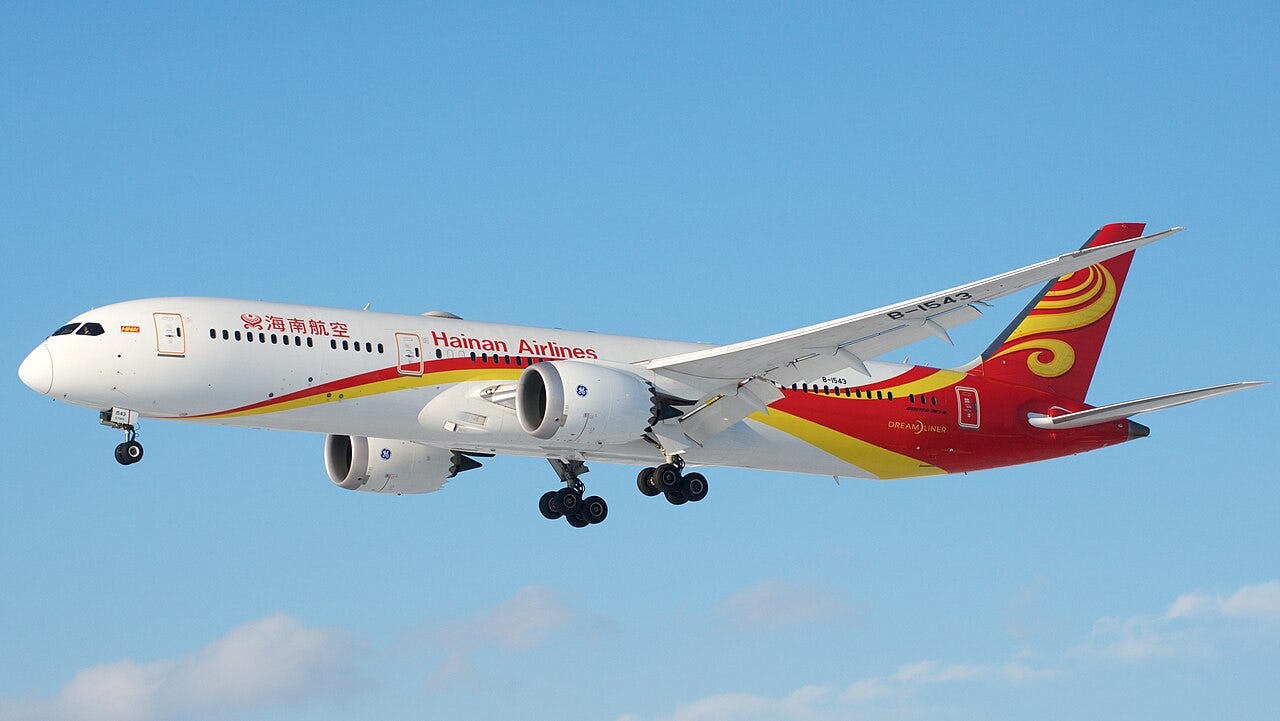
The widebody mix is split between Airbus and Boeing. Boeing 787 Dreamliners total 38 frames and operate the majority of international long-haul services, while Airbus A330s handle regional wide-body missions across Asia and into mid-haul European city pairs.
Fleet Age Profile
The reported average fleet age of 9.8 years is competitive among Chinese majors and roughly in line with the global network carrier average. The profile is not uniform, however, and the aging tail is concentrated in specific fleet types.
Boeing 787-8s are the oldest long-haul units, with the original delivery stream stretching back to 2013. This is precisely why the carrier has moved to dispose of nine 787-8 airframes, through a mix of lease returns and sales.
The Airbus A330-200 and A330-300 cohort carries an average age close to 11 years. Management is gradually transitioning these missions onto A330-900neos and refreshed 787-9s with upgraded seats.
APPROXIMATE AGE PROFILE BY TYPE
-------------------------------
Boeing 787-8       : Oldest, 10-12 yrs, being phased out
Boeing 787-9       : Mid-life, avg ~6-8 yrs
Boeing 737-800     : Mature, avg ~9-11 yrs
Boeing 737 MAX 8   : Young, avg <3 yrs
Airbus A330-200/300: Mature, avg ~11 yrs
Airbus A320neo     : Young, avg <3 yrs
Airbus A330-900neo : New, 2025 entry into service
On the narrow-body side, 737-800s anchor an older part of the fleet at around 9-11 years, while 737 MAX 8s deliver the youngest fleet slice on domestic missions. The A320neo complement is small but modern, slotted into regional density plays from Haikou and Sanya.
Aircraft Types, Cabin Strategy and Configuration
The carrier lists nine distinct configurations across Boeing 787 and 737 families and Airbus A320neo family and A330 family. Configurations vary meaningfully within the same aircraft type, reflecting the retrofit program.
Boeing 787-9 Dreamliners are offered in three configurations, with 289, 292 or 294 seats. The newest configuration with 294 seats carries a 26-seat business class using a 1-2-1 reverse herringbone layout, aligned with industry-leading long-haul premium products.
Boeing 787-8s fly in a single 213-seat configuration with 36 seats in business class. Their age and two-class density make them less competitive on premium long-haul routes, which is the primary operational rationale for their phase-out.
WIDE-BODY CONFIGURATIONS (latest published)
-------------------------------------------
B787-8   : 213 total (36 Biz / 177 Eco)
B787-9   : 289 / 292 / 294 (26-30 Biz, rest Eco & PE)
A330-200 : 214 (36 Biz / 178 Eco) or 260 (18 Biz / 242)
A330-300 : 292 (32 Biz / 260) or 303 (24 Biz / 279)
A330-900 : 301 (24 Biz / 277 Eco)
The Airbus A330-900neo features a signature 1-2-1 staggered business class with 24 suites and a 277-seat economy cabin. That cabin architecture is a step change in passenger experience compared with Hainan’s legacy A330-200s, most of which have angled lie-flat seats in business.
Narrow-body configurations are more utilitarian. The 737-800s appear in six densities ranging from 158 to 189 seats, while 737 MAX 8s come in a 176-seat two-class layout or a 189-seat single-class layout.
Airbus A320neos carry 164 or 172 seats with a small 4-8 seat business cabin depending on mission. The lone A321neo is configured with 204 seats including 8 business, effectively a bridge product for dense domestic trunk routes that do not justify wide-body uplift.
Fleet Strategy: Phase-Outs and Renewal Path
Three strategic plays define the current fleet roadmap. First, a disciplined wind-down of the Boeing 787-8 long-haul sub-fleet. Second, an opportunistic introduction of the Airbus A330-900neo. Third, a deferred but substantial Comac induction.
The A330-900neo entered the fleet on October 31, 2025, when the first aircraft, registered B-32MU, arrived in Haikou after a ferry flight from Toulouse. The type gives Hainan a product-equivalent successor to the A330-300 with lower fuel burn and modern cabin architecture.
The 787-8 exit is more dramatic. Nine of ten airframes are being disposed of through sales and lease returns, generating the RMB 941 million in aircraft disposal gains that flattered 2025 net income.
FLEET RENEWAL PRIORITIES (2026-2028)
-------------------------------------
Phase Out     : 9 x Boeing 787-8 (sale/lease return)
Refresh       : B787-9 cabin upgrade with new J seats
Grow          : A330-900neo (more units expected)
Grow          : B737 MAX 8 (30 on order)
Induct        : Comac C909 via Urumqi/Lucky Air
Defer         : Comac C919 (30 originally intended for Urumqi)
The Comac piece is in motion but the timing is opaque. Hainan Airlines Holding has amended its C919 order structure, pulling the 30 aircraft previously designated for subsidiary Urumqi Air back to group level as deployment options across multiple subsidiaries are evaluated.
Management’s unstated bet is that Chinese aircraft will enter service on domestic trunk lines first, providing a geopolitical hedge against Boeing or Airbus supply constraints. Integrating Comac’s product into the HU mainline fleet is a multi-year program requiring certification, crew type-rating and MRO ecosystem investment.
GEnx Engines and Sustainable Operations
Hainan Airlines selected GE Aerospace’s GEnx-1B engines to power the Boeing 787 Dreamliner fleet, a decision made early in the type’s commercial introduction. GEnx delivered the fuel burn and maintenance profile that allowed 787s to open long-haul thin routes from Beijing and Chongqing to Europe.

Rolls-Royce Trent 7000 engines power the new A330-900neo. That dual-engine supplier mix for the widebody fleet is now standard among Chinese carriers and gives Hainan optionality during maintenance and parts negotiations.
The airline was the first Chinese carrier to achieve energy management system certification, according to its public Skytrax disclosure. Initiatives cited include APU replacement, residual fuel control and route optimization, with more than 30 emissions reduction projects operationalized.
SUSTAINABILITY FOOTPRINT (disclosed initiatives)
-------------------------------------------------
Certified       : Energy management system (first CN carrier)
Programs        : Flight fuel-saving operations
                  Operational optimization
                  Onboard weight reduction
                  Ground energy conservation
Specific Action : APU replacement
                  Route optimization
                  Residual fuel control
Projects        : 30+ emissions reduction projects live
Freighter operations are structurally modest. The carrier does not operate passenger-to-freighter converted mainline jets directly, preferring to route cargo through sister company Tianjin Air Cargo’s six 737-800 converted freighters and through belly capacity on its own widebodies.
Aeronautical Engineers Inc. (AEI) began conversion work on a second 737-800 for Hainan Airlines in early 2026. That marks the start of a modest dedicated freighter presence for the mainline brand, built around Hainan’s need to support cross-border e-commerce flows out of Haikou and Sanya.