


On February 28, 2026, reports of explosions in Tehran began circulating. Within minutes, the orderly procession of commercial jets flowing through Gulf airspace had scattered in every direction.
What followed was the most severe peacetime disruption to one of aviation’s most critical hubs since the COVID-19 pandemic. Nearly four weeks on, Gulf airlines are in a slow, uneven, and costly recovery that is far from over.
The Scale of What Was Lost
The numbers alone explain why this conflict sent shockwaves through global aviation.
The eleven affected Middle Eastern nations accounted for 13.2% of globally scheduled flight capacity in March. Emirates, flydubai, and Qatar Airways alone represent 6.1% of global scheduled capacity, almost all of it driven by long-haul widebody operations.

Aviation data firm Cirium confirmed that more than 20,000 flights had been cancelled since the initial strikes. WINGX data showed the Middle East swung to a -29.2% decline in business jet departures in Week 9 of 2026 compared to the same period in 2025.
Scale of Disruption (as of early March 2026)
---------------------------------------------
- 20,000+ flights cancelled since Feb 28
- 13.2% of global scheduled capacity affected
- Middle East aviation traffic: -29.2% Week 9 YoY
- 164 business jets grounded across the region (peak)
- Air freight prices to US: jumped ~60%
Half a million passengers a day transited through Gulf hubs before the conflict. That flow essentially stopped overnight.

Where Each Major Airline Stands Right Now
Recovery has been far from uniform across the region’s carriers. Reuters data from Flightradar24, published on March 23, shows the following capacity recovery picture:
Airline Capacity Recovery vs. Pre-Conflict Levels (March 23, 2026)
--------------------------------------------------------------------
Emirates (Dubai)          ~75% of pre-conflict capacity
Air Arabia (Sharjah)      ~50%
Etihad Airways (Abu Dhabi) ~50%
flydubai (Dubai)          ~33%
Qatar Airways (Doha)      ~20%
Emirates has been the most cautious about committing to a public timeline. Iranian drones targeted Dubai International Airport on the same day Emirates announced plans to restore capacity to 60% of pre-war levels. On March 16, a drone struck a fuel storage area near Dubai International Airport, briefly halting operations before fire crews contained the situation. The airline has since resumed roughly 90% of its previously planned March 18 network, according to Aviation Week.
Qatar Airways is the most constrained of the big three Gulf carriers. It is operating a limited network between March 18 and March 28, maintaining service to select destinations including London Heathrow, Paris, Bangkok, and Tokyo Narita. At just 20% of its pre-conflict capacity, the carrier faces the steepest recovery challenge of any major Gulf airline.
Etihad resumed some Abu Dhabi flights from early March, but British Airways has extended suspension of Abu Dhabi services until the start of the winter season. That effectively removes a major feeder partner from Etihad’s network for months.
The Smaller Carriers: A More Precarious Situation
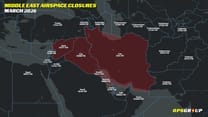
Bahrain’s Gulf Air has been forced to temporarily operate a limited schedule from Dammam in Saudi Arabia, with Bahrain’s airspace remaining closed since the initial strikes. This is an extraordinary operational upheaval for a national carrier operating from a foreign hub.
Kuwait Airways has all but suspended operations, while Jazeera Airways relocated its services to Al Qaisumah in Saudi Arabia, with passengers being transported by ground across the border. These are not contingencies that airlines planned to sustain for weeks.
Ian Petchenik, Director of Communications at Flightradar24, put the vulnerability of smaller carriers in sharp context. “If we were talking about a low-cost carrier in the US which didn’t have state support… I would say a month of complete shutdown might be irrecoverable,” he told Arab News.
The Airspace Squeeze and Its True Cost
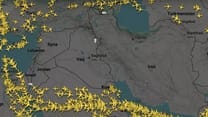
The physical airspace available to international carriers has been dramatically compressed. The New York Times reported that the corridor over Azerbaijan, used by many long-haul flights between Europe and Asia, has narrowed to just 50 miles at its tightest point.
Combined with airspace already restricted near the Russian-Ukrainian border since 2022, pilots and dispatchers are now threading widebodies through corridors that leave almost no margin for error.
Two primary alternative routing options currently exist: the Azerbaijan-Georgia-Turkey corridor to the north, and an Egypt-Saudi Arabia corridor to the south. Neither is efficient for the volumes of traffic formerly flowing through Gulf hubs.
Ernest Arvai, aviation analyst, quantified the financial pain directly: detours of two to three hours on a widebody aircraft can add approximately $6,000 to $7,500 per flight hour in operating costs. That figure compounds rapidly across hundreds of diverted flights per day.
Financial Pressure Points for Gulf Airlines
--------------------------------------------
- $6,000-$7,500 added cost per rerouted flight hour
- Brent crude oil surged 8-12% when markets reopened Feb 28
- Air freight rates to the US jumped ~60%
- Boeing 777-300ER overflight fees: ~$16,800 London-Shanghai
- Lost passenger revenue compounded by fixed fleet costs
Jet fuel costs surged with crude oil markets, airlines still carry fixed obligations on aircraft leases, crew contracts, and ground handling, regardless of whether jets are flying. “You have nothing coming in and a lot going out,” Petchenik told Arab News.
How the Broader Industry Is Adapting
The disruption has created winners elsewhere.
Air India and Air India Express rapidly added approximately 36 additional frequencies to Europe and North America between March 19 and March 28, representing more than 10,000 incremental seats.
Lufthansa Group added Munich-Singapore rotations and boosted Frankfurt-Cape Town service.
Air France up-gauged and increased frequencies to Bangkok, Singapore, Delhi, Mumbai, and Nairobi.
The redeployment reflects a fundamental structural reality: according to Aviation Week analyst John Strickland, passengers travelling east-west have become conditioned to transiting Gulf hubs and have few easy alternatives. “People have become used, particularly on east-west routings from Europe, to go via Gulf. It’s not a thought to consider maybe other ways,” he said.
European carriers, including British Airways, Lufthansa, KLM, Cathay Pacific, and Virgin Atlantic, have extended their suspensions of Middle East routes well into Q2 and beyond.
That inbound feed is critical to Gulf hub economics.
The Resilience Question
Stefano Baronci, Director General of Airports Council International Asia-Pacific and Middle East, told Arab News that airports in Saudi Arabia and Oman “have played a pivotal role to secure connectivity within the region and beyond, welcoming airlines and passengers from neighboring countries more impacted by the conflict.”
The GCC Aviation Authority, announced in December 2025, was cited by Baronci as a vehicle that could drive long-term regional integration. The current crisis, while devastating, has in one sense demonstrated what coordinated GCC aviation response looks like under pressure.
As Flightradar24’s Petchenik noted, the question for every airline still operating reduced schedules is becoming increasingly pointed: “Is this route still economically viable?” The answer depends almost entirely on one variable that no airline, analyst, or regulator can control: when the conflict ends.
For now, Gulf carriers are absorbing losses, operating compressed networks, and watching the skies with a wariness that has no precedent in their modern history.


