


Executive Summary
Iberia, the Spanish flag carrier within International Airlines Group (IAG), closed 2025 as one of the parent group’s two standout earnings drivers, with the wider IAG portfolio posting a record operating profit of €5.02 billion on revenue of €33.2 billion.
The carrier is mid-cycle on its €6 billion Flight Plan 2030, which targets annual profitability of 13.5% to 15% and a long-haul fleet expansion from 47 to 70 aircraft by decade's end.
Long-haul growth is being led by the Airbus A321XLR, which Iberia launched globally in November 2024, and by additional A350-900 deliveries that anchor a record summer 2026 schedule of 21 million seats.
Madrid Barajas remains the foundation of the network, supported by Aena’s record 2025 traffic of 321.6 million passengers across the Spanish airport system, with Barajas alone handling 68.1 million.
Recommended - Read Full Reports


Read All Reports
Table of Contents
Executive Summary
Key Facts: Company Profile
Business Overview
Corporate Structure and Position Within IAG
Financial Performance and LTM Revenue Profile
Revenue Growth Drivers
Key Services and Products
Strategic Roadmap: Flight Plan 2030
Iberia Fleet: In-Depth Analysis
Fleet Size and Composition
Widebody Fleet Composition and Strategy
The A321XLR Long-Haul Narrowbody Strategy
Narrowbody Mainline Fleet
Fleet Age Profile
Fleet Strategy and Renewal Plan
Route Network, Major Destinations and Strategy
Network Footprint and Geographic Strategy
Latin America: The Crown Jewel Network
North American Network
European Network and Domestic Spain
Network Strategy: Connection Banks and Connectivity
Major Operational Bases (Hubs)
Madrid Barajas: The Single-Hub Foundation
Terminal 4 and Terminal 4 Satellite Operations
La Muñoza Maintenance Center
Secondary Operating Bases
Competitive Position
Major Competitors
Iberia vs. Air France-KLM
Iberia vs. Lufthansa Group
Iberia vs. Air Europa
Iberia vs. TAP Air Portugal
Iberia vs. American Airlines (Joint Business Partner)
Iberia vs. Latin American Carriers
oneworld Alliance and Strategic Partnerships
oneworld Membership and Codeshare Network
Joint Business Agreements
Sustainability and SAF Strategy
Net Zero Commitment
Fleet Sustainability Drivers
Workforce and Labor Strategy
Customer Experience and Premium Strategy
Long-Haul Premium Cabin
Premium Economy and Economy
Iberia Plus Loyalty Program
Industry Context: Spanish and European Aviation Backdrop
Spanish Aviation Market Strength
European Capacity Discipline
Key Risks with Probabilities and Scenarios
Risk 1: Geopolitical and Fuel Price Shocks
Risk 2: Latin American Demand Slowdown
Risk 3: Air Europa Acquisition by a Competitor
Risk 4: Labor Disruption
Risk 5: Slot and Capacity Constraints at Madrid
Risk 6: SAF Cost and Supply Risk
Risk 7: Macroeconomic Recession in Europe
Iberia’s Digital and Customer Experience Investment
My Final Thoughts
Official Sources and Data
Key Facts: Company Profile
Iberia stands as one of Europe’s most established legacy carriers, founded in 1927 in Madrid and operating today as a wholly owned subsidiary of London-headquartered International Airlines Group.
The airline functions as the principal long-haul connector between Europe and Latin America, a position no European competitor matches in either depth or frequency.
The carrier’s commercial operations are led by Chairman and Chief Executive Marco Sansavini, who took the helm in early 2024 and has since steered the airline through union negotiations and the launch of the long-term strategic roadmap.
COMPANY PROFILE
--------------------------------------
Legal Name        : Iberia, Líneas Aéreas de España, S.A. Operadora
Founded           : June 28, 1927
Headquarters      : Madrid, Spain
Parent Company    : International Airlines Group (IAG)
Chairman & CEO    : Marco Sansavini
Primary Hub       : Madrid Barajas (T4 / T4S)
Alliance          : oneworld (member since 1999)
Frequent Flyer    : Iberia Plus
Mainline Fleet    : 96 aircraft (Planespotters, April 2026)
Subsidiary Fleets : Iberia Express (24), Iberia Regional (41)
Destinations      : ~135 in nearly 50 countries
IATA / ICAO       : IB / IBE
Callsign : IBERIAThe mainline carrier is supported by two operating subsidiaries that together extend its commercial reach across Europe and the regional Spanish market.
Iberia Express handles short and medium-haul leisure routes from Madrid, while Iberia Regional, operated under the Air Nostrum franchise, feeds the hub with smaller turboprop and regional jet equipment.
The airline’s 2025 performance helped lift IAG to what analysts describe as one of the strongest years in its history, with both British Airways and Iberia driving outsized contributions to consolidated earnings.

Business Overview
Corporate Structure and Position Within IAG
Iberia operates as one of five passenger-carrying brands inside International Airlines Group, sitting alongside British Airways, Aer Lingus, Vueling, and LEVEL. The group also operates IAG Cargo, IAG Loyalty, and IAG GBS as horizontal service businesses that monetize the combined fleet and customer base.
Within this portfolio, Iberia’s strategic mandate is clear. It serves as the group’s specialist long-haul carrier for the Europe to Latin America corridor, while simultaneously functioning as the dominant short and medium-haul operator from Madrid.
This dual role differentiates it from the more transatlantic-focused mandate carried by British Airways out of London Heathrow.
The structure was formalized when British Airways and Iberia merged in January 2011 to create IAG. Iberia retained operational independence, its own fleet, brand identity, and crew bases, while integration efforts focused on procurement, IT systems, and joint commercial agreements.
IAG OPERATING BRANDS AT A GLANCE
--------------------------------
British Airways  : Premium long-haul out of London Heathrow / Gatwick
Iberia           : Long-haul Latin America focus, Madrid hub
Vueling          : Pan-European low-cost from Barcelona
Aer Lingus       : Premium transatlantic from Dublin
LEVEL            : Long-haul leisure brand from Barcelona
IAG Cargo : Belly-hold cargo across all carriersFinancial Performance and LTM Revenue Profile
The most recent published full-year results show IAG generated €33.213 billion in revenue during 2025, an increase of 3.5% on the prior year. Operating profit climbed to €5.02 billion, an improvement of approximately 13% on 2024, while operating margin expanded to 15.1%.
Within that group result, Iberia delivered another excellent year and drove the Q4 performance, led by premium cabin demand, Latin America point-of-sale strength, and resilient business travel.
While IAG does not publish standalone audited Iberia financial statements outside its annual report, the Spanish flag carrier consistently ranks among the group’s two most profitable units.
Capacity discipline played a central role. Group-wide available seat kilometres (ASKs) grew by 2.4% during 2025, with passenger revenue per ASK essentially flat at plus 0.1%, indicating that growth was matched by demand rather than achieved through yield erosion.
IAG GROUP FINANCIAL HIGHLIGHTS, FULL YEAR 2025
----------------------------------------------
Revenue                      : €33.213 billion (+3.5%)
Operating Profit             : €5.02 billion
Operating Margin             : 15.1%
Net Profit Growth (vs 2024)  : +19.3%
Group ASK Growth             : +2.4%
PRASK Change                 : +0.1%
Cargo Revenue (IAG Cargo)    : €1,238 million (+0.3%)
Cargo, while a smaller contributor to total revenue, remained stable. IAG Cargo recorded €1,238 million for the full year, with belly-hold capacity from Iberia’s growing widebody fleet supporting premium pharmaceutical and perishables traffic on the Latin America trunk routes.
Revenue Growth Drivers
Three structural drivers underpin Iberia’s revenue trajectory entering 2026.
The first is sustained premium cabin penetration on transatlantic routes, where Business and Premium Economy yields continue to outperform the overall network average.
The second driver is geographic mix. Latin American point-of-sale demand, particularly from Brazil, Mexico, Argentina and Colombia, has rebounded strongly post-pandemic, and Iberia’s expansion into Recife, Fortaleza and Monterrey opens new origin markets without cannibalizing existing services.
The third driver is fleet productivity. Replacing older A330-200s and the now-retired A340-600s with A350-900s and A321XLRs reduces seat-mile costs while improving fuel burn. This unit cost benefit flows through to operating margin even when ticket prices remain stable.
Key Services and Products
Iberia’s commercial offering is segmented across four cabin classes on long-haul and three on short and medium-haul.
The flagship product remains the long-haul Business Class suite, branded internally as Business Class with Next-generation seats on retrofitted and new-build A350-900s, featuring a Recaro CL6720 platform with closing doors and 1-2-1 staggered configuration.
Premium Economy occupies a growing share of long-haul revenue, with dedicated cabins on all widebody equipment and now also fitted on the A321XLR. The product targets corporate travelers with restricted travel policies and leisure customers willing to pay a premium without committing to full Business fares.
Beyond seat sales, Iberia operates an integrated maintenance, repair and overhaul (MRO) division at La Muñoza, ancillary services through IAG Loyalty’s Avios program, and a rapidly expanding cargo business via IAG Cargo.
The MRO operation services third-party customers in addition to internal needs, providing a counter-cyclical revenue stream during periods of soft passenger demand.
Strategic Roadmap: Flight Plan 2030
In June 2025, Iberia formally launched its Flight Plan 2030 strategic roadmap, committing €6 billion of investment over five years.
The plan targets annual profitability of between 13.5% and 15%, fleet growth on long-haul from 47 to 70 aircraft, and full renewal of the short and medium-haul fleet.
The investment thesis rests on Madrid’s structural advantages, including geographic positioning between Europe and the Americas, access to a growing Latin American diaspora across Spain, and the operational headroom available at Madrid Barajas.
The strategy also contemplates digital and customer experience modernization, sustainability commitments, and workforce evolution.
FLIGHT PLAN 2030: HEADLINE TARGETS
----------------------------------
Total Investment        : €6 billion (2025-2030)
Profitability Target    : 13.5% to 15% annual
Long-haul Fleet         : 47 → 70 aircraft
Short/Medium-haul Fleet : Full renewal
SAF Usage Target        : 10% of fuel by 2030
Annual Passengers       : Targeting ~30 million annually
Iberia’s CEO has framed the plan as requiring a transformation of profiles to align workforce skills with the digital and operational ambitions of the next phase.
This includes pilot recruitment to support fleet growth, ground handling modernization, and investment in maintenance capacity at La Muñoza.
Iberia Fleet: In-Depth Analysis
Fleet Size and Composition
As of April 2026, Iberia mainline operates approximately 96 aircraft with eight more on firm order or planned, all from the Airbus family. The all-Airbus commitment dates back two decades and provides commonality benefits across pilot training, parts inventories, and maintenance procedures.
The mainline fleet is supplemented by Iberia Express with 24 aircraft and Iberia Regional, operated through Air Nostrum, with 41 aircraft. Combined, the Iberia Group flies approximately 161 aircraft across mainline and feeder operations, making it one of the largest single-airline-group fleets in southern Europe.
IBERIA GROUP FLEET STRUCTURE (April 2026)
-----------------------------------------
Iberia Mainline   : 96 aircraft (+8 on order)
Iberia Express    : 24 aircraft (+3 on order)
Iberia Regional   : 41 aircraft (Air Nostrum-operated)
Total Group       : ~161 aircraft
Common Hub        : Madrid Barajas (LEMD)
The mainline composition is split between widebody equipment for long-haul missions and narrowbody Airbus A320 family aircraft for European, Spanish domestic and short medium-haul flying.
Widebody Fleet Composition and Strategy
The widebody backbone consists of three aircraft types: the Airbus A330-200, Airbus A330-300, and Airbus A350-900. The fleet currently includes twelve two-class A330-200s and eight three-class A330-300s, supplemented by sixteen A350-900s with further deliveries scheduled.
The A350-900 has emerged as the strategic centerpiece. First delivered to Iberia in 2018, it offers approximately 25% lower fuel burn per seat than the A340-600s it replaced, an aircraft type the airline retired its last unit of in late 2020, following accelerated drawdowns during the pandemic.
WIDEBODY FLEET MIX (April 2026)
-------------------------------
Airbus A350-900   : 16 in service, more on order
Airbus A330-300   : 8 in service (three-class)
Airbus A330-200   : 12 to 17 in service (two-class)
Total Widebody    : ~36-41 aircraft
Mission Profile   : Latin America, North America, select Europe
The A350 deployment strategy concentrates these aircraft on the longest and densest routes. Bogotá, Buenos Aires, Lima, Mexico City, Sao Paulo, and Santiago de Chile all see regular A350-900 service, with the type also rotating onto select North American destinations including New York JFK, Los Angeles, and Boston.
The A330 fleet handles secondary long-haul missions. The A330-200 typically operates two-class routes to medium-density Latin American points, while the three-class A330-300 supports denser Caribbean and Central American services.
The A321XLR Long-Haul Narrowbody Strategy
Iberia took the global launch position on the Airbus A321XLR in November 2024, receiving the world’s first commercial delivery of the type. By late 2025, the airline marked one year since its global launch with multiple aircraft in service.
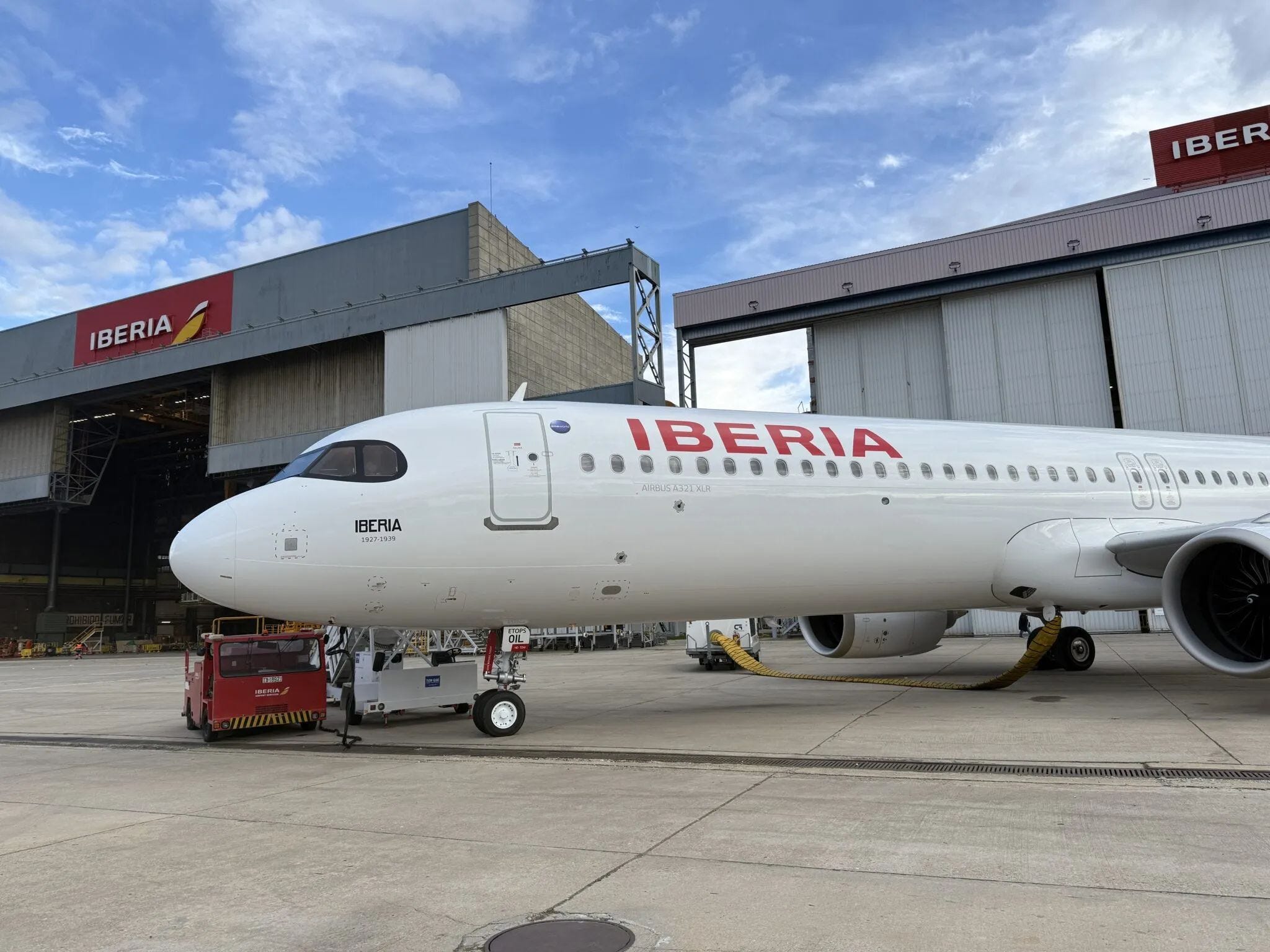
The XLR configuration on Iberia features a three-class layout including Business, Premium Economy, and Economy, with capacity for approximately 182 passengers.
The configuration is deliberately structured to mirror long-haul widebody product expectations, allowing the airline to deploy the type on routes where widebody economics do not work.
Strategic deployment has focused on opening new transatlantic markets that cannot sustain daily widebody service. Confirmed and operating routes include Madrid to Boston, Washington Dulles, San Juan, Santo Domingo, Recife and Fortaleza, with Toronto scheduled to launch in June 2026.
A321XLR ROUTE DEPLOYMENT (2025-2026)
------------------------------------
Madrid - Boston           : Operating
Madrid - Washington (IAD) : Operating
Madrid - San Juan (SJU)   : Launched 28 Oct 2025
Madrid - Santo Domingo    : Operating
Madrid - Recife (REC)     : Started 13 Dec 2025
Madrid - Fortaleza (FOR)  : Started 18 Jan 2026
Madrid - Toronto (YYZ)    : Launching Jun 2026
Madrid - Monterrey (MTY)  : New route, summer 2026
The XLR’s economics permit profitable operation on routes carrying 150 to 200 daily passengers, well below the 250-plus break-even of widebody equipment. This unlocks city pairs that have historically been served only via connections through other European hubs.
The XLR program received seven additional deliveries during 2025, with continuing deliveries through 2026 and 2027. Most XLRs in the Iberia fleet are deployed to North American and Caribbean destinations, with select Brazilian secondary cities being added through 2026.
Narrowbody Mainline Fleet
For European, Spanish domestic, and short medium-haul flying, Iberia operates a mixed fleet of Airbus A320 family aircraft including A319s, A320s, A320neos and A321s. The A320neo introduction has progressively replaced older A320ceo and A319 units, delivering approximately 15% lower fuel burn per seat.
Iberia has notably named individual A320 aircraft after Spanish aviation heritage, with units called Eagle Patrol and Getafe, Cradle of Spanish Aviation, reflecting the airline’s nearly century-long history.
Narrowbody utilization is concentrated on European trunk routes from Madrid, including London, Paris, Frankfurt, Brussels, Amsterdam, Rome, Milan, and Zurich, alongside major Spanish domestic flying to Barcelona, Valencia, Bilbao, Seville, Malaga and the Canary Islands.
Fleet Age Profile
The fleet age profile has improved materially under the current investment cycle. The A350-900 fleet remains young, with the oldest units delivered in 2018 and continuing deliveries pushing the average age below five years.
FLEET AGE INDICATORS (April 2026)
---------------------------------
A350-900 fleet      : Average ~4 years
A321XLR fleet       : Average ~1 year (newest type)
A330 family         : Average 8-12 years
A320 family (mix)   : Average 7-10 years
A320neo subset      : Average ~3-4 years
The narrowbody fleet skews older where A320ceo aircraft remain in service, although progressive A320neo introduction is reducing the average. Iberia Express, which operates a separate fleet, has an average aircraft age of approximately 11.4 years.
Fleet Strategy and Renewal Plan
The Flight Plan 2030 envisions long-haul fleet growth from 47 to 70 aircraft, with new A350s, A321XLRs, and A330neos named as the principal additions. This represents a near-50% expansion in long-haul capacity by decade end.
For the short and medium-haul segment, the strategy contemplates full renewal, suggesting continued migration to A320neo and A321neo equipment as the existing fleet reaches retirement. Iberia Express, which operates as a leisure and short-haul subsidiary, follows a parallel trajectory.
FLEET STRATEGIC PILLARS
-----------------------
1. Widebody growth     : Add A350-900s, evaluate A330neo
2. XLR expansion       : Continue A321XLR deliveries
3. Narrowbody renewal  : A320neo / A321neo replacement cycle
4. Engine commonality  : Standardize where possible
5. SAF compatibility   : All new deliveries SAF-capable
6. Cabin retrofit      : Roll out Next Business across widebodies
Engine choice and commonality also factor into the strategy. The A350 fleet uses Rolls-Royce Trent XWB powerplants, while the A321XLR runs CFM International LEAP-1A engines.
This dual sourcing reduces single-supplier risk while preserving sufficient scale on each platform for efficient maintenance contracting.