


Executive Summary
IndiGo (6E), operated by InterGlobe Aviation Ltd., remains India’s largest airline with a 63.6% domestic market share as of January 2026 and a fleet of over 440 aircraft. The airline crossed the INR 841 billion revenue mark in FY25, entering the $10 billion revenue club for the first time.
The carrier is executing an aggressive fleet and network transformation, with 930 aircraft on order from Airbus (including 60 wide-body A350-900s and 40 A321XLRs), alongside damp-leased Boeing 787-9 Dreamliners from Norse Atlantic Airways powering its long-haul debut to Europe.
IndiGo is building an extensive web of global partnerships with Delta Air Lines, Air France-KLM, Virgin Atlantic, KLM, Turkish Airlines, Japan Airlines, Jetstar, and Garuda Indonesia, connecting India to Europe, North America, Southeast Asia, and Australasia.
Key headwinds include the resignation of CEO Pieter Elbers in March 2026, ongoing Pratt & Whitney engine groundings affecting approximately 40 aircraft, the financial fallout from the December 2025 operational meltdown, and intensifying competition from the merged Air India Group under Tata ownership.
Recommended - Read Full Reports


Read All Reports
Table of Contents
Executive Summary
Key Facts: Company Profile
Business Overview
How IndiGo Became a $10 Billion Revenue Airline
FY25 Financial Performance: Crossing the $10 Billion Threshold
FY26 Quarterly Results: A Year of Turbulence and Record Revenue
Q1 FY26 (April to June 2025)
Q2 FY26 (July to September 2025)
Q3 FY26 (October to December 2025)
Revenue Growth Drivers
Key Products and Services
IndiGoStretch: The Two-Cabin Offering
IndiGo BluChip: The Loyalty Program
IndiGo CarGo: Freight Operations
IndiGo Fleet: In-depth Analysis
Current Fleet Size and Composition
Fleet Age: One of the Youngest Globally
The World’s Largest Aircraft Order Book
Aircraft Types Strategy: A Deep Dive
Airbus A320neo Family: The Backbone
Airbus A321neo: The High-Density Workhorse
Airbus A321XLR: The Game-Changer for International Growth
Airbus A350-900: The Long-Haul Future
Boeing 787-9 Dreamliner: The Bridge to Wide-Body Operations
ATR 72-600: Regional Connectivity
Fleet Strategy: From Domestic Giant to Global Contender
Route Network, Major Destinations, and Strategy
Domestic Network: Covering Every Corner of India
International Network: The Push to 50+ Destinations
Long-Haul European Expansion
Southeast Asia and Central Asia Expansion
Codeshare and Partnership Strategy
Major Operational Bases (Hubs)
Delhi: The Primary Hub
Mumbai: The Financial Capital and Long-Haul Base
Bengaluru: The Technology Capital
Other Key Bases
Competitive Position
India’s Aviation Market Structure: An Emerging Duopoly
IndiGo vs. Air India Group: The Core Rivalry
IndiGo vs. Akasa Air
IndiGo vs. SpiceJet
International Competitive Positioning
Sustainability and ESG Initiatives
IndiGo Green: The Environmental Roadmap
Leadership and Corporate Governance
The Departure of Pieter Elbers
Board and Governance Structure
Awards and Industry Recognition
Key Risks (With Probabilities and Scenarios)
Risk 1: Pratt & Whitney Engine Groundings
Risk 2: Leadership Transition
Risk 3: Foreign Exchange Volatility
Risk 4: Operational Disruptions and Regulatory Risk
Risk 5: Intensifying Competition from Air India
Risk 6: Aircraft Delivery Delays
Risk 7: Labour Costs and Regulatory Compliance
Technology and Innovation Initiatives
Digi Yatra and Contactless Travel
Digital Platform and Self-Service
In-Flight Entertainment and Connectivity
The India Aviation Growth Opportunity
Passenger Traffic Trajectory
IndiGo’s Position Within This Growth
Official Sources and Data
My Final Thoughts
Key Facts: Company Profile
Company Name:         InterGlobe Aviation Limited (IndiGo)
Founded:              2005 (Operations began August 4, 2006)
Founders:             Rahul Bhatia and Rakesh Gangwal
Headquarters:         DLF Corporate Park, Gurgaon, Haryana, India
IATA / ICAO Code:     6E / IGO
Stock Listing:        NSE: INDIGO | BSE: 539448
Primary Hub:          Indira Gandhi International Airport (DEL), Delhi
Fleet Size:           440+ aircraft (as of December 2025)
Aircraft on Order:    930 aircraft (Airbus)
Revenue (FY25):       INR 841 billion (~US$9.9 billion)
Net Profit (FY25):    INR 72.6 billion (9% net margin)
Employees:            ~37,300 (2024)
Daily Flights:        2,200+ (peak: 2,300+)
Destinations:         91+ domestic, 41+ international
Domestic Market Share: 63.6% (January 2026, DGCA)
CEO:                  Rahul Bhatia (Interim, since March 2026)
Website: www.goindigo.inBusiness Overview
How IndiGo Became a $10 Billion Revenue Airline
IndiGo was co-founded in 2005 by Rahul Bhatia of InterGlobe Enterprises and Rakesh Gangwal, a United States-based Indian expatriate. The airline commenced commercial operations on August 4, 2006, with a single route between Delhi and Imphal.
What started as a modest low-cost carrier has since grown into the world’s fastest-growing airline by passenger count and India’s undisputed market leader. IndiGo’s operational philosophy has been remarkably consistent: low fares, on-time performance, and a no-frills travel experience built on cost leadership.

The airline carried over 118 million customers in FY25 alone. It now operates around 2,200 daily flights and serves more than 130 destinations across India and internationally.
FY25 Financial Performance: Crossing the $10 Billion Threshold
Fiscal year 2025 (April 2024 to March 2025) was a landmark year for IndiGo. The airline posted its highest-ever annual revenue of INR 841 billion (approximately US$9.9 billion), representing an 18% year-over-year increase.
This placed IndiGo in an exclusive group of global airlines with annual revenues exceeding $10 billion.
Net profit for FY25 came in at INR 72.6 billion, with a net profit margin of approximately 9%. The Q4 FY25 quarter was particularly strong, with the airline posting its highest Q4 profit ever at INR 3,067.5 crore (US$358.5 million), a 62% surge compared to the same quarter the previous year.
FY25 Financial Highlights (InterGlobe Aviation Ltd.)
-----------------------------------------------------
Revenue from Operations:     INR 841 billion (~US$9.9 billion)
Year-over-Year Growth:       +18%
Net Profit (PAT):            INR 72.6 billion
Net Profit Margin:           ~9%
Q4 FY25 Revenue:             INR 22,151.9 crore (US$2.59 billion)
Q4 FY25 Net Profit:          INR 3,067.5 crore (+62% YoY)
EBITDAR (Q4 FY25):           INR 6,948.2 crore (31.4% margin)
Passengers Carried (FY25):   ~118 million
Domestic Market Share (FY25): ~63%

Source: IndiGo Q4 FY25 Press Release, IndiGo Annual Report FY25
Revenue from operations in Q4 FY25 increased by 24% year-on-year to INR 22,151.9 crore. EBITDAR margins improved significantly from 24.8% to 31.4% in the quarter, showing strong operational leverage.
Passenger revenue hit INR 19,567.3 crore (up 25.4%), while ancillary revenue brought in INR 2,152.5 crore (up 25.2%). The load factor climbed to 87.4%, up from 86.4% in the same quarter of the prior year.
FY26 Quarterly Results: A Year of Turbulence and Record Revenue
The first nine months of FY26 (April 2025 to December 2025) have presented a mixed picture of record revenues coupled with operational challenges and currency headwinds.
Q1 FY26 (April to June 2025)
IndiGo reported revenue from operations of INR 204,963 million (approximately INR 20,496 crore), a 7% increase year-over-year. Net profit stood at INR 21,763 million with an 11% net margin, though this represented a 20% decline from the same quarter the previous year.
Capacity (ASK) grew by 16.4% while passenger count increased by 11.6% to 31 million. The load factor declined by 2.1 percentage points to 84.6%, reflecting rapid capacity addition that outpaced demand growth.
Q2 FY26 (July to September 2025)
The traditionally weak monsoon quarter saw IndiGo report revenue of INR 185,553 million, up 9.3% year-over-year. However, the headline number was a net loss of INR 25,821 million, driven primarily by massive foreign exchange losses on dollar-denominated lease obligations.
Excluding the forex impact, IndiGo posted a net profit of INR 1,039 million, compared to a net loss of INR 7,539 million during the same period the previous year. This reversal underscored the improvement in core operating performance despite the unfavorable currency movements.
Q3 FY26 (October to December 2025)
IndiGo reported its highest-ever quarterly revenue of INR 23,471.9 crore (approximately US$2.76 billion). However, net profit plummeted 78% year-over-year to INR 549.8 crore due to INR 1,546.5 crore in exceptional items.
These exceptional items included INR 577.2 crore from operational disruptions during the first week of December 2025 (related to new Flight Duty Time Limitation rules) and INR 969.3 crore provisioned for new labour code implementation.
FY26 Quarterly Financial Summary (INR Crores)
-----------------------------------------------
Quarter       Revenue (Ops)    Net Profit/Loss    Key Note
Q1 FY26       20,496           2,176              11% net margin
Q2 FY26       18,555          (2,582)             Forex losses; +104 cr ex-forex
Q3 FY26       23,472           550                Highest-ever revenue; Dec meltdown
9M FY26 (est) ~62,523          ~144               Mixed: record topline, one-offs hit bottom line

Source: IndiGo Quarterly Press Releases (Q1, Q2, Q3 FY26)Revenue Growth Drivers
Several factors continue to drive IndiGo’s top-line growth.
Domestic Air Travel Demand: India’s domestic air passenger traffic grew 4.36% year-over-year to 152.49 lakh (15.25 million) passengers in January 2026 alone. For the full calendar year 2025, domestic traffic crossed 16.69 crore passengers. International traffic from India grew 8% to 7.8 crore passengers in 2025 as well.
Ancillary Revenue Growth: IndiGo’s ancillary income (baggage fees, seat selection, onboard food, and add-on services) has been growing at 20%+ rates. In Q1 FY26, ancillary revenues grew 22.1% year-over-year to INR 21,534 million.
IndiGoStretch Premium Product: The launch of IndiGoStretch (the airline’s business-class product) in November 2024 has opened a new revenue stream. As of Q3 FY26, the product is active on 12 routes with plans to expand the sub-fleet from 45 to 65 aircraft.
International Expansion: Long-haul operations to Manchester and Amsterdam (launched July 2025) and the induction of the A321XLR for routes to Athens and beyond are contributing incremental international revenue.
Key Products and Services
IndiGoStretch: The Two-Cabin Offering
IndiGoStretch represents IndiGo’s first entry into the premium segment. Launched in November 2024, it features a dedicated business cabin on select Airbus A321neo aircraft.
The Stretch+ cabin features three rows in a 2-2 configuration with 38 inches of seat pitch, deep recline, headrest dividers for added privacy, and both standard and USB-C power ports.
Seats are supplied by RECARO, and the product includes complimentary curated meals, beverages, priority boarding, and dedicated check-in lines.
IndiGoStretch Configuration (A321neo)
--------------------------------------
Cabin Layout:          2-2 configuration
Rows:                  3 rows (12 seats)
Seat Pitch:            38 inches
Seat Supplier:         RECARO
Power Outlets:         Standard AC + USB-C
Amenities:             Complimentary meals, priority boarding
Domestic Routes:       Delhi-Mumbai, Delhi-Bengaluru, Delhi-Chennai,
                       Delhi-Hyderabad, Mumbai-Bengaluru (and more)
International Routes:  Delhi/Mumbai to Bangkok, Singapore, Phuket, Dubai
Sub-Fleet Target:      65 aircraft (up from initial 45)

Source: IndiGo FY26 Growth Press Release, Business Traveller Review
Starting June 29, 2025, IndiGo began deploying IndiGoStretch internationally on routes between Delhi and Mumbai to Bangkok, Singapore, Phuket, and Dubai. The airline is also introducing specially curated complimentary hot meals on long-haul routes to Manchester and Amsterdam.
IndiGo BluChip: The Loyalty Program
IndiGo launched its loyalty program, IndiGo BluChip, in 2024. The program enrolled over 2 million members within its first six months, signaling strong customer adoption.
Members earn BluChips on every IndiGo flight with no blackout dates. The program features multiple tiers and has already forged partnerships with hospitality brands such as Accor Hotels for reciprocal benefits.
IndiGo CarGo: Freight Operations
IndiGo operates a dedicated freight operation under the IndiGo CarGo brand, using three Airbus A321-200P2F (Passenger-to-Freighter) converted aircraft. Each A321P2F supports a payload of up to 27 tonnes. The cargo division leverages IndiGo’s extensive domestic network to provide express freight services across India.
IndiGo Fleet: In-depth Analysis
Current Fleet Size and Composition
As of December 31, 2025, IndiGo operated a total fleet of 440 aircraft, making it by far the largest airline fleet in India and one of the largest single-airline fleets in the world.
The fleet is composed predominantly of Airbus narrowbody aircraft, with a growing number of wide-body aircraft joining through damp-lease arrangements for long-haul operations.

IndiGo Fleet Composition (As of December 31, 2025)
----------------------------------------------------
Aircraft Type              Count    Notes
Airbus A320neo             180      Core domestic workhorse
Airbus A320ceo              26      Legacy fleet (including 1 damp lease)
Airbus A321neo             168      Larger narrowbody for high-density routes
Airbus A321XLR               1      First delivered January 7, 2026
ATR 72-600                  46      Regional turboprop operations
Airbus A321-200P2F           3      Freighter (cargo operations)
Boeing 787-9 (damp lease)    5      Long-haul (Norse Atlantic)
Boeing 777 (damp lease)      2      Long-haul operations
Boeing 737 (damp lease)      5      Fleet augmentation
Airbus A321neo (damp lease)  3      Fleet augmentation
Airbus A320ceo (damp lease)  1      Fleet augmentation
----------------------------------------------------
TOTAL                      440

Source: IndiGo Q3 FY26 Results
The fleet composition reflects IndiGo’s phased transition from a purely narrowbody, single-type operator toward a multi-type fleet capable of serving routes from regional Indian cities to long-haul international destinations.
Fleet Age: One of the Youngest Globally
IndiGo maintains one of the youngest commercial airline fleets in the world. As of mid-2025, the average fleet age was 4.7 years.
The breakdown by aircraft type shows the Airbus A321 sub-fleet averaging just 2.6 years, while the A320 family averages 5.6 years and the ATR fleet averages 5.3 years.
Average Fleet Age by Aircraft Type (Mid-2025)
----------------------------------------------
Aircraft Type        Average Age
Airbus A321 family   2.6 years
Airbus A320 family   5.6 years
ATR 72-600           5.3 years
Overall Fleet        ~4.7 years
A young fleet provides multiple operational advantages: lower fuel consumption (newer engines are more efficient), reduced maintenance costs, higher dispatch reliability, and a better passenger experience.
The World’s Largest Aircraft Order Book
IndiGo holds the world’s largest aircraft order by any single airline, with a total of 930 aircraft on order from Airbus. This order book positions the airline for sustained capacity growth through the next decade and beyond.
IndiGo Aircraft Order Book (As of Late 2025)
----------------------------------------------
Aircraft Type         Orders    Purpose
Airbus A320neo        237       Domestic and short-haul
Airbus A321neo        563       High-density domestic and medium-haul
Airbus A321XLR         69       Extended-range international (up to 8,700 km)
Airbus A350-900        60       Long-haul wide-body international
Airbus A321P2F          1       Cargo freighter
----------------------------------------------
TOTAL                 930

Source: Airbus Press Releases
The sheer scale of this order book gives IndiGo significant leverage in negotiations with Airbus on pricing, delivery slots, and configuration flexibility.
It also signals a long-term commitment to the Airbus platform, eliminating the complexity and cost of running a mixed manufacturer fleet.
Aircraft Types Strategy: A Deep Dive
Airbus A320neo Family: The Backbone
The A320neo and A320ceo variants remain the core of IndiGo’s fleet. The A320neo, powered by CFM International LEAP-1A or Pratt & Whitney PW1100G engines, offers 15-20% fuel savings over the previous-generation A320ceo. IndiGo’s A320 fleet is configured with 180 or 186 seats in an all-economy layout.
As older A320ceo aircraft retire, they are being replaced by a mix of A320neo and (increasingly) A321neo aircraft, which offer more seats per departure and lower cost per available seat kilometer (CASK).
Airbus A321neo: The High-Density Workhorse
The A321neo has become IndiGo’s fastest-growing sub-fleet type, with 168 aircraft in service as of December 2025. Configured with 222 or 232 seats, the A321neo offers approximately 25% more capacity than the A320neo while operating on similar fuel burn levels.
The A321neo is the platform of choice for IndiGoStretch-equipped aircraft, where it is configured in a two-cabin layout with 12 business seats and 183 economy seats. It is deployed on IndiGo’s busiest domestic corridors (Delhi-Mumbai, Delhi-Bengaluru) and on key regional international routes to the Middle East and Southeast Asia.
Airbus A321XLR: The Game-Changer for International Growth
The A321XLR (eXtra Long Range) is arguably the most strategically significant aircraft type in IndiGo’s pipeline. IndiGo became the first Indian airline to induct the A321XLR when the first aircraft arrived in Delhi on January 7, 2026.

The A321XLR provides IndiGo with a range of up to 8,700 kilometers, opening routes to destinations across Europe, Central Asia, and East Africa that were previously unreachable with a single-aisle aircraft. Crucially, it does so with narrowbody operating economics, meaning IndiGo can launch new international routes without the higher break-even load factors associated with wide-body aircraft.
Airbus A321XLR: Key Specifications for IndiGo
----------------------------------------------
Maximum Range:          8,700 km
Seating Configuration:  12 IndiGoStretch + 183 Economy (195 total)
Firm Orders:            40 aircraft
Expected CY2026 Deliveries: 9 aircraft
Total A321XLR on Order: 69 (including options)
Initial Routes:         Athens, Istanbul, Denpasar (Bali)
Seat Supplier:          RECARO (enhanced recline, power outlets)

Source: Airways Magazine, IndiGo Press Release, Airbus
IndiGo plans to receive nine A321XLRs in calendar year 2026. The aircraft will initially operate on routes such as Athens (launched January 2026), with Istanbul and Denpasar (Bali) planned for subsequent deployment as more aircraft arrive.
Airbus A350-900: The Long-Haul Future
In October 2025, IndiGo finalized its commitment to the wide-body segment by converting a Memorandum of Understanding into a firm order for 30 additional A350-900 aircraft. This brought the airline’s total A350 orders to 60 aircraft.
The A350 will be powered by Rolls-Royce Trent XWB engines and is expected to begin deliveries in 2027. It offers a 25% advantage in fuel burn compared to previous-generation competitor aircraft and is capable of operating with up to 50% Sustainable Aviation Fuel.
IndiGo CEO Pieter Elbers stated at the time of the order that “these aircraft will play a pivotal role in enabling IndiGo to expand its reach, connect India with more destinations across the globe.”
Boeing 787-9 Dreamliner: The Bridge to Wide-Body Operations
While waiting for A350 deliveries (starting 2027), IndiGo bridged the gap by securing damp-leased Boeing 787-9 Dreamliners from Norse Atlantic Airways. The arrangement covers six aircraft, with deliveries completed by early 2026.
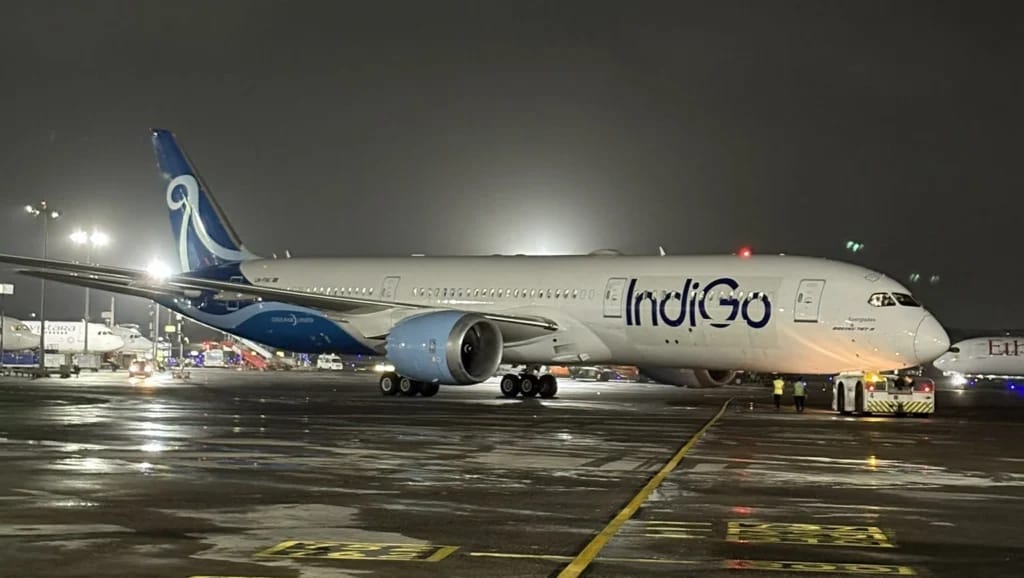
The damp lease structure means Norse Atlantic provides not just the aircraft but also the crew, maintenance, and insurance. These 787-9s are operating IndiGo’s inaugural long-haul services between Mumbai and Manchester and Amsterdam (both launched July 2025), with planned expansion to London Heathrow and Copenhagen.
ATR 72-600: Regional Connectivity
IndiGo operates 46 ATR 72-600 turboprop aircraft configured with 78 seats each.
These aircraft serve the airline’s regional network under the UDAN (Ude Desh ka Aam Naagrik) regional connectivity scheme and other tier-2 and tier-3 city routes where jet operations would not be economically viable.
Fleet Strategy: From Domestic Giant to Global Contender
IndiGo’s fleet strategy follows a clear three-pronged approach.
Short-term (FY26): Add approximately one new aircraft per week, targeting up to 56 new aircraft in calendar year 2026. This includes nine A321XLRs and continued A321neo deliveries. Damp-leased 787s and 777s provide interim wide-body capacity.
Medium-term (2027-2028): Induct A350-900 wide-body aircraft for dedicated long-haul operations. Transition from damp-leased Boeing wide-bodies to owned Airbus wide-bodies. Retire remaining A320ceo aircraft.
Long-term (2030): Surpass a fleet size of 600 aircraft, with a mix of A320neo, A321neo, A321XLR, and A350-900 serving an extensive domestic and global route network.
IndiGo Fleet Growth Trajectory
-------------------------------
FY25 (Mar 2025):    434 aircraft
Q1 FY26 (Jun 2025): 416 aircraft (net decrease due to returns)
Q2 FY26 (Sep 2025): 417 aircraft
Q3 FY26 (Dec 2025): 440 aircraft
CY2026 Target:      ~56 additional aircraft planned
2030 Target:        600+ aircraft

Source: IndiGo Quarterly Results (FY26), IndiGo FY26 Growth Announcement
IndiGo is also investing heavily in maintenance capabilities. The airline signed an MOU with Bangalore International Airport Limited (BIAL) to build a 31-acre MRO facility capable of handling both narrowbody and wide-body aircraft.
This reduces dependency on third-party MRO providers and is expected to improve aircraft availability, reduce turnaround times, and lower maintenance costs.