


Executive Summary
KLM Group posted an operating result of €416 million on revenues of €13.2 billion in 2025, a 3.9% turnover increase from 2024, with further structural cost measures planned under the “Back on Track” program and a €450 million restructuring initiative approved in early 2026.
The mainline fleet stands at 126 aircraft as of April 2026, with 52 aircraft on firm order, including 22 Airbus A350-900s, 3 A350Fs, 18 A321neos, and 9 A320neos, all anchored by a €7 billion multi-year fleet investment commitment.
The summer 2026 schedule covers 164 destinations (96 European, 68 intercontinental), adding Jersey, Santiago de Compostela, and Oviedo while expanding frequencies to Cape Town, Portland (Oregon), and San Diego.
A March 2026 Dutch Supreme Court ruling annulled the 478,000-flight cap at Amsterdam Schiphol, yet the government has confirmed the operational cap will remain in force until new legislation takes effect, creating capacity uncertainty through 2027.
Recommended - Read Full Reports


Read All Reports
Table of Contents
Executive Summary
Introduction
Key Facts: Company Profile
Business Overview
2025 Financial Performance: A Year of Stabilization
Net Income, Cash Position and Financial Flexibility
Revenue Mix and Growth Drivers
Engineering and Maintenance: A Quiet Profit Engine
Transformation and Cost Program
KLM Fleet: In-Depth Analysis
Fleet Size and Composition
Fleet Age and Replacement Priorities
Order Book and Delivery Schedule
Airbus A321neo: The European Narrow-Body Solution
Airbus A350-900: Long-Haul Transformation
Boeing 787 Dreamliner: The Current Long-Haul Flagship
Boeing 777: Wind-Down and Transition
Cargo Fleet and Martinair Operations
KLM Cityhopper Fleet
Fleet Strategy: The Big Picture
Route Network, Major Destinations and Strategy
Summer 2026 Network Scale
New European Destinations for Summer 2026
Frequency Increases and Upgauged Routes
Intercontinental Network Architecture
Latin American Expansion
Network Strategy Philosophy
Major Operational Bases (Hubs)
Amsterdam Airport Schiphol: The Single Mega-Hub
The Capacity Cap Challenge
Schengen vs Non-Schengen Operations
Secondary Bases
Competitive Position
Major Competitors in European Aviation
KLM vs Lufthansa Group
KLM vs IAG (British Airways)
KLM vs Turkish Airlines
KLM vs Emirates and Qatar Airways
KLM vs Ryanair and easyJet
SkyTeam Alliance and Joint Venture Architecture
Sustainability Strategy and SAF Commitments
Sustainable Aviation Fuel Position
Fleet-Driven Emissions Reduction
Operational Efficiency Programs
Transformation Program and Leadership
CEO Reappointment and Second Term
“Back on Track” Program Results
The €450 Million Follow-On Program
Digital Transformation and Customer Experience
Cabin Product Investments
In-Flight Connectivity
Cargo Strategy and AFKLMP Cargo
Cargo Business Model
Freighter Operations
A350F Freighter Transition
Labor Relations and Workforce
Employee Base
Union Dynamics
Talent Strategy
Key Risks and Probability-Weighted Scenarios
Risk 1: Schiphol Capacity Constraint
Risk 2: Labor Relations Disruption
Risk 3: Fleet Delivery Delays
Risk 4: Fuel Price Volatility
Risk 5: Geopolitical and Airspace Risk
Risk 6: SAF Cost and Availability
Risk 7: Competitive Margin Pressure
Strategic Outlook Through 2028
Financial Trajectory
Network Evolution
Fleet Modernization Milestones
Corporate Governance and Leadership Structure
Air France-KLM Group Governance
KLM Supervisory and Management Boards
Ownership Structure
Technology, Digital and Operational Innovation
Flight Operations Digitization
Customer Digital Experience
Revenue Management and Yield Optimization
My Final Thoughts
Official Sources and Data
Introduction
The world’s oldest continuously operating airline enters 2026 with a €7 billion fleet renewal program, a newly reappointed CEO steering a structural restructuring, and a Dutch Supreme Court ruling that has fundamentally reshaped its home base dynamics at Schiphol.
KLM Royal Dutch Airlines has rarely faced this combination of operational pressure and strategic opportunity simultaneously.
Passenger volumes at the Dutch flag carrier reached 34.1 million in 2025, with cargo contributing 621,000 tonnes to total KLM Group revenues of €13.2 billion. Those numbers sit inside a wider Air France-KLM Group that delivered a record operating margin of 6.1% for the first time since the 2004 merger.
This in-depth analysis report covers every component of KLM’s 2026 operating reality.
You will find fleet composition, route network analysis, hub dynamics at Amsterdam Schiphol, comparative positioning against IAG and Lufthansa Group, plus the probability-weighted risk scenarios.

Key Facts: Company Profile
KLM ROYAL DUTCH AIRLINES - COMPANY PROFILE (APRIL 2026)
-------------------------------------------------------
Legal Name:        Koninklijke Luchtvaart Maatschappij N.V.
Founded:           7 October 1919 (world's oldest operating airline)
Parent Company:    Air France-KLM Group
Headquarters:      Amstelveen, Netherlands
Main Hub:          Amsterdam Airport Schiphol (AMS)
CEO (President):   Marjan Rintel (reappointed February 2026)
Group CEO:         Benjamin Smith (Air France-KLM)
Alliance:          SkyTeam (founding member)
Group Revenue:     €13.2 billion (FY2025)
Group Op. Result:  €416 million (FY2025)
Passengers:        34.1 million (2025)
Cargo:             621,000 tonnes (2025)
Mainline Fleet:    126 aircraft (April 2026)
Aircraft on Order: 52 (A320neo family + A350 family)
Destinations S26:  164 worldwide (96 Europe, 68 intercontinental)
Subsidiaries: KLM Cityhopper, Transavia, Martinair, AFI KLM E&MThe full legal name of the carrier is Koninklijke Luchtvaart Maatschappij N.V., translated as Royal Aviation Company. The founding took place on 7 October 1919, which makes KLM the only airline in the world still operating under its original name more than a century later.
Today’s ownership structure places KLM as a wholly owned subsidiary within the Air France-KLM Group, the holding company formed in 2004.
The Dutch state retains a direct stake of approximately 9.3% in Air France-KLM, reflecting the strategic importance of the airline to the Netherlands’ economic connectivity.
Business Overview
2025 Financial Performance: A Year of Stabilization
KLM Group closed the 2025 financial year with revenues reaching €13.2 billion, a 3.9% year-over-year increase from the prior period. The operating result of €416 million demonstrates that the “Back on Track” improvement program is delivering tangible outcomes on unit costs.
However, management communications around the full-year results explicitly stated that further structural strengthening remains necessary. The company warned that current performance, while stable, still leaves KLM vulnerable to external shocks and cost inflation.
At the parent level, Air France-KLM Group reported consolidated revenues of €33.0 billion for 2025, up 4.9% year-over-year. The group operating result reached €2.0 billion, an improvement of €0.4 billion compared to 2024, translating to a 6.1% operating margin.
Net Income, Cash Position and Financial Flexibility
Group-level net income for Air France-KLM in 2025 came in at €1.754 billion, a substantial improvement of €1,265 million versus 2024. This improvement reflects both operational gains and non-recurring items that cleared up legacy accounting overhangs from the pandemic-era financing arrangements.
The cash position at the end of December 2025 stood at €9.4 billion across the consolidated group. Operating free cash flow approached €2 billion, driven by current EBITDA growth of €814 million year-over-year and a positive working capital movement of €752 million.
That liquidity cushion is critical given the €7 billion fleet investment commitment that will be deployed across the coming years. Capital intensity in the aircraft acquisition cycle is reaching a multi-decade high just as the carrier navigates Schiphol capacity uncertainty.
Revenue Mix and Growth Drivers
KLM’s revenue composition breaks down across three core activities inherited from the 2004 merger blueprint: passenger operations, cargo, and engineering and maintenance. Passenger revenue continues to represent the dominant portion of top line across both KLM mainline and KLM Cityhopper regional flying.
KLM REVENUE DRIVERS - 2025 SUMMARY
----------------------------------
Passenger (KLM + Cityhopper):    ~78-80% of total
Cargo (via AFKLMP Cargo):        ~10-12% of total
Engineering & Maintenance (AFI KLM E&M contribution):  ~8-10% of total
YoY Revenue Growth (Group):      +3.9%
Primary Growth Drivers:          Premium cabin yields,
                                 Long-haul leisure demand,
                                 Transatlantic JV capacity,
                                 MRO third-party contracts
Premium cabin performance was a notable contributor to the 2025 stabilization. Load factors across the premium segment strengthened year-over-year, supported by the corporate travel recovery on North Atlantic routes and sustained indirect connections through the Schiphol hub.
Cargo unit revenues faced tough year-on-year comparisons in the fourth quarter. The Q4 2024 benchmark included exceptional e-commerce and high-tech cargo flows, meaning Q4 2025 cargo unit revenue declined 11% even as total cargo tonnage remained supportive.
Engineering and Maintenance: A Quiet Profit Engine
The third pillar of the Air France-KLM business model is AFI KLM E&M, the combined maintenance, repair and overhaul arm. This division services not just the parent airlines but also hundreds of third-party operators across narrow-body, wide-body, engine, and component disciplines.
MRO revenues have become increasingly strategic as global engine shortages, particularly on Pratt & Whitney GTF-powered types, pushed shop visits to multi-year highs. AFI KLM E&M signed significant new contracts during 2025 with Asian and Middle Eastern operators seeking capacity outside the constrained OEM shop network.
The engineering segment also serves as a natural hedge against passenger volatility. When fleet utilization drops elsewhere in the industry, MRO demand typically rises as airlines extend the operational life of existing aircraft.
Transformation and Cost Program
Incoming 2026 marks the execution phase of a €450 million restructuring programme that Marjan Rintel is charged with delivering during her second mandate. This program layers on top of the already-executed “Back on Track” initiative that stabilized 2025 results.
Cost savings targets span procurement renegotiations, staffing levels across ground operations, digital process automation, and fleet simplification gains from the narrow-body transition. Unit cost reductions have become essential given labor inflation in the Netherlands and rising airport charges at Schiphol.
Public communication from management has been candid that cost reductions alone will not be sufficient. Revenue quality improvements through fleet gauge optimization and network rationalization are equally important to reaching mid-cycle profitability targets.
KLM Fleet: In-Depth Analysis

Fleet Size and Composition
The KLM mainline operates 126 aircraft as of mid-April 2026, with 124 active units plus two aircraft in transition status.
The composition reflects a mid-transition fleet where legacy types coexist with newer replacements already flying commercial services.
KLM MAINLINE FLEET - APRIL 2026
-------------------------------
AIRCRAFT TYPE           COUNT    ROLE
Airbus A321neo          15       European narrow-body
Airbus A330-200         5        Medium-haul wide-body
Airbus A330-300         5        Medium-haul wide-body
Boeing 737-700          6        European narrow-body
Boeing 737-800          28       European narrow-body
Boeing 737-900          5        European narrow-body
Boeing 777-200ER        15       Long-haul wide-body
Boeing 777-300ER        16       Long-haul wide-body
Boeing 787-9            13       Long-haul wide-body
Boeing 787-10           15       Long-haul wide-body
Boeing 747-400BCF       1        Cargo (Martinair)
Boeing 747-400ERF       3        Cargo (Martinair)
TOTAL                   126
Average Fleet Age:      13.1 years (Planespotters)
The narrow-body backbone remains the Boeing 737 Next Generation family at 39 aircraft combined across the -700, -800, and -900 variants.
The Airbus A321neo has grown to 15 units in approximately 20 months of service, establishing the Airbus narrow-body as the future of European flying.
Wide-body operations are split between the Boeing 777 family (31 aircraft), the Boeing 787 Dreamliner family (28 aircraft), and the Airbus A330 family (10 aircraft).
The Boeing 787-10 has become the long-haul workhorse following completion of all 15 firm deliveries, while the A330s have dropped to end-of-life status pending A350 arrivals.

Fleet Age and Replacement Priorities
The average mainline fleet age of approximately 13.1 years masks meaningful variance across types.
The Boeing 737 NG/MAX grouping averages 19.1 years, while the A330 family averages 16.9 years and the Boeing 777 sits at 16.4 years.
By contrast, the Boeing 787 fleet averages just 6.5 years, and the A321neo fleet is effectively brand new.
AVERAGE AGE BY TYPE - KLM (AIRFLEETS DATA)
------------------------------------------
Boeing 737 NG/MAX:       19.1 years    (41 units tracked)
Airbus A330:             16.9 years    (11 units tracked)
Boeing 777:              16.4 years    (31 units tracked)
Boeing 787:               6.5 years    (27 units tracked)
Airbus A321neo:           ~1 year      (15 units)
The replacement logic follows a clear structural hierarchy.
Narrow-body renewal targets the oldest Boeing 737-700s and the least efficient Boeing 737-800s first, while wide-body renewal prioritizes the A330-200s and Boeing 777-200ERs that carry the highest fuel burn relative to capacity.
Order Book and Delivery Schedule
The order pipeline stretches across four aircraft types, totaling 52 firm units as of April 2026. These deliveries will fundamentally transform the fleet profile over the next decade.
KLM ORDER BOOK - APRIL 2026
---------------------------
Airbus A320neo:    9 units
Airbus A321neo:    18 units
Airbus A350-900:   22 units
Airbus A350F:      3 units (cargo, Martinair)
TOTAL ON ORDER:    52 aircraft
The A350-900 order derives from the parent-level commitment announced in September 2023, when Air France-KLM ordered 50 A350s to be split between the two flag carriers. KLM’s allocation of 22 A350-900s will arrive progressively from late 2026 through approximately 2030.
First A350 delivery is scheduled for the end of summer 2026, with the aircraft already on the Final Assembly Line in Toulouse. The distinctive light blue KLM livery has already been applied to the tail, signaling that the certification and customer acceptance phase is approaching.
Airbus A321neo: The European Narrow-Body Solution
The A321neo entered KLM service in summer 2024 as the designated Boeing 737 replacement. Cabin configuration uses Recaro seats and Viasat Wi-Fi, establishing new cabin standards for European short and medium-haul flying.
The seat count of 232 in a single-class high-density layout reflects KLM’s European operating model. The selected CFM LEAP-1A engine specification optimizes for fuel burn on stage lengths between 500 and 2,500 nautical miles, covering virtually the entire intra-European network.
Adding 18 more A321neos plus the 9 A320neos will eventually take the Airbus narrow-body fleet to 42 aircraft, displacing the last of the 737-700s and a substantial portion of the 737-800 fleet. The 737-900 variant and newer 737-800 units may remain longer to flex with summer peak demand.
Airbus A350-900: Long-Haul Transformation
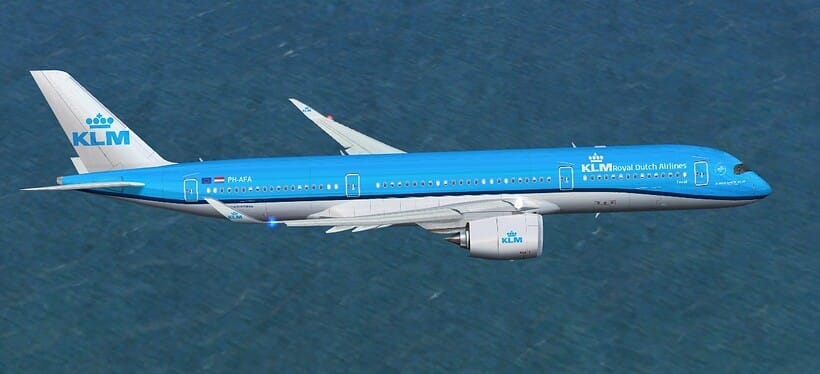
The A350-900 brings approximately 25% lower fuel consumption compared with the Boeing 777-200ER it will replace. Noise footprint shrinks by roughly 40%, a material consideration given the political sensitivity of Schiphol operations.
Passenger-facing improvements include one of the quietest cabin environments in class, improved air circulation, and elevated cabin pressure for long-haul comfort. The fully digital cockpit reduces pilot workload on ultra-long sectors while improving data integration with KLM’s operations control center.
Cabin layout decisions for the KLM A350 fleet have not been fully disclosed publicly, but the airline has signaled that the configuration will include World Business Class, Premium Comfort, and Economy cabins consistent with the completed 777 and 787 retrofit products.
Boeing 787 Dreamliner: The Current Long-Haul Flagship
The Boeing 787 Dreamliner family has grown to 28 aircraft split across the 787-9 (13 units) and 787-10 (15 units). The 787-10 completed deliveries recently, giving KLM the largest 787-10 fleet of any European network carrier.
Deployment strategy favors the 787-10 on high-density Asian and North American routes where the additional 40 seats versus the 787-9 generate meaningful unit economics. The 787-9 handles longer thin routes to destinations in Africa, Latin America, and secondary Asian cities.
Cabin retrofits across the 787 fleet introduced wireless charging, privacy panels, and the Premium Comfort cabin that positions between Economy and World Business Class. These products have been validated by elevated yields in the premium segment during 2025.
Boeing 777: Wind-Down and Transition
The Boeing 777 fleet of 31 aircraft remains KLM’s largest wide-body group by aircraft count, but its relative importance is declining. The 15 Boeing 777-200ERs are the primary retirement candidates under the A350 replacement program.
The 16 Boeing 777-300ERs will likely fly into the 2030s given their higher capacity and relative youth within the 777 family. Cabin retrofits on the 777-300ERs completed during 2024 and early 2025, giving these aircraft a modern product life of at least seven to ten additional years.
Cargo Fleet and Martinair Operations
Cargo operations run through Martinair, the wholly-owned KLM Group subsidiary that has operated entirely as a freighter airline since November 2011. The active cargo fleet consists of one Boeing 747-400BCF and three Boeing 747-400ERFs, all scheduled for replacement by three A350Fs beginning in 2027.
The 747-400 freighters carry 107 tonnes of cargo each in full-freighter configuration. Air France KLM Martinair Cargo launched a new Boeing 747-400 freighter service to Seoul-Incheon on 30 March 2026, operating three times weekly with a focus on high-tech electronics flows.
KLM Cityhopper Fleet
The regional subsidiary KLM Cityhopper operates approximately 24 aircraft across Embraer 175 and Embraer 195-E2 types. The E195-E2 fleet has grown to 22 units, with retrofit work underway to expand seat count from 132 to 136 seats by June 2026.
KLM CITYHOPPER FLEET - APRIL 2026
---------------------------------
Embraer E175:         Part of regional fleet (legacy type, being retired)
Embraer E195-E2:      22 aircraft (136-seat config by June 2026)
Fleet Total:          ~24 aircraft
Fuel Savings Target:  160,000 kg jet fuel/year (via catering weight reduction)
The seat density increase on the E195-E2 was achieved by reducing galley size and optimizing catering stocking. KLM Cityhopper expects to save 160,000 kilograms of jet fuel annually through the 5 million kilogram reduction in catering weight.
Cityhopper’s E195-E2 fleet experienced disruptions during 2024 and 2025 due to the well-documented Pratt & Whitney GTF engine issues. The airline is now returning remaining grounded aircraft to service as engine shop visits have accelerated.
Fleet Strategy: The Big Picture
KLM’s fleet transformation rests on four simultaneous transitions.
The narrow-body transition replaces Boeing 737 NG with Airbus A320neo family, the long-haul passenger transition introduces the A350-900 to replace A330-200 and 777-200ER, the cargo transition moves from Boeing 747-400 freighters to A350Fs, and the regional transition completes the Embraer E175 to E195-E2 shift.
Each transition carries distinct risks.
The narrow-body shift from Boeing to Airbus creates temporary dual-type training costs for pilots and maintenance staff, while the A350 introduction adds a third wide-body family alongside existing 777 and 787 operations.
KLM FLEET STRATEGY - FOUR PARALLEL TRANSITIONS
----------------------------------------------
1. NARROW-BODY:   Boeing 737 NG  -->  Airbus A320neo/A321neo
2. LONG-HAUL:     A330-200 & 777-200ER  -->  Airbus A350-900
3. CARGO:         Boeing 747-400 Freighter  -->  Airbus A350F
4. REGIONAL:      Embraer E175  -->  Embraer E195-E2
Total Investment:                       €7 billion over program
First A350 Delivery:                    End of Summer 2026
First A350F Delivery:                   2027
The €7 billion investment envelope represents one of the largest fleet renewals in the airline’s 106-year history.
Management has framed the capital deployment as essential both for unit economics and for the environmental license to operate at Schiphol.