


Executive Summary
Kongsberg Defence & Aerospace (KDA) closed 2025 with revenues of NOK 25 billion, a 32% year-on-year increase, an EBIT margin of 16.1%, and an order backlog of NOK 125 billion, with roughly 75% of that backlog earmarked for delivery beyond 2026.
The Kongsberg Maritime spin-off completed on April 23, 2026, leaving the parent group refocused around defence, aerospace, space, geospatial, and digital businesses, with Eirik Lie taking over as President and CEO.
A new US missile factory in James City County, Virginia, and an Australian missile facility at Newcastle are both moving from groundbreaking to ramp-up, anchoring NSM, JSM, and future allied production capacity outside Norway.
Major 2025 to 2026 contract milestones include a NOK 2 billion F-35 components agreement with Lockheed Martin, a USD 240 million JSM Lot 2 award from the US Air Force, the Canadian Coast Guard mid-shore vessel design contract through Kongsberg Vanguard LP, and a USD 1.5 billion CROWS framework extension with the US Army.
Recommended - Read Full Reports


Read All Reports
Table of Contents
Executive Summary
Introduction
Key Facts: Kongsberg Gruppen Company Profile
How’s Kongsberg Gruppen Relevant in 2026?
Kongsberg Gruppen: Company Overview
A Company Reset in 2026
Leadership Transition
Business Areas Under the New Structure
Geographic and Industrial Footprint
Key Product Lines, Programs and Services: Kongsberg Gruppen
Missile Systems: The Crown Jewels
Naval Strike Missile (NSM)
Joint Strike Missile (JSM)
3SM Tyrfing (Supersonic Strike Missile)
Air Defence: NASAMS, NOMADS and Iron Beam-Era Adaptations
NASAMS
NOMADS
Remote Weapon Stations: PROTECTOR, CROWS, RT60, RT40
Aviation Maintenance: KAMS and the F-35 Hub
F-35 Component Manufacturing
Space and Sovereign Satellite Communications
Geospatial and Situational Awareness
Kongsberg Gruppen Financial Analysis
2025 Group-Level Performance
Defence and Aerospace Segment Deep Dive
Order Book and Visibility
Profitability and Margin Trajectory
Cash, Capex and Investment Profile
Revenue and Growth Drivers
NATO Rearmament and Norway’s National Defence Plan
Allied Demand for Long-Range Strike
Remote Weapon Station Renewal
Air Defence in a Drone-Dominated Battlespace
LTM and Forward Visibility
Major Competitors
Kongsberg vs MBDA
Kongsberg vs Lockheed Martin
Kongsberg vs RTX (Raytheon)
Kongsberg vs Saab
Kongsberg vs Korean Primes
Kongsberg Gruppen Competitive Analysis and Moat
Industrial Moat: Hard-To-Replicate Manufacturing
Programme-Lock Moat: NSM/JSM Inside F-35 and US Navy
Partnership Moat: Lockheed Martin and RTX
National Champion Moat in Norway
Innovation Moat: 3SM Tyrfing and Sovereign SATCOM
Strategic Outlook for 2026 and Beyond
Industrial Ramp Decisively Underway
Capturing the Counter-Drone Opportunity
Sovereign Satellite Communications Push
Norway, Ukraine and the Eastern Flank
Patria Joint Stake
Financial and Commercial Implications
Revenue Trajectory Through 2030
Margin Implications
Capital Allocation Choices
Customer Concentration Trends
Key Risks and Scenarios
Risk 1: Geopolitical Reversal
Risk 2: Ramp-Up Execution
Risk 3: Component and Supply Chain Constraints
Risk 4: Export Control and Political Friction
Risk 5: Programme Concentration in NSM/JSM
Risk 6: CEO Transition Friction
Risk 7: Technology Disruption
Aerospace & Defence Industry Implications
F-35 Sustainment Becomes a Multi-Decade Annuity
European Defence Industrial Base Reshaping
Allied Production Capacity as Strategic Asset
Kongsberg SWOT Analysis
My Final Thoughts
Official Sources and Data
Introduction
The Norwegian technology group, Kongsberg Gruppen, has quietly become one of the most consequential names in Western precision strike, ground-based air defence, and remote weapon stations.
April 23, 2026, marked a turning point: the formal demerger of Kongsberg Maritime, leaving the parent company sharper, leaner, and almost entirely defined by its defence and aerospace ambitions.
212 years after its founding in the small mountain town of Kongsberg, the company is now operating at the centre of NATO rearmament programmes, F-35 sustainment, allied missile production scale-up, sovereign satellite communications and Ukraine’s air defence backbone.
Stakeholders across aviation, aerospace, and defence are watching how this once mid-sized supplier suddenly ranks among the most critical Western primes for fifth-generation strike weapons and integrated air defence.
Key Facts: Kongsberg Gruppen Company Profile
Legal name:         Kongsberg Gruppen ASA
Listing:            Oslo Stock Exchange (ticker: KOG)
Founded:            1814 (Kongsberg Vapenfabrikk)
Headquarters:       Kongsberg, Norway
Largest shareholder: Government of Norway (~50%)
Group employees:    ~15,000 across 40 countries (post-demerger consolidation)
Total Group revenue 2025: NOK 58.6 billion
KDA revenue 2025:   NOK 25 billion (+32% YoY)
KDA EBIT margin:    16.1%
KDA order backlog:  ~NOK 125 billion
Group order backlog: NOK 157 billion (NOK 130 billion retained post-demerger)
Outgoing CEO:       Geir Håøy (concluded 23 April 2026)
Incoming CEO:       Eirik Lie (former President of KDA)
Core defence sites: Kongsberg, Raufoss, Rygge, Kjeller (Norway);
Johnstown PA, Toano VA (USA); Newcastle (Australia)The company’s identity is rooted in being a long-cycle technology partner to defence ministries and tier-one primes rather than a pure equipment vendor.
Its dual identity as a missile house and a complex precision-machining supplier sets it apart from most direct peers.

How’s Kongsberg Gruppen Relevant in 2026?
Few European defence names have changed more decisively in five years than Kongsberg.
In 2019 the group was viewed as a mid-tier Nordic defence specialist with a strong niche in remote weapon stations.
By April 2026 it sits at the heart of allied precision strike rearmament, with a 44% Q4 revenue jump in its defence and aerospace business and customer commitments stretching through 2030.
What makes the moment unusual is not just the growth rate, but the structural reset.
The Maritime spin-off gives shareholders a defence-aerospace pure-play and gives management a sharper mandate.
New factories on three continents, a sovereign satellite communications push, and a CEO change in the same year mean 2026 is being managed as a deliberate strategic inflection.
For aviation, aerospace, and defence stakeholders, the relevant question is not whether Kongsberg is growing.
It’s whether its industrial footprint, programme breadth, and partnership architecture can absorb the next wave of allied demand without the bottlenecks now plaguing other Western missile primes.
Kongsberg Gruppen: Company Overview
A Company Reset in 2026
Kongsberg’s most consequential corporate event in recent memory was the completed spin-off of Kongsberg Maritime on 23 April 2026.
From that date forward, the parent group is built around defence, aerospace, space, digital, and discovery technologies, with maritime listed as a separate company on the Oslo Børs.
The demerger was formally registered in the Norwegian Register of Business Enterprises on 22 April 2026, with the first trading day for the new structure on 23 April. The exchange ratio was set at 1:1, meaning each Kongsberg shareholder received one share of the new maritime entity for every share of the parent already held.
For aerospace and defence stakeholders, the most important consequence is the sharper capital allocation discipline this enables.
With maritime gone, the bulk of group resources, management attention and industrial planning concentrate on KDA, Kongsberg Discovery (sensor and ocean technology), Kongsberg Digital and the company’s growing space activities.
Leadership Transition
Geir Håøy, who led the group for ten years, concluded his time as CEO on the same April 23 date. Eirik Lie, who previously ran Kongsberg Defence & Aerospace, stepped up to lead the parent group, reinforcing the defence centre of gravity in the company’s executive leadership.
Lie’s promotion is symbolically important. The leadership change places at the top of the company someone whose career has been spent inside the missile, air defence and weapon stations business, signalling continuity for KDA’s customer programmes and a clear continued prioritisation of defence and aerospace.
Business Areas Under the New Structure
Post-demerger Kongsberg Gruppen ASA (KOG):
  - Kongsberg Defence & Aerospace (KDA) — defence prime
  - Kongsberg Discovery — sensors, sonar, ocean technology
  - Kongsberg Digital — industrial software, digital twins
  - Kongsberg Geospatial — visualisation and situational awareness
  - Space activities — small satellites, sovereign SATCOM
  - Kongsberg Aviation Maintenance Services (KAMS) — MRO, under KDA
KDA itself is the flagship business area inside this revised structure, with revenues that exceed NOK 20 billion in defence and a backlog providing multi-year visibility.
Geographic and Industrial Footprint
Norway remains the historical industrial heart, with Kongsberg town hosting missile final assembly, Raufoss focused on precision machining and ammunition components, Kjeller and Rygge supporting military aviation maintenance, and several specialised facilities across the country.
The international expansion has accelerated dramatically. The most visible new sites are James City County in Virginia, where Kongsberg held a groundbreaking ceremony for a USD 100 million missile production facility on 19 January 2026, and Newcastle in Australia, where construction continues on a NSM and JSM factory expected to begin production in 2027.
Existing US operations centre on Johnstown, Pennsylvania, the long-standing CROWS production hub. Combined with the company’s Australian growth, the result is a three-continent industrial footprint that mirrors the geography of allied demand.
Kongsberg's industrial nodes (defence and aerospace):
- Kongsberg, Norway: Missile assembly, system integration
- Raufoss, Norway: Precision parts, F-35 components, ammunition
- Rygge, Norway: F-35 National Air Vehicle Depot (KAMS)
- Kjeller, Norway: KAMS aviation MRO HQ
- Johnstown, PA, USA: CROWS production
- Toano (James City County), VA, USA: New NSM/JSM facility
  (construction underway, ~180 employees planned)
- Newcastle, NSW, Australia: NSM/JSM factory
  (construction underway, production from 2027, ~100 jobs)
- Patria minority stake (49.9%, Finland, JV partner)
Key Product Lines, Programs and Services: Kongsberg Gruppen
Missile Systems: The Crown Jewels
The missile business is the single largest growth engine inside KDA and is built around three families that share common technology roots and increasingly share industrial tooling.
Naval Strike Missile (NSM)
The NSM is a fifth-generation, sea-skimming anti-ship missile with a range typically reported around 185 km. It uses a passive imaging infrared seeker for terminal homing and is capable of striking both ships at sea and land targets in coastal scenarios.
By the latest published Kongsberg data, the NSM and JSM have been selected by Norway, Poland, Malaysia, Germany, the United States, Japan, Romania, Canada, Australia, Spain, the Netherlands, the United Kingdom, and Denmark. That export footprint places the NSM in the top tier of Western anti-ship and coastal-defence systems globally.
The US Navy has institutionalised the NSM into multiple programmes, including the OTH-WS (Over-the-Horizon Weapon System) for Constellation-class frigates, Independence-class littoral combat ships, and the US Marine Corps’ NMESIS coastal defence system, which uses an unmanned ROGUE-Fires platform to launch the NSM.
Kongsberg also pushed the NSM into the Australian StrikeMaster vehicle, firing the NSM from the StrikeMaster for the first time in October 2025. This is a step toward expanding NSM into a vehicle-mounted coastal defence concept that competes directly with mobile anti-ship platforms from other Western and Asian primes.
NSM (selected open-source operating users and contracts):
- Norway, Poland, Malaysia (legacy users)
- Germany — F124, F125, F126 frigate fleets
- USA — Navy LCS, Constellation FFG, USMC NMESIS
- Japan — coastal defence and shipboard
- Romania — coastal defence (signed)
- Australia — Hunter-class FFG, StrikeMaster, coastal defence
- Spain, Netherlands, Denmark, Canada, UK — naval programmesJoint Strike Missile (JSM)
The JSM is the air-launched derivative designed specifically to fit internally in the F-35A weapons bay, allowing the aircraft to retain its low observability while carrying a long-range, precision land-attack and anti-ship weapon. This single design choice has made the JSM unique among Western 5th-generation strike weapons.
In December 2025, Kongsberg was awarded a USD 240 million firm-fixed-price contract by the US Air Force for JSM Lot 2 production. The order represents a major industrial commitment by the US to a Norwegian-developed weapon, a noteworthy signal of long-term programme stickiness.
Japan has emerged as one of the largest international JSM operators. Tokyo’s fifth follow-on order was announced in late 2025, and Japan received first deliveries in March 2026, equipping its F-35A fleet with long-range counterstrike capability for the first time.
Germany also moved decisively, deciding to acquire JSM for its F-35 fleet in an agreement valued at about NOK 6.5 billion. This places Berlin alongside Norway, Australia, Japan and the US Air Force as a JSM customer.
3SM Tyrfing (Supersonic Strike Missile)
The 3SM Tyrfing is the next-generation supersonic anti-ship and land-attack missile being developed jointly by Norway, Germany and Kongsberg, with planned operational fielding around 2035.
A development contract was signed in 2024, and Germany’s parliament has approved its share of development funding. The system is designed to extend Kongsberg’s missile lineage into supersonic envelopes, complementing the subsonic NSM/JSM and giving NATO members a domestic alternative to Russian and Chinese supersonic anti-ship weapons.
For aerospace stakeholders, Tyrfing is the clearest signal that Kongsberg is investing in propulsion and seeker technology beyond the current NSM family. The programme is also a strategic hedge: if subsonic missiles begin to be intercepted at unacceptable rates in future high-end engagements, Tyrfing positions the company to remain in the Western anti-ship missile mix.
Air Defence: NASAMS, NOMADS and Iron Beam-Era Adaptations
NASAMS
The National Advanced Surface-to-Air Missile System (NASAMS) is the air defence backbone of the company’s portfolio.
Co-developed with RTX Corporation (Raytheon), the system uses the AIM-120 AMRAAM and other interceptors against aircraft, cruise missiles and drones.

NASAMS gained a global profile after its deployment in defending key infrastructure in Ukraine. Norway and the United States have repeatedly funded additional NASAMS deliveries to Kyiv.
Recent customers include Lithuania, Denmark with a EUR 500 million contract, Australia and the Netherlands.
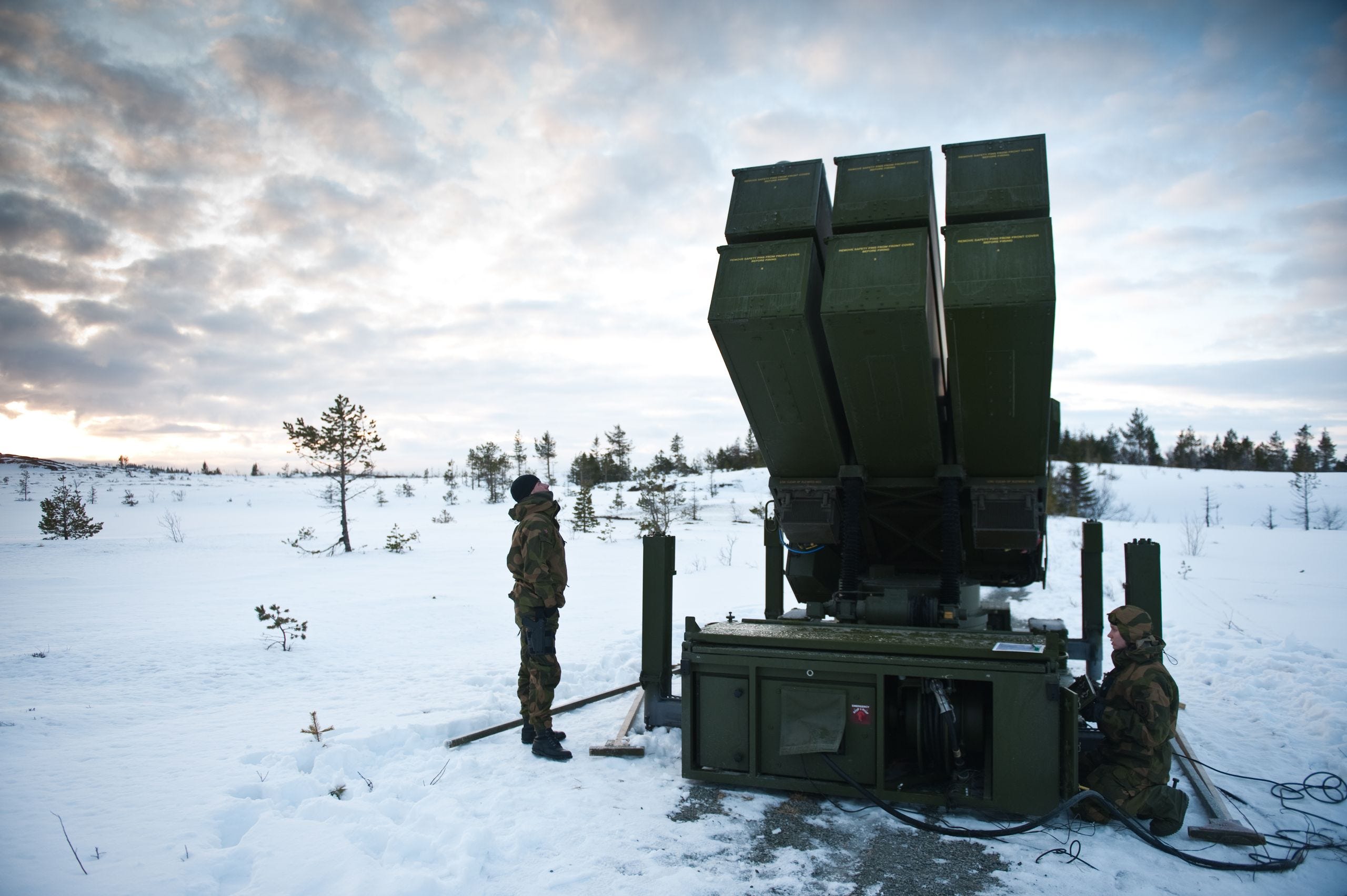
Norway and Ukraine have also opened discussions on co-producing a domestic interceptor for NASAMS in Ukraine, expanding the company’s footprint into a new and politically symbolic geography.
NOMADS
The National Manoeuvre Air Defence System (NOMADS), developed for the Norwegian Army, is a mechanised short-range system designed to operate alongside front-line ground forces and to defeat low-flying threats including drones and cruise missiles.
It complements NASAMS at shorter ranges, allowing customers to buy a layered air defence stack from a single supplier-pair (Kongsberg–RTX).
The Netherlands has confirmed NOMADS alongside NASAMS, indicating early traction for the layered architecture in NATO procurement.
Air defence portfolio at a glance:
- NASAMS — medium range, AMRAAM/AMRAAM-ER/AIM-9X interceptors
- NOMADS — manoeuvre short-range, mechanised, mobile
- Counter-UAS integration — being added across the stack
- Co-production tracks: USA (RTX), Ukraine, Australia, LithuaniaRemote Weapon Stations: PROTECTOR, CROWS, RT60, RT40
The PROTECTOR family of remote weapon stations is one of Kongsberg’s oldest and most globally distributed product lines. The US Army version, marketed as CROWS (Common Remotely Operated Weapon Station), has been in production since 2007.
Kongsberg has delivered more than 18,000 CROWS units to the US Army alone, and the company holds a USD 1.5 billion framework contract running into the next decade. The framework was extended further with the USD 500 million extension tied to annual allocations.
In February 2026, Patria signed a EUR 140 million contract with Kongsberg for PROTECTOR RS4 stations on the CAVS vehicle programme, supplying Sweden and Germany. The deal underlines how PROTECTOR has become the de facto Western RWS for new combat vehicle programmes.
The medium-calibre variants RT40 and RT60 push the PROTECTOR upward into Infantry Fighting Vehicle territory, with the RT40 weighing about 2,450 kg and capable of mounting 30/40mm Bushmaster cannons, and the RT60 designed for IFV-class platforms.
A counter-UAS upgrade path is now being developed alongside the US Army to give the existing CROWS fleet drone-defeat capability, presented at AUSA 2025. This is a strategic move that could substantially extend the lifetime and addressable market of the installed RWS base.
PROTECTOR/CROWS family (operational tiers):
- LW (Light Weapon) — vehicle-mounted, small arms
- M153 CROWS — US Army standard, 18,000+ units
- RS4 — Patria CAVS, Sweden, Germany, Finland
- RT40 — medium calibre, Type-X tested
- RT60 — IFV variant, large turret
- C-UAS — drone defeat upgrade in developmentAviation Maintenance: KAMS and the F-35 Hub
Kongsberg Aviation Maintenance Services (KAMS) is the Norwegian government-aligned MRO provider for military aircraft and helicopter fleets, with operations across six locations in Norway and a workforce of more than 470 specialists.
KAMS is also the host site for Norway’s F-35 National Air Vehicle Depot at Rygge, expanded to 5,000 square meters to provide in-country lifecycle support for Norway’s F-35 fleet. The depot makes Norway one of the few European nations with sovereign F-35 heavy maintenance capability.
KAMS additionally serves as Norway’s authorised maintenance centre for Bell 412 and provides support to multiple Western military helicopter and fixed-wing fleets.
F-35 Component Manufacturing
Kongsberg is a long-term strategic partner on the F-35, supplying composite and machined components used across all three variants. In March 2026, the company secured a NOK 2 billion contract from Lockheed Martin covering F-35 Lots 20 to 22 and extending production through 2030.
This contract is significant for two reasons.
First, the visibility it gives KDA’s Raufoss precision engineering operations through the latter half of the decade.
Second, the depth of integration into the F-35 enterprise, which protects Kongsberg from being designed out and reinforces its credibility as a 5th-generation aerospace supplier.
Space and Sovereign Satellite Communications
Kongsberg has built a satellite bus product line covering missions up to 500 kg, serving remote sensing, communications, surveillance and research applications. The company began operating its first satellite, ARVAKER 1 N3X, in 2025, after launch from Vandenberg on a SpaceX Transporter mission.
Most strategically, Kongsberg unveiled a new sovereign satellite communications offering powered by Meridian, in partnership with SpinLaunch.
This positions the company directly in a space communications segment dominated to date by US commercial constellations and selected European institutional projects.
Space and SATCOM building blocks:
- Small satellite bus family (up to 500 kg)
- ARVAKER smallsat operational fleet (Arctic surveillance focus)
- Sovereign SATCOM solution with SpinLaunch's Meridian LEO platform
- Ground systems and end-to-end integration heritage
Geospatial and Situational Awareness
Kongsberg Geospatial provides software for real-time air picture, command and control, and unmanned systems airspace management. Products include TerraLens, the underlying geospatial visualisation engine, and IRIS Terminal, a BVLOS situational awareness platform for UAS operators.
This division ties directly into the broader portfolio. Air-defence customers benefit from common visualisation, and the unmanned systems software business is increasingly relevant as drones become a defining feature of every modern conflict.
Kongsberg Gruppen Financial Analysis
2025 Group-Level Performance
The group recorded total revenues of NOK 58.6 billion in 2025, with operating profit (EBIT) of NOK 9.3 billion and an EBIT margin of 14.1%. Revenue growth for the year was approximately 17% across the group, while Q4 alone saw revenue growth of 21% compared with Q4 2024.
Group financial highlights (2025 full year):
- Total revenue:      NOK 58.6 billion
- Operating profit:   NOK 9.3 billion
- EBIT margin:        14.1%
- Q4 revenue:         NOK 16.8 billion (+21% YoY)
- Total order backlog (year-end): NOK 157 billion
- Backlog retained post-Maritime demerger: NOK 130 billion
- Group employees:    ~15,000
The figures reflect a business operating well above its historical run rate. Even excluding the Maritime contribution, the rest of the group is delivering double-digit revenue growth, and KDA is the clear engine of expansion.
Defence and Aerospace Segment Deep Dive
KDA closed 2025 with revenues of NOK 25 billion and 32% year-on-year growth. EBIT margin reached 16.1%, an improvement of about 90 basis points versus 2024, reflecting both volume leverage and a richer mix of programme deliveries.
In the fourth quarter, the segment delivered NOK 7,937 million in revenue, a 44% increase year-on-year. This level of acceleration within a single quarter is unusual for a defence prime and reflects the start of major missile programme deliveries combined with strong RWS volumes.
KDA 2025 financial picture:
- Revenue:           NOK 25 billion (+32% YoY)
- EBIT margin:       16.1%
- Q3 2025 revenue:   NOK 5,885 million (+38% YoY)
- Q4 2025 revenue:   NOK 7,937 million (+44% YoY)
- Backlog (year-end): ~NOK 125 billion
- Backlog beyond 2026: ~75% of total
Underlying drivers include increased deliveries of missiles, growth in air defence systems, and elevated remote weapon station volumes for US and European customers.
Order Book and Visibility
The KDA order backlog of around NOK 125 billion at year-end 2025 grew from NOK 110.7 billion at the end of Q3 2025, representing one of the largest defence backlogs in the Nordics.
Group-wide order intake for 2025 totalled NOK 50,091 million, down from NOK 54,382 million in 2024, but the comparison is misleading. The 2024 figure included exceptional one-off megacontracts, while the 2025 intake remains well above any year before 2023 and reflects a more normalised cadence.
The backlog distribution favours longer-cycle deliveries. With about three-quarters scheduled for 2027 and beyond, the group has extended visibility through the end of the decade, lowering the risk of revenue compression even if order intake moderates in any single quarter.
Profitability and Margin Trajectory
EBIT margins in KDA approaching 16% are at the high end of European defence primes for missile and air-defence specialists.
The improvement reflects three factors: first, larger production runs benefiting fixed-cost absorption at Kongsberg, Raufoss and Johnstown; second, premium pricing on programmes where the company holds a unique technological position (NSM/JSM); third, a relatively clean balance sheet that allows ramp-up investment without margin-eroding interest expense.
The CFO’s commentary in the Q4 2025 earnings call suggested margin expansion would continue but moderate, reflecting the J-curve effect of new factories ramping in Virginia and Newcastle.
Cash, Capex and Investment Profile
Kongsberg is in the middle of a major investment cycle. The Toano facility in Virginia has been described as a USD 100 million investment at 150,000 square feet.
The Newcastle missile factory is part of an Australian programme with up to AUD 850 million of investment alongside customer commitments.
Capacity additions in Norway have also been substantial, including the Rygge F-35 depot expansion and missile capacity additions in Kongsberg town. These investments are funded from operating cash flow and the strong backlog gives high confidence in capital recovery.
Revenue and Growth Drivers
NATO Rearmament and Norway’s National Defence Plan
The most powerful structural driver is the post-2022 European rearmament cycle. Norway specifically committed an additional NOK 115 billion (USD 11.84 billion) over ten years in March 2026, on top of an existing NOK 1.62 trillion long-term plan running 2025 to 2036.
Norway’s 2026 defence budget itself sits near NOK 180 billion.
For Kongsberg, this means the home market alone is committing to combat-critical munitions, air defence and aviation sustainment throughout the visible planning horizon, supplemented by NATO and individual partner spending plans across Europe.
Allied Demand for Long-Range Strike
Demand for long-range conventional strike weapons has shifted sharply since 2022. Allied air forces and navies are acquiring strike weapons at far higher rates than at any time since the Cold War. Kongsberg sits inside this trend through the JSM and NSM, both of which are sold-in to multiple NATO and allied militaries.
The JSM’s unique fit inside the F-35 weapons bay provides a specific competitive advantage, since alternatives such as LRASM and JASSM are external carriage weapons that compromise stealth.
Remote Weapon Station Renewal
Remote weapon stations are being installed across new vehicle programmes globally and added to existing fleets through midlife upgrades. The Patria CAVS deal for Sweden and Germany in February 2026 illustrates the dynamic, with PROTECTOR RS4 chosen as the standard mounted weapon for the joint Nordic-German vehicle.
The C-UAS upgrade path adds a new revenue layer to the installed base of 18,000+ CROWS in US service alone, plus comparable fleets in allied service. Each retrofit potentially adds incremental hardware and software content per unit.
Air Defence in a Drone-Dominated Battlespace
NASAMS and NOMADS are seeing demand growth driven by the changing threat environment. Eirik Lie, in his role as KDA president before becoming group CEO, said publicly that demand for anti-missile and anti-drone systems is growing.
Allied governments are now prioritising layered air defence to counter cruise missiles, ballistic threats, loitering munitions, and one-way attack drones. NASAMS and NOMADS together address the medium- and short-range tiers of that stack, with C-UAS-tuned variants increasingly relevant.
LTM and Forward Visibility
On a last-twelve-months basis through Q4 2025, KDA generated approximately NOK 25 billion in revenue. Given the order backlog of NOK 125 billion and the typical conversion pattern for defence primes, the segment has approximately five years of revenue cover at current run rates, even with no new orders.
KDA forward visibility framework (estimate):
- LTM revenue (end-2025):     ~NOK 25 billion
- Backlog/revenue ratio:      ~5.0x
- Backlog beyond 2026:        ~NOK 94 billion (75% of NOK 125 billion)
- Implied multi-year cover:   strong through 2030
This level of visibility is rare in non-aerospace defence segments and gives Kongsberg unusual planning certainty for capacity and workforce decisions.
Major Competitors
KDA does not compete on a whole-portfolio basis with any single rival, because its mix of missiles, RWS, air defence, and F-35 components is unusual. Competition tends to be programme-specific, and the relevant competitor list differs across segments.
The most relevant competitors across the portfolio include:
MBDA (Europe) — anti-ship and air-defence missile systems, especially in NATO Europe.
Lockheed Martin (USA) — competing strike missile families (LRASM, JASSM), and US-domestic prime competition for some integration roles.
RTX (Raytheon) (USA) — partner on NASAMS, but competes on AMRAAM-replacement interceptors and other air-defence stack elements.
Saab (Sweden) — RBS15 family for anti-ship strike, ground-based air defence and Nordic competition.
Leonardo (Italy) — anti-ship missiles and air defence systems through MBDA and standalone offerings.
Boeing (USA) — Harpoon and SLAM-ER competition on legacy platforms.
Hanwha Aerospace / LIG Nex1 (Korea) — increasingly competitive in cost-driven export missile and air-defence markets.
Israel Aerospace Industries / Rafael (Israel) — air defence, especially in non-NATO export markets.
Kongsberg vs MBDA
MBDA is the most direct European competitor in missile systems. Where Kongsberg is highly focused on the NSM/JSM family and now Tyrfing, MBDA carries a much broader portfolio across anti-ship (Exocet), air-launched cruise (SCALP/Storm Shadow), surface-to-air (Aster/CAMM), and air-to-air (Meteor).
The relevant battleground is anti-ship strike, where MBDA’s Exocet remains the most-exported anti-ship missile globally, and its Naval Cruise Missile family extends MBDA into longer-range strike. Kongsberg’s NSM has won most major Western competitions over the last decade, especially where stealth, US integration and export availability mattered.
For F-35 internal carriage, JSM has no direct MBDA competitor today, giving Kongsberg an effective monopoly in 5th-generation internal-bay anti-ship and land-attack strike for that aircraft.
Kongsberg vs Lockheed Martin
Lockheed Martin is simultaneously Kongsberg’s largest customer (F-35 components) and a competitor at programme level via LRASM and JASSM.
The competitive overlap is thin in air-launched anti-ship strike for F-35, since LRASM is an external-carriage weapon, but is more direct in long-range land-attack strike from non-stealth platforms.
The relationship is structurally cooperative. With NOK 2 billion in F-35 component contracts running through 2030 and Kongsberg sitting inside the F-35 enterprise, the two companies have aligned incentives that go far beyond JSM. The ability to remain both partner and selective competitor is a defining feature of Kongsberg’s market posture.
Kongsberg vs RTX (Raytheon)
RTX is the joint NASAMS partner and one of the largest forces in Western air defence.
The two companies share programme economics and customer relationships in NASAMS sales, but compete elsewhere. RTX produces the AMRAAM and AIM-9X interceptors used in NASAMS, plus its own Patriot and SkyCeptor offerings.
The cooperative relationship is ironclad in NASAMS, and the USD 1.2 billion 2022 NASAMS Ukraine order and subsequent rounds have benefited both companies.
Kongsberg vs Saab
Saab is the closest Nordic competitor and operates across anti-ship missiles (RBS15), air defence radars (Giraffe family), command and control, and aircraft (Gripen). The two companies sometimes compete in anti-ship missile bids and in selected RWS competitions through Saab’s Trackfire family.
In 2025, both companies posted record results, reinforcing how Nordic primes are riding the European rearmament wave from a low historical base.
Kongsberg vs Korean Primes
Hanwha Aerospace and LIG Nex1 increasingly compete in export markets where price and rapid delivery are decisive.

Korean offerings span air defence (KM-SAM, Cheongung), anti-ship missiles (SSM-700K Haeseong), and RWS, and have seen substantial export traction in Eastern Europe and the Middle East.
Kongsberg’s response is differentiation through integration with US-aligned platforms (F-35, US Navy ships) and deeper participation in NATO supply chains, where Korean primes have less existing stack integration.