


Executive Summary
Korean Air closed FY2025 with revenue of KRW 16.5 trillion (+2.4% YoY) and operating profit of KRW 1.54 trillion, while Q1 2026 revenue hit a record KRW 4.52 trillion, up 14% year-on-year.
The Asiana acquisition, finalized December 12, 2024, created a combined operation projected to reach a single brand by end-2026, with Asiana’s three LCC subsidiaries set to consolidate into Jin Air.
A landmark 103-aircraft order for Boeing 777-9s, 787-10s, 737-10s, and 777-8 freighters, valued at approximately $50 billion, anchors the carrier’s fleet plan through 2039.
The airline currently operates 169 aircraft with an average fleet age of 10.6 years, serving roughly 90 international destinations across 35 countries.
Recommended - Read Full Reports


Read All Reports
Table of Contents
Executive Summary
Introduction
Korean Air Company Profile: Key Facts
Korean Air Revenue & Financial Analysis
FY2025 Headline Numbers
Q1 2026 Performance: A Record-Breaking Start
Korean Air Revenue Growth Drivers
Cargo Business Deep Dive
Brand Value and Market Positioning
Capital Structure and Investment Cycle
Korean Air Fleet Analysis
Current Fleet Size and Composition
Aircraft Type Strategy and Configuration
The Boeing Mega-Order in Context
Airbus A350 Family Strategy
Narrowbody Refresh: A321neo and 737 MAX
Fleet Age and Modernization Pace
Korean Air Route Network, Major Destinations and Strategy
Network Footprint Overview
2026 Long-Haul Network Expansion
Northeast Asia: The Volume Engine
Transpacific Network: The Delta Joint Venture
European Network Strategy
North America Coverage
Southeast Asia and Oceania
Network Distribution After Merger Slot Reallocation
Major Operational Bases (Hubs)
Incheon International Airport (ICN): The Primary Hub
Incheon Lounge and Premium Infrastructure Investment
Maintenance and Engineering Hub at Incheon
Gimpo International Airport (GMP): The Secondary Hub
Other Operational Bases
Korean Air Competitive Position
Major Competitors
Korean Air vs Singapore Airlines
Korean Air vs Cathay Pacific
Korean Air vs Japan Airlines and ANA
Korean Air vs Chinese Carriers
Korean Air vs Domestic LCCs
SkyTeam Alliance Position and Joint Ventures
Brand Identity Refresh: The 2025 Rebranding
The March 2025 Reveal
Rationale and Reception
Sustainability and ESG Strategy
Carbon Reduction Performance
Sustainable Aviation Fuel (SAF) Programs
ESG Reporting and Governance
Loyalty and Customer Experience: SKYPASS
CEO Walter Cho’s Strategic Direction
Q1 2026 Operational Performance Detail
Asiana Integration: Operational Mechanics
Key Risks for Korean Air
Risk 1
Risk 2
Risk 3
Risk 4
Risk 5
Risk 6
Risk 7
Risk 8
Risk 9
Risk 10
Outlook for 2026 and Beyond
My Final Thoughts
Official Sources & Data
Introduction
The South Korean flag carrier closed 2025 with record annual revenue of KRW 16.5 trillion, then opened 2026 with a quarterly top-line of KRW 4.52 trillion, the highest single-quarter result in its 56-year history.
Behind those numbers sits a company in the middle of one of the most consequential transformations in Asian aviation since deregulation.
The carrier completed its $1.3 billion acquisition of Asiana Airlines in December 2024, unveiled a new corporate identity in March 2025, and committed to a combined Boeing order exceeding 150 aircraft within a single calendar year.
The next 12-18 months will determine whether Korean Air becomes a genuine top-tier global carrier or remains a regional powerhouse with overextended ambitions.
This report dissects every operational and strategic dimension of the airline as it stands in 2026.

Korean Air Company Profile: Key Facts
COMPANY                : Korean Air Lines Co., Ltd.
HEADQUARTERS           : Seoul, Republic of Korea
PARENT GROUP           : Hanjin KAL (Hanjin Group)
CHAIRMAN & CEO         : Walter Cho (Cho Won-tae)
FOUNDED                : 1969 (privatized from Korean Air Lines)
PRIMARY HUB            : Incheon International Airport (ICN)
SECONDARY HUB          : Gimpo International Airport (GMP)
ALLIANCE               : SkyTeam (founding member, 2000)
LOYALTY PROGRAM        : SKYPASS
EMPLOYEES              : ~18,257 (Korean Air standalone, late 2024)
FLEET SIZE             : 169 aircraft (May 2026)
DESTINATIONS           : ~90 international + 10 domestic
FY2025 REVENUE         : KRW 16,502 billion (~USD 11.2 billion)
FY2025 OPERATING PROFIT: KRW 1,540 billion
ICAO / IATA CODES      : KAL / KE
The airline traces its commercial roots to the 1969 takeover of the state-run Korean Air Lines by the Hanjin Group, then led by Cho Choong-hoon, the late grandfather of current chair Walter Cho.
By 2026 the carrier had crossed 16.49 million passengers for a single calendar year, with Tokyo as its single most popular destination.
The completion of the Asiana acquisition fundamentally redefined the corporate footprint. Korean Air now holds a 63.88% stake in Asiana, with full operational integration scheduled for late 2026.
Korean Air Revenue & Financial Analysis
FY2025 Headline Numbers
The flag carrier closed calendar year 2025 with revenue of KRW 16,502 billion, an increase of 2.4% over FY2024. Operating expenses rose 5.3% to KRW 14,963 billion, compressing operating profit to KRW 1,540 billion against the prior year’s record-setting KRW 1,990 billion.
Net profit for the full year totaled KRW 965 billion, a 21% decline from FY2024’s KRW 1,250 billion result. The variance reflects merger-related integration costs, currency volatility, and softer cargo yields rather than any structural deterioration in core passenger demand.
The Q4 2025 result alone delivered revenue of KRW 4,551.6 billion, an increase of KRW 522 billion year-on-year. That single quarter accounted for 27.6% of full-year revenue, indicating that demand strength accelerated into the second half of 2025.
Q1 2026 Performance: A Record-Breaking Start
The first quarter of 2026 produced what the company described as its strongest opening period in history. Revenue reached KRW 4.52 trillion, equivalent to roughly USD 3.04 billion at prevailing exchange rates, up 14% from Q1 2025.
Operating profit climbed 5% to KRW 436 billion, while net profit jumped 40% to KRW 495 billion.
Passenger revenue alone hit KRW 2.61 trillion, a 7.3% lift, supported by intra-Asia leisure travel, business demand recovery on transpacific routes, and stronger ancillary monetization across the upgraded SKYPASS platform.
KOREAN AIR HEADLINE FINANCIALS (KRW BILLION)

Metric              FY2024     FY2025     Q1 2026
-----------------------------------------------------
Revenue             16,116.6   16,502     4,520
Operating Profit    1,990      1,540      436
Net Profit          1,250      965        495
Operating Margin 12.3% 9.3% 9.6%Korean Air Revenue Growth Drivers
Three forces shaped the 2025 revenue trajectory.
The first was sustained short-haul leisure demand from South Korea to Japan and China, with the carrier reporting a significant year-on-year increase on China routes specifically.
The second was the gradual normalization of long-haul yields on European and North American sectors, where premium cabin demand outpaced economy growth across most of 2025. The third was network reactivation tied to the Asiana platform, with route consolidation freeing slots for higher-yield deployments.
Cargo revenue, historically a defining line for Korean Air, came under pressure during the year. The fourth quarter saw cargo revenue slide as tariff-related uncertainty dampened cross-border e-commerce flows that had driven the segment through 2023 and 2024.
Cargo Business Deep Dive
Cargo remains a structurally larger share of Korean Air’s revenue mix than at most peer carriers. In Q2 2025, cargo revenue stood at KRW 1,055.4 billion, down 4% year-on-year but still representing approximately a quarter of total quarterly revenue.
The cargo arm operates a dedicated freighter fleet alongside belly-hold capacity. Korean Air also became a new Airbus A350F customer in late 2025, signaling a long-term refresh of the freighter fleet beyond its existing Boeing 777Fs and 747-8Fs.
Brand Value and Market Positioning
The corporate brand value reached USD 2.6 billion in 2025, a 33% increase from the prior year. The metric reflects both the post-merger consolidation of market share and the impact of the rebranding exercise unveiled in March 2025.
KEY REVENUE SEGMENT MIX (FY2025 ESTIMATE)

Passenger          : ~62% of total revenue
Cargo              : ~24% of total revenue
Aerospace & MRO    : ~8% of total revenue
Catering / Other : ~6% of total revenueCapital Structure and Investment Cycle
The airline funded the Asiana takeover through a combination of cash on hand and structured financing, with the final closing valued at KRW 1.8 trillion. The completion of that transaction triggered a multi-year capital deployment cycle covering aircraft, infrastructure, cabin retrofits, and digital platforms.
The 103-aircraft Boeing commitment alone, valued at approximately USD 50 billion including GE Aerospace engines and servicing, anchors capex through the late 2030s.
Combined with the earlier Airbus A350 order and ongoing infrastructure investments at Incheon, the total committed spending profile exceeds USD 60 billion.
Korean Air Fleet Analysis
Current Fleet Size and Composition
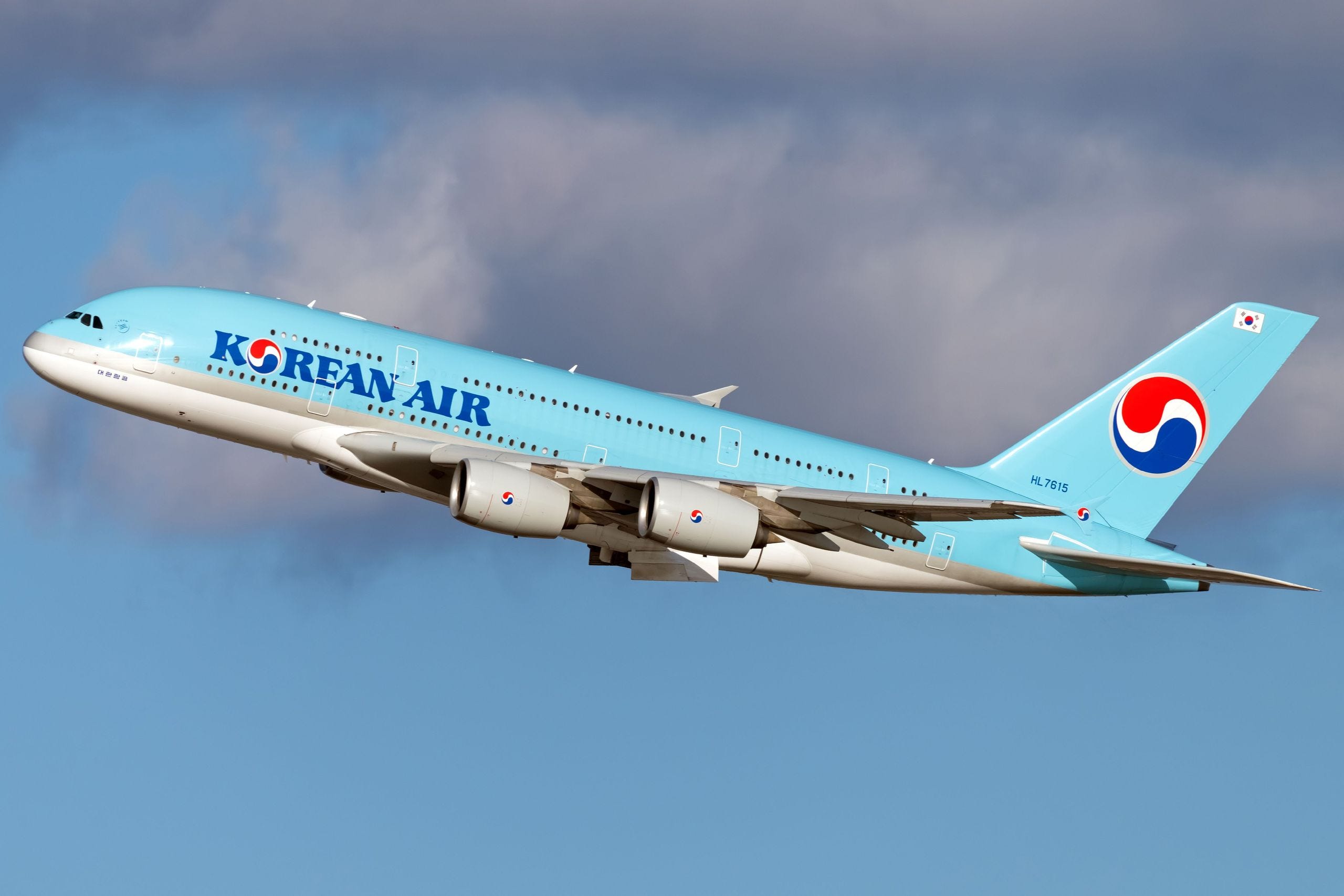
As of May 2026, Korean Air operates 169 active aircraft with an additional 5 confirmed on order or planned for near-term delivery. The average fleet age stands at 10.6 years, placing it in the upper-middle range for full-service carriers globally.
The mix spans both manufacturers and includes narrowbody, widebody, and freighter platforms.
The new combined Korean Air and Asiana identity will eventually carry nine aircraft types across 19 variants, a complexity profile that the executive team has openly described as something to be reduced over the medium term.
KOREAN AIR FLEET COMPOSITION (MAY 2026, INDICATIVE)

AIRBUS NARROWBODY
  A220-300              : Regional & domestic operations
  A321-neo              : Short to medium-haul
AIRBUS WIDEBODY
  A330-200 / A330-300   : Medium-haul, redeployed for capacity
  A350-900              : Long-haul (3 in service)
  A380-800              : Ultra-high capacity (5 active)
BOEING NARROWBODY
  737-800 / 737-900     : Domestic & regional
  737-8 MAX             : Pending first delivery
BOEING WIDEBODY
  747-8i                : Premium long-haul
  777-200ER / 777-300ER : Backbone long-haul
  787-9                 : Long-haul, fuel-efficient
FREIGHTERS
747-8F / 777F : Cargo backboneAircraft Type Strategy and Configuration
The Boeing 777-300ER remains the backbone of the long-haul passenger network. The carrier views these aircraft as offering a better balance between passenger demand and cargo capacity than the alternative widebody platforms operated under the Asiana legacy.

The Airbus A380, once positioned as the carrier’s flagship for premium-heavy routes such as Los Angeles and London, has been progressively scaled back.
Plans first announced in 2021 to retire the type within five years were pushed past the original 2026 timeline due to delivery delays affecting replacement aircraft. Five A380s remain operational, deployed selectively on capacity-heavy routes.

The Boeing 747-8i, another quad-jet flagship, is being retired on an accelerated schedule. The carrier confirmed plans to phase out five 747-8i aircraft by September 2025, with several units sold to Sierra Nevada Corporation for conversion into next-generation U.S. government command platforms.
The Boeing Mega-Order in Context
In August 2025, the airline placed what management described as the largest aircraft order in its history. The deal covers 103 Boeing aircraft, comprising 20 Boeing 777-9s, 25 Boeing 787-10s, 50 Boeing 737-10s, and 8 Boeing 777-8 Freighters.
When combined with separate orders placed earlier in 2025, including a finalized landmark widebody deal in March, the full-year Boeing commitment from Korean Air surpassed 150 aircraft. Deliveries from this commitment will run between 2026 and 2039.
The 777-9 specification matters operationally. Each aircraft seats 426 passengers in a two-class configuration with a range of 13,510 km, and the carrier has positioned the type as a long-term replacement for both the existing 747-8i and the older 777-300ERs.
The 787-10 will fill medium-density long-haul missions where the larger 777-9 is uneconomic.
Airbus A350 Family Strategy
The A350 fleet, while small at three aircraft today, anchors a major future expansion. In March 2024 the carrier finalized a firm order for 33 A350s, valued at approximately USD 13.7 billion and split between 27 A350-1000s and 6 A350-900s.
The A350-1000 was selected specifically for its payload-range capabilities, making it deployable on the carrier’s longest-range missions to the U.S. East Coast and Latin America. The smaller A350-900 will support medium-density long-haul missions and provide commonality benefits in cockpit and maintenance procedures.
In late 2025 the airline added the A350F freighter to its order book, becoming a launch-tier customer for the cargo variant and signaling a long-term Airbus presence in the freighter fleet alongside the Boeing 777-8F.
Narrowbody Refresh: A321neo and 737 MAX
The Airbus A321neo serves as the workhorse for short-to-medium-haul routes within Asia. Each aircraft carries 182 seats including 8 Prestige Class and 174 economy seats, configured for the dense markets between Korea, Japan, China, and Southeast Asia.
In late 2025 the carrier unveiled a refreshed A321neo cabin product including a 40-seat Premium Class layout in a 2-4-2 configuration, with the new Premium Class offering approximately 50% more space than existing economy.
The first Boeing 737-8 MAX is expected to enter service in April 2026, beginning a multi-year narrowbody refresh that will run alongside the much larger 737-10 commitment.
Fleet Age and Modernization Pace
The 10.6-year average fleet age understates the bifurcation across the operation. The narrowbody segment skews older due to the legacy 737-800 and 737-900 fleet, while the long-haul widebody fleet has been progressively refreshed through the A350 deliveries and 787-9 inductions of recent years.
Once the full Boeing 103-aircraft commitment, the Airbus A350 deliveries, and the A350F freighter additions enter service, the average fleet age is expected to drop substantially through the early 2030s.
FLEET STRATEGY GUIDING PRINCIPLES (MANAGEMENT DISCLOSURES)

1. Reduce variant complexity from 19 toward a long-term target of fewer types
2. Standardize on the 777-9 for replacement of 747-8i and 777-300ER
3. Use 787-10 and A350-900 for medium-density long-haul flexibility
4. Use A350-1000 for ultra-long-haul missions
5. Refresh narrowbody fleet via 737-10 and A321neo growth
6. Maintain a dedicated freighter fleet across 777-8F and A350F