


Executive Summary
LATAM Airlines Group posted US$14.5 billion in revenue for full-year 2025, a record for the group, with net income of US$1.5 billion (up 49.4% year over year).
The airline expects to grow its fleet to 410 aircraft by the end of 2026, placing it among the 12 largest carriers globally by fleet size, on par with Turkish Airlines.
Seven new routes are planned for 2026, including long-haul flights from Sao Paulo to Amsterdam, Brussels, and Cape Town, alongside a projected 11% growth in international capacity.
Premium segment revenues have more than doubled since 2019, climbing from US$1.5 billion to US$3.3 billion in 2025, reinforcing LATAM’s margin expansion strategy.
Recommended - Read Full Reports


Read All Reports
Table of Contents
Executive Summary
Key Facts: Company Profile
Introduction
Business Overview
Financial Performance: Full-Year 2025 Results
Revenue Growth Drivers
Balance Sheet Strength and Capital Allocation
2026 Financial Guidance
Key Services and Business Segments
Ownership Structure
LATAM Fleet: In-depth Analysis
Fleet Size and Composition
Aircraft Types: Strategy and Configuration
Airbus A320 Family (Narrowbody Core)
Airbus A319-100 (Legacy Regional Fleet)
Boeing 787 Dreamliner (Long-Haul Workhorse)
Boeing 777-300ER (High-Density Long-Haul)
Boeing 767-300ER (Passenger) and 767-300F (Cargo)
Fleet Strategy: Growth to 410 Aircraft by 2026
The Embraer E195-E2: A New Chapter
The Airbus A321XLR: Middle-of-Market Strategy
Route Network, Major Destinations and Strategy
Overview of the Network
2026 Route Expansion: The Biggest in LATAM’s History
New Domestic Routes in Brazil
New Long-Haul International Routes
Frequency Increases on Existing International Routes
Middle East and Africa: Future Expansion Targets
Domestic Capacity Boost in Brazil
Major Operational Bases (Hubs)
Sao Paulo Guarulhos International Airport (GRU)
Santiago Arturo Merino Benitez International Airport (SCL)
Jorge Chavez International Airport, Lima (LIM)
El Dorado International Airport, Bogota (BOG)
Potential Fifth Hub: Northeastern Brazil
Competitive Position
LATAM as the Region’s Dominant Carrier
LATAM vs. Abra Group (Avianca and Gol)
LATAM vs. Copa Airlines
LATAM vs. JetSmart
The Delta Air Lines Joint Venture
Premium Cabin Strategy and Customer Experience
The Premium Revenue Engine
Cabin Modernization and the Premium Comfort Class
Customer Satisfaction Metrics
Industry Awards and Recognition
Sustainability Strategy and Environmental Commitments
Digital Transformation and Operational Efficiency
LATAM Cargo Group: Air Freight Operations
Key Risks
1. Brazilian Regulatory and Tax Reform
2. Competitive Pressure from Abra Group Consolidation
3. Fuel Price Volatility
4. Aircraft Delivery Delays
5. Currency Exposure
6. Macroeconomic Slowdown in Latin America
Corporate History: From Merger to Rebound
Investment and Fleet Modernization Outlook: 2026 to 2030
The LATAM Pass Ecosystem
Operational Excellence: Workforce and Culture
My Final Thoughts
Official Sources and Data
Key Facts: Company Profile
Company Name:          LATAM Airlines Group S.A.
Headquarters:          Santiago, Chile
CEO:                   Roberto Alvo
Founded:               2012 (merger of LAN Airlines and TAM Linhas Aereas)
Ticker Symbol:         LTM (NYSE and Santiago Stock Exchange)
Employees:             ~35,568
Fleet Size (End 2025): 371 aircraft
Passengers (2025):     87.4 million
Revenue (FY 2025):     US$14.5 billion
Net Income (FY 2025):  US$1.5 billion
Primary Hubs:          Santiago (SCL), Sao Paulo Guarulhos (GRU),
                       Lima (LIM), Bogota (BOG)
Domestic Markets:      Brazil, Chile, Colombia, Ecuador, Peru
Loyalty Program:       LATAM Pass (54 million members)
Key Partners: Delta Air Lines (JV), Qatar Airways (shareholder)Introduction
LATAM Airlines Group closed 2025 as the largest carrier in the Southern Hemisphere, transporting 87.4 million passengers and generating US$14.5 billion in operating revenue.
The Santiago-based group, born from the 2012 merger of Chile’s LAN and Brazil’s TAM, has undergone a remarkable financial turnaround since emerging from Chapter 11 bankruptcy in late 2022.
With 41 new aircraft arriving in 2026, a deepening premium strategy that has already doubled high-margin revenue, and an aggressive route expansion into Europe and Africa, LATAM is building a business model that few Latin American peers can replicate at scale.
This in-depth analysis report breaks down every operational layer of the group, from fleet composition to competitive positioning, to help airline industry stakeholders understand where LATAM stands and where it’s headed.

Business Overview
Financial Performance: Full-Year 2025 Results
LATAM Airlines Group delivered its strongest financial year on record in 2025. Total operating revenues reached US$14.5 billion, representing an 11.2% increase compared to 2024. This growth was driven overwhelmingly by passenger operations, which contributed US$12.6 billion to the top line.
Net income for the year hit US$1.5 billion, a 49.4% jump from 2024. This performance was underpinned by an adjusted operating margin of 16.2%, which expanded 3.5 percentage points year over year, signaling structural improvements in how the group converts revenue into profit.
The fourth quarter alone brought in US$3.9 billion in operating revenue, with passenger revenues surging 20.3% during that period. Q4 net income attributable to shareholders reached US$484 million, a 78.1% increase over Q4 2024.
LATAM Airlines Group: Full-Year 2025 Financial Summary
-------------------------------------------------------
Total Operating Revenue:       US$14.5 billion (+11.2% YoY)
Passenger Revenue:             US$12.6 billion
Cargo Revenue:                 US$1.65 billion
Net Income:                    US$1.5 billion (+49.4% YoY)
Adjusted Operating Income:     US$2.4 billion
Adjusted Operating Margin:     16.2%
Adjusted EBITDAR:              US$4.1 billion (28.2% margin)
Passengers Transported:        87.4 million
Load Factor:                   84.4%
ASK Growth: 8.2%Revenue Growth Drivers
Three forces propelled LATAM’s top-line growth in 2025.
First, the premium segment produced extraordinary results. Revenues from premium cabins, ancillaries, upsell options, and LATAM Travel & Corporate channels climbed to US$3.3 billion, more than doubling the US$1.5 billion figure recorded in 2019. This growth in premium revenue consistently outpaced total revenue expansion.
Second, capacity increases of 8.2% in Available Seat Kilometers (ASKs) allowed the group to serve more passengers without sacrificing load factor, which held at 84.4%. LATAM transported an average of more than 239,000 passengers daily throughout 2025.
Third, the cargo division continued to generate meaningful revenue. LATAM Cargo Group contributed US$1.65 billion in revenue, roughly 11% of the group total. The cargo affiliates moved over 1 million tons during the year, and the division received the global Cargo Airline of the Year award, cementing LATAM Cargo as the dominant air freight player in South America with an estimated 30% regional market share.
Balance Sheet Strength and Capital Allocation
The group ended 2025 with a liquidity position of US$3.7 billion, equivalent to 25.7% of the last twelve months’ revenue. Adjusted net leverage stood at a disciplined 1.5x, a metric that positions LATAM favorably against most global airline peers.
Strong cash generation exceeding US$1.4 billion gave management the confidence to return significant capital to shareholders. During the year, the group allocated US$585 million to share buybacks.
Separately, LATAM paid US$400 million in interim dividends in December and US$293 million in statutory dividends during the second quarter.
Capital Allocation (2025)
--------------------------
Share Buybacks:           US$585 million
Interim Dividends:        US$400 million
Statutory Dividends:      US$293 million
Total Shareholder Return: US$1.28 billion
Liquidity (Year-End):    US$3.7 billion
Net Leverage: 1.5x2026 Financial Guidance
For 2026, LATAM is guiding for revenue between US$15.5 and US$16.0 billion, which would represent approximately 7% to 10% growth over 2025. Adjusted operating income is projected at US$2.35 to US$2.65 billion, with an adjusted operating margin in the 15.0% to 17.0% range.
The adjusted EBITDA target sits at US$4.20 to US$4.60 billion, with margins of 27.0% to 29.0%. Adjusted levered free cash flow is expected to exceed US$1.7 billion.
The group is targeting liquidity above US$5.0 billion and total net debt below US$6.2 billion, with a net debt-to-EBITDAR ratio of 1.4x or below.
2026 Guidance Summary
-----------------------
Revenue:                   US$15.5 - 16.0 billion
Adjusted Operating Income: US$2.35 - 2.65 billion
Adjusted Operating Margin: 15.0% - 17.0%
Adjusted EBITDA:           US$4.20 - 4.60 billion
Adjusted EBITDA Margin:    27.0% - 29.0%
Levered Free Cash Flow:    > US$1.7 billion
Liquidity Target:          > US$5.0 billion
Net Debt Target:           < US$6.2 billion
Net Debt / EBITDAR: <= 1.4xKey Services and Business Segments
LATAM operates three core business segments.
The passenger business, contributing roughly 87% of total revenue, runs across five domestic South American markets and connects the continent to North America, Europe, Oceania, Africa, and the Caribbean.
LATAM Cargo Group represents the second major segment, operating 20 dedicated freighters plus belly capacity across the entire passenger fleet.
The third pillar is the LATAM Pass loyalty program, which reached 54 million members by year-end 2025 after adding 4 million new members during the year. LATAM Pass processes approximately 30,000 seat redemptions per day and maintains over 100 commercial partnerships, making it the largest frequent-flyer program across Latin America.
Ownership Structure
As of July 31, 2025, LATAM’s shareholder base reflects the post-bankruptcy restructuring. Sixth Street Partners holds the largest stake at 20.1%.
Strategic Value Partners owns 11.5%. Delta Air Lines and Qatar Airways each hold 10.0%, giving both airline partners meaningful board influence.
The Cueto Group, a founding family behind LAN Airlines, retains 5.0%. The remaining 38.3% is held by other investors.
Major Shareholders (as of July 31, 2025)
------------------------------------------
Sixth Street Partners:     20.1%
Strategic Value Partners:  11.5%
Delta Air Lines:           10.0%
Qatar Airways:             10.0%
Cueto Group:                5.0%
Other Investors: 38.3%LATAM Fleet: In-depth Analysis
Fleet Size and Composition
LATAM ended 2025 with a total of 371 aircraft, having received 26 new jets throughout the year. This positions the group as the dominant carrier in Latin America by fleet count and places it within reach of the global top 12.
The fleet is split between narrowbody and widebody aircraft, with a smaller dedicated cargo fleet. Narrowbody aircraft dominate the count, with 293 Airbus A320-family jets handling the bulk of domestic and short-haul international flying. The widebody fleet of 57 aircraft, primarily Boeing 787s and 777s, operates long-haul routes to North America, Europe, Oceania, and Africa. Twenty Boeing 767-300F freighters serve the cargo division.
The average fleet age is 12.4 years. LATAM management has committed to maintaining this average at or below 12 years through ongoing deliveries of new-generation aircraft.
Fleet Composition (End of 2025)
---------------------------------
NARROWBODY (Passenger):
Airbus A319-100:       ~39 aircraft
Airbus A320-200:       ~135 aircraft
Airbus A320neo:        ~52 aircraft
Airbus A321-200:       ~49 aircraft
Airbus A321neo:        ~18 aircraft
Subtotal Narrowbody:   ~293 aircraft

WIDEBODY (Passenger):
Boeing 767-300ER:      ~9 aircraft
Boeing 777-300ER:      ~10 aircraft
Boeing 787-8:          ~10 aircraft
Boeing 787-9:          ~28 aircraft
Subtotal Widebody:     ~57 aircraft

CARGO:
Boeing 767-300F:       ~20 aircraft

TOTAL FLEET:           ~371 aircraft
Average Fleet Age: 12.4 yearsAircraft Types: Strategy and Configuration
Airbus A320 Family (Narrowbody Core)
The Airbus A320 family forms the backbone of LATAM’s network. The older A320ceo variants seat around 180 passengers, while the A321-200 aircraft carry up to 224 passengers. These workhorses handle routes across all five domestic markets and short-haul international services.
The A320neo and A321neo variants are replacing older CEO models. According to LATAM’s fleet plan, the neo family grew from 31 aircraft in 2023 to approximately 70 by end-2025, with the number projected to reach 77 in 2026.
These newer models consume approximately 15-20% less fuel per seat compared to their predecessors, directly lowering unit costs.
Airbus A319-100 (Legacy Regional Fleet)
LATAM currently operates around 39 Airbus A319-100s, each seating 144 passengers. These aircraft average 17 years of age, making them the oldest type in the fleet.
Rather than retiring them immediately, LATAM launched a US$40 million overhaul program to install new seats, improve onboard connectivity, and extend the usable life of these jets until newer Embraer E195-E2s begin arriving.
This overhaul decision reflects a pragmatic approach. With aircraft delivery delays across the industry, LATAM chose to modernize what it has while waiting for new types. The A319 primarily serves regional routes from Lima and Sao Paulo.
Boeing 787 Dreamliner (Long-Haul Workhorse)
LATAM operates 38 Boeing 787 Dreamliners, split between 10 787-8s and 28 787-9s. These aircraft handle the majority of transatlantic, transpacific, and other long-haul services. The Boeing 787 is the aircraft type LATAM is deploying on its new 2026 routes to Amsterdam, Brussels, and Cape Town.

The 787’s fuel efficiency and range capabilities make it central to LATAM’s international expansion strategy. Management continues to take delivery of additional 787-9s, with the fleet plan projecting 41 Dreamliners by the end of 2026.
Boeing 777-300ER (High-Density Long-Haul)
Ten Boeing 777-300ERs serve LATAM’s highest-demand long-haul routes. These wide-body jets offer the highest seat capacity in the fleet and are deployed on routes where demand justifies the additional size, particularly between Sao Paulo and major European and North American gateways.
Boeing 767-300ER (Passenger) and 767-300F (Cargo)
Nine Boeing 767-300ERs remain in the passenger fleet, primarily used on medium-haul international routes within the Americas. The 767 passenger fleet is gradually being phased as 787 deliveries continue.
The cargo fleet consists of 20 Boeing 767-300F freighters. These aircraft are the backbone of LATAM Cargo’s operations, running both on the passenger network’s routes and on cargo-only frequencies.
Fleet Strategy: Growth to 410 Aircraft by 2026
LATAM’s fleet strategy for 2026 is among the most ambitious in the airline industry. The group plans to receive 41 new aircraft during the year, bringing the total fleet to approximately 410 by December.
This would rank LATAM among the world’s 12 largest airlines by aircraft count, placing it alongside Turkish Airlines.
Fleet Growth Trajectory
-------------------------
End of 2023:    333 aircraft
End of 2024:    344 aircraft
End of 2025:    371 aircraft (+26 new deliveries)
End of 2026:    ~410 aircraft (+41 new deliveries)
End of 2027:    ~437 aircraft (+27 new deliveries)
By 2030:        130+ new aircraft to be introduced
Target:         ~200 next-generation models by decade's end
Capital expenditure on fleet, net of financing, is projected at US$1.7 billion for both 2026 and 2027. The group aims to have approximately 200 next-generation aircraft in its fleet by the end of the decade, representing about half the total fleet.
The Embraer E195-E2: A New Chapter
Perhaps the most strategically significant fleet addition is the Embraer E195-E2. In September 2025, LATAM ordered up to 74 of these regional jets, broken into 24 firm orders and 50 purchase options. Deliveries are scheduled to begin in the second half of 2026, initially for LATAM Airlines Brazil.
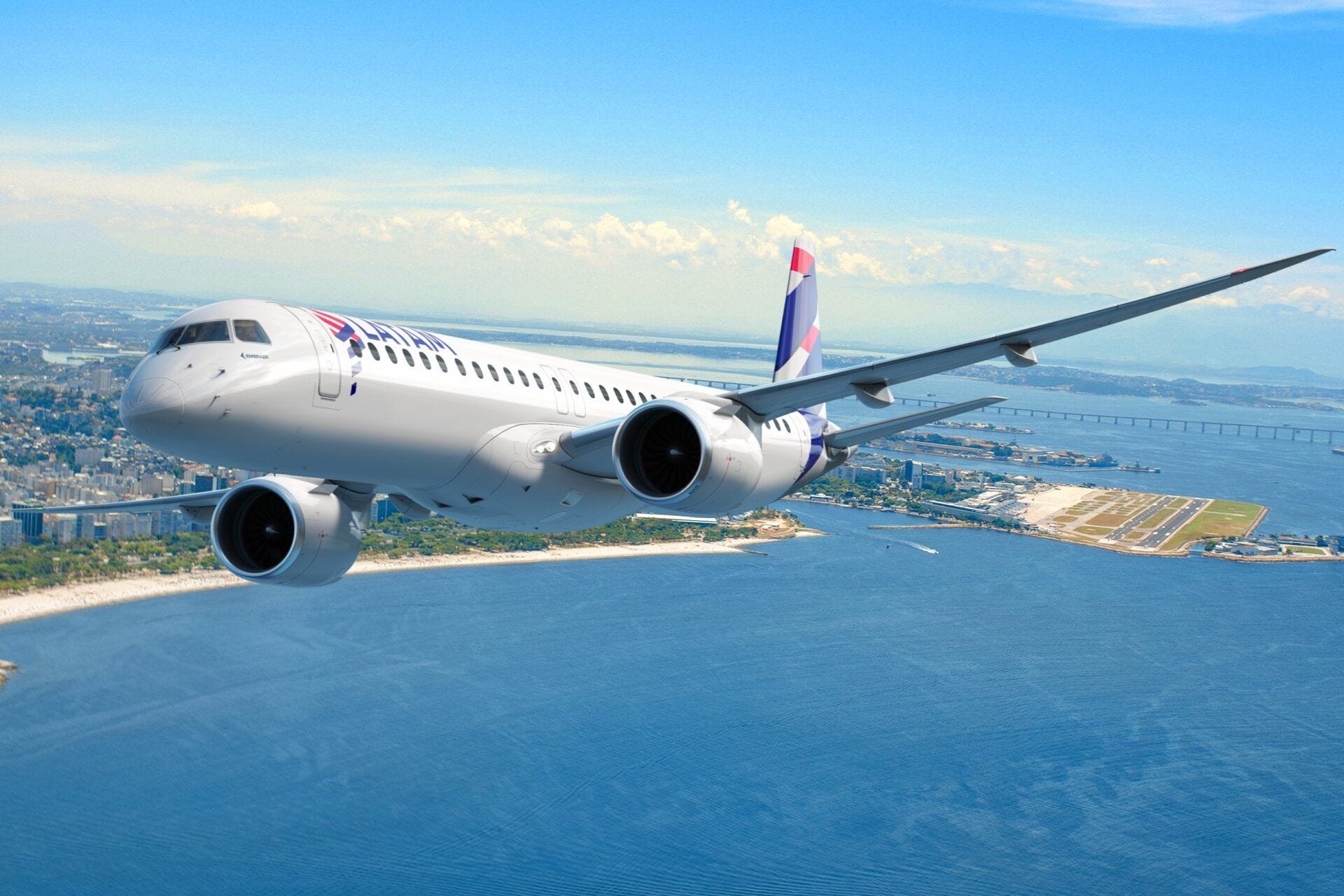
The E195-E2 fills a gap in LATAM’s fleet by offering roughly 130 to 146 seats, smaller than the A320’s 180 but larger than traditional regional turboprops. LATAM’s CEO Roberto Alvo has stated that the E195-E2 will open regional routes that have remained largely untapped across South America.
This aircraft type allows LATAM to serve smaller cities that cannot fill a 180-seat A320 but have enough demand for a right-sized jet. The E195-E2 also delivers significant fuel savings over older narrowbodies, with Embraer reporting up to 25% lower fuel burn per seat compared to the previous E-Jet generation.
Embraer E195-E2 Order Details
-------------------------------
Total Order:           Up to 74 aircraft
Firm Orders:           24
Purchase Options:      50
First Delivery:        H2 2026
Initial Operator:      LATAM Airlines Brazil
Seat Configuration:    ~130-146 (estimated)
Primary Role:          Regional routes in South America
Key Benefit: Opens underserved city pairsThe Airbus A321XLR: Middle-of-Market Strategy
The first A321XLR delivery is expected in 2027. This aircraft represents LATAM’s answer to the “middle of market” question, bridging the gap between narrowbody and widebody operations. The A321XLR can fly transatlantic distances with narrowbody economics, a combination that could transform LATAM’s European network.
LATAM is considering deploying the A321XLR on European routes from 2027. The aircraft will be outfitted with a premium business cabin, consistent with LATAM’s broader premium-first approach.
By using a narrowbody for thinner long-haul routes, LATAM can serve city pairs that would not justify a full widebody deployment, potentially opening new direct links from secondary South American cities to European destinations.