


Welcome to AviationOutlook: The aviation newsletter built exclusively for decision-makers.
Become an “Annual” member now & get this special discount offer.
As a paid member, you get access to:
200+ Reports - All major airlines + aerospace & defense companies (updated regularly).
Daily / Weekly - Deep-dive analysis & insights.
Monthly - Industry outlook reports.
In case you missed it, here are the latest analysis reports:
Embraer - Company Analysis and Outlook Report 2026 (Updated)
American Airlines’ Six-Route Europe Play: Yield Discipline or Widebody Overreach?
Check Out All Reports
Executive Summary
Lion Air, operated by PT Lion Mentari Airlines, remains the cornerstone of the Lion Air Group, Indonesia’s largest privately held aviation conglomerate by aircraft count, with the group operating a combined fleet of roughly 371 aircraft spanning five carriers across Indonesia, Malaysia, and Thailand.
The Lion Air mainline fleet as of early 2026 sits at 101 to 118 aircraft, dominated by the Boeing 737-900ER and Boeing 737-800, supplemented by 737 MAX 9, Airbus A330-300, and a new generation of Airbus A330-900neo widebodies used for Hajj and Umrah pilgrimage charters.
Operationally, Lion Air centers its hub-and-spoke design on Soekarno-Hatta International Airport (Terminal 1B effective 17 November 2025), with secondary operating bases in Surabaya, Denpasar, Medan, Makassar, Manado, Batam, and Yogyakarta.
Lion Air continues to push a long-deferred USD 500 million IPO, faces fuel-cost pressure as Indonesia raised the fuel surcharge ceiling to 38 percent in 2026, and competes intensely with Garuda Indonesia, Citilink, AirAsia Indonesia, Pelita Air, and TransNusa across the archipelago.
Recommended - Read Full Reports


Read All Reports
Table of Contents
Executive Summary
Introduction
Lion Air Company Profile: Key Facts
Corporate Structure
Identity, Branding and Positioning
Lion Air Revenue Growth Drivers
Key Services and Products
Lion Air Fleet Analysis
Mainline Fleet Size and Composition
Fleet Age Disclosure
Aircraft Type Strategy and Configuration
Fleet Strategy and Order Book
Maintenance, MRO and Asset Management
Safety-Oriented Fleet Evolution
Lion Air Route Network Strategy, Major Destinations and Analysis
Network Architecture
Domestic Network
International Network
Network Strategy Going Forward
Major Operational Bases (Hubs)
Primary Hub: Soekarno-Hatta International Airport, Jakarta (CGK)
Secondary Hubs
Hub Coordination Across the Group
Lion Air Competitive Position
Major Competitors
Lion Air vs. Garuda Indonesia
Lion Air vs. Citilink
Lion Air vs. AirAsia Indonesia
Lion Air vs. Pelita Air
Within-Group Coopetition
Lion Air Leadership and Governance
Pilot Training and Human Capital Infrastructure
Cargo and Logistics: Lion Parcel
Safety, Operational Reliability and Quality
Sustainability and Fleet Modernization
Indonesian Aviation Macro Backdrop for 2026
Lion Air IPO Considerations
Key Risks for Lion Air
Risk 1
Risk 2
Risk 3
Risk 4
Risk 5
Risk 6
Risk 7
Risk 8
Risk 9
Strategic Outlook for 2026 and Beyond
My Final Thoughts
Official Sources and Data
Introduction
Indonesia is the world’s largest archipelagic nation, and aviation is the connective tissue.
Few carriers embody that reality more aggressively than Lion Air, the no-frills low-cost carrier that broke records with the largest Boeing 737 order in history and grew from two leased Boeing 737-200s in June 2000 into a national institution.

For 2026 and beyond, the airline operates inside a much harder commercial environment.
Fuel costs are higher, the rupiah is weaker, the Indonesian domestic market is still trailing 2019 traffic levels, and competitors like Pelita Air and a re-energized Garuda Indonesia are clawing back share.
This report dissects Lion Air’s fleet strategy, route economics, hub structure, leadership, competitive position, risk profile, and more.
Lion Air Company Profile: Key Facts
Lion Air is a privately held Indonesian low-cost carrier headquartered at the Lion Air Tower in Jakarta. The legal entity is PT Lion Mentari Airlines, and the carrier sits within the larger Lion Air Group holding company.
The airline was founded in October 1999 by brothers Rusdi Kirana and Kusnan Kirana, and it commenced commercial operations on 30 June 2000. It is the country’s largest privately run airline and historically the dominant force in Indonesian domestic low-cost travel.
Captain Daniel Putut Kuncoro Adi is the President Director of Lion Air Group. Rudy Lumingkewas continues to serve as President Director of Lion Air mainline, while Rusdi Kirana retains long-term strategic influence despite formally stepping back from day-to-day operations.
Corporate Structure
The Lion Air Group is privately controlled by the Kirana family. The Kirana brothers are co-owners, and Forbes has tracked them as some of Indonesia’s most prominent self-made business families.
The group has resisted public listing for more than a decade, although the carrier has revisited IPO plans multiple times, most recently exploring a Jakarta listing that could raise up to USD 500 million.
LION AIR GROUP - CORPORATE TREE (2026)
└── PT Lion Group (Lion Air Group)
    ├── Lion Air (Indonesia, LCC)
    ├── Wings Air (Indonesia, regional ATR operator)
    ├── Batik Air (Indonesia, full-service)
    ├── Batik Air Malaysia (Malaysia, full-service, formerly Malindo Air)
    ├── Thai Lion Air (Thailand, LCC)
    ├── Super Air Jet (Indonesia, ULCC; informally affiliated)
    ├── Lion Parcel (logistics)
    ├── Lion Bizjet (charter)
    ├── Batam Aero Technic (MRO)
    └── Lion Hotel & Plaza (hospitality)
Identity, Branding and Positioning
Lion Air is positioned squarely as a no-frills low-cost carrier with a single-class economy cabin and ancillary-revenue-driven pricing. The slogan “We Make People Fly” is consistent with the founder’s stated mission of democratizing flight in an archipelago where surface transport between islands is impractical.
Inside the Lion Air Group, the mainline carrier sits one notch above ultra-low-cost Super Air Jet but below the full-service Batik Air. This stratification is deliberate, allowing the group to fence multiple price-points without cannibalizing itself.
Lion Air Revenue Growth Drivers
The most significant near-term revenue growth driver for Lion Air is the pilgrimage segment. The carrier launched direct Umrah flights from Solo to Jeddah in July 2025 and from Padang to Jeddah on 14 July 2025, expanding its widebody pilgrimage offering.
The Hajj 1446H season in 2025 demonstrated the strength of this segment. Lion Air operated 13 Hajj kloter flights from Saudi Arabia to Banjarmasin with 100 percent on-time performance, a marked operational success that reinforces the airline’s position as a primary Hajj transport provider.
A second growth driver is ancillary revenue. The airline updated its checked baggage policy effective 17 July 2025, with revised Free Baggage Allowance bands. The redesign nudges more passengers toward paid prepaid baggage purchases, lifting per-passenger ancillary contribution.
A third lever is cargo. Belly-hold cargo, supplemented by parent-group subsidiary Lion Parcel, gives Lion Air a logistics adjacency that is increasingly important as Indonesian e-commerce volumes continue to grow.
Key Services and Products
Lion Air’s core product is single-class economy scheduled point-to-point service, with seat pitch of 29 inches and a basic complimentary cabin experience. Customers can purchase prepaid baggage at lower rates online via the official Lion Air booking site up to six hours before departure.
The carrier offers complementary services through the wider Lion Air Group, including charter flights, business-jet services via Lion Bizjet, and integrated cargo via Lion Parcel. For pilgrimage travelers, Lion Air sells dedicated direct Umrah packages and operates Hajj kloter charters during the annual pilgrimage season.
Lion Air Fleet Analysis
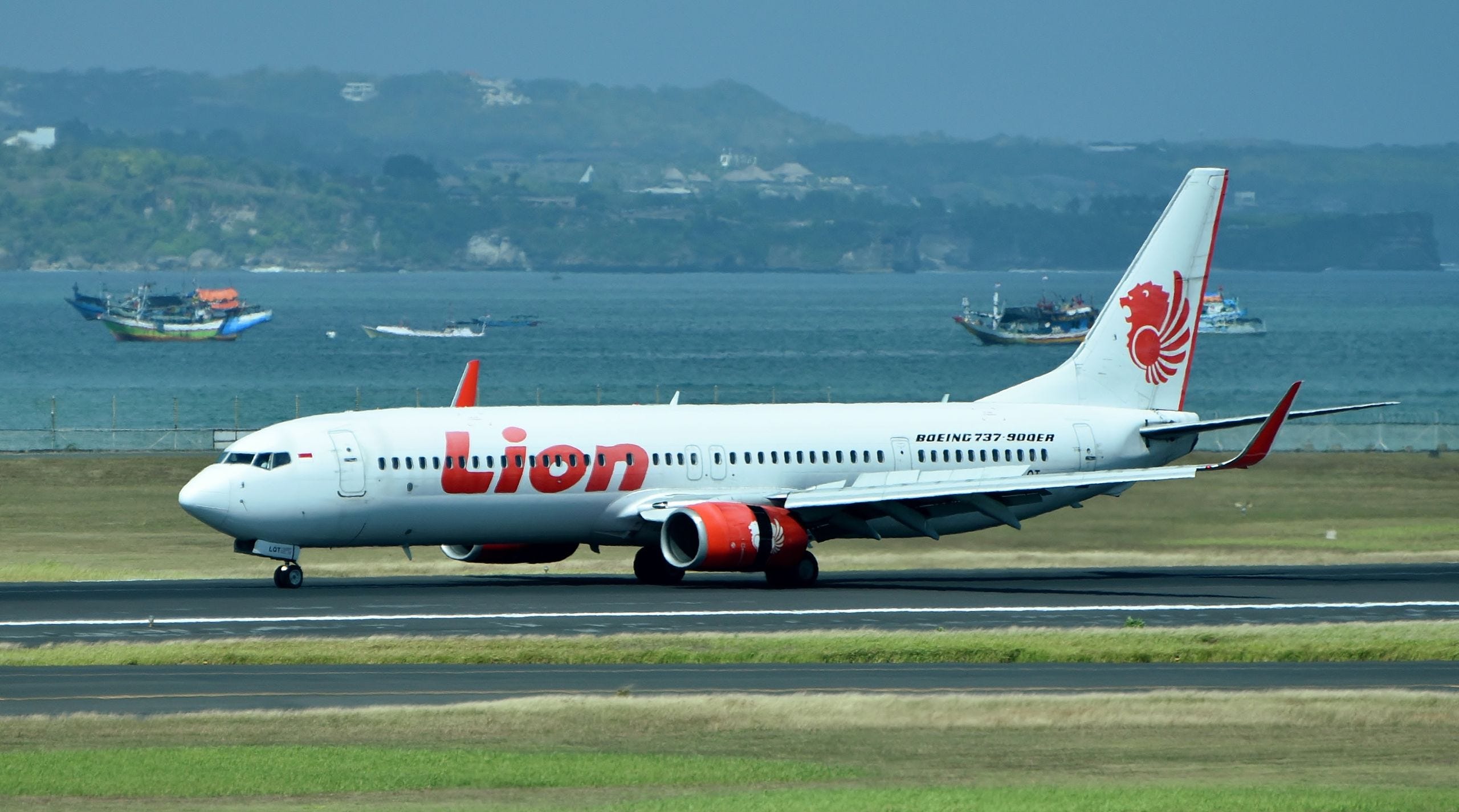
The fleet is the operational beating heart of Lion Air, and it is also the source of both the carrier’s largest opportunities and its largest historical controversies. This section reconstructs the airline’s fleet composition, age, configuration choices, and broader fleet strategy in detail.
Mainline Fleet Size and Composition
Lion Air officially states that it operates 118 aircraft, spanning four families: Boeing 737-900ER, Boeing 737-800, Boeing 737 MAX, and Airbus A330.

The carrier lists 65 Boeing 737-900ER, 38 Boeing 737-800, 10 Boeing 737 MAX 8, and 5 Airbus A330-300 aircraft. The tally as of March 2025 records 101 active aircraft, with the addition of eight Airbus A330-900neo widebodies that have entered the fleet for Umrah and Hajj operations.
LION AIR MAINLINE FLEET - 2026 SNAPSHOT
Boeing 737-900ER ........ 60 to 65 aircraft (215 economy seats)
Boeing 737-800 .......... 24 to 38 aircraft (189 economy seats)
Boeing 737 MAX 8/9 ...... 4 to 10 aircraft  (MAX 8: 180-189 seats)
Airbus A330-300 ......... ~5 aircraft (436-440 seats, two-class)
Airbus A330-900neo ...... ~8 aircraft (~436 seats, charter)
TOTAL MAINLINE .......... ~101 to 118 aircraft
Fleet Age Disclosure
Lion Air states an average fleet age of 6.73 years, which would place it among the younger Asia-Pacific narrowbody fleets.
The aging cohort of 737-900ERs, many delivered between 2008 and 2014, faces increasing C-check and D-check costs, while the small but expanding MAX 8/9 cohort delivers double-digit fuel-burn improvement per block hour relative to the legacy NG fleet.
Aircraft Type Strategy and Configuration
The Boeing 737-900ER is Lion Air’s workhorse. Lion Air was the launch customer for the variant and configures it in a single-class 215-seat all-economy layout with 29-inch pitch. This is one of the highest-density 737-900ER configurations in the world and is critical to Lion’s per-trip unit economics.
The Boeing 737-800, with a 189-seat single-class economy layout, fills shorter sectors and routes with lower demand densities. The aircraft remains a flexible reserve for slot-constrained domestic markets such as Bali (DPS) and Surabaya (SUB).
The Boeing 737 MAX 8 has a documented seating count on the airline’s own website of “as many as 108 passengers.” Industry data and tracking sources, however, suggest standard MAX 8 configurations at Lion Air carry 180 to 189 passengers in single class. The discrepancy is best read as a website oversight rather than a literal cabin layout, and analysts should treat 180+ economy seats as the operational reality for revenue planning.
The Boeing 737 MAX 9 is configured for 215 passengers in line with the 737-900ER, allowing seamless route swaps as the MAX 9 cohort grows. This commonality is intentional and supports rapid cabin-crew familiarization and slot interchangeability.
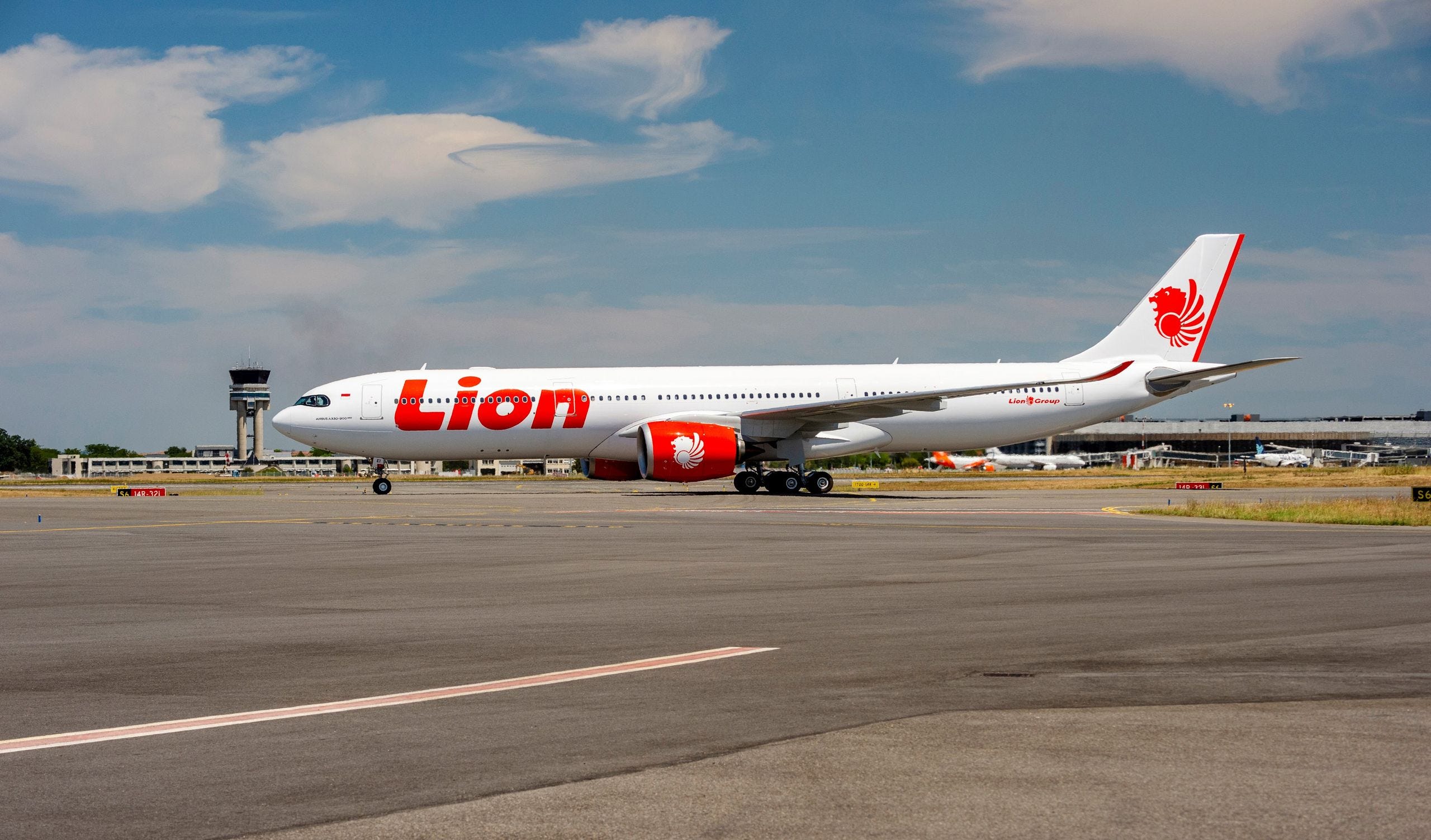
The Airbus A330-300 and A330-900neo are the widebody arm of the fleet. The A330-300 operates at high-density configurations of up to 440 passengers for international charter, particularly for pilgrimage. The A330-900neo, introduced as the first in Asia-Pacific in 2019, delivers roughly 25 percent better fuel burn per seat versus the A330ceo and supports non-stop city pairs across the Saudi Arabia network.
Fleet Strategy and Order Book
Lion Air has historically placed some of the largest single orders in commercial aviation history. The carrier signed a USD 24 billion order for 234 Airbus A320 family aircraft and a 230-aircraft Boeing 737 commitment that broke industry records at the time of signing.
The most consequential current order for the mainline carrier is the 50-aircraft Boeing 737 MAX 10 commitment signed at the 2017 Paris Air Show, valued at approximately USD 6.24 billion at list prices. This was, at the time of signing, the largest incremental order for the MAX 10 variant globally.
Deliveries against this order remain pending. The Boeing 737 MAX 10 is approaching certification, with the FAA having recently approved Type Inspection Authorization. As deliveries materialize, Lion Air will receive the most fuel-efficient single-aisle aircraft in the 737 family, positioned to replace older 737-900ERs nearing midlife.
LION AIR (MAINLINE) ORDER BOOK - PUBLIC RECORD
- Boeing 737 MAX 10: 50 firm (2017 PAS commitment, $6.24B)
- Boeing 737 MAX family: residual unbuilt frames from 2011/2017 deals
- Airbus A320neo / A321neo: partially deferred or reallocated to Batik
- Airbus A330neo: incremental wide-body adds for Hajj/Umrah
Maintenance, MRO and Asset Management
Lion Air leans heavily on a sister-company MRO ecosystem. Batam Aero Technic, the group’s MRO subsidiary, performs C-checks, painting, and heavy maintenance for Lion mainline aircraft, providing the group with both cost control and independence from external Asia-Pacific MRO bottlenecks.
The group also partners with Airbus through the Angkasa Training Center for pilot training and with OEMs Boeing, Honeywell, and lessors GECAS, BOCA, and Avolon for asset financing.
This commercial architecture has been a defining feature of Lion Air’s expansion philosophy: sale-leaseback transactions and lessor financing fund order growth without diluting equity at the holding-company level.
Safety-Oriented Fleet Evolution
The October 2018 loss of Lion Air Flight JT610 remains the defining inflection point in Lion Air’s modern fleet management. The accident, which involved a Boeing 737 MAX 8, drove sweeping safety overhauls inside the airline and the global grounding of the MAX family.
Today, Lion Air operates under Indonesia’s 80.8 percent ICAO aviation safety rating, which ranks Indonesia second in ASEAN behind Singapore. Internal safety programs have been substantially upgraded, with the Safety Director position elevated and reporting directly into the executive team.