


Executive Summary
Record Financial Performance: Lufthansa Group generated EUR 39.6 billion in revenue in 2025 (up 5% year-over-year) and EUR 2 billion in Adjusted EBIT (up more than 20%), beating analyst expectations.
Fleet and Margin Transformation Underway: A massive fleet renewal program is in full swing, with nearly one new aircraft delivered per week in 2026, targeting a reduction of long-haul aircraft types from 13 to 6 by 2030 and an Adjusted EBIT margin of 8 to 10% by 2028-2030.
Strategic Expansion via M&A: The 41%-owned ITA Airways integration is proceeding at a record pace; a potential majority stake move to 90% is expected by mid-2026. Simultaneously, non-binding bids for TAP Air Portugal were due April 2, 2026, making Lufthansa the most acquisitive European airline group.
Geopolitical Headwinds: The escalating conflict involving Iran has suspended flights to eight Middle East destinations, sent jet fuel prices surging, and introduced significant forecast uncertainty for 2026 and beyond, even as it creates short-term demand shifts toward Asia and Africa.
Recommended - Read Full Reports


Read All Reports
Table of Contents
Executive Summary
Introduction
Key Facts: Company Profile
Business Overview
The Four-Pillar Model
Multi-Hub Architecture as a Structural Differentiator
Revenue and Growth Drivers
LTM Revenue Performance
Five Key Revenue and Earnings Drivers
1. Fleet Modernization and Fuel Savings
2. The Allegris Premium Cabin Effect
3. The Turnaround Program at Lufthansa Airlines
4. Cargo Market Tailwinds
5. ITA Airways Integration Earnings Contribution
Key Services and Products
Passenger Airlines: A Multi-Brand, Multi-Segment Portfolio
Lufthansa Technik: The World’s Leading Independent MRO
Lufthansa Cargo: A Dynamic Logistics Business
Miles & More: Europe’s Largest Frequent Flyer Program
Network and Major Destinations
Summer 2026: A Broader Global Footprint
Long-Haul Focus: The Southern Hemisphere Strategy
Fleet Strategy
The Great Fleet Simplification
New Aircraft Performance Advantages
Total Fleet Order Commitment
Major Competitors
Europe’s “Big Three” Legacy Groups
IAG: The Profitability Benchmark
Air France-KLM: The Weakest Financial Position
Low-Cost Competition: Ryanair’s Shadow
Competitive Analysis: Moat and Differentiation
What Protects Lufthansa’s Market Position
Recent Developments
ITA Airways Integration: Europe’s Fastest Airline Merger
Lufthansa Group Signs Fleetwide Starlink Deal
The TAP Air Portugal Pursuit
The Middle East War: Risk and Opportunity
Sustainability: 7 Million Passengers Choose Greener Flying
Eurowings Expands Strategically from Berlin
Key Risks: Probabilities and Scenarios
Risk 1: Prolonged Middle East Conflict and Energy Shock
Risk 2: Aircraft Delivery Delays
Risk 3: Labor Strikes and Cost Inflation
Risk 4: Yield Pressure and Demand Weakness
Risk 5: ITA Airways Integration Execution Risk
Risk 6: US Dollar Weakness
Primary Sources and Official Data
My Final Thoughts
Introduction
Lufthansa Group just closed its centennial year by posting the highest revenue in its 100-year history, reaching EUR 39.6 billion in 2025 while simultaneously managing geopolitical upheaval in the Middle East, stubborn labor costs, and delayed aircraft deliveries.
That achievement alone commands attention from every airline industry stakeholder watching Europe’s aviation sector.
But the more pressing story is what comes next.
The group’s fleet modernization is peaking in 2026, its ITA Airways integration is accelerating, a high-stakes bid for TAP Air Portugal is on the table, and a structural reshaping of the entire long-haul fleet down to six aircraft types by 2030 is underway.
For the airline industry stakeholders, this is a company at a genuine inflection point.
Key Facts: Company Profile
Company Name:     Deutsche Lufthansa AG (Lufthansa Group)
Headquarters:     Frankfurt am Main, Germany
Founded:          Founded in its current form in 1953
                  (Centennial year 2026 marks 100 years since original 1926 founding)
CEO:              Carsten Spohr (Chairman of the Executive Board)
CFO:              Till Streichert
Stock Exchange:   Frankfurt Stock Exchange (ETR: LHA)
Employees:        Over 100,000 worldwide
Fleet Size:       Over 730 aircraft (as of 2025)
Passengers (2025):135 million guests
Revenue (2025):   EUR 39.6 billion (record)
Adj. EBIT (2025): EUR 2.0 billion
Adj. EBIT Margin: 4.9%
Alliance:         Star Alliance (founding member)
Hubs:             Frankfurt, Munich, Zurich, Vienna, Brussels, Rome
Global Rank:      #1 in Europe, #4 globally
Key Subsidiaries: Lufthansa Airlines, SWISS, Austrian Airlines,
                  Brussels Airlines, ITA Airways (41% stake),
                  Eurowings, Lufthansa Cargo, Lufthansa Technik

Business Overview
The Four-Pillar Model
Lufthansa Group operates through four distinct business segments, each contributing a different dimension of earnings resilience and growth.
The first and largest is the network airlines segment, which accounts for roughly 70% of group revenue. This segment includes:
Lufthansa Airlines,
SWISS International Air Lines,
Austrian Airlines,
Brussels Airlines, and
The newly integrated ITA Airways.
These airlines operate from six hubs in economically affluent European markets, a structural advantage that supports premium pricing and high yields relative to secondary city-pair competitors.
The second pillar is the point-to-point model represented primarily by Eurowings.
This low-cost carrier serves German metropolitan areas outside Lufthansa’s main hubs, with a strong focus on leisure traffic. Eurowings was recently allocated 40 brand-new Boeing 737-8 MAX aircraft as part of the broader group fleet renewal strategy.
It also includes other leisure and regional carriers like Discover Airlines, Edelweiss Air, Air Dolomiti, Lufthansa CityLine, and Lufthansa City Airlines.
The third pillar is Lufthansa Cargo, which the group’s own Investor Relations head described as “currently the group’s most profitable business unit per capital employed.” It operates 18 Boeing 777F dedicated freighters and carries approximately half its cargo in passenger aircraft bellies.
The fourth pillar is Lufthansa Technik, the world’s leading independent provider of aircraft maintenance, repair, and overhaul (MRO) services. With revenue topping EUR 8 billion for the first time in 2025, Technik is a formidable standalone business serving hundreds of airlines globally.
Multi-Hub Architecture as a Structural Differentiator
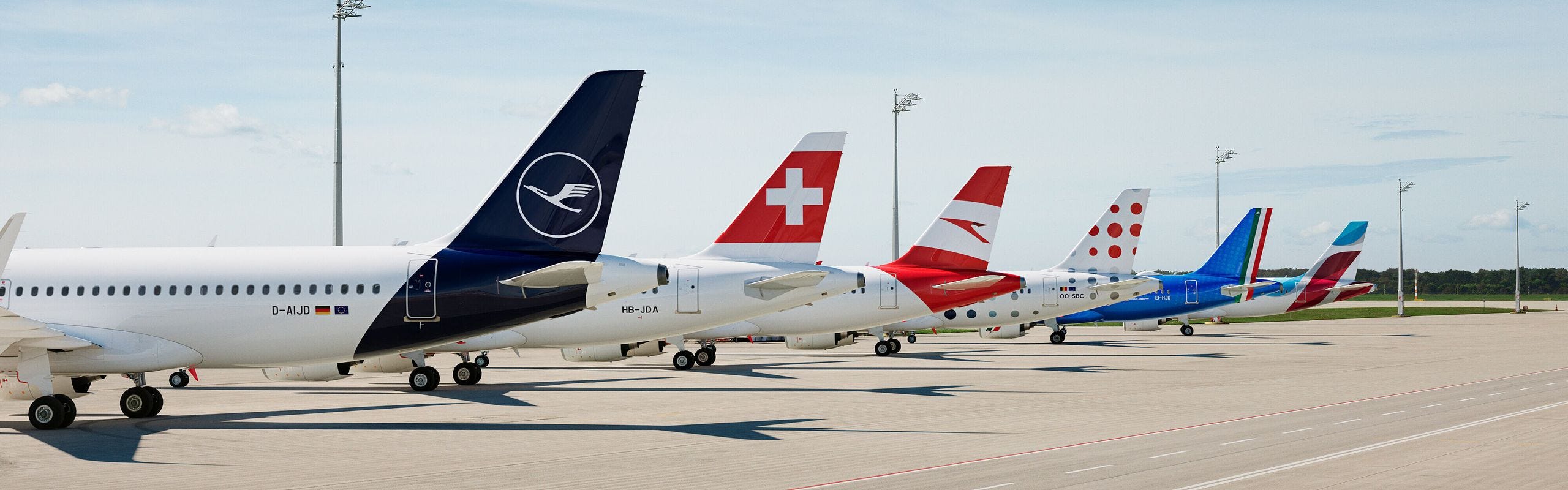
Unlike U.S. airline groups that tend to consolidate everything under a single brand after acquisitions, Lufthansa Group deliberately preserves distinct brand identities for each of its airlines.
This is not merely a cultural preference. It is a calculated approach to capturing market loyalty across multiple geographies.
Each hub carries a specialized role. Brussels is positioned as the group’s Africa hub, for example, with 18 sub-Saharan African destinations now including the newly added Kilimanjaro, Tanzania in Summer 2026.
Rome serves as the gateway into the Italian market and the Mediterranean, while Zurich and Vienna serve as premium hubs in German-speaking and Central European markets respectively.
The group has been pushing deeper behind-the-scenes integration across these hubs, including centralized network planning that staggers departure times to maximize connection opportunities and avoid internal cannibalization.
This allows a traveler from, say, Southeast Asia multiple daily connection options through multiple European hubs rather than a single gateway.
Revenue and Growth Drivers
LTM Revenue Performance
Lufthansa Group’s full-year 2025 financial results represent a significant step in the group’s multi-year recovery and transformation.
Here’s a snapshot of key financial metrics for 2025 (the most recent complete fiscal year):
Total Revenue:               EUR 39.6 billion   (+5% vs. 2024)
Passenger Airlines Revenue:  EUR 30.1 billion   (+3% vs. 2024)
Lufthansa Technik Revenue:   EUR 8.049 billion  (+12% vs. 2024)
Adjusted EBIT:               EUR 2.0 billion    (+~25% vs. 2024)
Adjusted EBIT Margin:        4.9%               (vs. 4.4% in 2024)
Consolidated Net Income:     EUR 1.3 billion    (flat vs. 2024, impacted
                                                 by deferred tax effects)
Operating Cash Flow:         EUR 4.0 billion    (+EUR 100m vs. 2024)
Adjusted Free Cash Flow:     EUR 1.2 billion    (vs. EUR 840m in 2024)
Passengers Carried:          135 million        (+3% vs. 2024)
Seat Load Factor:            83.2%              (record; vs. 83.1% in 2024)
Lufthansa Cargo Adj. EBIT:   EUR 324 million    (+29% vs. 2024)
Lufthansa Technik Adj. EBIT: EUR 603 million    (-1% vs. 2024, FX/tariff impact)
Dividend per Share:          EUR 0.33           (+10% vs. prior year)
Five Key Revenue and Earnings Drivers
1. Fleet Modernization and Fuel Savings
The most transformational growth driver for the coming years is fleet renewal. The group achieved EUR 500 million in cost savings in 2025 alone due to lower kerosene prices and a weaker US dollar.
New-generation aircraft such as the Boeing 787 Dreamliner and Airbus A350 offer up to 30% lower fuel consumption and 20-30% lower maintenance costs compared to previous generations.
2. The Allegris Premium Cabin Effect
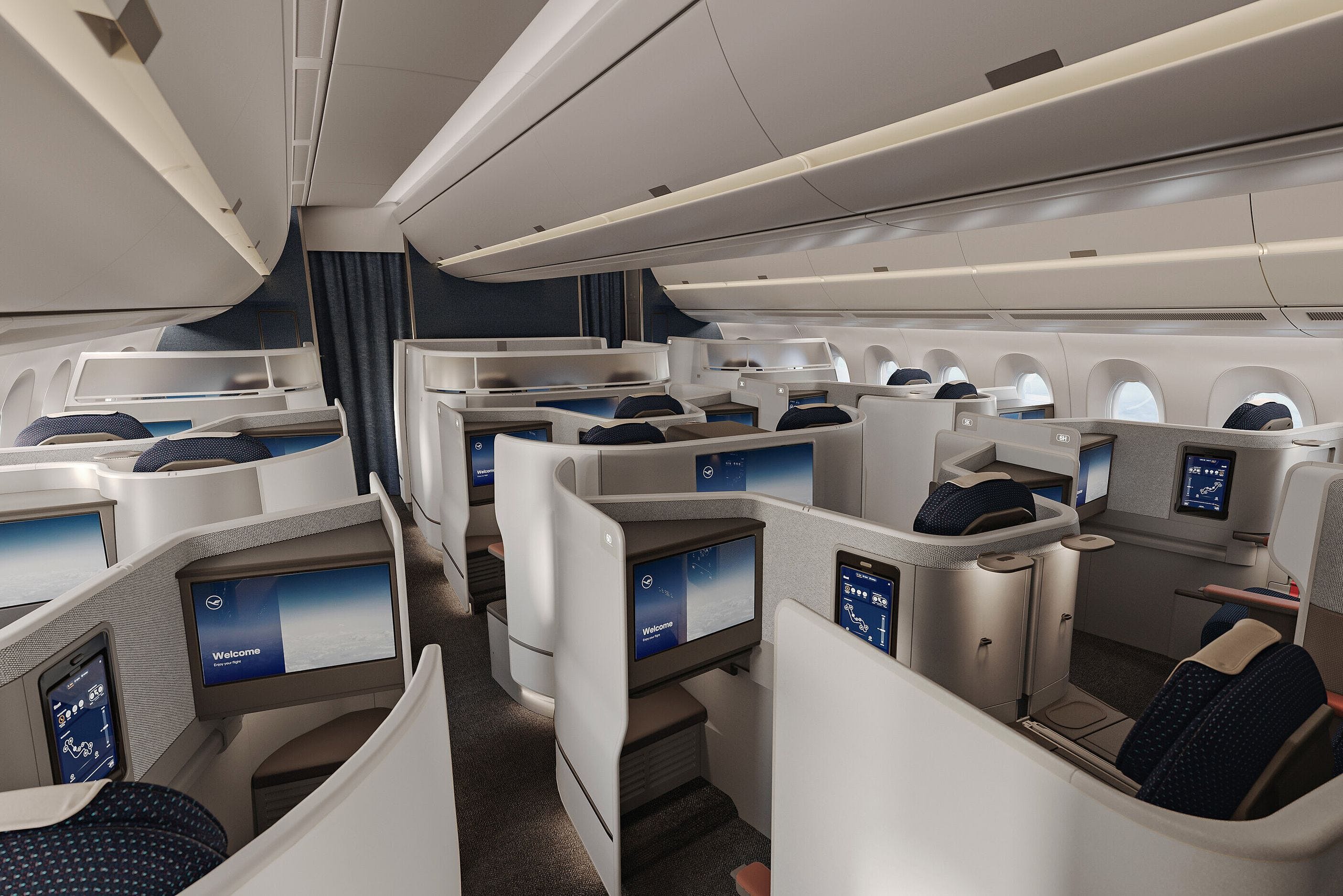
Lufthansa Airlines invested approximately EUR 2.5 billion in developing the Allegris cabin interior, which began rolling out in 2024. The impact on unit revenues has been measurable. The new product has driven a 12% increase in unit revenues on aircraft where it is deployed, and ancillary revenues across the group rose 15% in 2025.
The Allegris cabin features multiple differentiated business-class seat types with direct aisle access, allowing Lufthansa to charge premium prices for premium seat selections in advance.
By 2030, the group expects 95% of long-haul seats across all group airlines to feature a state-of-the-art product with aisle access.
3. The Turnaround Program at Lufthansa Airlines
Lufthansa Airlines (the core brand) posted a positive Adjusted EBIT margin of 0.9% in 2025, marking a return to profitability after a difficult stretch.
The turnaround program delivered more than EUR 500 million in gross earnings impact in 2025. The program targets a cumulative gross earnings effect of approximately EUR 1.5 billion in 2026 and EUR 2.5 billion by 2028.
More than 80% of the measures delivering the additional EUR 1 billion expected in 2026 are already in implementation. Over 700 individual measures are part of the program, with more than half expected to be completed by end of 2026.
4. Cargo Market Tailwinds
Lufthansa Cargo delivered a standout performance in 2025. Strong demand from Chinese e-commerce, pharmaceuticals, and semiconductors drove a 29% year-on-year increase in Adjusted EBIT to EUR 324 million.
The Iran war conflict in 2026 is providing an additional cargo tailwind, with roughly 18% of global air cargo capacity removed from the market as Gulf-based carriers reduce operations.
5. ITA Airways Integration Earnings Contribution
ITA Airways, now 41% owned by Lufthansa Group, contributed EUR 90 million to the group’s earnings in 2025, its first year as part of the group.
This is considered a strong result for an early-stage integration, and it is expected to grow significantly as codesharing, joint network planning, and loyalty integration deepen.
Key Services and Products
Passenger Airlines: A Multi-Brand, Multi-Segment Portfolio
Lufthansa Group’s passenger offerings span the full spectrum from full-service long-haul to leisure-focused point-to-point travel. Each brand occupies a defined segment:
Brand                 Hub(s)           Primary Market           Specialty
---------------------------------------------------------------------------
Lufthansa Airlines    Frankfurt,       Global full-service      Premium LH
                      Munich           network airline          product (Allegris)
SWISS Intl. Air Lines Zurich           Premium Swiss market     Swiss Senses cabin
Austrian Airlines     Vienna           Central/Eastern Europe   Regional expertise
Brussels Airlines     Brussels         Western Europe / Africa  Africa network (18
                                                                sub-Saharan dest.)
ITA Airways           Rome, Milan      Italian market           Med./Transatlantic
Eurowings             Germany          Leisure/point-to-point   Low-cost model
Discover Airlines     Frankfurt        Leisure long-haul        Charter/scheduled
Edelweiss             Zurich           Leisure, vacation        Holiday long-haul
Lufthansa Technik: The World’s Leading Independent MRO
Lufthansa Technik is not simply an in-house maintenance provider. It is a commercially independent MRO business that supports approximately 4,600 aircraft under long-term component contracts for hundreds of airlines worldwide.
Its 2025 revenue of EUR 8.049 billion represents a 12% year-on-year increase, making it the first time the division surpassed EUR 8 billion. In 2025, Lufthansa Technik concluded new contracts with a total volume of EUR 8.8 billion, ensuring planning security for years ahead.
Three-quarters of Technik’s revenue through 2028 is already under contract, giving the business exceptional revenue visibility. The division is targeting EUR 10 billion in revenue with a double-digit margin by 2030, backed by a EUR 2 billion global expansion investment program running through 2030.
Growth areas include new facilities in Portugal and Canada, an expanding defense business (including contracts with the German Air Force, German Navy, and involvement in the F-35 program), and a rapidly growing digital MRO ecosystem. The “Digital Tech Ops Ecosystem” now supports over 120 customers with more than 11,000 aircraft.
Lufthansa Cargo: A Dynamic Logistics Business
Lufthansa Cargo operates one of Europe’s most capable air freight networks. In Summer 2026, it runs 87 weekly freighter flights to up to 35 destinations worldwide, using its fleet of 18 Boeing 777F aircraft.
Asia is the dominant market, with up to 48 weekly connections to 17 destinations. New transpacific services link Ho Chi Minh City, Shanghai, and Los Angeles. The division has also built a six-hub European cargo network spanning Frankfurt, Munich, Vienna, Brussels, Rome, and soon Zurich, supported by SWISS WorldCargo cooperation.
In addition to dedicated freighters, Lufthansa Cargo benefits from belly capacity on up to 7,500 weekly passenger flights operated across the group.
Miles & More: Europe’s Largest Frequent Flyer Program
With 36 million members, Miles & More is the largest frequent flyer program in Europe. As of April 1, 2026, it officially became the loyalty program of ITA Airways, expanding both its membership base and the network of earn-and-burn opportunities for members.
The program also now awards miles for sustainable travel choices, an integration of the group’s decarbonization agenda with its loyalty infrastructure.
Network and Major Destinations
Summer 2026: A Broader Global Footprint
For Summer 2026, Lufthansa Group airlines collectively offer over 14,000 weekly connections to 330 destinations in around 100 countries. This marks a material expansion of the group’s global reach, with a deliberate focus on long-haul routes across the Southern Hemisphere.
Key New / Expanded Routes in Summer 2026:
-------------------------------------------
Lufthansa (FRA):   St. Louis (5x weekly), Cape Town (5x weekly),
                   Rio de Janeiro (6x weekly), Nairobi (daily),
                   Washington D.C. (14x weekly), Trondheim (4x weekly - NEW)

Lufthansa (MUC):   Sao Paulo (3x weekly), Johannesburg (retained),
                   both operated by A350-900

SWISS (ZRH):       Poznan, Poland (NEW from March 29, 2026),
                   Rijeka, Croatia (NEW, July/August only),
                   Tokyo (daily in Apr, May, Oct; 5x weekly other months)

Austrian (VIE):    Expanded Greece, Spain, Italy routes;
                   "Coolcation" destinations resumed (Sylt, Edinburgh,
                   Lofoten Islands)

Brussels Airlines: Kilimanjaro, Tanzania (NEW - 18th sub-Saharan dest.),
                   2x weekly from June 2026

Edelweiss (ZRH):   Windhoek, Namibia (NEW - 2x weekly from June),
                   expanded Seattle, Punta Cana, Tampa, Halifax,
                   Cape Town, Colombo

ITA Airways:       London Heathrow resumed (2x daily),
                   expanded Greece, Spain, Italian islands

Discover Airlines: Shannon (Ireland) - NEW, Brindisi (Italy) - NEW,
                   Larnaca, Cyprus (daily, NEW), year-round Seychelles
Long-Haul Focus: The Southern Hemisphere Strategy
Capacity growth on intercontinental routes is targeted at approximately 6% for 2026, while short-haul capacity is expected to remain flat. The group is specifically targeting South America, Africa, and selected parts of Asia including India.
This shift is both structural and opportunistic. The closure of Gulf airspace has redirected passenger flows toward non-Gulf alternatives, and Lufthansa’s direct long-haul network from European hubs positions it to capture this demand. Bookings on Asian and African routes jumped by 20% following the Gulf conflict escalation, according to the company’s own investor statements.
In contrast, several European feeder routes are being trimmed. Lufthansa Airlines will reduce more than 50 frequencies on German domestic feeder routes for Summer 2026, including Munich-Cologne, Dusseldorf-Berlin, and Frankfurt-Leipzig.
Some routes such as Munich-Munster/Osnabruck are under further review. The logic is straightforward: short-haul flying in Germany carries a disproportionate cost burden.
Fleet Strategy
The Great Fleet Simplification
Lufthansa Group’s fleet strategy is one of the most consequential transformations in European aviation right now. The group operates a total of over 730 aircraft, and it is currently renewing 240 of them in the largest fleet modernization in its history.
The centerpiece of this strategy is the reduction of long-haul aircraft types from 13 to just 6 by 2030. This simplification is expected to drive substantial productivity gains, reduce pilot training complexity, lower spare parts inventories, and improve operational reliability.
For an airline group operating at scale, fleet homogeneity translates directly into lower per-unit operating costs.
Fleet Transformation Timeline:
--------------------------------
2025:   New-gen aircraft = 27% of total fleet
2026:   ~30% new-gen aircraft by year-end
        Nearly 1 new aircraft delivered per week
        Net CapEx: EUR 2.9 billion
2030:   ~60% new-gen aircraft
        Long-haul types reduced: 13 --> 6
        95% of long-haul seats with state-of-the-art cabin product
        Eurowings to receive 40 Boeing 737-8 MAX aircraft

New Aircraft Performance Advantages
The new-generation aircraft entering the fleet deliver concrete economic advantages that directly flow through to the P&L:
Metric                    New Gen vs. Legacy Aircraft
---------------------------------------------------------
Fuel Consumption:         Up to 30% lower
Maintenance Costs:        20-30% lower
Cabin Product Quality:    Allegris (LH) / Swiss Senses (SWISS) -- new
CO2 per ASK:              Materially lower (AeroSHARK coatings add further savings)
Total Fleet Order Commitment
The group has ordered a total of 205 aircraft at a list value of approximately EUR 30 billion with delivery dates extending through the current decade. The total number of new aircraft expected before 2030 exceeds 230.
Critically, 2026 and 2027 will be peak capital expenditure years as the group absorbs the bulk of these deliveries. Net CapEx for 2026 is expected at EUR 2.9 billion, accounting for sale-leaseback transactions.
Despite this elevated investment phase, the group is targeting EUR 0.9 billion in free cash flow for the full year.
Major Competitors
Europe’s “Big Three” Legacy Groups
Lufthansa Group competes most directly with IAG (International Airlines Group) and Air France-KLM among the full-service, hub-based European airline groups.
A key comparison across these three:
Metric                    Lufthansa Group    IAG             Air France-KLM
-----------------------------------------------------------------------------
2025 Passengers           135 million        121.6 million   102.8 million
2025 Revenue (approx.)    EUR 39.6 billion   ~EUR 30 billion  ~EUR 31 billion
Adj. EBIT Margin (2025)   4.9%               >12%            ~5-6%
Margin Target             8-10% (2028-30)    12-15%          >8%
Widebody Aircraft (active) 189               190             195
Fuel Hedge 2026           77%                62%             62%
Market Cap (2026 context) Higher             Higher          EUR ~3.5 billion
Dominant LCC Competitor   Ryanair            easyJet/Ryanair Ryanair/easyJet
IAG: The Profitability Benchmark
IAG, parent of British Airways, Iberia, Aer Lingus, and Vueling, stands as the most profitable of the three large European legacy groups by a significant margin.
IAG is already delivering operating margins at the top end of its 12-15% target range, while Lufthansa and Air France-KLM are still working their way toward the bottom of their own targets.
IAG’s structural advantages include a stronger position in the premium transatlantic market (British Airways), a more cost-efficient short-haul model through Vueling, and a leaner overall cost structure relative to revenue scale.
However, Lufthansa’s more diversified business model (with substantial Technik and Cargo revenues) provides earnings resilience that IAG’s more passenger-centric model lacks.
Air France-KLM: The Weakest Financial Position
Air France-KLM’s market capitalization sat at only approximately EUR 3.5 billion heading into 2026, reflecting the financial community’s concerns about its profitability trajectory and leverage.
Its non-fuel unit costs were guided at 0-2% growth at constant exchange and fuel prices for 2026, somewhat weaker than IAG’s guidance. The group planned 3-5% capacity growth and EUR 3 billion in capex.
Low-Cost Competition: Ryanair’s Shadow
In terms of passengers, Ryanair extends its European lead in 2025, ranking above Lufthansa Group in overall passenger volumes.
This is a relevant competitive pressure primarily on short-haul European routes, which is one of the reasons Lufthansa is deliberately pulling capacity from loss-making short-haul feeder routes and redirecting resources toward long-haul growth.
