


Executive Summary
Northrop Grumman closed full-year 2025 with $42 billion in sales, $4.2 billion in net earnings, $3.3 billion in free cash flow, and a record backlog of $95.7 billion, with 2026 guidance set at sales of $43.5 billion to $44.0 billion.
The B-21 Raider program reached an agreed 25 percent capacity expansion with the Department of the Air Force in February 2026, and the company committed to a $2.5 billion multi-year capital investment plan to support it.
The Sentinel intercontinental ballistic missile program completed its acquisition restructure in 2026, with the first flight test still tracking to 2027 and initial operating capability targeted for the early 2030s.
Q1 2026 segment operating income nearly doubled year over year to $1.072 billion as Aeronautics Systems revenue grew 17 percent to $3.28 billion, signaling that the company’s biggest aviation programs are now scaling profitably.
Recommended - Read Full Reports


Read All Reports
Table of Contents
Executive Summary
Introduction
Key Facts: Company Profile
Northrop Grumman Company Overview
A Defense Prime With a Specific Identity
The Four-Segment Operating Structure
Strategy Anchored to Three Programs
Leadership and Governance
Key Product Lines, Programs, and Services
B-21 Raider: The Center of Gravity
MQ-4C Triton: The Maritime ISR Workhorse
E-2D Advanced Hawkeye: The Carrier Group’s Eyes
Sentinel Intercontinental Ballistic Missile
E-130J TACAMO
The Beacon Autonomy Ecosystem and Model 437
Mission Systems’ Airborne Radars and Electronic Warfare
Defense Systems: Ammunition, Solid Rocket Motors, and Sentinel
Space Systems
Financial Analysis
2025 Headline Performance
2025 Segment Sales Breakdown
Q4 2025 Performance
Q1 2026 Performance and Margin Inflection
2026 Guidance and Capital Spending
Capital Returns
Revenue and Growth Drivers
LTM Revenue and Growth Pattern
What Is Actually Driving the Growth?
The Backlog Anchor
Aviation-Specific Growth Drivers in 2026
Major Competitors
Northrop Grumman vs. Lockheed Martin
Northrop Grumman vs. RTX
Northrop Grumman vs. Boeing
Northrop Grumman vs. General Dynamics, L3Harris, and Anduril
Competitive Analysis and Moat
The Three Pillars of the Moat
Why the Moat Is Defensible?
Where the Moat Could Erode
Aeropsace Industry Implications
What the B-21 Acceleration Says About National Strategy
What the Sentinel Restructure Says About Acquisition Reform
What the Margin Inflection Says About Defense Prime Economics
Financial and Commercial Implications
Cash Flow Profile Through 2026
Margin Trajectory
Capital Allocation Implications
Commercial Implications for Suppliers
Key Risks With Probability and Scenarios
Risk 1: Cost Overrun Recurrence on B-21
Risk 2: Sentinel Schedule or Cost Slippage
Risk 3: Defense Budget Stress
Risk 4: Autonomy Disruption to High-End Manned Aviation
Risk 5: Workforce and Clearance Pipeline Stress
SWOT Analysis
Outlook for 2026 and Beyond
The Near-Term Setup
The 2027 to 2030 Horizon
Beyond 2030
My Final Thoughts
Official Sources and Data
Introduction
When the U.S. Air Force quietly increased the planned production rate of the B-21 Raider by 25 percent in February 2026, it did more than reshape the bomber roadmap. It crystallized a strategic moment for the company that builds it.
Northrop Grumman is no longer simply a defense supplier; it has become the connective tissue of America’s nuclear triad, its long-range strike capability, and an emerging architecture of autonomous airpower.
The first quarter of 2026 brought a near doubling of segment operating income to $1.072 billion, and Aeronautics Systems revenue climbed 17 percent year over year.
With backlog hovering near record highs and three multi-decade franchise programs simultaneously ramping, the 2026 story for this Falls Church, Virginia, headquartered company is fundamentally about industrial scaling under intense national security demand.
This in-depth analysis report examines that scaling story in detail. Let’s get started.
Key Facts: Company Profile
COMPANY:        Northrop Grumman Corporation
TICKER:         NYSE: NOC
HEADQUARTERS:   Falls Church, Virginia, United States
CHAIR & CEO:    Kathy J. Warden
SEGMENTS:       Aeronautics Systems | Defense Systems
                Mission Systems | Space Systems
2025 SALES:     $42.0 billion
2025 NET INC.:  $4.2 billion ($29.08 diluted EPS)
2025 BACKLOG:   $95.7 billion (record)
2026 GUIDANCE:  Sales $43.5B to $44.0B
                MTM-adjusted EPS $27.40 to $27.90
                Free cash flow $3.1B to $3.5B
SHARES OUT:     ~142 million (April 16, 2026)
DIVIDEND: $2.31 per share quarterlyNorthrop Grumman Company Overview
A Defense Prime With a Specific Identity
Northrop Grumman occupies a distinctive position among the largest American defense contractors. Where some peers split their portfolios across heavy commercial aviation or vehicle platforms, Northrop Grumman is concentrated almost entirely on national security customers.
The company describes itself as a leading global aerospace and defense technology company. The practical meaning of that phrase, in 2026, is a tightly integrated portfolio that spans stealth aircraft, strategic missiles, naval surveillance drones, military space systems, mission electronics, and advanced weapons.
The Falls Church, Virginia headquarters anchors a workforce of roughly 100,000 people across the United States and abroad. Manufacturing centers in Palmdale and Melbourne, Florida, propellant plants in Promontory, Utah, and integration facilities in Linthicum, Maryland form the spine of the operating footprint.
The Four-Segment Operating Structure
The company reorganized its reporting into four sectors that double as reportable segments: Aeronautics Systems, Defense Systems, Mission Systems, and Space Systems. Each was deliberately structured around a coherent mission area rather than legacy heritage businesses.
Aeronautics Systems is the airframe and large-platform integrator, home to the B-21 Raider, the E-2D Advanced Hawkeye, the MQ-4C Triton, and the Global Hawk family. Defense Systems handles ammunition, missile motors, mission readiness, and increasingly the Sentinel intercontinental ballistic missile.
Mission Systems builds airborne radars, electronic warfare suites, navigation systems, and the kind of mission electronics that ride inside virtually every front-line American combat aircraft. Space Systems builds satellites and rocket motors and runs the previously separate launch systems business that came in via the Orbital ATK acquisition.
Strategy Anchored to Three Programs
If you asked the senior leadership team to summarize 2026, the answer would converge on three programs.
The first is the B-21 Raider long-range stealth bomber, now the centerpiece of the U.S. long-range penetrating strike strategy.
The second is the Sentinel intercontinental ballistic missile, the replacement for the aging Minuteman III.
The third is the open-architecture autonomy push that Northrop Grumman has bundled under its Beacon program.
These three lines, taken together, define how the company thinks about the next decade of American airpower.
Each is a multi-decade contract pipeline. Each anchors thousands of supplier relationships. And each is structurally insulated from the kind of commercial market cyclicality that touches some peers.
NORTHROP GRUMMAN'S STRATEGIC TRIPOD (2026)

[1] B-21 RAIDER         Long-range penetrating strike
                        25 percent capacity uplift in 2026

[2] SENTINEL ICBM       Ground-based leg of nuclear triad
                        Restructure complete in 2026

[3] BEACON & AUTONOMY   Crewed-uncrewed teaming, Model 437
AI-driven flight test ecosystemLeadership and Governance
The company is led by Chair and Chief Executive Officer Kathy J. Warden, who took the chief executive role in 2019 and added the chair title shortly thereafter. Her tenure coincides with the rebuild of the segment structure, the disposal of non-core federal IT services, and the absorption of Orbital ATK.
The senior team includes Chief Financial Officer Ken Crews, who replaced Dave Keffer in 2024, and segment leadership that includes Tom Jones at Aeronautics Systems and Lisa Disbrow as Chair of Defense Systems’ transition activity. The board includes a mix of former senior military officers, industrial executives, and finance leaders.
That mix matters. Defense procurement decisions hinge on credibility with Pentagon customers as much as on capital allocation prowess. The leadership composition signals that Northrop Grumman wants to be measured on operational delivery first.
Key Product Lines, Programs, and Services
B-21 Raider: The Center of Gravity
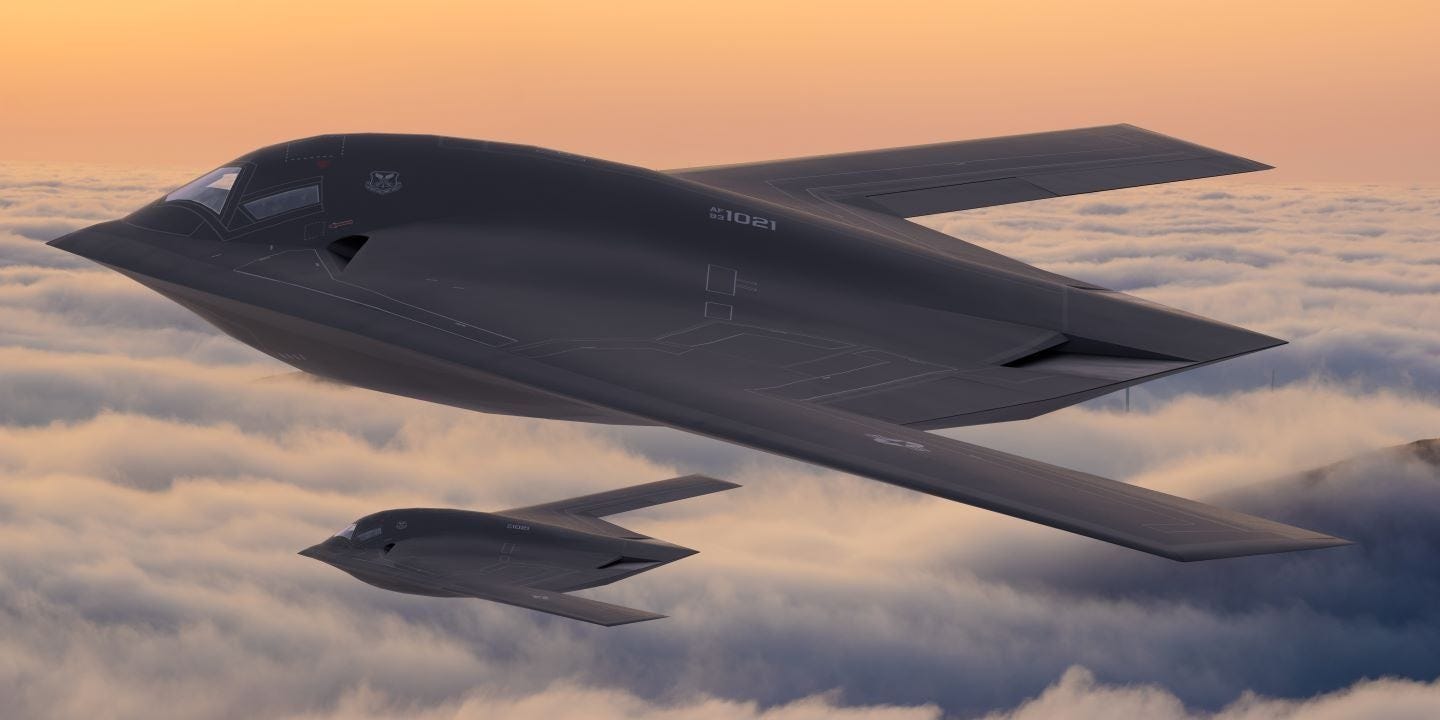
The B-21 Raider is the most visible single program inside the Aeronautics Systems segment, and it is the program that will drive both the headline narrative and the segment margin trajectory through 2026 and beyond.
The aircraft was designed under the Long Range Strike Bomber acquisition program of record and is described by the U.S. Air Force as the foundation of future long-range penetrating strike.
Production happens at Plant 42 in Palmdale, California, with manufacturing partner content distributed across a national supplier base. The aircraft entered low-rate initial production after first flight, and additional test aircraft have been delivered to Edwards Air Force Base.
In February 2026, the Department of the Air Force and Northrop Grumman announced a 25 percent production capacity increase tied to a multi-year contract framework. Coverage of the agreement quoted the U.S. Air Force noting that the program had delivered aircraft on schedule in 2025 and that the next phase prioritizes a higher manufacturing tempo.
To resource that ramp, the company committed to a $2.5 billion multi-year capital investment program, with $200 million flagged for 2026 alone. That investment funds tooling, additional surface preparation capacity, and clean-room expansion at the Palmdale site.
B-21 RAIDER: KEY 2026 FACTS

Customer:           U.S. Air Force
Final Assembly:     Plant 42, Palmdale, California
Capacity Step:      ~25 percent increase agreed Feb 2026
NG Capex Plan:      ~$2.5 billion multi-year
2026 Capex Slice:   ~$200 million
First Base:         Ellsworth AFB, South Dakota
Status:             Low-rate initial production, flight test
                    activity continuing
The strategic significance of the B-21 acceleration goes well beyond a single platform. It signals that the U.S. defense planning community is prepared to absorb the cost of building a real bomber fleet rather than maintaining a paper one.
For Northrop Grumman, this is the program that ultimately moves Aeronautics Systems from low-margin development risk into higher-margin production. The transition was visible in Q1 2026 results, with Aeronautics Systems revenue rising 17 percent to $3.28 billion and operating margin reaching 9.3 percent.
MQ-4C Triton: The Maritime ISR Workhorse
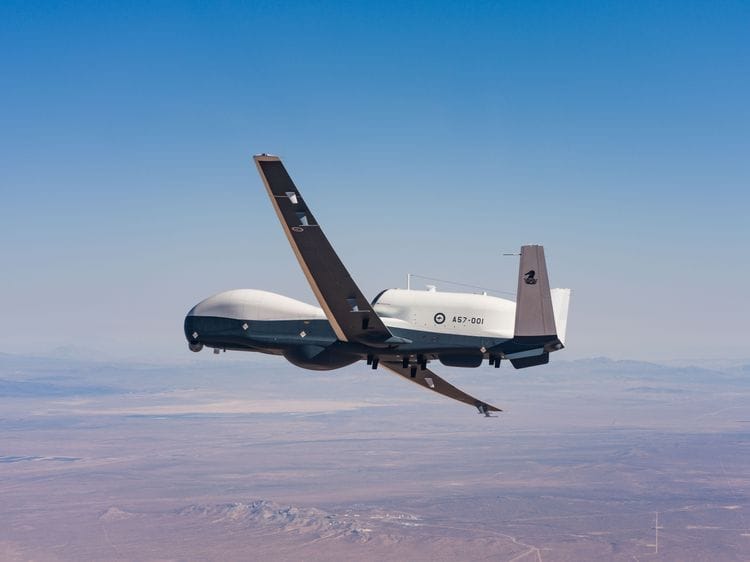
The MQ-4C Triton is the U.S. Navy’s high-altitude, long-endurance maritime intelligence, surveillance, reconnaissance, and targeting unmanned aircraft. It operates above 50,000 feet and carries a multi-intelligence sensor suite designed for wide-area maritime patrol, signals intelligence, and over-the-horizon targeting.
The platform supports both U.S. and Australian operations and has become a recurring topic in coverage of Indo-Pacific maritime surveillance. The Royal Australian Air Force has fielded the aircraft as part of its broader maritime ISR architecture.
MQ-4C TRITON SNAPSHOT

Operator:        U.S. Navy and Royal Australian Air Force
Role:            Persistent maritime ISR and targeting
Cruise altitude: 50,000+ feet
Mission profile: Long-endurance ocean patrol
Configuration:  IFC-4 multi-intelligence baseline
Manufacturer:    Northrop Grumman (Palmdale, CA)
For the Aeronautics Systems segment, Triton sits in a less headline-heavy slot than the B-21 but contributes a steady production tail and an attractive sustainment annuity.
As maritime competition intensifies in the western Pacific, the platform’s appeal to allied governments has grown.
E-2D Advanced Hawkeye: The Carrier Group’s Eyes
The E-2D Advanced Hawkeye is the U.S. Navy’s airborne battle management aircraft, providing the carrier strike group with airborne early warning, command and control, and surveillance reach. It is built at the company’s Saint Augustine, Florida facility.
Production deliveries support both the U.S. Navy and international customers, with France having been selected for the export configuration. Japan has also acquired the platform in successive lots through a joint procurement framework.
The E-2D’s role in 2026 has taken on additional weight after the U.S. Air Force’s E-7 Wedgetail program faced ambiguity and the Navy looked for ways to extend airborne early warning resilience using the Hawkeye fleet. That backdrop adds long-tail program value through the late 2030s.
Sentinel Intercontinental Ballistic Missile
The LGM-35A Sentinel program is the U.S. Air Force’s replacement for the aging Minuteman III intercontinental ballistic missile force. Northrop Grumman is the prime contractor for both the missile and a substantial portion of the ground systems and silo modernization scope.
The program went through a Nunn-McCurdy critical breach in 2024 and entered a restructuring process to address cost and schedule risk, particularly in the launch facility component.
The U.S. Air Force confirmed in February 2026 that the restructure would complete by year end along with regaining Milestone B certification.
SENTINEL ICBM PROGRAM STATUS, 2026

Prime contractor:    Northrop Grumman
Customer:            U.S. Air Force
Replaces:            LGM-30G Minuteman III
Stage 2 motor test:  Full-scale qualification, July 2025
First flight test:   Targeted 2027
Initial capability:  Targeted early 2030s
Restructure end:     End of 2026
In Q1 2026, Defense Systems revenue benefited from higher Sentinel volume as the program continued to ramp.
The accelerated prototyping approach for launch silo design announced in March 2026 reflects a more iterative engineering model that the company has pushed into the program.
E-130J TACAMO
The E-130J Phoenix II is the U.S. Navy’s next-generation airborne strategic command, control, and communications platform, designed to replace the E-6B Mercury TACAMO mission. Northrop Grumman is the mission systems integrator under a $3.5 billion award announced in late 2024.
In 2026, the company secured a $225.1 million contract modification to develop the comprehensive training backbone for the program. The training contract is the kind of long-cycle work that builds sustainment annuity into a fielded platform.
The E-130J adds another nuclear command and control franchise to the company’s portfolio, alongside Sentinel. Together, those two programs make Northrop Grumman the dominant industrial player in the airborne and ground-based strategic deterrence architecture.
The Beacon Autonomy Ecosystem and Model 437
Northrop Grumman’s autonomy strategy crystallized in 2025 with the launch of Beacon, an open-access testbed ecosystem that integrates partner-developed autonomous software with a digital platform and real flight assets.
Six initial partner companies were announced in mid-2025 to develop and scale autonomous flight capabilities.
The flight asset at the heart of Beacon is the Scaled Composites Model 437 Vanguard, an optionally-manned stealth demonstration aircraft built by the Northrop Grumman subsidiary. The aircraft has been described as 41 feet long with a 41-foot wingspan and a 10,000 pound maximum takeoff weight.
BEACON AUTONOMY ECOSYSTEM

Lead:               Northrop Grumman
Test platform:      Scaled Composites Model 437 Vanguard
Configuration:      Optionally-manned, stealth-shaped
Phase 1 Partners:   Six companies (announced mid-2025)
Goal:               Open-architecture autonomy maturation
Use case:           Crewed-uncrewed teaming, CCA pathways
The strategic logic is to keep Northrop Grumman in the conversation around the U.S. Air Force’s Collaborative Combat Aircraft program and adjacent autonomy procurements without locking the company into an unsustainable winner-take-all bet.
Beacon also positions the company as a software integrator and not just an airframe builder.
Mission Systems’ Airborne Radars and Electronic Warfare
Mission Systems is the segment most likely to be invisible in headlines yet most likely to ride inside whatever aircraft American forces fly.
The portfolio includes the AN/APG-81 active electronically scanned array radar inside the F-35 Lightning II, the AN/APG-83 Scalable Agile Beam Radar that has retrofitted the F-16 fleet, and a long list of electronic warfare and infrared countermeasure systems.
The 2025 annual report attributed Mission Systems sales growth to continued ramp-up on restricted airborne radar programs. That language is the company’s way of disclosing that classified radar production is one of the segment’s largest growth contributors without naming the customer.
For aviation industry stakeholders, Mission Systems is the segment that ties Northrop Grumman to virtually every front-line American combat aircraft regardless of which prime contractor builds the airframe. That cross-fleet penetration is a quietly powerful structural advantage.
Defense Systems: Ammunition, Solid Rocket Motors, and Sentinel
Defense Systems brings together the company’s ammunition production, large solid rocket motor manufacturing, and increasingly the Sentinel intercontinental ballistic missile workstream.
The ammunition franchise is anchored by 20mm, 30mm, and larger caliber lines supplying the U.S. Army, Navy, and Air Force.
Solid rocket motor production happens at Promontory, Utah, where the company manufactures motors for missiles, interceptors, and space launch vehicles. The 2025 full-scale qualification test of the Sentinel Stage 2 motor at Promontory was a critical program milestone for the broader restructure narrative.
The Defense Systems segment also produces the GEM 63XL strap-on solid rocket booster used on United Launch Alliance’s Vulcan Centaur rocket. A launch anomaly affecting the GEM 63XL contributed to an unfavorable estimate at completion adjustment recorded in Q1 2026.
Space Systems
The segment includes military and intelligence satellites, the wind-down work on the Next Generation Interceptor, and the previously separate launch systems business.
Space Systems sales declined 3 percent year over year in Q1 2026, primarily due to the Next Generation Interceptor wind-down following the customer’s selection decision.
The segment continues to participate in restricted programs that contribute meaningfully to backlog.
Financial Analysis
2025 Headline Performance
Northrop Grumman closed the 2025 fiscal year with $42.0 billion in sales, operating cash flow of $4.8 billion, and free cash flow of $3.3 billion. Free cash flow grew approximately 26 percent year over year.
Net earnings were $4.2 billion, or $29.08 per diluted share. The 2025 operating income line was pressured by a $477 million loss provision related primarily to B-21, which is what drove the consolidated operating margin rate to 6.3 percent.
NORTHROP GRUMMAN, FULL-YEAR 2025

Total sales:               $42.0 billion
Net earnings:              $4.2 billion
Diluted EPS:               $29.08
Operating cash flow:       $4.8 billion
Free cash flow:            $3.3 billion
Net awards:                $46.3 billion
Backlog:                   $95.7 billion
Operating margin:          6.3 percent
                           (impacted by ~$477M B-21 charge)
The 2025 cash story matters more than the headline operating margin because operating margin in defense prime contractors during a major program ramp is a noisy signal. Operating cash flow and free cash flow are the cleaner read on the underlying business.
2025 Segment Sales Breakdown
The four segments produced full-year 2025 sales as follows. Aeronautics Systems delivered $12,992 million in sales. Defense Systems delivered $8,002 million. Mission Systems delivered $12,506 million. Space Systems delivered $10,771 million.
The two largest segments by revenue, Aeronautics and Mission Systems, are roughly the same size but tell different stories.
Aeronautics is a heavy-asset, large-program business dominated by the B-21 and Triton. Mission Systems is a high-mix, mostly classified, electronics-intensive business that ships content into U.S. and allied combat aircraft.
2025 SEGMENT SALES (FULL YEAR)

Aeronautics Systems:    $12,992 million
Mission Systems:        $12,506 million
Space Systems:          $10,771 million
Defense Systems:         $8,002 million
                       ----------
Total (gross):         $44,271 million
After eliminations: ~$42,000 millionQ4 2025 Performance
The fourth quarter of 2025 was the strongest revenue quarter of the year, with sales of $11.7 billion, up 10 percent year over year. Aeronautics Systems delivered $3.922 billion in Q4 sales, Mission Systems $3.449 billion, Space Systems $2.859 billion, and Defense Systems $2.147 billion.
Net awards in the quarter alone were $15.9 billion, and the year-end backlog of $95.7 billion was a record level for the company. That backlog represents roughly 2.3 years of revenue at the 2025 sales pace.
Q1 2026 Performance and Margin Inflection
The first quarter of 2026 told a meaningfully different operating margin story. Total sales rose 4 percent to $9.881 billion, with Aeronautics Systems revenue of $3.283 billion (up 17 percent), Defense Systems at $1.899 billion, Mission Systems at $2.861 billion, and Space Systems at $2.480 billion.
Segment operating income jumped 89 percent to $1.072 billion, with Aeronautics Systems contributing $488 million of higher operating income year over year. The consolidated segment operating margin rate rose from 6.0 percent to 10.8 percent.
Q1 2026 RESULTS VS. Q1 2025

Total sales:           $9.881B  (+4% YoY)
Segment OI:            $1.072B  (+89% YoY)
Segment margin:        10.8%   (vs. 6.0%)
Aeronautics revenue:   $3.283B  (+17% YoY)
Aeronautics margin:    9.3%
Backlog:               $95.6 billion
Free cash flow:        ($1.823B) seasonal use
The single most important takeaway from Q1 2026 is the Aeronautics Systems margin recovery. With the B-21 loss provisions taken in 2024 and 2025 now in the rearview mirror, the segment can express its underlying production economics more cleanly.
2026 Guidance and Capital Spending
Management’s 2026 financial guidance, reaffirmed at the Q1 2026 release, targets sales of $43.5 billion to $44.0 billion, segment operating income of $4.85 billion to $5.0 billion, mark-to-market adjusted earnings per share of $27.40 to $27.90, and free cash flow of $3.1 billion to $3.5 billion.
The notable update at Q1 2026 was a higher capital expenditure outlook of $1.85 billion for 2026, reflecting the planned acceleration of B-21 production capacity.
Capital intensity is therefore rising at the same time the program ramps, which compresses near-term free cash flow but builds throughput for later years.
2026 GUIDANCE (REAFFIRMED Q1 2026)

Sales:                $43.5B to $44.0B
Segment OI:           $4.85B to $5.0B
MTM-adjusted EPS:     $27.40 to $27.90
Free cash flow:       $3.1B to $3.5B
Capex (revised):      ~$1.85B
For aviation industry stakeholders, the increased capital spend is the clearest signal that the B-21 industrial scaling is real and not a press release. Capacity money is harder to fake than aspirational program statements.
Capital Returns
The board declared a quarterly dividend of $2.31 per share in February 2026. That equates to an annualized dividend of $9.24 per share at the current rate.
Share repurchases continue alongside the dividend. The combined posture is consistent with the company’s stated capital deployment framework of investing in the business first, returning excess cash to shareholders second, and pursuing strategic mergers and acquisitions selectively.
Revenue and Growth Drivers
LTM Revenue and Growth Pattern
Trailing twelve-month revenue through Q1 2026 stood at approximately $42.4 billion. Growth has accelerated from low single digits in 2024 to mid single digits in 2025 to the high single digits visible in late 2025 and Q1 2026.
The acceleration reflects the convergence of three different growth engines: the B-21 production scaling, the Sentinel ramp inside Defense Systems, and the restricted airborne radar growth inside Mission Systems. Each is independent of the others, which de-risks the overall growth trajectory.
LTM REVENUE PROGRESSION

2024 FY:           ~$41.0 billion
2025 FY:           $42.0 billion
LTM Q1 2026:       ~$42.4 billion
2026E Guidance: $43.5B - $44.0BWhat Is Actually Driving the Growth?
In Q1 2026, Aeronautics Systems sales increased $469 million year over year, primarily due to higher sales on B-21 and other restricted programs as well as increased volume on the E-130J TACAMO program. That single passage is the cleanest official summary of the segment growth thesis.
Mission Systems growth has been driven by what the 2025 annual report described as continued ramp-up on restricted airborne radar programs. The phrase recurs in earnings releases and investor materials and points to a multi-year revenue tail tied to platform recapitalization.
Defense Systems growth is being shaped by Sentinel ramp and ammunition demand. Solid rocket motor work for both Sentinel and commercial space customers contributes additional volume.
The Backlog Anchor
Backlog of $95.7 billion at year-end 2025 represents a record. By Q1 2026, the figure stood at $95.6 billion, essentially flat as quarterly bookings closely tracked revenue.
The backlog provides multi-year revenue visibility and gives the company room to be selective on bid submissions. It also reduces the bid-and-proposal pressure that smaller defense suppliers face.
Aviation-Specific Growth Drivers in 2026
For the narrower aviation lens, the most interesting growth driver of 2026 is the B-21 capacity step-up. The agreement reached with the U.S. Air Force in February 2026 increases production capacity by 25 percent and extends the multi-year program runway.
The accelerated Triton retrofit and IFC-4 multi-intelligence baseline work also contribute Aeronautics Systems revenue alongside continued international interest in the platform. The E-2D Advanced Hawkeye continues delivering through France’s procurement and additional Japan lots.
Major Competitors
The most relevant competitive set spans both U.S. primes and selected European and emerging suppliers.
MAJOR NORTHROP GRUMMAN COMPETITORS (AVIATION/A&D)

- Lockheed Martin Corporation (NYSE: LMT)
- RTX Corporation (NYSE: RTX, formerly Raytheon)
- The Boeing Company (NYSE: BA)
- General Dynamics Corporation (NYSE: GD)
- L3Harris Technologies (NYSE: LHX)
- Huntington Ingalls Industries (NYSE: HII)
- BAE Systems plc (LON: BA.)
- Airbus Defence and Space
- Leonardo S.p.A.
- Anduril Industries (private)
The most important head-to-head comparisons, though, are with Lockheed Martin, RTX, and Boeing. Each contests Northrop Grumman in a different part of the portfolio.
Northrop Grumman vs. Lockheed Martin
Lockheed Martin is the larger company by revenue, with substantially greater scale in tactical aircraft through the F-35 Lightning II program. It is also the dominant prime in tactical fighter production globally and a major missile and helicopter supplier.
The competitive interface with Northrop Grumman is most direct at the long-range strike layer and at the strategic missile layer. Northrop won the bomber competition that became the B-21 over a Boeing-Lockheed team and won the Sentinel intercontinental ballistic missile prime role over Boeing.
Where Lockheed Martin is the prime on the F-35, however, Northrop Grumman supplies critical mission systems content into the aircraft, including the AN/APG-81 radar and the distributed aperture system. That architectural reality means the two companies are simultaneously competitors and collaborators inside the same fleet.
Northrop Grumman vs. RTX
RTX is the conglomerate that includes Pratt & Whitney engines, Collins Aerospace avionics, and Raytheon missiles. The portfolio is broader than Northrop Grumman’s and skews much more heavily toward propulsion and missile systems.

The two companies compete for radar work, electronic warfare contracts, and selected weapon system primes. RTX’s commercial aviation exposure, particularly through Pratt & Whitney’s geared turbofan engine, makes the company more cyclical than Northrop Grumman.
For the aviation lens specifically, Northrop Grumman’s relative absence from commercial aviation insulates it from airline order volatility. RTX must manage both the defense and commercial cycles simultaneously.
Northrop Grumman vs. Boeing
Boeing is the most lopsided comparison because Boeing’s commercial aviation business dominates its identity. Boeing’s defense, space, and security business has experienced sustained margin pressure on fixed-price programs including the KC-46 tanker and the T-7A trainer.

In long-range strike, Boeing partnered with Lockheed Martin in the bomber competition that Northrop Grumman won. In strategic missiles, Boeing was the incumbent prime on the legacy Minuteman III but lost the Sentinel competition.
Northrop Grumman’s structurally cleaner defense focus has translated into more consistent program execution. Boeing has struggled with defense margin volatility that Northrop Grumman has largely avoided since the B-21 charges were taken.
Northrop Grumman vs. General Dynamics, L3Harris, and Anduril
General Dynamics overlaps with Northrop Grumman primarily in mission systems and combat support work, with limited aviation overlap.
L3Harris competes more directly in mission systems electronics, communications, and select space payloads.
Anduril Industries is an emerging private competitor focused on autonomous systems, software, and selected unmanned aircraft. Northrop Grumman’s Beacon program is part of the response to that disruption pressure, designed to keep the company structurally relevant in an autonomy-first procurement era.
