


Executive Summary
Pegasus Airlines closed 2025 as one of Europe’s most profitable low-cost carriers, reporting €3.41 billion in revenue and €301 million in net profit for the full year, alongside a 15% jump in passenger volumes.
The Turkish carrier operated a fleet of 130 aircraft at the close of the third quarter, dominated by next-generation Airbus A321neo and A320neo jets, with the final nine Boeing 737-800s scheduled for phase-out and a 200-aircraft Boeing 737-10 order scheduled to begin arriving in 2028.
The airline carried 43.3 million guests across 156 destinations in 54 countries, with Istanbul Sabiha Gökçen anchoring operations and Ankara Esenboğa developing as a secondary connecting hub.
In December 2025, the company signed a €154 million deal to acquire Czech Airlines and Smartwings, marking the most consequential outbound M&A step in the carrier’s history.
Recommended - Read Full Reports


Read All Reports
Table of Contents
Executive Summary
Key Facts: Company Profile
Business Overview
Financial Performance and Revenue Composition
Full-Year 2025 Top-Line and Profitability
Revenue Mix by Segment
Operating Metrics and Unit Economics
Revenue Growth Drivers
Capacity Growth Driven by Fleet Upgauging
Network Densification
Ancillary and Digital Monetisation
Partnerships and Inorganic Levers
Key Services and Products
Pegasus Fleet: In-Depth Analysis
Fleet Size and Composition
Current Aircraft Inventory
Fleet Age and Modernity
Aircraft Types and Cabin Configuration Strategy
Airbus A321neo: The Growth Workhorse
Airbus A320neo: The Versatile Mid-Size
Airbus A320ceo: The Declining Legacy Subfleet
Boeing 737-800: The Final Legacy Piece
Fleet Strategy: The Dual-Source Doctrine
The Historic Boeing 737-10 Order
Why Two OEMs?
Fleet Growth Profile
Technical Operations and Maintenance Strategy
In-House MRO Capability
Engine Strategy
Route Network, Major Destinations, and Network Strategy
Network Scale and Geographic Reach
Current Network Footprint
Domestic Turkey Backbone
International Network Layers
Network Strategy
Point-to-Point with Selective Hubbing
The Ankara Sub-Hub Concept
Seasonal Leisure Base Strategy
Selective International Growth
Major Operational Bases (Hubs)
Istanbul Sabiha Gökçen International Airport (SAW): The Primary Hub
Operational Footprint at Sabiha Gökçen
Why Sabiha Gökçen Works for Low-Cost Operations
The New Sabiha Gökçen MRO Centre
Ankara Esenboğa (ESB): The Emerging Sub-Hub
Strategic Rationale for Ankara
Antalya (AYT) and İzmir (ADB): Secondary Coastal Bases
Antalya
İzmir
Competitive Position
Major Competitors
Airline-by-Airline Competitive Comparison
Pegasus vs Turkish Airlines (THY)
Pegasus vs AJet (AnadoluJet)
Pegasus vs SunExpress
Pegasus vs Ryanair and Wizz Air
Pegasus vs Gulf Carriers
Competitive Moats
Home Market Structural Position
Cost Base and Fleet Economics
Ancillary Monetisation Sophistication
The Pegasus Digital and Operational Model
The Digital-First Airline Thesis
Self-Service and Cost Per Passenger
Mobile App as a Commercial Platform
Sustainability Framework
ESG and Fleet Modernisation
Sustainable Aviation Fuel and Carbon Strategy
Human Capital and Leadership
CEO Güliz Öztürk
Governance Structure
Inorganic Growth: The Czech Airlines and Smartwings Acquisition
Deal Structure and Rationale
Strategic Fit
Integration Considerations
Key Risks, with Probabilities and Scenarios
1. Macro and Currency Risks
Turkish Lira Volatility
Jet Fuel Price Spikes
2. Geopolitical and Operational Risks
Regional Conflict
Sabiha Gökçen Capacity Constraints
3. Commercial and Integration Risks
Competitive Intensification
Smartwings Integration
4. Structural and Regulatory Risks
Supply Chain and OEM Delivery Delays
Regulatory and Slot Risks
Cybersecurity and IT
Environmental and SAF Cost Trajectory
Future Outlook: 2026 and Beyond
What to Watch in 2026 and 2027
Capacity and Traffic Ramp
Smartwings Integration Milestones
Boeing 737-10 Certification and First Delivery
Sabiha Gökçen Terminal 3 and Capacity Expansion
Credit Rating Trajectory
My Final Thoughts
Official Sources and Data

Key Facts: Company Profile
Pegasus Hava Taşımacılığı A.Ş. operates as a publicly traded low-cost airline with strong profitability metrics and a modern single-aisle fleet backbone.
COMPANY PROFILE SNAPSHOT (as of Q1 2026)
----------------------------------------
Legal Name:        Pegasus Hava Taşımacılığı A.Ş.
Trading Symbol:    BIST: PGSUS
IATA / ICAO Code:  PC / PGT
Callsign:          SUNTURK
Founded:           12 January 1991
LCC Relaunch:      March 2005 (under ESAS Holding)
IPO:               26 April 2013 (Borsa Istanbul)
Headquarters:      Kurtköy, Pendik, Istanbul, Türkiye
Primary Hub:       Istanbul Sabiha Gökçen (SAW)
Secondary Bases:   Ankara (ESB), Antalya (AYT), İzmir (ADB)
Fleet Size:        130 aircraft (as of 30 Sept 2025)
Avg. Fleet Age:    ~5.4 years
Network:           156 destinations, 54 countries
Passengers (2025): 43.3 million
Revenue (2025):    €3.41 billion
Net Profit (2025): €301 million
Load Factor (2025): 87.7%
Ownership:         ESAS Holding (controlling shareholder)
CEO:               Güliz Öztürk
Chairman:          Ali Sabancı
Loyalty Program: BolBolPegasus is controlled by ESAS Holding, the investment vehicle of the Sabancı family, and has remained consistently profitable since its low-cost relaunch two decades ago.
The airline’s identity as a digital-first, ancillary-heavy low-cost carrier has become one of the defining case studies in European aviation, particularly for observers of the transition from hybrid to full ultra-low-cost models.
Business Overview
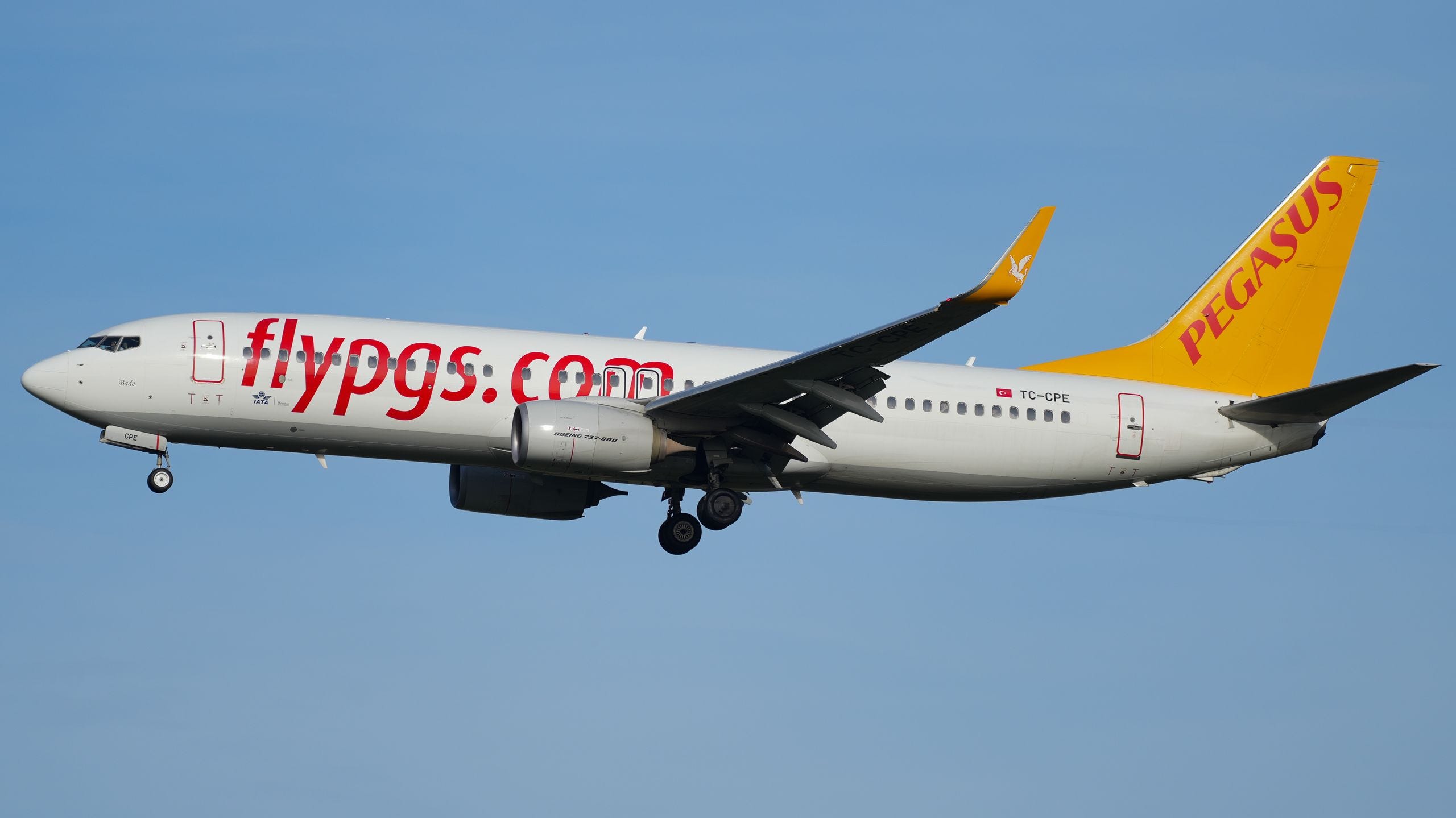
Pegasus is no longer the small charter carrier it was in the early 1990s.
The business today is built around two reinforcing engines: unit-cost leadership on point-to-point flying, and a rapidly expanding ancillary revenue machine tied to the BolBol loyalty ecosystem.
The airline’s leadership, under CEO Güliz Öztürk, describes the strategy as a blend of digital efficiency, deep fleet renewal, and focused geographical expansion across the Turkish domestic market and nearby international regions within a roughly three-to-five-hour flight radius of Istanbul.
Financial Performance and Revenue Composition
Full-Year 2025 Top-Line and Profitability
Pegasus generated €3.41 billion in revenue in the 2025 fiscal year, a 9% increase versus 2024, with Q4 revenue of €814 million rising 8.1% year-on-year.
Net profit for the year came in at €301 million. Management disclosed that Q4 net income fell 71% year-on-year and full-year net income was down 17% compared with 2024, reflecting a normalisation of yields after a period of post-pandemic over-earning.
EBITDA for the first nine months of 2025 was €692 million. Q3 2025 delivered €395 million of EBITDA at a 35.9% margin, consistent with the 26% to 27% EBITDA margin range guided for the full year.
Revenue Mix by Segment
PEGASUS 2025 REVENUE MIX (HIGH-LEVEL)
-------------------------------------
Scheduled passenger revenue ..... dominant
Ancillary revenue per passenger . ~EUR 29.7 in Q2 2025
Ancillary revenue growth (YoY) .. +21% in Q2 2025
Cargo & other .................... complementary
Total 2025 revenue ............... EUR 3.41 billion
Ancillary revenue has become the distinguishing feature of the commercial model. The airline reported ancillary revenue per passenger of €29.7 in the second quarter of 2025, growing 6% year-on-year, with total ancillary revenue up 21%.
Ancillary categories span baggage fees, seat selection, onboard sales, duty-free, insurance, hotel and car rental affiliate commissions, and monetisation of the BolBol points ecosystem.
This composition matters. Every incremental euro of ancillary revenue drops through at far higher margins than scheduled passenger yield, cushioning the airline against fare deflation on highly competitive short-haul sectors.
Operating Metrics and Unit Economics
Total available seat kilometres (ASKs) reached 58.1 billion in the first nine months of 2025. Nine-month load factor was 87.4%, while Q3 alone delivered 89.2% load factor, a very strong figure by European low-cost carrier benchmarks.
On unit costs, 2025 data from sell-side coverage indicates ex-fuel CASK rose 5% while total CASK remained flat year-on-year. For 2026, the airline has hedged 61% of expected fuel consumption, insulating a meaningful portion of its 2026 cost base against oil volatility.
The company’s credit metrics have continued to improve. Fitch revised the Outlook on the BB- rating to Positive in mid-2025, citing solid profitability, increasing scale, and deleveraging versus previous cycles.
Revenue Growth Drivers
Capacity Growth Driven by Fleet Upgauging
The gradual replacement of 189-seat Boeing 737-800s and 180-seat A320s with 239-seat A321neo aircraft has structurally lifted departures-adjusted capacity. Every swap adds roughly 50 seats without requiring additional crew complement beyond cabin staffing.
This upgauging is the single largest ASK growth lever between 2025 and 2028, before the Boeing 737-10s begin to reinforce the narrowbody fleet.
Network Densification
The second driver is frequency and new-route densification out of Istanbul Sabiha Gökçen, Ankara, and the leisure bases. The carrier served 156 destinations as of the third quarter of 2025, compared with 148 in the middle of 2024.
New routes from Ankara Esenboğa, including Sharm el Sheikh, Bucharest, and Dubai, reflect a deliberate effort to make the capital’s airport a meaningful second base rather than a spoke of Istanbul.
Ancillary and Digital Monetisation
The third lever is margin-rich ancillary growth. Digital self-service via the flypgs.com platform and the Pegasus mobile app has reduced distribution costs while enabling dynamic merchandising of baggage bundles, extra legroom seats, and partner services.
BolBol loyalty activity drives both revenue and data capture. Welcome points of 1,000 BolPoints on a first flight and earn-and-burn on ancillary purchases, as detailed on the BolBol program page, are designed to push repeat buying behaviour.
Partnerships and Inorganic Levers
The fourth revenue lever is external. The pending acquisition of Czech Airlines and Smartwings adds a Central European platform, and the carrier maintains interline relationships with partners such as flynas to feed long-haul traffic into its short-haul network.
Key Services and Products
Pegasus offers scheduled passenger transport across a single-class single-aisle fleet. On board, the carrier sells a buffet-style paid catering service, duty-free, and prepaid bundles including Advantage and Extras packages.
Cargo services are operated within passenger aircraft belly space and handled through Pegasus Cargo, targeting general cargo, perishables, and e-commerce flows alongside its dense short-haul network.
Technical services have grown materially after the 2026 opening of a new aircraft maintenance centre at Sabiha Gökçen, with capabilities spanning line maintenance, base checks, engine and landing gear replacement, avionics upgrades, and structural modifications.
Pegasus Fleet: In-Depth Analysis
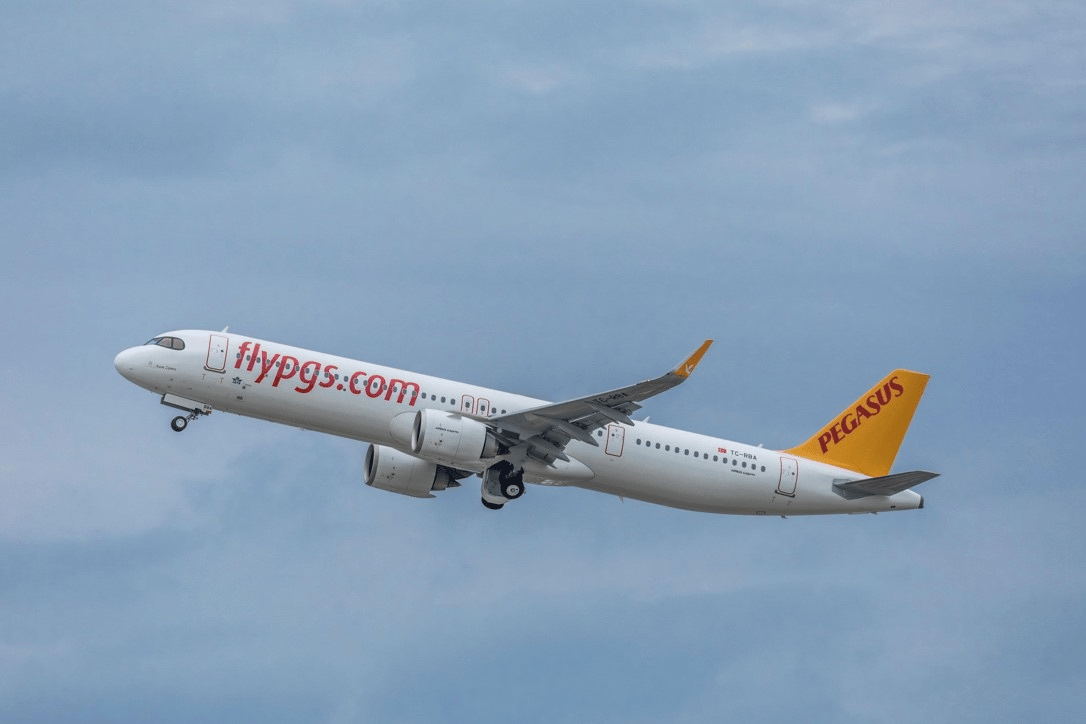
The Pegasus fleet in 2026 is a near-textbook example of a focused single-aisle platform in the middle of a multi-year, multi-OEM renewal programme.
Fleet Size and Composition
Current Aircraft Inventory
At the end of the third quarter of 2025, the airline operated 130 aircraft across four subtypes. The composition is overwhelmingly Airbus, and tilted towards the larger A321neo variant.
FLEET COMPOSITION (as of 30 September 2025)
-------------------------------------------
Type             Count   Status
-----------------------------------
Airbus A321neo    66     Active, growing
Airbus A320neo    46     Active, stable
Airbus A320ceo     9     Damp-lease, exiting
Boeing 737-800     9     To be phased out
-----------------------------------
TOTAL            130
Avg. Fleet Age   ~5.4 years (one of Europe's youngest)
The 66 A321neo aircraft already in service as of late September 2025, up from 65 in August, reflect the current delivery cadence out of Airbus’s Toulouse and Hamburg lines.
The three A320ceos currently operated on damp lease are scheduled to exit by the end of 2025, leaving six wholly owned A320ceos and nine Boeing 737-800s as the only non-neo aircraft in the fleet going into 2026.
Fleet Age and Modernity
Pegasus received the World’s 2nd Youngest Aircraft Fleet Award for 2025 based on a fleet average age of 4.5 years as of 31 December 2024.
With A321neo inductions through 2025, the average age has drifted closer to 5.4 years, but it remains well below European low-cost carrier medians.
The airline’s remaining nine Boeing 737-800s are the oldest part of the inventory at roughly 10 to 11 years average age. Their planned phase-out is a core reason for the large Boeing 737-10 order.
Aircraft Types and Cabin Configuration Strategy
Airbus A321neo: The Growth Workhorse
The A321neo is the central platform of the fleet plan. Configured in a single-class 239-seat layout, it offers the lowest seat-mile cost of any aircraft in the fleet and a roughly 15% fuel burn reduction per seat versus the outgoing A320ceos on longer sectors.
Cabin specification includes slimline seats, ACF-compatible door arrangements on later frames, and LED mood lighting. The 239-seat count exploits the full exit-limit configuration, maximising density without downgrading regulatory comfort.
On 3.5-to-5-hour missions to Western Europe, the Gulf, and North Africa, the A321neo offers both range margin and payload margin that the 737-800 simply cannot match, which is the operational rationale for phasing out the 737-800s.
Airbus A320neo: The Versatile Mid-Size
The A320neo fleet of 46 aircraft, all delivered against a 42-unit book once the final frames arrived, sits between the A321neo and the retiring A320ceos in terms of role.
Typical configuration is in the high-180s seat range single-class, depending on the exit-door scheme. This subfleet handles thinner domestic and short-haul international routes where the A321neo would be over-gauged.
Operationally, the A320neo and A321neo share a common type rating and very similar systems, reducing crew complexity and pilot training costs across the combined fleet of 112 neo aircraft as of Q3 2025.
Airbus A320ceo: The Declining Legacy Subfleet
The remaining A320ceos, including three damp-leased aircraft exiting by year-end 2025, are the lowest priority in the plan. Their older CFM56 engines deliver higher CASK than the neos, and they are held purely for flexibility during the handover.
Cabin configurations are inherited from earlier fleet standards, and the airline has avoided investing in cabin retrofits for an aircraft type that will not remain in the plan.
Boeing 737-800: The Final Legacy Piece
Nine Boeing 737-800s, including the iconic Ada special livery aircraft, close out the legacy fleet. Average age sits above ten years, and they are configured with 189 seats.
The airline has stated plainly that all Boeing 737-800s will be phased out. The exact timing depends on the pace of A321neo deliveries against the outstanding 43-unit A321neo order book and the arrival of Boeing 737-10s from 2028 onwards.
Fleet Strategy: The Dual-Source Doctrine
Pegasus is unusual among Europe’s low-cost carriers because it has chosen to remain a two-OEM operator rather than commit to a single fleet type like Ryanair or Wizz Air.
The Historic Boeing 737-10 Order
In December 2024, the carrier signed a landmark agreement for up to 200 Boeing 737-10 aircraft, with 100 firm and 100 options. The firm portion alone is valued at roughly $36 billion at list prices.

Deliveries are scheduled from 2028 onwards. The remaining 100 options will be evaluated against market conditions and fleet needs in the coming years, a deliberately flexible construction.
FLEET ORDER BOOK SUMMARY
------------------------
AIRBUS SIDE
  A320neo    : 42 firm  | All delivered
  A321neo    : 108 firm | 66 delivered, 42 remaining

BOEING SIDE
  737-10     : 100 firm + 100 options
  First delivery : 2028
  Phasing     : staggered multi-year

PIPELINE TOTAL (firm) : ~142 additional aircraft (post-Sep 2025)Why Two OEMs?
Running two manufacturers adds complexity in crew training, spares, and maintenance. The management case is that the additional complexity is outweighed by three strategic benefits.
The first is supplier negotiating power. Having both Airbus and Boeing as viable paths for fresh growth capacity preserves bargaining leverage on each future order.
The second is delivery schedule resilience. Airbus backlogs for A321neo have become extremely long, and Boeing’s 737 MAX ramp has had its own bumps. Running both platforms spreads the exposure to any single production constraint.
The third is legacy compatibility. Pegasus operated Boeing 737s for decades, so its engineering and line maintenance base carries deep 737 knowledge that will be reactivated as the 737-10 arrives.
Fleet Growth Profile
Fleet size was planned to reach 127 aircraft at the end of 2025. The airline publicly guided a fleet expansion of eight additional A321neos into 2026.
Looking further out, the combination of the remaining 42 Airbus A321neos on order plus the 100 firm Boeing 737-10s establishes a multi-year delivery stream that comfortably supports mid-to-high single-digit annual ASK growth through the early 2030s.
Analysts following the name have noted that there will be a delivery gap between the last A321neo deliveries and the first 737-10 arrivals. Filling this will require either acceleration of A321neo deliveries or opportunistic lease-in, which the airline has signalled it is willing to consider.
Technical Operations and Maintenance Strategy
In-House MRO Capability
In February 2026, Pegasus inaugurated a new aircraft maintenance centre at Sabiha Gökçen, materially deepening in-house MRO capability.
Capabilities include line maintenance, engine and landing gear replacement, avionics and structural modifications, base maintenance, full cabin refurbishment, and painting. This reduces reliance on third-party MRO and creates a base for potential third-party revenue opportunities.
Engine Strategy
A320neo family aircraft at Pegasus are powered by CFM LEAP-1A engines, aligning with the airline’s preferred commonality with ex-CFM56 engineering experience. The incoming 737-10s will be powered by LEAP-1B, preserving a single engine-family relationship across the combined future fleet.
This LEAP-only engine strategy simplifies pooling, spares forecasting, and maintenance planning, despite the presence of two airframe OEMs.