


Welcome to AviationOutlook: The aviation newsletter built exclusively for decision-makers.
Become an “Annual” member now & get this special discount offer.
As a paid member, you get access to:
200+ Reports - All major airlines + aerospace & defense companies (updated regularly).
Daily / Weekly - Deep-dive analysis & insights.
Monthly - Industry outlook reports.
In case you missed it, here are the latest analysis reports:
Embraer - Company Analysis and Outlook Report 2026 (Updated)
American Airlines’ Six-Route Europe Play: Yield Discipline or Widebody Overreach?
Check Out All Reports
Executive Summary
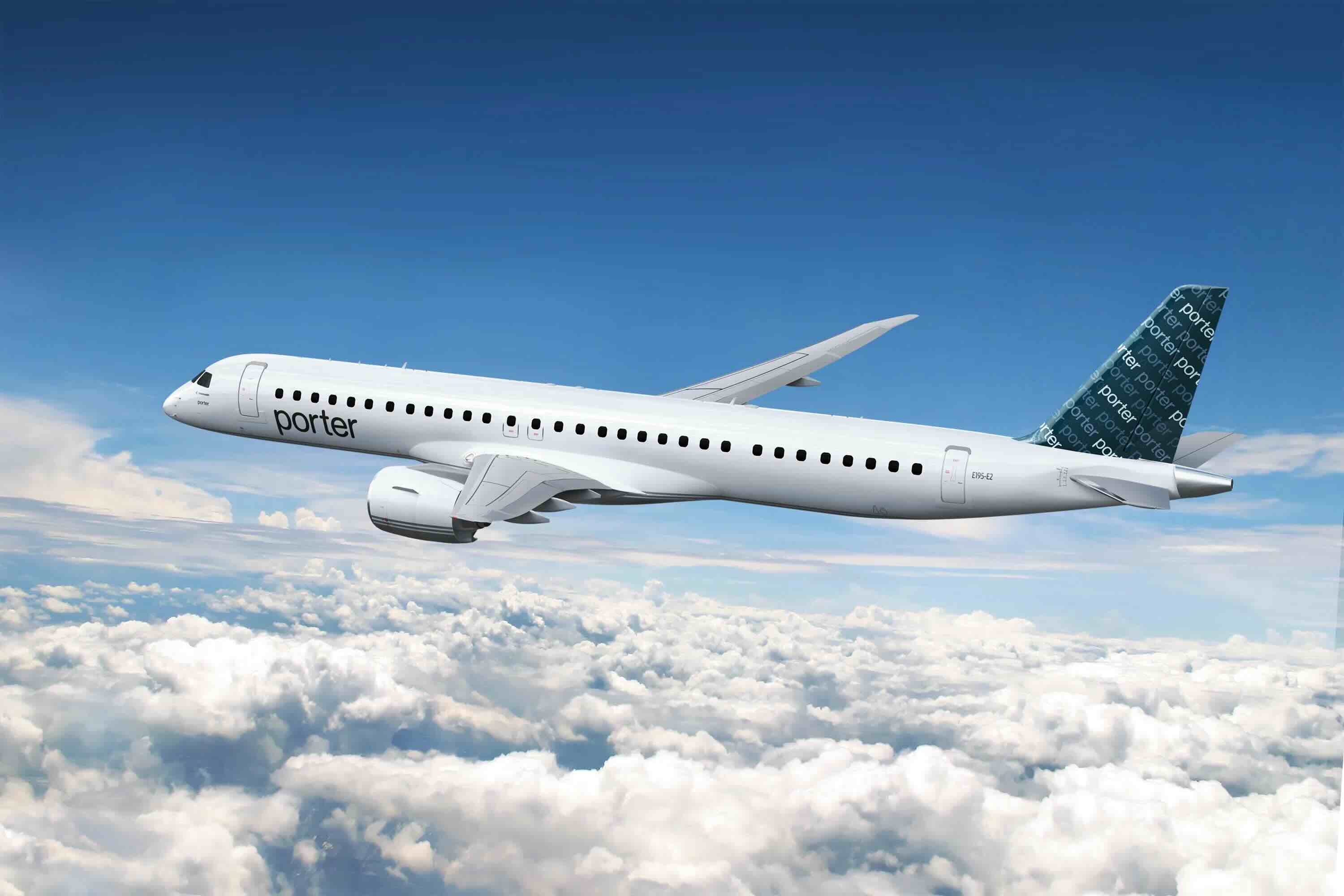
Porter Airlines is now Canada’s third-largest carrier by capacity, operating a fleet of 81 aircraft anchored on a 50-jet Embraer E195-E2 milestone reached in late December 2025, with firm orders for 75 jets and purchase rights for an additional 25.
The carrier carried out its first international flights beyond Canada and the U.S. during the 2025-26 winter and is increasing southern capacity by more than 150% for the 2026-27 season, adding Aruba, Montego Bay, San Jose (Costa Rica) and Los Cabos.
Porter will become the launch carrier of Montréal Metropolitan Airport (YHU) on June 15, 2026, opening 12 nonstop routes simultaneously and creating its newest operational base, the most ambitious greenfield airport launch by a single Canadian airline in decades.
The carrier operates a barbell hub strategy across Billy Bishop, Toronto Pearson, Hamilton, Ottawa, Montréal-Trudeau, Halifax and now Montréal Metropolitan, pairing 132-seat single-class E195-E2 jets for trunk and sun routes with 29 Dash 8-400 turboprops for short, thin and downtown Toronto regional flying.
Recommended - Read Full Reports


Read All Reports
Table of Contents
Executive Summary
Introduction
Porter Airlines Company Profile: Key Facts
Porter Airlines Performance Analysis
Growth Profile and Latest Trailing Twelve Months Indicators
Revenue Quality and the Elevated Economy Product
2025-26 Capacity and Route Disclosures
Revenue Growth Drivers Through 2026 and Beyond
Growth Driver 1
Growth Driver 2
Growth Driver 3
Growth Driver 4
Key Services and Products
Porter Airlines Fleet Analysis
Fleet Size and Composition
Fleet Age and Quality
Aircraft Type Strategy and Configuration
Embraer E195-E2 Configuration
De Havilland Dash 8-400 Configuration
Fleet Strategy and Procurement Doctrine
Porter Airlines Route Network Strategy and Major Destinations Analysis
Network Philosophy
Major Destinations and Route Categories
Eastern Canadian Regional Routes
Trans-Canada Trunk Routes
U.S. Transborder Routes
Sun and Leisure Routes
Emerging Markets and Future Optionality
Network Strategy for 2026 and Beyond
Porter Airlines Major Operational Bases (Hubs)
Billy Bishop Toronto City Airport (YTZ)
Toronto Pearson International Airport (YYZ)
Hamilton International Airport (YHM)
Ottawa Macdonald-Cartier International Airport (YOW)
Montréal-Trudeau International Airport (YUL)
Montréal Metropolitan Airport (YHU), New From June 15, 2026
Halifax Stanfield International Airport (YHZ)
Porter Airlines Competitive Position
List of Major Competitors
Porter vs Air Canada
Porter vs WestJet
Porter vs Flair Airlines
Porter vs Air Transat (Cooperation, Not Competition)
Porter vs U.S. Transborder Operators
Onboard Product, Brand and Customer Recognition
The Elevated Economy Product
Awards and Industry Recognition
Partnerships, Loyalty and Distribution
Air Transat Joint Venture
Alaska Airlines Atmos Rewards Partnership
American Airlines Partnership
BMO VIPorter Mastercard
Operational Capabilities, Maintenance and Sustainability
Porter Airlines Key Risks: With Probability and Scenario Analysis
Risk 1
Risk 2
Risk 3
Risk 4
Risk 5
Risk 6:
Risk 7
Risk 8
Risk 9
Risk 10
My Final Thoughts
Official Sources and Data
Introduction
A 19-year-old airline that began with four turboprops flying out of a small island airport in downtown Toronto has, by mid-2026, become the most disruptive force in Canadian aviation.
Porter Airlines now operates around 50 Embraer E195-E2 jets, has filed for delivery of up to 100 of them, and is launching an entirely new commercial airport in suburban Montréal on June 15.
The story is no longer about a polite regional carrier with free wine and a downtown Toronto niche.
It’s about a privately held challenger that has methodically rebuilt its business around a single 132-seat aircraft type, then used that platform to push deep into Air Canada and WestJet trunk routes, U.S. transborder gateways, and the Caribbean.
The pace is unusual even by global standards.
For airline industry stakeholders, the question for 2026 and beyond is how the network will mature, whether unit economics will hold as the network lengthens, and what happens when the last of the 75 firm E195-E2s arrives.
Porter Airlines Company Profile: Key Facts
Porter Airlines is a privately held Canadian airline headquartered in Toronto.
The carrier has spent nearly two decades positioning itself between full-service legacy operators and ultra-low-cost newcomers, and it is now executing the most aggressive fleet and network transformation in its history.
Legal Entity        : Porter Airlines Inc. (operating subsidiary of Porter Aviation Holdings Inc.)
Founded             : February 2006 (first revenue flight October 23, 2006)
Headquarters        : Toronto, Ontario, Canada
CEO                 : Michael Deluce
Founder/Chair       : Robert Deluce
Ownership           : Privately held - Deluce family, OMERS, private institutional investors
Team Members        : 4,300+ (as of Oct 2025)
Total Fleet         : ~77 aircraft (Oct 2025); ~81 per third-party trackers in 2026
E195-E2 in fleet    : 50 delivered (Dec 2025); 75 firm + 25 options
Dash 8-400 in fleet : 29
Average Fleet Age   : ~7.3 years
Total Routes        : 87+ (and growing through 2026)
Total Destinations  : 45+, across Canada, U.S., Mexico, Caribbean, Central America
Hub Airports        : YTZ, YYZ, YHM, YOW, YUL, YHU (from June 15, 2026), YHZ
Star Rating         : 4-Star Airline (Skytrax)
The Deluce family’s involvement in Canadian aviation goes back decades, including ownership of Air Ontario before its absorption into Air Canada in the 1990s.
Porter Aviation Holdings Inc. is the parent company, with the Deluce family, the Ontario Municipal Employees Retirement System (OMERS), and other private institutional investors holding the equity.
The leadership team has remained remarkably stable, with Michael Deluce as president and CEO and Andrew Pierce as vice president of network planning and reporting, acting as the public face of route announcements.
Porter’s identity is built around a 4-Star Skytrax rating and an all-inclusive economy product that has now spread to its long-haul transborder and sun routes.