Welcome to AviationOutlook: The aviation newsletter built exclusively for decision-makers.
Become an “Annual” member now & get this special discount offer.
As a paid member, you get access to:
200+ Reports - All major airlines + aerospace & defense companies (updated regularly).
Daily / Weekly - Deep-dive analysis & insights.
Monthly - Industry outlook reports.
In case you missed it, here are the latest analysis reports:
Embraer - Company Analysis and Outlook Report 2026 (Updated)
American Airlines’ Six-Route Europe Play: Yield Discipline or Widebody Overreach?
Check Out All Reports
Executive Summary
Pratt & Whitney recorded full-year 2025 revenues of $32.9 billion, up 17% year-over-year, with adjusted operating profit of $2.725 billion, up 19%.
The Geared Turbofan (GTF) powder metal inspection crisis, with a gross financial impact of $6 to $7 billion, remains the company’s single biggest operational and reputational risk, with Airbus formally seeking damages as of March 19, 2026.
Defense revenues surged 30% in 2025, driven by F135 production and sustainment, and the company is accelerating development of the all-digital XA103 engine for the U.S. Air Force’s Next Generation Adaptive Propulsion (NGAP) program.
For 2026, Pratt & Whitney projects mid-single-digit sales growth overall, with commercial aftermarket on a high-single-digit growth trajectory, underpinned by expanding GTF and V2500 shop visit volumes.
Recommended - Read Full Reports


Table of Contents
Executive Summary
Introduction
Key Facts: Company Profile
Business Overview
About Pratt & Whitney
Three Business Pillars
The RTX Ecosystem Advantage
Revenue and Growth Drivers: Last Twelve Months (LTM) and 2026 Outlook
2025 Full-Year Revenue Performance
Margin Expansion and Profitability
2026 Growth Trajectory
Key Product Lines, Programs, and Services
The GTF Engine Family: Cornerstone of the Commercial Business
GTF Advantage: The Upgraded Engine Now Certified
F135: The World’s Most Advanced Fighter Engine
F135 Engine Core Upgrade (ECU): Block 4 Enablement
F100 Engine: Sustaining the Legacy Fighter Fleet
F117: C-17 Globemaster III Sustainment
IAE V2500: A Workhorse Still Delivering
Pratt & Whitney Canada: The Smaller Engine Specialist
Major Competitors
CFM International: The Volume Leader
GE Aerospace: The Widebody and Military Player
Rolls-Royce: The Widebody Specialist
Safran Aircraft Engines: A Powerful Partnership
Competitive Analysis and Moat
Where Pratt & Whitney Holds a Strong Position?
Long-Term Installed Base and Aftermarket Lock-In
Where the Moat Is Under Pressure?
Recent Developments
GTF Powder Metal Crisis: The Full Picture in 2026
Airbus Pursues Formal Damages Claim Against Pratt & Whitney
GTF Advantage Engine Achieves Dual Regulatory Certification
F135 Engine: A Year of Major Defense Contract Awards
F135 Engine Core Upgrade: Powering the F-35’s Next Chapter
The NGAP Program: Pratt & Whitney’s Bet on the Next Decades of Military Flight
Pratt & Whitney Canada: Quiet Growth and Emerging Applications
MRO Network Expansion and Supply Chain Developments
Financial and Commercial Implications
For Airlines: Capacity Constraints and Cost Impacts
For Airbus and OEM Production
For RTX Corporation
Key Risks: Probabilities and Scenarios
Risk 1: GTF AOG Levels Stabilize Rather Than Decline Significantly
Risk 2: Airbus Damages Arbitration Escalates
Risk 3: Next-Generation Aircraft Engine Competition
Risk 4: F135 ECU / NGAP Schedule Slippage
Risk 5: Tariffs and Supply Chain Disruptions
SWOT Analysis
My Final Thoughts
Primary Sources and Official Data
Introduction
Pratt & Whitney sits at the center of one of the most consequential stories in aviation today.
The company simultaneously boasts record-breaking revenues of $32.9 billion for 2025 and faces its largest industrial crisis in decades, with over 835 aircraft grounded globally due to a contaminated powder metal manufacturing defect that continues to ripple through the narrowbody fleet.
The dual reality of operational disruption alongside strong financial growth defines Pratt & Whitney’s position as we enter 2026.
With a formal damages claim launched by Airbus in March 2026, a next-generation military engine in development, and a certified GTF Advantage engine about to enter service, the company’s trajectory over the next few years will have profound implications for the entire aviation supply chain.
Key Facts: Company Profile
Full Legal Name:     Pratt & Whitney (a division of RTX Corporation)
Parent Company:      RTX Corporation (NYSE: RTX)
Headquarters:        East Hartford, Connecticut, USA
Founded:             1925 (celebrating its centennial year in 2025)
Primary Segments:    Large Commercial Engines, Pratt & Whitney Canada,
                     Military Engines
Key Products:        GTF (PW1000G series), GTF Advantage, F135, F100,
                     F117, PT6, PW100, PW800 series
FY 2025 Revenue:     $32.916 billion (reported and adjusted)
FY 2025 Adj. OpProfit: $2.725 billion (Adj. ROS: 8.3%)
RTX Total Backlog:   $268 billion (record, as of December 31, 2025)
Military Engines In Service: Over 7,000 engines with 34 armed forces globally
GTF Orders (H1 2025): Nearly 1,100 orders and commitments
Website:             rtx.com/prattwhitney
Business Overview
About Pratt & Whitney
Pratt & Whitney is a world leader in the design, manufacture, and service of aircraft engines and auxiliary power units (APUs). As a wholly-owned subsidiary of RTX Corporation, it is one of three core business segments within RTX, alongside Collins Aerospace and Raytheon.
The company’s work spans commercial aviation, regional and business aviation, and military propulsion. It operates globally, with key manufacturing, engineering, and MRO centers in the United States, Canada, Singapore, Poland, and several other countries.
Three Business Pillars
Pratt & Whitney’s business model rests on three interconnected pillars.
The first is Large Commercial Engines, which covers the GTF engine family powering the Airbus A320neo, A220, and Embraer E2 families.
The second is Pratt & Whitney Canada, which produces engines for business aviation, regional turboprops, and helicopters, including the iconic PT6 and PW100 families.
The third is Military Engines, which encompasses the F135 powering the F-35 Lightning II, the F100 powering F-15s and F-16s, and the F117 used on the C-17 Globemaster III.
The aftermarket business is increasingly important, too. As installed fleets mature, MRO revenues from both commercial and military customers provide a durable, long-cycle revenue stream that extends well beyond the initial engine sale.
The RTX Ecosystem Advantage
Being part of RTX provides Pratt & Whitney with significant structural advantages.
RTX’s total 2025 revenues reached $88.6 billion, providing Pratt with the financial depth to absorb a multi-billion-dollar crisis while simultaneously investing in next-generation programs.
The group-level backlog of $268 billion, up 23% year-over-year, reflects sustained global demand for both commercial aviation and defense products.
Revenue and Growth Drivers: Last Twelve Months (LTM) and 2026 Outlook
2025 Full-Year Revenue Performance
Pratt & Whitney’s 2025 performance was notably strong across all three of its main revenue streams.
Commercial OE sales grew 28%, driven by higher volumes and a favorable mix in large commercial engine deliveries, with large commercial engine deliveries up 6% for the full year.
Commercial aftermarket sales rose 21%, reflecting both higher volume and heavier content in large commercial engines and Pratt & Whitney Canada overhaul work.
Military revenues posted an equally impressive 30% gain. The primary drivers were higher F135 production volume and increased sustainment work across the F135 and F100 programs.
The company’s Q4 2025 performance was particularly strong, with Pratt & Whitney posting quarterly revenues of $9.5 billion, up 25% year-over-year on both an adjusted and organic basis.
Margin Expansion and Profitability
Adjusted operating profit for the full year reached $2.725 billion, up 19% versus 2024, with an adjusted Return on Sales (ROS) of 8.3%.
This modest margin expansion reflects the tug-of-war between growing MRO throughput, GTF-related compensation payments, and rising military revenues.
The adjusted ROS remains below the company’s long-term aspirations, partly because the ongoing GTF fleet compensation cash outflows, approximately $1 billion in 2025, are compressing margins.
2026 Growth Trajectory
Management has guided for mid-single-digit revenue growth for Pratt & Whitney in 2026.
The commercial aftermarket is projected to grow at a high-single-digit rate, fueled by rising GTF shop visit volumes, continued strength in V2500 overhauls, and Pratt & Whitney Canada aftermarket expansion.
The GTF aftermarket alone is expected to deliver one to two percentage points of margin expansion in 2026. Commercial OE growth is expected in the low-single-digit range, constrained by the ongoing parts supply challenge that continues to weigh on new engine output.
The powder metal cash compensation outflows are projected to step down to roughly $700 million in 2026, which will itself be a meaningful tailwind to margins.
PRATT & WHITNEY REVENUE SNAPSHOT (2025 vs. 2026 Guidance)

  FY 2025 Revenue:       $32.916 billion (+17% YoY)
  Q4 2025 Revenue:       $9.496 billion (+25% YoY)
  FY 2025 Adj. Op. Profit: $2.725 billion (+19% YoY)
  FY 2025 Adj. ROS:      8.3%

  2025 Commercial OE Growth:         +28%
  2025 Commercial Aftermarket Growth: +21%
  2025 Military Revenue Growth:       +30%

  2026 Guidance: Mid-single-digit total sales growth
  2026 Commercial Aftermarket: High-single-digit growth
  2026 GTF Compensation Cash Outflows: ~$700 million
  (vs. ~$1 billion in 2025)
Key Product Lines, Programs, and Services
The GTF Engine Family: Cornerstone of the Commercial Business
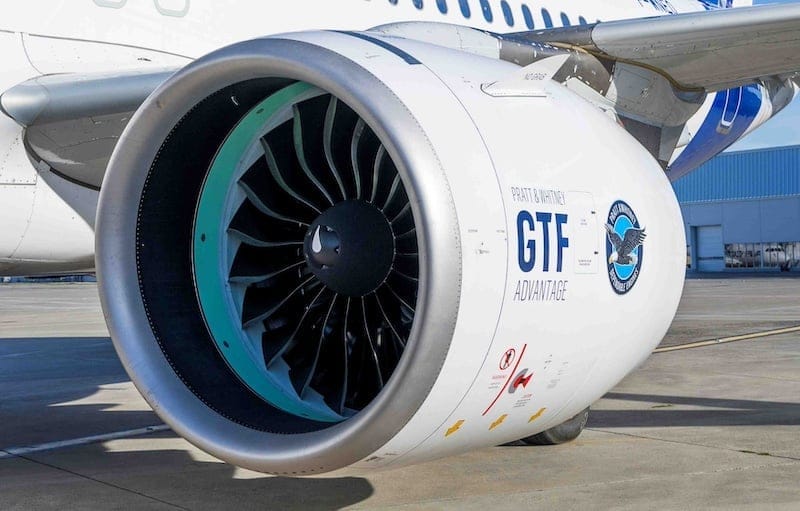
The Geared Turbofan (PW1000G series) is Pratt & Whitney’s flagship commercial engine family.
It powers the Airbus A320neo family (PW1100G), Airbus A220 (PW1500G), Embraer E2 series (PW1700G/PW1900G), and Mitsubishi SpaceJet.

The core innovation is a reduction gearbox that allows the fan to spin at a different speed from the low-pressure turbine, delivering up to 20% lower fuel consumption and a 75% smaller noise footprint compared with the engines it replaced.
The program has accumulated substantial commercial momentum. By mid-2025, nearly 1,100 GTF engine orders and commitments had been secured in 2025 alone.
Despite ongoing operational challenges related to the powder metal inspection program, airlines, including Vietjet, have continued to select the GTF for new A320neo family orders.
GTF Advantage: The Upgraded Engine Now Certified
The GTF Advantage is the most important near-term product upgrade in Pratt & Whitney’s commercial portfolio. The engine received FAA type certification in February 2025 and EASA validation in October 2025, with commercial entry into service expected in 2026.
The GTF Advantage delivers 4% more takeoff thrust at sea-level airports and 8% more at high-altitude airports compared to the base GTF. It also incorporates incremental fuel efficiency improvements.
The A321XLR, the ultra-long-range narrowbody that EASA certified in February 2025, is powered exclusively by the GTF.
F135: The World’s Most Advanced Fighter Engine
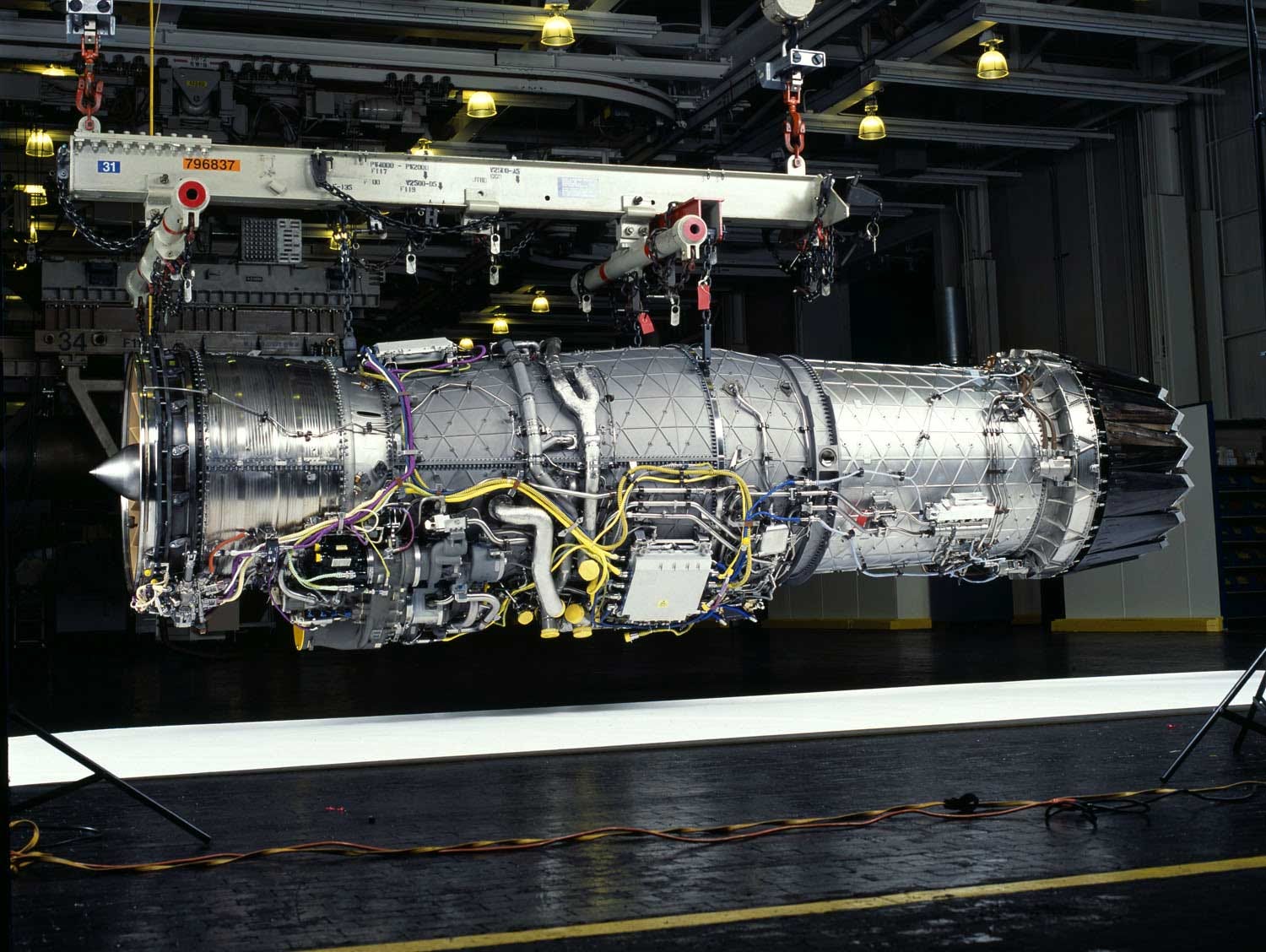
The F135 is the sole propulsion system for the F-35 Lightning II, the world’s most widely fielded fifth-generation stealth fighter.
Operating across three variants (F-35A conventional takeoff, F-35B short takeoff/vertical landing, and F-35C carrier variant), the F135 powers the aircraft of 19 nations. The engine has surpassed over 1 million recorded flight hours, demonstrating strong safety and readiness performance.
In 2025, the program saw a series of major contract awards.
Pratt & Whitney received a $2.8 billion F135 production contract in August, followed by a $1.6 billion sustainment contract from the U.S. Navy in December. A further $670 million contract modification for the F135 propulsion system was awarded in September 2025.
F135 Engine Core Upgrade (ECU): Block 4 Enablement
The F135 ECU is a fleet-wide upgrade program designed to deliver the additional power and thermal management capacity needed to enable F-35 Block 4 capabilities. It’s designed to be retrofittable across all three F-35 variants, covering both fielded and new-production aircraft.
The ECU is the only engine upgrade program that supports all three F-35 variants while leveraging existing production and maintenance infrastructure.
According to the Pentagon’s schedule, F-35 Block 4 modernization is now expected to reach full production no earlier than 2031, and Pratt & Whitney’s ECU design review is expected to reach a critical milestone at mid-2026.
F100 Engine: Sustaining the Legacy Fighter Fleet
The F100 powers the U.S. Air Force’s F-15 Eagle and F-16 Fighting Falcon fleets. It remains a critical sustainment business for Pratt & Whitney.
In 2025, the company received contracts totaling over $1.2 billion for F100 engine sustainment, covering parts supply for these legacy fleets that continue to serve in large numbers both in the U.S. and with allied nations.
F117: C-17 Globemaster III Sustainment
The F117 engine powers every Boeing C-17 Globemaster III strategic transport aircraft in service.
With the U.S. Air Force planning to award a 10-year performance restoration contract to Pratt & Whitney for the C-17 by the end of fiscal year 2027, this program represents a long-term, stable aftermarket revenue stream.
IAE V2500: A Workhorse Still Delivering
While technically a product of International Aero Engines (IAE), a consortium in which Pratt & Whitney is the primary shareholder, the V2500 powers a significant portion of the older Airbus A320ceo fleet still in service worldwide.
Pratt conducted approximately 800 V2500 shop visits in 2025, and 2026 is expected to be at roughly the same level, plus or minus 20 shop visits.
The program remains a meaningful aftermarket revenue contributor despite the fleet gradually retiring.
Pratt & Whitney Canada: The Smaller Engine Specialist
Pratt & Whitney Canada is the global leader in turboprop, turboshaft, and small turbofan engines for business, regional, and utility aviation.
Its product families include the PT6 turboprop, the PW100/150 regional turboprop, the PW800 business jet turbofan, and helicopter turboshafts. The PT6 aerial application variant surpassed 1 million flight hours in 2025, while the PT6 E-Series crossed 500,000 flight hours in October 2025.
Pratt & Whitney Canada was selected in 2025 by Horizon Aircraft to power its hybrid vertical takeoff aircraft with the PT6A engine, illustrating the family’s applicability to emerging aviation segments.
The aftermarket for Pratt Canada engines is expected to grow at a high-single-digit rate in 2026, outpacing revenue passenger kilometer (RPK) trends.