AviationOutlook Newsletter

AviationOutlook Newsletter

Qatar Airways - Strategic Analysis and Outlook Report 2026 (Updated)

Dipesh Dhital's avatar
Dipesh Dhital
May 15, 2026
∙ Paid

Executive Summary

  • Qatar Airways Group closed fiscal year 2024/25 with record revenues of QAR 86 billion (approximately US$23.22 billion) and net profits of QAR 7.85 billion (US$2.15 billion), the strongest financial performance in the carrier’s history, while carrying over 43 million passengers.

  • The airline cemented its position as a global widebody powerhouse with a historic order for up to 210 widebodies from Boeing in May 2025, comprising 130 Dreamliners and 30 777-9 jets, while remaining the launch customer of the 777X family.

  • A leadership transition saw Hamad Ali Al-Khater appointed Group CEO effective 7 December 2025, succeeding Badr Mohammed Al-Meer, with a renewed focus on the Airbus relationship and ambitious expansion to over 150 destinations by mid-2026.

  • The carrier reinforced its global footprint through a 25% stake in Virgin Australia, a record-setting Skytrax World’s Best Airline title for a ninth time in 2025, and a Cargo business that produced US$4.8 billion in revenue.

Get Latest Aviation News Insights and In-Depth Industry Reports Direct to Your Inbox. Don’t Miss Any Key Aviation Updates That Matter.


Recommended - Read Full Reports

Top 50 Airlines + Reports Each (2026)

Top 50 Airlines + Reports Each (2026)

Dipesh Dhital
·
Apr 26
Read full story
Top 50 Aerospace Companies + Reports Each (2026)

Top 50 Aerospace Companies + Reports Each (2026)

Dipesh Dhital
·
May 7
Read full story
Lockheed Martin - Company Analysis and Outlook Report 2026 (Updated)

Lockheed Martin - Company Analysis and Outlook Report 2026 (Updated)

Dipesh Dhital
·
Mar 30
Read full story
Alaska Airlines - Fleet Strategy, Route Network & Company Analysis Report 2026 (Updated)

Alaska Airlines - Fleet Strategy, Route Network & Company Analysis Report 2026 (Updated)

Dipesh Dhital
·
Apr 21
Read full story

Read All Reports


Table of Contents

  • Executive Summary

  • Qatar Airways Company Profile: Key Facts

  • Qatar Airways Revenue & Financial Analysis

    • Group Revenue, Operating Income and Profitability

    • Revenue Composition and the Last Twelve Months Picture

    • Latest Earnings Report and Forward Guidance

    • Revenue Growth Drivers

    • Key Products and Services

  • Qatar Airways Fleet Analysis

    • Fleet Size and Composition

    • Fleet Age

    • Aircraft Types Strategy and Cabin Configuration

    • Fleet Strategy and Outlook

  • Qatar Airways Route Network Strategy, Major Destinations and Analysis

    • Network Architecture and Strategic Philosophy

    • Network Expansion to 150+ Destinations in 2026

    • Regional Network Breakdown

    • Ultra-Long-Haul and Unique Routes

    • Codeshare and Alliance Network Multiplier

  • Major Operational Bases (Hubs)

    • Hamad International Airport: The Single Mega-Hub

    • Why a Single-Hub Model

    • Operational Resilience and Constraints

  • Qatar Airways Competitive Position

    • Major Competitors

    • Qatar Airways vs. Emirates

    • Qatar Airways vs. Etihad Airways

    • Qatar Airways vs. Saudia and Riyadh Air

    • Qatar Airways vs. Turkish Airlines

    • Qatar Airways vs. Singapore Airlines and Cathay Pacific

  • Qatar Airways Cargo: The Hidden Profit Engine

    • Cargo Business Scale

    • Why the Cargo Business Matters

  • Innovation, Digital and Customer Experience

    • Starlink Inflight Connectivity

    • Qsuite Next Gen Cabin

    • Loyalty Program Evolution

  • Sustainability and Climate Strategy

    • Net Zero by 2050

    • Sustainable Aviation Fuel

    • Operational Efficiency Gains

  • Strategic Partnerships and Equity Investments

    • The Virgin Australia Partnership

    • The IAG and American Airlines Alliances

    • The IndiGo and Greater China Partnerships

  • Leadership Transition: From Al-Meer to Al-Khater

    • The Al-Meer Era (November 2023 to December 2025)

    • The Al-Khater Era (December 2025 onwards)

  • Awards, Recognition and Brand Equity

  • Key Risks (Probability and Scenario Analysis)

    • Risk 1

    • Risk 2

    • Risk 3

    • Risk 4

    • Risk 5

    • Risk 6

    • Risk 7

    • Risk 8

  • My Final Thoughts

  • Official Sources and Data

Qatar Airways Company Profile: Key Facts

Qatar Airways is the state-owned flag carrier of the State of Qatar, operating from a single mega-hub at Hamad International Airport in Doha.

Founded on 22 November 1993 and relaunched under His Highness Sheikh Hamad bin Khalifa Al Thani in 1997, the carrier has scaled into one of the most influential long-haul widebody operators in the world.

The company sits inside a broader holding structure called Qatar Airways Group, which encompasses passenger flying, cargo, business jets, ground handling, catering, retail concessions, and aviation training.

QATAR AIRWAYS GROUP – KEY FACTS (2026)

Founded:                    1993 (relaunched 1997)
Headquarters:               Qatar Airways Tower, Doha, Qatar
Primary Hub:                Hamad International Airport (DOH)
Group CEO:                  Hamad Ali Al-Khater (effective 7 Dec 2025)
Outgoing CEO:               Badr Mohammed Al-Meer (Nov 2023 – Dec 2025)
Alliance Membership:        oneworld (since 30 October 2013)
Loyalty Program:            Privilege Club (Avios currency)
Group Revenue (FY 24/25):   QAR 86.0 billion (~US$23.22 billion)
Group Net Profit:           QAR 7.85 billion (~US$2.15 billion)
Passengers Carried:         43 million+ (FY 24/25)
Total Fleet:                ~250+ aircraft (as of late 2025)
Destinations (Summer 2026): 150+ destinations
Cargo Revenue (FY 24/25):   QAR 17.9 billion (~US$4.8 billion)
Award Status:               Skytrax World's Best Airline 2025 (9th time)

The Qatar Airways Group also operates Qatar Executive (private jet charter), Qatar Aviation Services (ground handling), Qatar Aircraft Catering Company, Qatar Duty Free, Qatar Airways Holidays, Internal Media Services, and Qatar Distribution Company.

Each subsidiary contributes meaningfully to the consolidated topline while keeping the core flying operation focused on long-haul connectivity.

The carrier’s brand identity is defined by premium positioning, modern widebody fleet renewal, and a “single-hub, single-stop” connection model that funnels global demand through Doha.

That model is the architectural foundation for everything else the company does.
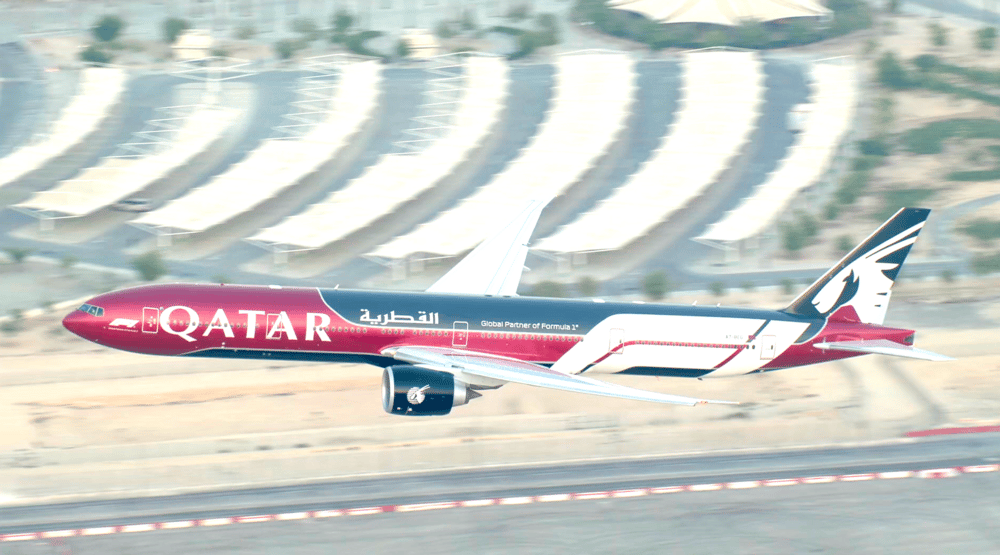
Qatar Airways Boeing 777
Image source: qatarairways.com

Qatar Airways Revenue & Financial Analysis

Group Revenue, Operating Income and Profitability

Qatar Airways Group reported revenue and other operating income of QAR 86 billion for the 12 months ended 31 March 2025, an increase of approximately 6 percent year-on-year.

Net profit jumped 28 percent to QAR 7.85 billion (around US$2.15 billion), establishing FY 2024/25 as the most profitable year in the airline’s three-decade history.

Management has openly credited the renewed “Qatar Airways 2.0” strategic framework, which prioritises operational discipline, network optimisation, and accelerated digital transformation.

The improvement also reflects continued strength in premium long-haul demand and a tightly managed unit-cost base.

QATAR AIRWAYS GROUP – HEADLINE FINANCIALS (FY 2024/25)

Revenue & Other Operating Income:   QAR 86.02 billion (US$23.22 bn)
Year-over-Year Revenue Growth:      +6%
Group Net Profit:                   QAR 7.85 billion (US$2.15 bn)
Year-over-Year Profit Growth:       +28%
Passengers Carried:                 43+ million (+7.8% YoY)
Network Capacity Growth (ASK):      +4% YoY
Cargo Revenue:                      QAR 17.9 billion (US$4.8 bn)
Cargo Volume:                       1.5+ million tonnes
Hamad International Throughput:     Record passenger volumes

The result is particularly significant because it was delivered against a backdrop of widebody delivery delays, ongoing supply chain stress in the airframe and engine ecosystem, and elevated geopolitical risk across the Middle East.

Revenue Composition and the Last Twelve Months Picture

While the carrier reports on a March-ending fiscal year and does not publish quarterly disclosures, the most recent twelve-month period covers 1 April 2024 to 31 March 2025.

The published QAR 86 billion topline is therefore the most authoritative LTM revenue number available, with no subsequent half-year update yet superseding it.

Revenue is generated across four primary streams.

  • The first is scheduled passenger flying through Qatar Airways.

  • The second is dedicated air freight via Qatar Airways Cargo.

  • The third is the suite of group companies that monetise Hamad International Airport, including Qatar Aviation Services and Qatar Duty Free.

  • The fourth is the corporate aviation and ancillary businesses such as Qatar Executive.

Latest Earnings Report and Forward Guidance

In the FY 2024/25 earnings statement, management indicated continued momentum into FY 2025/26, supported by strong forward bookings on premium long-haul routes, accelerating cargo yields out of Asia, and the ramp-up of new aircraft deliveries.

Outgoing CEO Badr Al-Meer flagged that the airline expects another strong fiscal year ahead, although he openly acknowledged that aircraft deliveries from both Boeing and Airbus remain the key swing factor on capacity growth.

Following his departure in December 2025, new CEO Hamad Al-Khater has signalled an early focus on restoring the Airbus relationship.

The airline is a state-owned, unlisted entity, so forward guidance is provided in qualitative narrative form rather than numeric ranges. That structure gives management considerable flexibility to invest counter-cyclically through fleet orders and route launches.

Revenue Growth Drivers

The most important revenue driver is sustained passenger traffic growth. With 43 million+ passengers carried in FY 2024/25, the carrier grew passenger volume by 7.8 percent against capacity growth of only 4 percent, signalling robust load factors and rising yields.

A second engine is premium cabin demand. The Qsuite product on Boeing 777-300ER and Airbus A350-1000 aircraft commands a meaningful yield premium versus regional competitors, and the airline has successively rolled out the new Qsuite Next Gen suite on its 777X retrofits and 787-9 Dreamliners to defend that pricing power.

A third lever is cargo. Qatar Airways Cargo reported revenue of QAR 17.9 billion and carried more than 1.5 million tonnes in FY 24/25, retaining its position as the world’s largest international air cargo carrier.

A fourth driver is the airport-anchored retail ecosystem. Qatar Duty Free reported sales turnover growth of 12 percent year-on-year, processing over 15 million transactions on the back of higher passenger throughput at Hamad International Airport.

Key Products and Services

The flagship product is Qsuite, the doors-fitted business class suite that pioneered the “double bed in the sky” concept and remains a benchmark in the industry.

The recent Qsuite Next Gen update adds wireless charging, larger 4K monitors, and refined cabin styling.

QATAR AIRWAYS CABIN PRODUCT MATRIX (2026)

First Class:        A380 only (limited routes from Doha)
Qsuite Business:    777-300ER, A350-1000, retrofitting onto 787-9
Business Class:     787-8, A330, select 777-200LR
Premium Economy:    Not offered (key differentiator vs. competitors)
Economy Class:      All widebody and A321neo single-aisle fleet
Onboard Wi-Fi:      Free Starlink across most of the 777 fleet
Inflight Catering:  Qatar Aircraft Catering, full meal service

Onboard connectivity is now a major selling point. The carrier has rolled out free Starlink Wi-Fi across its Boeing 777 fleet, offering gate-to-gate satellite internet at no cost to passengers.

The Privilege Club program, which uses Avios as currency, was strengthened in August 2025 with the launch of Privilege Club Pro, a paid subscription tier targeting frequent flyers.

Qatar Airways Fleet Analysis

Fleet Size and Composition

Qatar Airways operates one of the most modern widebody fleets in commercial aviation. There are 270 active aircraft under the Qatar Airways AOC as of late 2025, with another 17 on firm short-term delivery and many more on order beyond that horizon.

The fleet is predominantly twin-aisle widebodies, reflecting the long-haul, single-hub business model. Single-aisle aircraft are a small minority, and the company exited the 737 MAX 10 order book in 2025 to refocus on widebody growth.

Airbus - Company Analysis and Outlook Report 2026 (Updated)

Airbus - Company Analysis and Outlook Report 2026 (Updated)

Dipesh Dhital
·
Mar 30
Read full story
Boeing - Company Analysis and Outlook Report 2026 (Updated)

Boeing - Company Analysis and Outlook Report 2026 (Updated)

Dipesh Dhital
·
Mar 15
Read full story
QATAR AIRWAYS FLEET COMPOSITION (Late 2025 / Early 2026)

WIDEBODY PASSENGER FLEET
- Airbus A380-800           ~8 aircraft       (Premium long-haul, limited use)
- Airbus A350-1000          ~24-28 aircraft   (Largest A350-1000 operator)
- Airbus A350-900           ~34 aircraft      (Long, thin routes)
- Airbus A330-200/300       Phasing out
- Boeing 777-300ER          ~50+ aircraft     (Flagship long-haul)
- Boeing 777-200LR          ~9 aircraft       (Ultra-long-haul specialist)
- Boeing 787-9              Newly arriving    (Mid-size widebody)
- Boeing 787-8              ~30 aircraft

NARROWBODY PASSENGER FLEET
- Airbus A321neo            First deliveries Oct 2025
- Airbus A320 family        Limited
- Boeing 737 MAX 8          ~5 aircraft

CARGO FLEET (Qatar Airways Cargo)
- Boeing 777F freighter     ~28 aircraft

ON ORDER (firm, post-2025 deliveries)
- Boeing 787 Dreamliners    130 firm (+50 options)
- Boeing 777-9              94 firm
- Boeing 777-8F             34 firm (+16 options)
- Airbus A350               Outstanding deliveries
- Airbus A321neo (high-density) 50 firm

Fleet Age

The combined fleet has an average age that sits in the mid-single-digits in years, supported by aggressive retirements of older A330s and rapid Dreamliner and A350 induction.

This places Qatar Airways among the youngest widebody operators globally, which directly supports both unit-cost performance and sustainability metrics.

The carrier has emphasised that modernisation is not optional. New widebodies burn between 20 and 25 percent less fuel per available seat kilometre than the aircraft they replace, and that delta translates directly to operating margin in a high-fuel environment.

Aircraft Types Strategy and Cabin Configuration

The widebody fleet uses three signature configurations.

The 777-300ER and A350-1000 carry the flagship Qsuite product in business class, with a Qsuite-equipped 777 typically configured with 42 Qsuite seats and 282 economy seats.

The A380, a legacy of pre-2020 capacity decisions, retains both a true first class and Qsuite business class for use on the heaviest routes.

SIGNATURE WIDEBODY CONFIGURATIONS

Boeing 777-300ER (Qsuite):
- 42 Qsuite business class (1-2-1)
- 282 economy class
- Free Starlink Wi-Fi gate-to-gate

Airbus A350-1000 (Qsuite):
- 46 Qsuite business class
- 281 economy class
- Long, thin ultra-long-haul missions

Airbus A380-800:
- 8 First class private suites
- 48 Qsuite business class
- 461 economy class
- Operated to London, Sydney, Paris and select premium routes

Boeing 787-9 (next-gen):
- New mini-suite business class
- High-density premium long-haul markets

The new 787-9 Dreamliners are being rolled out with a next-generation business class mini-suite, giving the airline a Qsuite-equivalent product on its smaller widebody. The 787-8 retains the previous reverse-herringbone business class.

The A321neo deliveries that began in October 2025 introduced a high-density 236-seat all-economy configuration.

The first three frames entered service on routes including Doha-Madinah, Doha-Multan, and Doha-Peshawar, demonstrating their use as a tool for capacity-disciplined growth into secondary cities.

Fleet Strategy and Outlook

In May 2025, Boeing and Qatar Airways announced a historic order for up to 210 widebodies, comprising 130 firm 787 Dreamliners and 30 firm 777-9 aircraft, with options on a further 50 787s and 20 777Xs.

This order was signed during the US presidential visit to Doha in May 2025 and locked in Qatar Airways as Boeing’s most strategically important widebody customer of the decade.

LANDMARK BOEING ORDER – May 2025

Firm Aircraft:
- 130 Boeing 787 Dreamliners
- 30 Boeing 777-9 (in addition to existing 60+ already on order)

Options:
- Up to 50 additional 787 Dreamliners
- Up to 20 additional 777Xs

Implications:
- Largest widebody order in Boeing's commercial history with one customer
- Cements Qatar Airways as the 777X launch customer (passenger AND freighter)
- Supports growth toward 80 million annual passengers by 2030

The carrier had already locked in 34 firm Boeing 777-8 freighters with 16 options in 2022, making Qatar Airways the global launch customer of both 777-9 passenger and 777-8F freighter variants. This dual launch role is unprecedented and gives Qatar Airways unique influence on the 777X program timetable.

On the Airbus side, the A350 paint dispute was settled in February 2023 and an outstanding A350 order was reactivated. The 50 A321neo high-density aircraft, ordered as part of the resolution, are now being delivered, although Qatar Airways was still awaiting many of them as of late 2025.

The strategic intent under both Al-Meer and his successor has been to use the next decade of widebody deliveries to scale group capacity to 80 million passengers a year by 2030, nearly double the FY 24/25 level. That is the largest single fleet-driven growth ambition by any Middle East carrier.

In May 2025, the carrier also cancelled an order for 50 Boeing 737 MAX 10 aircraft, a clear signal that single-aisle strategy will be anchored on the Airbus A321neo family rather than Boeing narrowbodies.

Qatar Airways Route Network Strategy, Major Destinations and Analysis

This post is for paid subscribers

Already a paid subscriber? Sign in
© 2026 Dipesh Dhital · Privacy ∙ Terms ∙ Collection notice
Start your SubstackGet the app
Substack is the home for great culture