


Executive Summary
RTX closed 2025 with adjusted sales of $88.6 billion, organic growth of 11 percent, and a record $268 billion backlog, then extended that run with Q1 2026 sales of $22.1 billion and a new peak backlog of $271 billion.
Demand across the three segments (Collins Aerospace, Pratt & Whitney, Raytheon) is being propelled by a twin engine: a super cycle in commercial aftermarket services and a historic rearmament wave across NATO, the Indo-Pacific, and Ukraine.
Management raised 2026 adjusted sales guidance to $92.5 to $93.5 billion and lifted adjusted EPS to a range of $6.70 to $6.90, while keeping free cash flow at $8.25 to $8.75 billion.
The GTF engine saga is moving from crisis to controlled ramp after EASA validated the GTF Advantage in April 2026, while munitions and air-defense orders continue to balloon.
Recommended - Read Full Reports


Read All Reports
Table of Contents
Executive Summary
Introduction: Why RTX Matters in 2026
Key Facts: RTX Company Profile
RTX Corporation Company Overview
Corporate Structure and Reporting Segments
Leadership and Strategic Direction
Geographic and Customer Footprint
Key Product Lines, Programs, and Services
Pratt & Whitney: Propulsion at the Core
Collins Aerospace: The Systems Integrator
Raytheon: Effectors, Sensors, and Integrated Defenses
The LTAMDS Radar: A Single Program with Strategic Weight
Counter-UAS: Where Raytheon Gets the Most Operational Traction
RTX Financial Analysis: A Company Moving From Recovery to Record
Full-Year 2025 Results: A Breakout Year
Q1 2026 Results: Momentum Accelerates
Updated 2026 Guidance and the Shape of Future Cash Flow
Margin Architecture and Operating Profit Mix
Balance Sheet and Capital Return
RTX Revenue and Growth Drivers: Three Super-Cycles Running in Parallel
Commercial Aftermarket: The Silent Compounder
Commercial OE: A320neo and 787 Ramp
Defense Demand: Munitions, Air Defense, and Propulsion
Five Landmark Munitions Agreements (February 2026)
Major Competitors: A Company vs. Company View
Lockheed Martin: The Pure-Play Defense Benchmark
Northrop Grumman: The Space and Strategic Pureplay
General Dynamics: Marine, Land, and Services
GE Aerospace: The Pure-Play Engine Rival
Boeing and Airbus: Customer-Competitor Dynamics
Competitive Analysis and Moat
The Installed-Base Moat
Technology and IP Depth
Integrated Kill Chain and System-of-Systems Positioning
Barriers to Entry
Recent Developments: What 2026 Has Brought So Far
GTF Advantage Receives EASA A320neo Validation (April 17, 2026)
Patriot GEM-T Contract for Ukraine (April 14, 2026)
U.S. Army LTAMDS Contract Modification (April 17, 2026)
Netherlands Patriot Award (April 8, 2026)
F135 Production Definitization (March 2026)
Five-Agreement Munitions Framework (February 4, 2026)
Clean Aviation HECATE Project Completion (March 2026)
Strategic and Programmatic Outlook: 2026 and Beyond
F-47 NGAD Engine Competition: A Decadal Prize
Hypersonics and Long-Range Strike
Golden Dome and Homeland Missile Defense
European Defense Industrial Expansion
Sustainability and the Hybrid-Electric Transition
Financial and Commercial Implications
Implications for Airline Customers
Implications for Allied Governments
Implications for the Supply Chain
Implications for Competing OEMs
Key Risks with Probabilities and Scenarios
GTF Fleet-Management Charges
Commercial Travel Downturn
Supply Chain and Skilled Labor Constraints
Geopolitical Risk
Regulatory and Export-License Risk
Technology Transition Risk
RTX Corporation SWOT Analysis
My Final Thoughts
Official Sources and Data
Introduction: Why RTX Matters in 2026
There is rarely a period in modern aerospace where one company touches almost every major platform simultaneously.
RTX is that company in 2026.
From the F-35’s F135 propulsion to the Airbus A320neo’s GTF geared turbofan, from the Patriot interceptor shipped into Ukraine to the Collins-built cockpit electronics on a Boeing 787, the RTX footprint crosses civilian and military aerospace with uncommon breadth.
What makes 2026 a genuine inflection point is timing.
Airline traffic growth has pushed the global installed engine fleet into a deep overhaul cycle, NATO’s collective defense spending keeps rising, and Indo-Pacific air-and-missile-defense demand is now a multi-decade commitment.
The result is a twin commercial-and-defense acceleration that RTX’s operating model was arguably built to capture.
This report dives into the financials, programs, competitive moat, risks, and forward outlook for RTX’s aerospace, aviation, and defense businesses, with a focus on what industry stakeholders, analysts, and executive decision-makers actually need to understand for 2026 and beyond.
Key Facts: RTX Company Profile
Legal name:           RTX Corporation (NYSE: RTX)
Headquarters:         Arlington, Virginia, USA
CEO/Chairman:         Christopher T. Calio
Business segments:    Collins Aerospace | Pratt & Whitney | Raytheon
FY2025 adjusted sales: $88.6 billion (+11% organic)
FY2025 free cash flow: $7.9 billion
Year-end 2025 backlog: $268 billion  (Commercial $161B / Defense $107B)
Q1 2026 backlog:       $271 billion  (Commercial $162B / Defense $109B)
Workforce:            ~185,000 employees globally
R&D + CapEx (2025):   Over $10 billion (company and customer funded)
Ticker:               RTX (NYSE)
Exchange:             New York Stock Exchange
The company is the product of the April 2020 merger of Raytheon Company and United Technologies’ aerospace businesses, and it rebranded from Raytheon Technologies to RTX in July 2023.
Today, it is the world’s second-largest defense contractor by revenue and one of the most important suppliers of propulsion, avionics, interiors, radars, and effectors in both commercial and military aviation.
Christopher Calio, who moved up from chief operating officer to chief executive on May 2, 2024, has pushed a mandate of “deliver more and deliver it faster,” which now frames every segment’s operating agenda.

RTX Corporation Company Overview
Corporate Structure and Reporting Segments
RTX operates through three principal segments, each a named heritage brand with its own leadership, customer set, and technology roadmap.
Collins Aerospace provides avionics, interiors, landing systems, mission systems, and power & controls.
Pratt & Whitney provides commercial and military engines, plus aftermarket services.
Raytheon provides integrated air and missile defense, strategic and tactical missiles, naval radars, and advanced electronics.
The three segments are not ring-fenced.
Management intentionally runs cross-segment initiatives around digital thread manufacturing, additive parts, and shared engineering talent, a framework CEO Chris Calio has called leveraging the company’s technology footprint across commercial and defense.
The corporate structure was deliberately simplified after the 2020 merger, with non-core units shed to sharpen focus.
The cybersecurity and intelligence services business was divested in April 2024 to private equity and became Nightwing, leaving RTX as a pure-play aerospace and defense prime.
THE THREE PILLARS OF RTX (FY2025 REPORTED SALES)
-------------------------------------------------
Pratt & Whitney     $32.92B   Commercial + military engines + aftermarket
Collins Aerospace   $30.20B   Avionics, interiors, mission systems
Raytheon            $28.04B   Air & missile defense, effectors, radars
-------------------------------------------------
Total operating profit FY2025: $10.7B combined segment operating profitLeadership and Strategic Direction
Chris Calio’s core strategic narrative is deceptively simple: convert a record backlog into cash faster than the industry thinks is possible. He has reorganized around three imperatives, execution, innovation, and a stronger supply chain.
Those imperatives line up directly with where investors and customers have historically pressed management the hardest, namely Pratt & Whitney’s powder-metal durability issue, Collins’s post-Covid interiors recovery, and Raytheon’s munitions throughput.
The leadership bench extends beyond the CEO. The operating presidents of the three segments report into him, and a corporate strategy and development office coordinates M&A, portfolio moves, and enterprise technology. Operating leverage, not portfolio expansion, is the current mantra.
Arlington, Virginia remains the corporate base of the enterprise, chosen in 2022 to put RTX physically closer to customers in the Pentagon, Congress, and the intelligence community.
Geographic and Customer Footprint
RTX has roughly 185,000 employees across more than 180 countries. It has major manufacturing and engineering hubs in Connecticut (East Hartford), Massachusetts (Andover, Tewksbury), Iowa (Cedar Rapids), Florida, Arizona, Texas, California, and an expanding European production and sustainment footprint in the UK, Germany, Poland, Spain, and the Netherlands.
Commercial customers include almost every significant airframer and airline globally, including Airbus, Boeing, Embraer, and a long tail of defense OEMs.
Defense customers include the U.S. Department of War (the renamed DoD), more than 50 allied governments, and emerging demand sources in the Gulf and the Indo-Pacific.
Key Product Lines, Programs, and Services
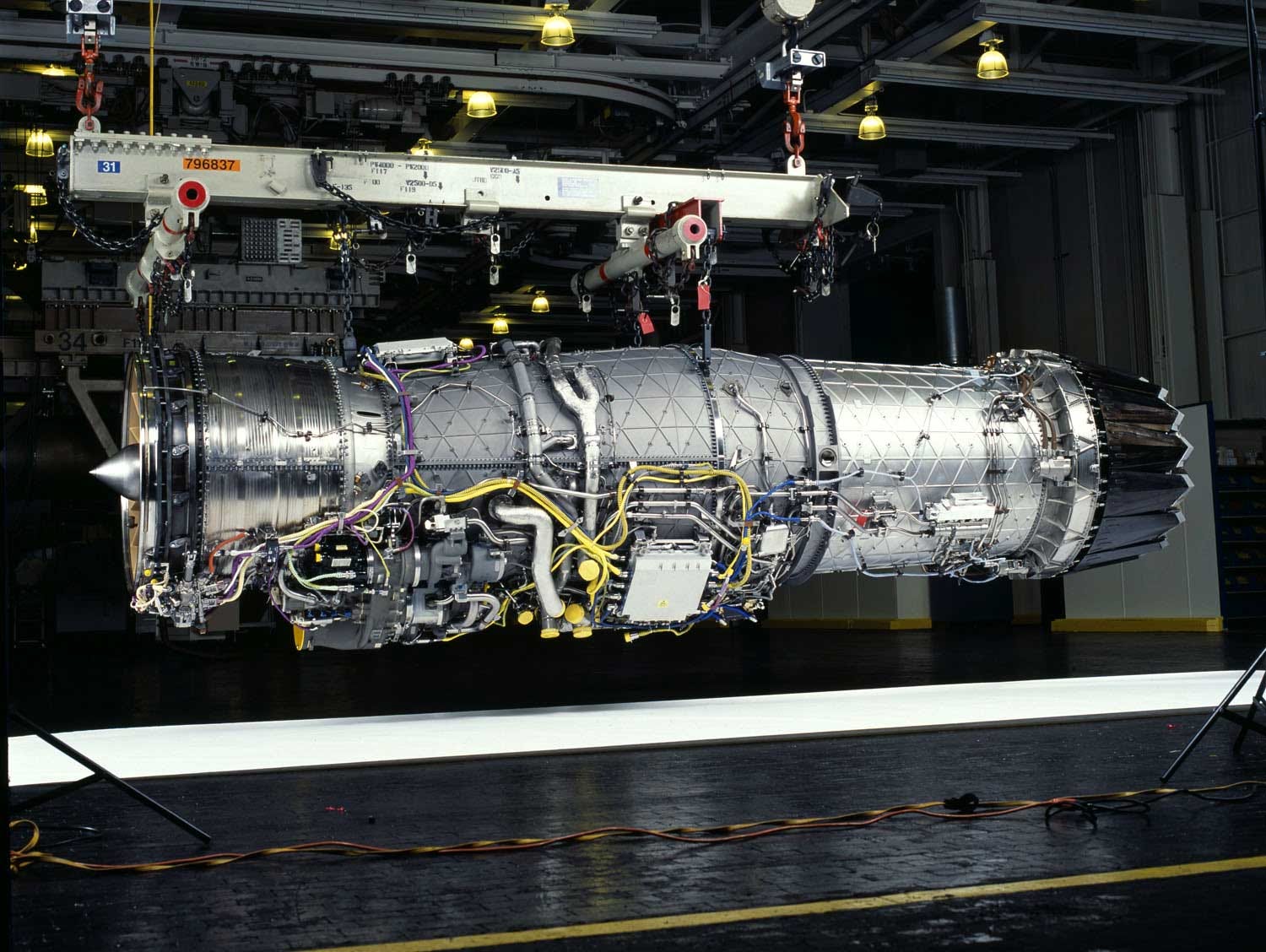
Pratt & Whitney: Propulsion at the Core
The GTF (geared turbofan) family is the centerpiece of Pratt’s commercial business. It powers the A320neo family, the A220, and the Embraer E2 series.
The GTF Advantage, certified by the FAA in February 2025 and validated by EASA in October 2025 and then again for A320neo family application on April 17, 2026, is the upgraded standard that will carry the product line into the 2030s.
On the military side, the F135 engine powers every F-35 delivered to date.
The F135 Engine Core Upgrade (ECU) is the propulsion modernization path that enables the Block 4 capability suite for the F-35, and Pratt received a $1.3 billion contract to mature that upgrade in late 2024. The ECU remains the lowest-risk, most cost-effective propulsion refresh for the F-35 fleet.
Pratt also powers legacy fleets including the F-22 Raptor (F119), C-17 (F117), and many KC-46 tankers (via the PW4062). A significant aftermarket business wraps around those fleets.
PRATT & WHITNEY KEY PROGRAMS (2026)
-----------------------------------
Commercial:
  GTF / GTF Advantage (A320neo, A220, Embraer E2)
  V2500 (A320 classic) - aftermarket
  PW800 (Gulfstream G500/G600/G700, Dassault Falcon)
Military:
  F135 (F-35) - production lots 18-19 at $6.6B
  F119 (F-22 Raptor)
  F117 (C-17)
  PW4062 (KC-46 tanker)
Next-gen:
  XA103 adaptive engine concept for F-47 NGAD
Hybrid-electric research with Clean Aviation Joint UndertakingCollins Aerospace: The Systems Integrator
Collins is sometimes the least visible of the three segments because its systems are inside other airframers’ aircraft, but its content per aircraft on narrowbody, widebody, and regional jets is among the highest in the industry.
The avionics portfolio includes the Pro Line Fusion integrated flight deck, the F-35 Gen III Helmet Mounted Display System, head-up displays, and a portfolio of communication, navigation, and surveillance electronics. The interiors business offers seats, galley, lavatory, oxygen, cabin lighting, and connectivity.
Mission systems is the military-leaning part of Collins and covers network electronic warfare, electronic surveillance, and secure communication. Connected aviation and the cabin ARINC services form a high-recurring-revenue ecosystem that airlines struggle to displace once adopted.
Collins also anchors RTX’s sustainability work, participating in the European Union’s Clean Aviation SWITCH and HECATE projects, including achievements around Technology Readiness Level 5 for high-voltage electric power systems.
Raytheon: Effectors, Sensors, and Integrated Defenses
Raytheon’s portfolio splits roughly into four buckets: air-and-missile-defense systems, precision weapons, radars and sensors, and advanced electronics.
Air-and-missile-defense anchors include the Patriot weapon system (now in its 16th international customer footprint after the Netherlands deal), the LTAMDS (Lower Tier Air and Missile Defense Sensor) radar replacing legacy Patriot radar, the NASAMS medium-range system, SM-3 and SM-6 Standard Missiles, and the Coyote counter-UAS effector that has been combat-proven against drone swarms.
Precision weapons include Tomahawk, AMRAAM, AIM-9X Sidewinder, StormBreaker, Javelin (with Lockheed Martin), and Stinger.
The hypersonic and strategic missile side includes the Navy’s new hypersonic missile for which Raytheon is prime, and Raytheon’s role supporting the AGM-181 LRSO next-generation nuclear cruise missile program.
The LTAMDS Radar: A Single Program with Strategic Weight
LTAMDS is worth a dedicated subsection because it represents the next-generation air defense radar for the U.S. Army and a likely export product for allies. The U.S. Army awarded RTX a $904.6 million contract modification in April 2026 to continue LTAMDS production through 2030.
LTAMDS uses a 360-degree GaN (gallium nitride) active electronically scanned array architecture and is specifically designed to counter advanced threats like saturation cruise-missile attacks and hypersonic maneuvering vehicles. The move from prototyping into Low-Rate Initial Production is a meaningful signal that the program is stable and likely to expand.
Counter-UAS: Where Raytheon Gets the Most Operational Traction
Counter-UAS (counter-unmanned aerial systems) is one of the fastest-evolving segments of modern air defense because of the Ukraine war and Red Sea drone swarms.
Raytheon’s Coyote has seen heavy combat use, and production is ramping to meet exploding global demand. Expect counter-UAS to transition from niche to structural over 2026-2028.