


Executive Summary
Financial acceleration underway: For the first nine months of FY26 (April to December 2025), Ryanair recorded total revenue of €13.03 billion, up 12% year-on-year, and profit after tax of €2.57 billion, up 32%. Full-year FY26 guidance calls for approximately 208 million passengers and pre-exceptional profit after tax of €2.13 billion to €2.23 billion.
Fleet modernisation milestone reached: All 210 Boeing 737-8200 “Gamechanger” aircraft were delivered by the end of February 2026, completing a $22 billion investment. The next phase, 300 Boeing 737 MAX 10 aircraft worth over $40 billion at list price, is set to begin arriving in Spring 2027 following expected FAA certification in summer 2026.
Summer 2026 network is Ryanair’s largest ever: More than 106 new routes are on sale for Summer 2026, supported by three brand-new bases in Tirana (Albania), Rabat (Morocco), and Trapani (Sicily), alongside record schedules across Central and Eastern Europe.
Cost gap is widening, not narrowing: A BBB+ credit rating from both Fitch and S&P, a debt-light balance sheet, and a new fleet burning 16% less fuel per seat give Ryanair a structural cost advantage that most competitors cannot close in the near term.
Recommended - Read Full Reports


Read All Reports
Table of Contents
Executive Summary
Key Facts: Company Profile
Financial Performance Overview: From Volume Play to Yield Recovery
FY26 First Half: Profit Up 42%
Q3 FY26: Resilience Under Regulatory Pressure
Ryanair Route Network and Major Destinations: Strategic Analysis
The Secondary Airport Philosophy
Summer 2026 Network Expansion: The Biggest Schedule in Ryanair History
Tirana (Albania): A $400 Million Bet on the Balkans
Rabat (Morocco): Africa on the Network
Trapani-Marsala (Sicily): Italy’s 20th Ryanair Base
Kraków: Central Europe’s Largest Ryanair Base
Capacity Reallocation: Where Ryanair Is Pulling Back
Ryanair Fleet Strategy: A Two-Phase Modernisation Programme
Phase One Complete: The 737-8200 “Gamechanger” Programme
The Boeing 737 MAX 10: Ryanair’s Real Long-Term Growth Engine
Longest Nonstop Routes: What the MAX Enables
Fleet Management: The Retiring 737-800 Fleet
The Ryanair Group: Five-Brand Structure
Competitive Position: How Ryanair Defends Its Lead
The Unit Cost Gap: Wider Than at Any Point in a Decade
Competing Against easyJet and Wizz Air
Competing Against Legacy Carriers
The Balance Sheet as a Competitive Advantage
Ancillary Revenue: The 30% Revenue Engine
Distribution Strategy: The OTA Restructuring
ESG and Sustainability: The Fleet-Led Approach
Key Risks to Watch in 2026 and Beyond
Risk 1: European ATC Disruption
Risk 2: Airport Charges and Tax Policy
Risk 3: Boeing MAX 10 Certification and Delivery Delays
Risk 4: Italian AGCM Fine and European Regulatory Scrutiny
Risk 5: Macroeconomic Slowdown and Fare Sensitivity
Risk 6: Geopolitical Events and Fuel Price Volatility
The Road to 300 Million Passengers: FY27 and Beyond
My Final Thoughts
Primary Sources and Official Data
Also Read
Key Facts: Company Profile
RYANAIR HOLDINGS PLC - COMPANY PROFILE (AS OF APRIL 2, 2026)
================================================================
Founded:             1984 (Waterford, Ireland)
Headquarters:        Dublin, Ireland
CEO:                 Michael O'Leary (Group CEO)
Group Brands:        Ryanair DAC | Ryanair UK | Buzz | Malta Air | Lauda Europe
Employees:           ~22,000+
Stock Listing:       Euronext Dublin (RYA) | Nasdaq (RYAAY) | LSE (0RYA)
Credit Rating:       BBB+ (Fitch & S&P)
================================================================
FLEET (AS OF MARCH 3, 2026):   647 aircraft
  B737-800 (Next-Gen):         411 aircraft | 189 seats each
  B737-8200 "Gamechanger":     210 aircraft | 197 seats each
  Airbus A320 (Lauda):         26 aircraft  | 180 seats each
  Boeing 737-700 (Buzz):       1 aircraft
  Business Jets:               3x Bombardier Challenger 3500 + 1x Learjet 45
On Order:
  Boeing 737 MAX 10:           300 aircraft | 228 seats | Delivery: 2027-2034
================================================================
SUBSIDIARIES (Aircraft by AOC, Dec 31, 2025):
  Ryanair DAC:        348 aircraft
  Malta Air:          179 aircraft
  Buzz (Poland):      78 aircraft
  Lauda Europe:       26 aircraft
  Ryanair UK:         15 aircraft
  Total Fleet:        646 aircraft (646 at Dec 31, 2025)
================================================================
NETWORK (Summer 2026):
  Destinations:       235+ across 40+ countries
  Total Routes:       2,600+
  New S26 Routes:     106+
  New S26 Bases:      Tirana | Rabat | Trapani
================================================================
FINANCIAL HIGHLIGHTS:
  FY25 Passengers:    200.2 million (first European airline to cross 200M)
  FY25 Revenue:       €13,949 million
  FY25 Net Profit:    €1,612 million
  FY26 Guidance PAT:  €2.13 billion - €2.23 billion (pre-exceptional)
  FY26 Pax Guidance:  ~208 million
================================================================
ESG RATINGS (FY25):
  MSCI:               A
  CDP:                A-
  Sustainalytics:     No. 1 Global Large-Cap Airline
================================================================
Financial Performance Overview: From Volume Play to Yield Recovery
Ryanair’s FY25 (the year ended March 31, 2025) was defined by a deliberate strategic trade-off. Management chose to cut average fares from approximately €50 in FY24 to €46 in FY25, absorbing a 7% fare decline to stimulate volume and capture market share that opened up when competitors retrenched.
The result was 200.2 million passengers in FY25, making Ryanair the first European airline in history to cross the 200 million passenger threshold in a single fiscal year.
Total revenue for FY25 came in at €13,949 million, a 4% increase year-on-year, while profit after tax settled at €1,612 million, down 16% from the prior year as a direct consequence of the deliberate fare reduction.
That trade-off has since paid off clearly. FY26 has brought a sharp fare recovery alongside volume growth.
FY26 First Half: Profit Up 42%
H1 FY26 results (the six months to September 30, 2025) showed profit after tax rising 42% to €2.54 billion. Traffic grew 3% to a record 119 million passengers for the half, while average fares jumped 13% to €58.
Total H1 FY26 revenue rose 13% to €9.82 billion. Scheduled revenue climbed 16% to €6.91 billion, and operating costs grew at a much more modest 4%, or just 1% per passenger, demonstrating continued cost discipline as the fleet modernises.
An interim dividend of €0.193 per share was declared and was paid in February 2026, reflecting Ryanair’s policy to return 25% of annual after-tax profit to shareholders via dividends, alongside ongoing share buybacks.
The group had by FY25 already purchased and cancelled 7% of its issued share capital.
Q3 FY26: Resilience Under Regulatory Pressure
For Q3 FY26 (the quarter ended December 31, 2025), Ryanair reported revenue of €3.21 billion, up 9%, with 47.5 million passengers carried, a 6% increase. Average fares for the quarter rose 4% to €44.
Pre-exceptional profit after tax was €115 million. However, the headline PAT came in at just €30 million after Ryanair took an €85 million exceptional charge related to an Italian competition authority fine, which the airline has pledged to appeal (discussed further in the Risks section).
RYANAIR NINE-MONTH FY26 PERFORMANCE SNAPSHOT (April - December 2025)
=====================================================================
Metric                   Nine-Month FY26     Change YoY
=====================================================================
Total Revenue:           €13.03 billion      +12%
Scheduled Revenue:       ~€9.2 billion       +15%
Ancillary Revenue:       ~€3.8 billion       +6%
Profit After Tax:        €2.57 billion       +32%
Passengers Carried:      ~183 million        +5%
=====================================================================
FY26 FULL-YEAR GUIDANCE:
  Passengers:            ~208 million        (+4% vs FY25)
  Average Fare Growth:   +8% to +9% vs FY25
  PAT (pre-exceptional): €2.13bn to €2.23bn
=====================================================================
Source: Ryanair Q3 FY26 Results | investor.ryanair.comRyanair Route Network and Major Destinations: Strategic Analysis
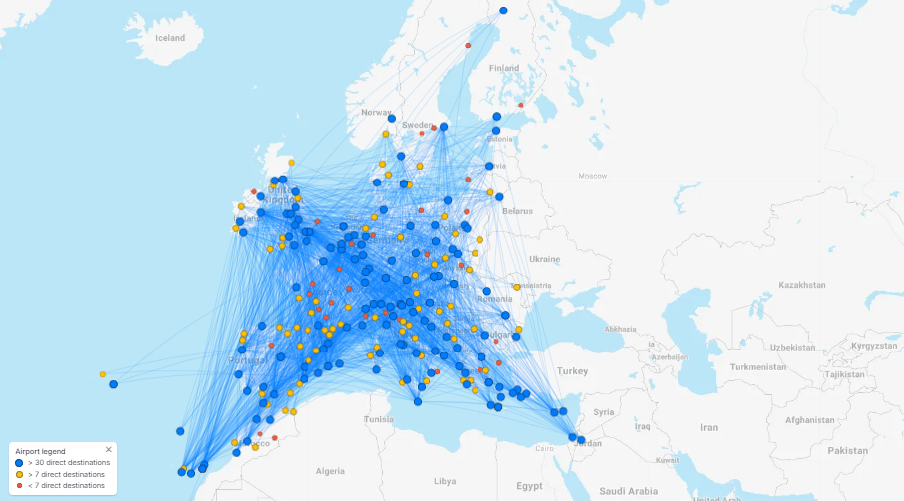
Ryanair operates more than 2,600 routes connecting 235+ destinations across 40+ countries. That breadth of coverage is not simply a function of scale; it’s a direct output of a deliberate network architecture that has been refined over four decades.
The core logic is straightforward. Rather than chasing frequency on the most congested trunk routes, Ryanair has built its network on high-density, point-to-point connections between secondary airports, leisure gateways, and emerging city-break markets.
The Secondary Airport Philosophy
One of Ryanair’s most enduring strategic advantages is its secondary airport model.
Instead of competing at premium primary hubs such as Frankfurt Main, London Heathrow, or Paris Charles de Gaulle, the airline has built its network around lower-cost alternatives: London Stansted, Frankfurt Hahn, Paris Beauvais, Bergamo, Kraków, and dozens more.
These secondary airports charge fees estimated at roughly 50% below those at major hubs. Ryanair uses the volume of passengers it delivers as leverage: airports get meaningful traffic growth, and Ryanair gets very low landing fees, subsidised handling costs, and sometimes airport-funded marketing support.
This model is not passive. When an airport raises charges beyond what Ryanair views as competitive, the airline pulls capacity and does so publicly and quickly.
In winter 2025-26, Ryanair cut capacity from Austria, Germany, and regional Spain while simultaneously adding aircraft in Albania, Morocco, Slovakia, and Sweden, where cost structures remained favourable.
The secondary airport model is thus both a cost lever and a negotiating weapon.
Summer 2026 Network Expansion: The Biggest Schedule in Ryanair History
For Summer 2026, Ryanair has placed more than 106 new routes on sale and opened three new bases in Tirana, Rabat, and Trapani. The total summer schedule of over 2,600 daily flights is the largest the group has ever operated.
The expansion is strategically concentrated. Eastern Europe, the Western Balkans, North Africa, and Central Europe are the clear growth corridors.
Italy remains a major destination and capacity market, with Ryanair reinforcing its position as Italy’s largest carrier from Turin to Trapani.
Tirana (Albania): A $400 Million Bet on the Balkans
Albania’s capital has become one of the most compelling growth stories in European aviation in 2026. Ryanair has based a fourth Boeing 737 at Tirana International Airport Nene Tereza, representing a total investment of $400 million, and is operating 43 routes for Summer 2026, including 20 new connections to destinations such as Alghero, Baden-Baden, Eindhoven, Genoa, Memmingen, Parma, and Wroclaw.
Traffic to Tirana is expected to reach 4 million passengers in 2026, a 50% increase. Ryanair’s CEO Michael O’Leary has directly attributed this investment to Albania’s zero aviation tax policy and Tirana Airport’s competitive growth incentive scheme.
Beyond the summer season, Ryanair has committed to growing Tirana to up to six based aircraft and a $600 million total investment by 2030, targeting over 6 million passengers and 60 routes per year, provided that the favourable tax environment is maintained.
This is one of the clearest illustrations of Ryanair’s “government tax policy drives investment” doctrine in action.
Rabat (Morocco): Africa on the Network
For the first time, Ryanair has opened a dedicated base on African soil, with two Boeing 737s based at Rabat-Salé Airport from April 2026.
The Rabat base supports 20 routes connecting Morocco’s historic capital to multiple major European cities, making Ryanair a meaningful carrier in the North Africa-to-Europe leisure and diaspora traffic segment.
This move also reinforces a broader North Africa push. Ryanair has been expanding from Nuremberg to Rabat for Summer 2026, illustrating how the network connects secondary European cities with emerging African destinations, not just hubs to hubs.
The strategic rationale is clear: Morocco’s growing middle class, its diaspora communities in France, Spain, Italy, and the Netherlands, and the country’s expanding tourism sector represent a high-growth demand pool that Ryanair is well placed to serve at ultra-low fares.
Trapani-Marsala (Sicily): Italy’s 20th Ryanair Base
Ryanair’s reopening of its Trapani base from January 2026 is a direct consequence of the Sicilian Regional Government’s decision to abolish the municipal tax at smaller Sicilian airports.
The Summer 2026 schedule delivers two based aircraft (a $200 million investment), 24 routes, including six brand-new connections to Stockholm, Bournemouth, Bari, Lublin, Saarbrücken, and Verona, and 1.2 million passengers per year, a 35% increase from the prior period.
This marks Trapani as Ryanair’s 20th base in Italy and its third in Sicily. The airline has simultaneously called on the Sicilian Government to extend the same tax removal to larger airports, including Palermo and Catania, where the municipal tax continues to restrict growth.
Kraków: Central Europe’s Largest Ryanair Base
Kraków in Poland has emerged as Ryanair’s largest single base in Central Europe.
For Summer 2026, Ryanair added three further Boeing 737s, bringing the total to 15 based aircraft representing a $1.5 billion cumulative investment. Four new routes connect Kraków to Amman, Bucharest, Budapest, and Sofia, supporting 13% traffic growth and more than 6,000 local jobs.
Kraków also hosts some of Ryanair’s longest nonstop sectors enabled by the 737 MAX. The Kraków to Tenerife South route spans approximately 2,437 miles, making it the longest nonstop city pair in Ryanair’s current network.
This range capability, previously impossible with the older 737-800, is a direct product of the MAX’s improved fuel efficiency and extended range.
Capacity Reallocation: Where Ryanair Is Pulling Back
Not every market has benefited from Ryanair’s Summer 2026 capacity surge. The airline has cut approximately 1.2 million seats from regional Spanish airports and closed its operation at Asturias entirely, citing what it describes as uncompetitive fee increases by airport operator Aena.
Similar pullbacks have been applied in Austria, Belgium, and Germany. Ryanair specifically points to higher aviation taxes, ATC inefficiency, and rising airport charges in those markets as the drivers of capacity withdrawal.
The airline has been direct that capital and aircraft follow government policy, not geography alone.
SUMMER 2026 NETWORK: KEY CAPACITY HIGHLIGHTS
=====================================================================
Market/Base           Aircraft    Routes   Passengers p.a.  Change
=====================================================================
Tirana, Albania       4           43       4.0 million      +50%
Bratislava, Slovakia  -           33       -                +70% capacity
Kraków, Poland        15          (incl.   -                +13%
                                  4 new)
Budapest, Hungary     11          67       6.5 million seats -
Croatia (total)       9           118      4.3 million seats +5%
Turin, Italy          3           32       3.3 million      +21%
Trapani, Italy        2           24       1.2 million      +35%
Rabat, Morocco        2           20       New base          -
Sweden (total)        -           83       4.4 million       -
Gdańsk, Poland        -           43       -                Record
Regional Spain        -           -        -1.2 million     -10%
=====================================================================
Source: Ryanair Corporate Press Releases | corporate.ryanair.com