


Executive Summary
Saab closed 2025 with SEK 79.1 billion in sales and 25.6% organic growth, while order bookings exploded 74% to a record SEK 168.5 billion, lifting backlog to SEK 275 billion.
The Gripen E/F program won landmark export contracts in Colombia (17 aircraft) and Thailand, and the GlobalEye platform was selected by France and provisionally by NATO to replace the alliance’s E-3A Sentry fleet.
Capital expenditure tripled to roughly SEK 7.2 billion in 2025, and headcount grew by 10,000 to about 28,000 employees, supporting a Gripen production ramp targeting up to 30 aircraft per year.
Q1 2026 confirmed the trend with 23.6% organic growth, a 32% rise in EBIT, and an order backlog reaching SEK 274 billion, while management raised its medium-term sales CAGR target from 18% to 22%.
Recommended - Read Full Reports


Read All Reports
Table of Contents
Executive Summary
Introduction
Key Facts: Saab Company Profile
Saab AB Company Overview
Origins and the Modern Operating Model
Strategic Posture Under Micael Johansson
Geographic Footprint Expansion
Key Product Lines, Programs and Services
Aeronautics
Gripen E/F: The Center of the Strategic Story
Recent Commercial Wins on Gripen
T-7A Red Hawk Workshare With Boeing
GlobalEye
Dynamics
Carl-Gustaf and AT4
NLAW
RBS 70 NG and Nimbrix
Surveillance
Giraffe Radar Family
Erieye Family
Naval (Saab Kockums)
A26 Blekinge-Class Submarine
Surface Combatants and Visby
Combitech
Financial Analysis: Saab
2025 Full-Year Results
Q1 2026 Continuation
Capital Deployment
Long-Term Financial Targets
Cash Flow Profile
Saab Revenue and Growth Drivers
Backlog Coverage and Visibility
Geographic Demand Mix
Aftermarket and Through-Life Support
Latest Twelve Months Snapshot
Major Competitors: Saab
Saab vs. Lockheed Martin
Saab vs. Dassault Aviation
Saab vs. BAE Systems
Saab vs. Boeing
Saab vs. Thales
Saab vs. TKMS and Naval Group
Saab Competitive Analysis and Moat
Sovereignty as a Selling Proposition
The Erieye Radar Lineage
Submarine Continuity
The Gripen Operating Cost Advantage
Risk to the Moat: Scale
Strategic Industry Context
European Defense Industrial Awakening
Sovereignty After the Transatlantic Reset
The Counter-UAS Imperative
Air-Independent Propulsion Submarine Demand
Open Architecture and Software
Financial and Commercial Implications
Margin Trajectory
Capital Structure
Working Capital and Inventory
Foreign Exchange
Aftermarket Economics
Industrial Capacity Bottlenecks
Key Risks and Probabilities
Execution Risk on Capacity Ramp
A26 Submarine Delivery Risk
Geopolitical Reversal
Concentration Risk in Gripen Customer Base
Foreign Exchange Volatility
Cybersecurity and Industrial Espionage
Supply Chain Disruption
Boeing T-7A Schedule Slip
ESG and Banking Access
Industrial Footprint and Workforce
Sweden as Operational Heartland
United States Expansion
United Kingdom Production
Brazil
Innovation and R&D Posture
Doubling R&D
Autonomous and AI Systems
Open Architecture Software
Sustainability Engineering
Saab AB SWOT Analysis
Outlook for 2026 and Beyond
Near-Term 2026 Trajectory
2027 to 2028 Inflection
NATO GlobalEye Conversion Risk
Long-Term Platform Successor Question
Submarine Roadmap Beyond A26
My Final Thoughts
Official Sources and Data
Introduction
The Swedish defense manufacturer, Saab, which began life building wooden trainer aircraft in 1937, has spent the past two years transforming into one of the most consequential aerospace and defense suppliers in the Western alliance.
The combination of a renewed Russian threat to NATO’s eastern flank, a fragile European trust in transatlantic defense procurement, and a portfolio of mature, exportable platforms has placed Saab in a position few small-nation primes have ever occupied.
For aerospace and defense stakeholders in the European supply chains, sovereign capability buildouts, or the future of multinational fighter and surveillance programs, the Saab story in 2026 deserves close, careful examination.
The numbers are unusual, the geopolitics are unusual, and the operational tempo at Linköping, Karlskoga, Järfälla, and Karlskrona is unlike anything the company has experienced since the height of the Cold War.
This report breaks down the company’s full operating picture, products, finances, competitive position, and risks for stakeholders.
Key Facts: Saab Company Profile
COMPANY:           Saab AB (publ)
HEADQUARTERS:      Stockholm, Sweden
PRINCIPAL SITES:   Linköping, Karlskoga, Järfälla, Karlskrona, Gothenburg
                   West Lafayette (Indiana, USA), Fareham (UK)
LISTED:            Nasdaq Stockholm, ticker SAAB B
CEO & PRESIDENT:   Micael Johansson
CFO:               Anna Wijkander
EMPLOYEES (FY25):  ~28,000
SALES (FY25):      SEK 79.1 billion
ORDER BACKLOG:     SEK 275 billion (year-end 2025)
                   SEK 274 billion (Q1 2026)
BUSINESS AREAS:    Aeronautics, Dynamics, Surveillance, Naval
                   plus Combitech (independent technical consultancy)
FOUNDED:           1937
LARGEST OWNER: Investor ABThe total share count stands at 543,383,388 shares, divided into A and B classes, with the A shares held privately by Investor AB.
This ownership structure has provided Sweden’s flagship defense prime with an unusually long planning horizon, a feature increasingly relevant as program lifecycles push past three decades.
Saab AB Company Overview
Origins and the Modern Operating Model
Saab was founded in 1937 to build aircraft for the Swedish Air Force during a period of European rearmament that bears uncomfortable similarities to the present.
The company rebuilt itself in the 1990s around the JAS 39 Gripen multirole fighter and a portfolio of land and naval systems acquired through the consolidation of Sweden’s defense industry, including the absorption of Bofors weapons and Kockums shipyard.
Today, the group operates as a four-business-area defense and security prime with one independent technical consultancy. The four areas are Aeronautics, Dynamics, Surveillance, and Naval, with Combitech operating separately as a Nordic engineering services firm.
The portfolio runs across the kill chain.
Saab supplies sensors, command-and-control systems, weapon effects, manned platforms (fighters, surveillance aircraft, submarines), and the training and support infrastructure that connects them.
That breadth is unusual at Saab’s revenue scale and creates an integrated systems-of-systems offer that customers buying from larger primes often have to assemble across multiple suppliers.
Strategic Posture Under Micael Johansson
CEO Micael Johansson took over in 2019 and has steered Saab through the most consequential strategic shift in its modern history. Under his leadership, the company has expanded its industrial footprint outside Sweden, deepened its partnership with Boeing on the T-7A Red Hawk, and aggressively pursued sovereign capability deals in Europe and Latin America.
Johansson’s public framing in the Q4 2025 earnings call has been consistent: customers want capability now, sovereignty in production, and life-of-platform partnership rather than transactional sales. Saab’s offer has been calibrated against those preferences for the past two years.
Anna Wijkander, the CFO appointed in 2024, has used the recent reporting cycles to push a clearer narrative around capital deployment. R&D is doubling and capex is tripling, but cash generation has remained healthy because of large advance payments tied to the new export deals.
Geographic Footprint Expansion
Saab’s home base remains Sweden, where the Linköping site builds Gripen and contributes to GlobalEye, and Karlskoga produces ground-combat weapons.
Karlskrona is home to Saab Kockums, the submarine and surface combatant yard. Järfälla houses Surveillance, including radar, electronic warfare and combat systems engineering.
International expansion has accelerated, too.
The West Lafayette, Indiana, facility has scaled production of the T-7A aft fuselage, the United Kingdom hosts Saab UK’s Giraffe 1X radar production line, and the company has built local industrial relationships in Brazil tied to the Gripen E/F program.
The geographic spread serves two purposes. It places Saab inside customer industrial strategies, and it provides currency and supply-chain hedging against Swedish krona volatility and Nordic component bottlenecks.
Key Product Lines, Programs and Services
Saab’s product portfolio is organized around four business areas, each with distinct customer bases, margin profiles and program durations.
For aerospace and defense stakeholders, understanding the differences between them is essential because strategic and capital decisions are made at the business-area level.
Aeronautics
Aeronautics is the largest single business area by program visibility.
It is the home of Gripen, the T-7A workshare with Boeing, and a remote tower air-traffic-control adjacency that has carved out steady civilian aviation revenue.
Gripen E/F: The Center of the Strategic Story
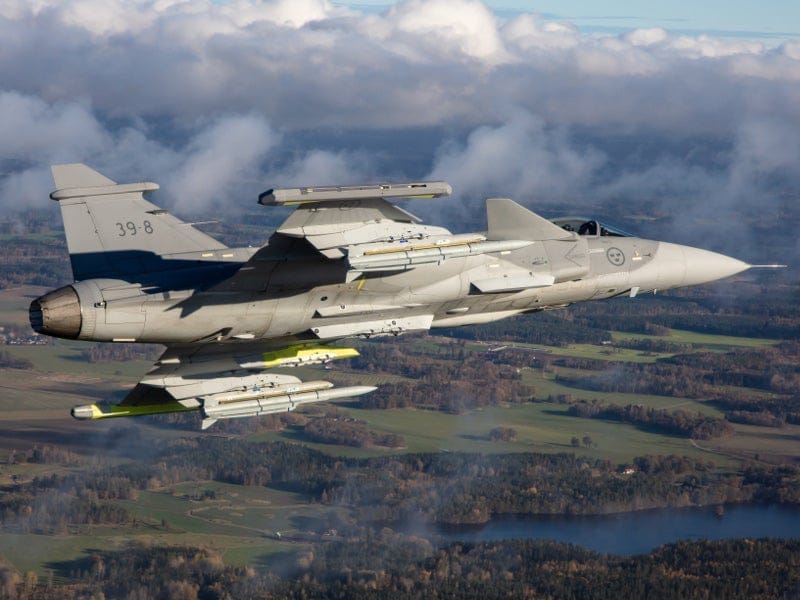
The Gripen E/F is a single-engine multirole combat aircraft with a GE F414G engine, ten hardpoints, an active electronically scanned array radar from Selex ES, an infrared search-and-track sensor, and integration with the MBDA Meteor beyond-visual-range air-to-air missile.
GRIPEN E HEADLINE FEATURES
- Engine: GE F414G with supercruise capability
- Sensors: AESA radar, IRST, EW suite with 360° spherical coverage
- Hardpoints: 10
- Primary BVRAAM: Meteor (up to 7 carried)
- Operating cost: estimated ~USD 36,200 per flight hour (industry analysis)
- Customer base: Sweden, Brazil, Hungary, Czech Republic,
                 Thailand, South Africa, UK (test), Colombia
Several characteristics make the platform commercially relevant in 2026.
First, the Meteor pairing provides one of the largest no-escape zones in the air-to-air domain among in-service Western missiles.
Second, the operating cost is materially lower than F-35 or Rafale on a per-flight-hour basis. Defense analysts comparing the platforms have placed Gripen E/F operating costs at roughly 25% to 30% below the F-35 at 200 flying hours per year.
Third, the export model is unusual. Saab has confirmed that customers receive the same capability set as the Swedish primary operator, which is not always the case with American or French exports that often arrive with degraded sensors or restricted munitions options.
Recent Commercial Wins on Gripen
Colombia signed a EUR 3.1 billion contract for 17 Gripen E/F aircraft, with deliveries between 2026 and 2032. Thailand placed an SEK 5.3 billion order for four Gripen E/F as part of a planned 12-aircraft fleet renewal, with deliveries from 2025 to 2030.
Sweden itself placed a USD 270 million order in late 2025 to fund Gripen system development through 2028, securing the upgrade path for current operators.
In Q1 2026, the company outlined a Gripen production ramp targeting up to 30 aircraft per year, depending on order pipeline conversion. Canada remains in active discussion under a dual-fleet pitch alongside the F-35 procurement, and Saab has provided detailed information to Ottawa.
T-7A Red Hawk Workshare With Boeing
The T-7A advanced trainer for the United States Air Force is co-developed with Boeing under an industrial split where Saab builds the aft fuselage and Boeing assembles the aircraft in St. Louis. Saab’s West Lafayette facility in Indiana opened in 2021 and has scaled steadily.

The program has experienced delays at the Boeing assembly end, with the United States Air Force pushing initial operational capability to 2027.
For Saab, the immediate financial exposure is bounded because it is a workshare partner rather than a prime, but the long-term opportunity is substantial given an installed pilot training fleet that the United States Air Force is committed to replacing.
In November 2024 Saab received a USD 101.7 million order from Boeing for production-representative aft fuselages, signaling the program’s transition out of the engineering and manufacturing development phase into low-rate initial production.
GlobalEye
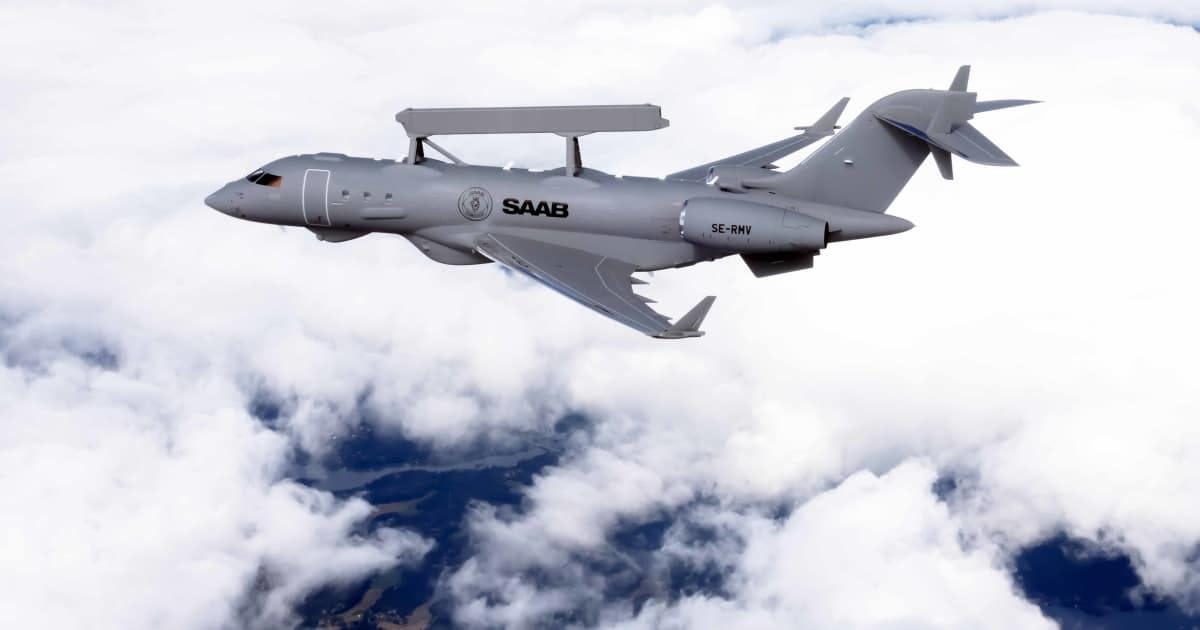
GlobalEye is technically a Surveillance product from a business-area perspective, but the airframe integration ties it to Aeronautics-style program management. It is a multirole airborne early warning and control platform built on the Bombardier Global 6000/6500 business jet, fitted with the Erieye Extended Range radar.
The system provides an operational endurance exceeding 12 hours and a detection range above 550 kilometers, which is competitive with any AEW&C platform currently in service. It has been ordered by the United Arab Emirates, Sweden, France, and now likely NATO.
In December 2025, France finalized a SEK 12.3 billion contract for two GlobalEye aircraft, with deliveries between 2029 and 2032. This was a sovereignty-driven decision after France ruled out the Boeing E-7 Wedgetail.
In April 2026, the NATO Support and Procurement Agency selected GlobalEye, jointly produced with Bombardier, to replace 14 E-3A Sentry aircraft at Geilenkirchen.
The deal is reported at roughly EUR 5 billion and represents the most significant European AEW&C commitment in two decades.
Dynamics
Dynamics produces ground-combat weapon effects, including the Carl-Gustaf recoilless rifle family, the AT4 single-shot anti-armor weapon, the NLAW guided anti-tank system co-developed with Thales UK, and the RBS 70 NG ground-based air defense system.
Dynamics also covers anti-ship missiles such as the RBS 15 and underwater systems including torpedoes.
Carl-Gustaf and AT4
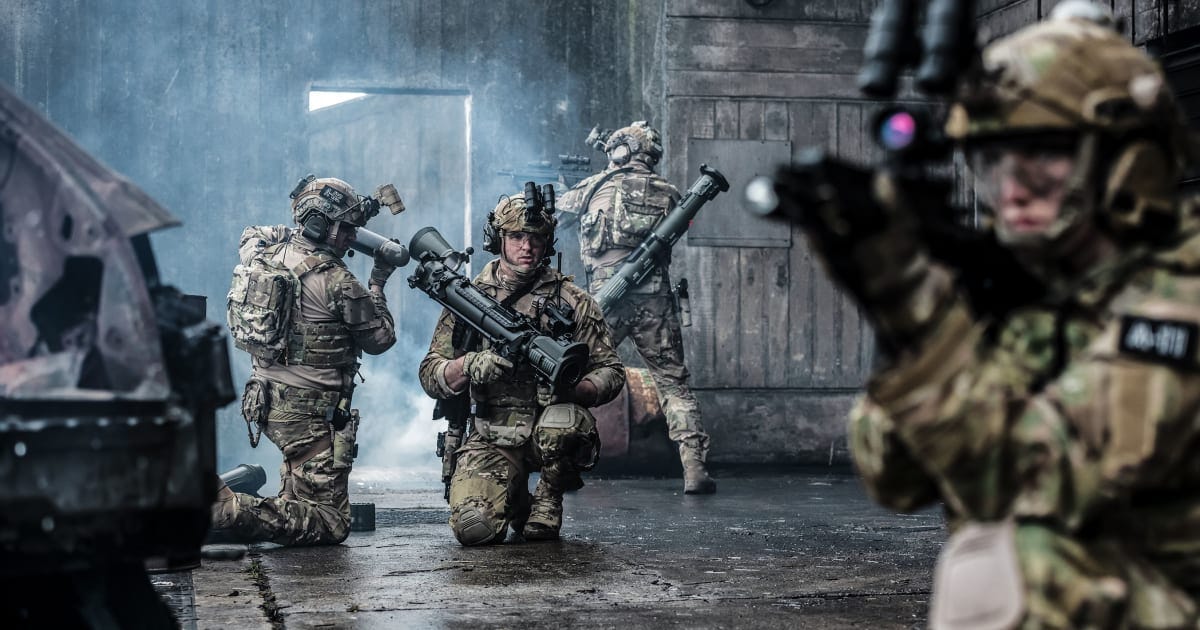
The Carl-Gustaf M4 is the latest evolution of a weapon family that first entered service in 1948. It is in use with more than 40 armed forces and has been used extensively in Ukraine since 2022.
CARL-GUSTAF M4 KEY DATA
- Caliber: 84mm
- Weight: under 7 kg (M4 variant)
- Reusable launcher with broad ammunition family
- Customers: 40+ countries
- Modes: anti-armor, anti-fortification, illumination, smoke
Lithuania ordered a combined SEK 1.3 billion package of AT4 weapons and Carl-Gustaf ammunition in December 2025. Denmark placed a SEK 510 million Carl-Gustaf order with deliveries between 2026 and 2028.
These weapons systems are not glamorous, but they are extremely high-cadence revenue generators with strong margins. The munitions consumption in Ukraine, combined with NATO-wide stockpile rebuilding, has driven Dynamics to multi-year capacity expansion.
NLAW
NLAW, the Next-Generation Light Anti-Tank Weapon, has been one of the defining infantry anti-armor weapons of the Russia-Ukraine conflict. The system is a fire-and-forget overhead-attack weapon designed to defeat modern main battle tanks at short ranges in urban terrain.
Saab has been steadily expanding NLAW production with United Kingdom co-production through Thales UK and additional capacity expansions in Sweden.
The system is a centerpiece of the Saab urban combat doctrine narrative, where short engagement distances and overhead-attack profiles are operational realities.
RBS 70 NG and Nimbrix
The RBS 70 NG ground-based air defense system uses a laser-beam-riding missile, making it resistant to electronic countermeasures. Sweden placed a multi-year RBS 70 order in 2025 to support both the Army and the future Amphibious Battalion 2030.
Saab unveiled Nimbrix at DSEI 2025, a counter-UAS missile under one meter in length with a five-kilometer range, designed to defeat low-altitude drone swarms cost-effectively.
The C-UAS market is one of the fastest-growing segments in Western defense, and Nimbrix is Saab’s first dedicated entry. The product has been engineered for cost-per-shot economics rather than maximum kinematic performance.
Surveillance
Surveillance covers Saab’s radar, electronic warfare, signals intelligence, and combat-management-system portfolio.
It is the most technology-intensive business area and the one most exposed to evolving software-driven warfare.
Giraffe Radar Family
The Giraffe radar family ranges from the lightweight Giraffe 1X for forward area air defense to the larger Giraffe 4A for theater air surveillance and the Giraffe 8A for long-range air defense.
The United States Army awarded Saab a USD 46 million Giraffe 1X contract in October 2025 to support security cooperation partners, with deliveries from 2026. A Latin American customer placed a SEK 550 million Giraffe 4A order the same year.
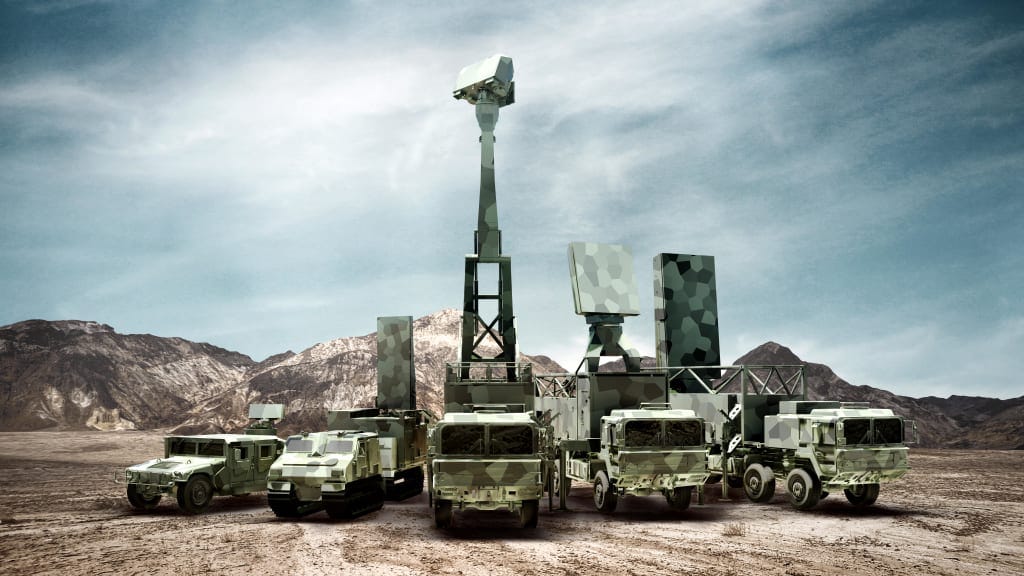
The Saab UK production line in Fareham doubled capacity in early 2025, reflecting the broader Saab strategy of placing production where customers demand sovereign content.
Erieye Family
The Erieye AESA radar family is the airborne complement to the Giraffe ground radar lineage. The legacy Erieye is fitted to Saab 340 and Saab 2000 platforms still in service worldwide, while Erieye ER is the radar payload of GlobalEye.
The radar’s competitive advantage is detection range against low-observable and small-cross-section targets, including modern cruise missiles and unmanned aerial systems. The combination of the radar with the Bombardier Global 6500 airframe is what made GlobalEye attractive to NATO over the Boeing E-7 Wedgetail in the recent procurement.
Naval (Saab Kockums)
Saab Kockums is the underwater specialist of the group, headquartered in Karlskrona and Malmö. It is the only Western yard with continuous experience designing and building diesel-electric and Stirling-cycle air-independent propulsion submarines.
A26 Blekinge-Class Submarine
The A26 is positioned as the first 5th-generation submarine, with extended air-independent propulsion endurance, a Multi-Mission Portal that allows special-forces deployment and unmanned underwater vehicle launch, and an advanced acoustic-signature management system.
A26 BLEKINGE-CLASS HIGHLIGHTS
- Length: ~66 meters
- Displacement: ~1,930 tonnes (surfaced)
- AIP: Stirling-cycle, multi-week submerged endurance
- Multi-Mission Portal for special operations and UUV ops
- Two units under construction at Karlskrona for Sweden
- Selected by Poland in October 2025
The A26 program has had a difficult schedule history, but Saab has begun scaling Karlskrona infrastructure for serial production. Poland’s October 2025 selection of A26 under the Orka program is the first major export win for the platform and adds a multi-decade revenue stream tied to Polish naval modernization.
Surface Combatants and Visby
Saab Kockums also produces the Visby-class corvette, one of the more interesting low-observable surface combatant designs in service.
Sweden has a sustained Visby modernization program, and Kockums supports a wide range of mid-life upgrades for export navies.
Combitech
Combitech is an independent technical consultancy with around 2,000 employees in the Nordics and Latin America.
It supports defense and civilian critical infrastructure projects and serves as a talent pipeline for the wider group, while also providing diversified services revenue.
Financial Analysis: Saab
2025 Full-Year Results
The 2025 reporting cycle was the most consequential single year in modern Saab history. According to the year-end report, sales reached SEK 79.1 billion against SEK 63.8 billion in 2024, organic growth of 25.6% and reported growth of 24.1%.
SAAB FULL-YEAR 2025 (SEK)
- Sales:                  79.1 billion (+24.1% reported, +25.6% organic)
- Adjusted operating inc. +37% YoY growth
- EBIT margin:            9.8% (vs. 8.9% in 2024)
- Order bookings:         168.5 billion (+74% YoY)
- Order backlog:          275 billion (~3.5x annual sales)
- Q4 sales:               27.7 billion
- Q4 EBIT:                3.26 billion (+67%)
- Q4 EBIT margin:         11.8%
- Dividend:               SEK 2.40 per share (raised)
The order intake number is unusual at any scale of defense industry. SEK 168.5 billion of new orders against SEK 79.1 billion of revenue in the same year produces a book-to-bill ratio above 2.0x, which means Saab is converting demand to backlog faster than it is converting backlog to revenue.
The Q4 quarter alone produced SEK 100 billion of order bookings versus SEK 17.6 billion in Q4 2024, driven by the Colombia Gripen contract and the France GlobalEye order.
Q1 2026 Continuation
The first quarter of 2026 confirmed that the trajectory was not a 2025 one-off. Sales rose 21.4% reported and 23.6% organically to SEK 19.2 billion, EBIT increased 32%, the EBIT margin reached 10.0%, and the order backlog ticked up to SEK 274 billion despite high quarterly conversion.
SAAB Q1 2026 RESULTS (SEK)
- Sales:                  19.2 billion (+21.4% reported, +23.6% organic)
- EBIT growth:            +32% YoY
- EBIT margin:            10.0%
- Net income:             1.47 billion (vs. 1.27 billion Q1 2025)
- Order backlog:          274 billion
- All four BAs delivered double-digit organic growth
- Surveillance and Dynamics led growth
Net income rose 15% to SEK 1.47 billion, with all four business areas plus Combitech delivering double-digit organic growth, led by Surveillance and Dynamics.
Capital Deployment
Saab’s capital story matters as much as its income statement. Capital expenditure tripled to roughly SEK 7.2 billion in 2025, with management indicating further increases in the medium term. Research and development expense doubled over the same period.
This level of capital intensity is unusual for a defense prime of Saab’s size and reflects a deliberate decision to absorb upfront cost to position for the order pipeline that has now arrived. Headcount grew by roughly 10,000 to 28,000 employees during the period, the most aggressive recruitment phase in the company’s history.
Long-Term Financial Targets
In February 2026, Saab raised its medium-term financial targets meaningfully. The new revenue CAGR target for the 2023 to 2027 period is 22%, lifted from 18% previously.
EBIT growth is expected to outpace sales growth, with margin expansion as programs mature past the upfront capacity-investment phase.
Cash Flow Profile
Operational cash flow benefited materially from advance payments tied to the Colombia and France contracts, both of which are typical of European arms exports where customers fund production milestones rather than waiting for delivery.
The CFO’s framing in the Q4 transcript was clear: cash flow lumpiness will continue, but the multi-year direction is positive given the order book.
Saab Revenue and Growth Drivers
Backlog Coverage and Visibility
The SEK 275 billion order backlog at year-end 2025 provided approximately 3.5 years of coverage at the 2025 sales run-rate. By Q1 2026, that number had moved to SEK 274 billion despite the year’s first-quarter sales conversion, indicating ongoing robust order intake.
BACKLOG COVERAGE BY BUSINESS AREA (Year-End 2025)
- Aeronautics:    Multi-decade visibility (Gripen E/F + GlobalEye)
- Dynamics:       3-5 year visibility (NLAW, Carl-Gustaf, RBS 70)
- Surveillance:   3-4 year visibility (Giraffe, Erieye, EW)
- Naval:          Multi-decade (A26 Sweden + Poland)
Backlog visibility is uneven across business areas. Aeronautics has the longest tail, with Gripen E/F deliveries extending into the 2030s for current orders. Naval has similarly long tails. Dynamics has shorter cycles but very high replenishment cadence given consumable munitions.
Geographic Demand Mix
Saab’s revenue base used to be heavily skewed toward Sweden. As of 2025 it has rebalanced, with Europe ex-Sweden, the United States and emerging markets all growing as a share. Colombia, Thailand, Poland and the United Arab Emirates are now meaningful customers, alongside core NATO European buyers.
The European NATO defense spending pool grew approximately 20% in real terms in 2025, reaching roughly EUR 500 billion. For the first time, all NATO allies exceeded the 2% of GDP defense spending threshold. Saab has positioned itself as one of the principal beneficiaries of that uplift.
Aftermarket and Through-Life Support
A growing share of Saab revenue is recurring through-life support tied to platforms in service. Gripen support contracts, Giraffe radar maintenance, A26 fleet management, and Carl-Gustaf ammunition supply all generate predictable revenue streams that smooth the lumpiness of new-platform contracts.
This aftermarket layer is one of the structural margin levers identified by management. As the active fleet of Saab platforms grows globally, the aftermarket pool grows with it, generally at higher margin than first-of-class deliveries.
Latest Twelve Months Snapshot
On a trailing-twelve-month basis through Q1 2026, Saab generated approximately SEK 82.5 billion in revenue, with operating income tracking ahead of sales growth in line with the medium-term targets.
The combination of organic growth in the low to mid-twenties, plus margin expansion, plus a backlog roughly 3.3 to 3.5 times annual sales, defines the company’s current operating profile.
Major Competitors: Saab
The competitive landscape for Saab is fragmented across business areas. The company faces different competitor sets in fighters, AEW&C, ground combat weapons, radar, and submarines.
The principal competitors across the portfolio include:
Lockheed Martin (F-35 program)
Dassault Aviation (Rafale)
BAE Systems (Eurofighter Typhoon partner)
Boeing Defense, Space & Security (F-15EX, E-7 Wedgetail)
Northrop Grumman (radar and EW systems)
RTX (formerly Raytheon Technologies)
Leonardo (Italian aerospace and defense prime)
MBDA (European missile prime)
Rheinmetall (ground systems and ammunition)
General Dynamics
L3Harris Technologies
Thales Group (radar, EW, naval systems)
TKMS (ThyssenKrupp Marine Systems) (submarine competitor for A26)
Naval Group (French submarine competitor)
Hanwha Ocean (Korean submarine competitor)
Saab vs. Lockheed Martin
The Lockheed Martin competition is concentrated in the fighter market. Lockheed’s F-35 dominates Western fighter sales, and Saab does not compete head-on in the stealth fighter segment.
The competitive overlap is in the political layer, where customers must choose between F-35 sovereignty constraints and Gripen full transfer-of-technology terms. Hungary, Brazil, the Czech Republic, Thailand and Colombia all chose Gripen over alternatives partly for sovereignty reasons. Lockheed Martin’s scale and lifecycle ecosystem remain unmatched, but Saab’s offer is structurally different.
In radar, Lockheed Martin competes with Saab in mid-tier ground-based air surveillance through the AN/TPS-77 family, but Giraffe has gained share in NATO Europe.
Saab vs. Dassault Aviation
Dassault’s Rafale is the closest like-for-like Western competitor to Gripen E/F. Both are fourth-generation-plus single-platform multirole fighters from a small-nation prime. The Rafale is a twin-engine platform with a larger payload and longer range, while Gripen is single-engine with lower acquisition and operating cost.
The Indian, Egyptian, Qatari, Greek and Indonesian wins for Rafale during 2020-2024 demonstrated Dassault’s strong export momentum. Saab’s response has been to lean into life-cycle cost, sovereignty and technology transfer.
Saab vs. BAE Systems
BAE Systems is a Eurofighter Typhoon partner and a competitor in radar, electronic warfare and submarines.

BAE’s scale dwarfs Saab, but the two companies often partner on specific projects. The competitive friction is principally in fighter exports where Eurofighter and Gripen meet, such as the recent Colombia campaign that Gripen won.
In submarines, BAE’s nuclear-only focus means there is no real overlap with the conventional A26.
Saab vs. Boeing
Boeing is simultaneously a Saab partner on T-7A and a competitor on AEW&C. The recent NATO selection of Saab GlobalEye over Boeing E-7 was a clear competitive loss for Boeing in a category where Boeing had previously dominated.
In fighters, Boeing’s F-15EX and F/A-18 Super Hornet do not compete directly with Gripen. The training partnership remains unaffected by the AEW&C friction.
Saab vs. Thales
Thales is a major European radar and electronic warfare competitor and a partner on NLAW.

The two companies coexist in different parts of the European defense supply chain, with overlap principally in airborne and ground-based radar.
Saab vs. TKMS and Naval Group
In submarines, Saab Kockums faces TKMS (with the Type 212CD) and Naval Group (with the Scorpène and Barracuda) as principal export competitors.
The Polish Orka selection of A26 over TKMS and Naval Group offerings was a significant competitive marker, indicating that A26’s combination of multi-mission flexibility and Swedish industrial cooperation terms was decisive.