


Executive Summary
SAS Scandinavian Airlines has executed one of Europe’s most consequential airline turnarounds, emerging from Chapter 11 in August 2024 with a fresh capital structure anchored by Air France-KLM, Castlelake, Lind Invest, and the Danish State, and celebrating its 80th anniversary in 2026.
The carrier finished FY2024 with revenue of SEK 45.9 billion and 25.2 million passengers carried, followed by a 2025 of record punctuality where SAS finished No. 2 in Europe and No. 3 globally, before topping Cirium’s March 2026 rankings at 89.75% on-time performance.
A record jet order of 45 Embraer E195-E2s (plus 10 options) valued at roughly USD 4 billion, alongside ongoing widebody deliberations between Airbus A350/A330neo and Boeing 787/777X families, positions the airline for a multi-year fleet renewal.
Air France-KLM has initiated proceedings to increase its stake in SAS from 19.9% to 60.5% with closing targeted for the second half of 2026, effectively pulling the SkyTeam newcomer into the orbit of one of Europe’s three global airline groups.
Recommended - Read Full Reports


Read All Reports
Table of Contents
Executive Summary
Key Facts: Company Profile
Business Overview
From Chapter 11 to European Airline of the Year
Revenue Base and Commercial Drivers
Ownership Structure and Governance
Management and Strategic Leadership
Core Services and Product Portfolio
SAS Fleet: In-depth Analysis
Fleet Size and Current Composition
Aircraft Types, Configurations and Strategy
Airbus A320 Family: The Short-Haul Backbone
Airbus A330-300: The Proven Long-Haul Workhorse
Airbus A350-900: The Flagship
Embraer E195 and the Incoming E195-E2
Fleet Strategy Philosophy
Fleet Age and Technical Modernity
Route Network, Major Destinations and Strategy
Network Philosophy: Scandinavia to the World via Copenhagen
Long-Haul Network Architecture
Winter 2026/27 Expansion: Dubai, Phuket and Krabi
Summer 2025 Baseline and Summer 2026 Continuity
Domestic and Intra-Scandinavian Strategy
European Short-Haul Network
Major Operational Bases (Hubs)
Copenhagen Airport: The Global Scandinavian Hub
Stockholm Arlanda: The Sweden Gateway
Oslo Gardermoen: The Norway Hub
Secondary and Tertiary Bases
Competitive Position
Major Competitors of SAS
SAS vs. Norwegian Air Shuttle
SAS vs. Finnair
SAS vs. Ryanair
SAS vs. Lufthansa Group (Including Eurowings)
SAS vs. the Gulf Carriers
SkyTeam Alliance Membership and Air France-KLM Integration
The Strategic Alliance Switch
The Air France-KLM Commercial Partnership
Moving Toward the Transatlantic Joint Venture
Sustainability Strategy and SAF Commitments
Net-Zero by 2050
Sustainable Aviation Fuel and Product Integration
Recognition and Industry Awards
Technology, Product and Digital Transformation
Starlink In-Flight Connectivity
Digital Customer Experience
Everyday Earn and Non-Flight Partnerships
Cargo, Medevac and Ancillary Operations
SAS Cargo
Medical Evacuation Operations
Key Operational Milestones and 80th Anniversary
The 80th Anniversary Programme
Punctuality Crown
Safety Considerations
Key Risks With Probabilities and Scenarios
Risk Framework Overview
Regulatory Risk: Air France-KLM Majority Approval
Fleet Risk: Widebody Order and PW1900G Engine Availability
Commercial Risk: Ryanair-Led Nordic Price Competition
Sustainability Risk: SAF Supply and Cost
Geopolitical Risk: Russia Airspace and Middle East
Operational Risk: Safety and Human Factors
Labor and Workforce Risk
Macroeconomic Risk
Latest Product and Network Initiatives in 2026
Partnerships and Codeshares
Winter 2025/26 Expansion from Copenhagen
Olympic Partnerships
Charity and Community
Competitive Moat and Strategic Differentiation
Scandinavian Brand Equity
Copenhagen Hub Quality
Product Premium
SkyTeam Global Reach
Strategic Outlook for 2026 and Beyond
The Widebody Decision
Integration Into Air France-KLM Group
E195-E2 Entry Into Service
Network Scale
My Final Thoughts
Official Sources and Data
Key Facts: Company Profile
Company Name:       SAS AB (Scandinavian Airlines System)
Founded:            August 1, 1946 (80th anniversary in 2026)
Headquarters:       Solna, Stockholm, Sweden
IATA / ICAO Code:   SK / SAS
Call Sign:          SCANDINAVIAN
CEO:                Anko van der Werff (since July 2021)
Chairman:           Kåre Schultz
Alliance:           SkyTeam (joined September 1, 2024)
Principal Hub:      Copenhagen Airport (CPH)
Secondary Hubs:     Stockholm Arlanda (ARN), Oslo Gardermoen (OSL)
Mainline Fleet:     ~65 aircraft (SAS SK AOC): A320 family, A330, A350
Regional Fleet:     16 Embraer E195 (SAS Link)
Low-Cost Unit:      30 A320neo (SAS Connect)
Destinations:       135+ across Europe, North America and Asia
Employees:          ~10,000
FY2024 Revenue:     SEK 45.9 billion
FY2024 Passengers:  25.2 million
Loyalty Program:    EuroBonus (~8 million members)
Subsidiaries: SAS Link, SAS Connect, SAS CargoThe three Air Operator Certificates (AOCs) operated under the SAS brand give the group significant operational flexibility across short, medium, and long-haul segments.
Business Overview
From Chapter 11 to European Airline of the Year
The SAS of April 2026 bears almost no resemblance to the beleaguered carrier that filed for Chapter 11 bankruptcy protection in July 2022.
After roughly 25 months inside a parallel restructuring process in the United States and Sweden, the airline formally exited on August 28, 2024, with the court approving a USD 1.2 billion exit financing package made up of USD 475 million in new equity and USD 725 million in secured convertible debt.
That capital unlock allowed management to refinance more than USD 2 billion of pre-petition debt, strip out legacy cost overhang, renegotiate aircraft leases, and commit to a clean-sheet fleet plan. The airline closed FY2024 with revenue of SEK 45.9 billion, carrying 25.2 million passengers, representing 6.4% year-on-year growth in traffic.
The headline operating loss of SEK 2.1 billion in FY2024 looked heavy on paper, but the underlying operational metrics told a different story. Punctuality jumped from 70% on-time arrivals in 2023 to 81.4% in 2024 and 86.1% in 2025, the latter achieved while operating nearly 30,000 more flights than two years earlier.
By January 2026, SAS had added the title of European Airline of the Year 2026 at the Grand Travel Awards, voted by travel industry professionals, and in April 2026 it was ranked the world’s most punctual airline for March 2026.
Revenue Base and Commercial Drivers
SAS revenues are overwhelmingly passenger-led, with cargo accounting for a secondary share via the belly capacity of its A330, A350 and A320neo family.
The top line is driven by a simple geographic logic: Scandinavia has a high per-capita propensity to fly, premium business demand on transatlantic corridors, and a rapidly growing leisure segment on Southern European and Asian routes.
SAS Revenue & Traffic Snapshot (Latest reported, FY2024):

Revenue:                SEK 45,900 million
Operating loss:         SEK 2,100 million
Net result:             SEK 1,580 million
Passengers carried:     25.2 million (+6.4% YoY)
Punctuality (2024):     81.4% on-time arrivals
Punctuality (2025):     86.1% on-time arrivals
Punctuality (Mar 2026): 89.75% (World No. 1, Cirium)
Fleet (mainline SK AOC):~65 aircraft
EuroBonus members:      ~8 million
Business class demand, premium economy (“SAS Plus”), and corporate accounts on Scandinavian to USA routes remain a disproportionate contributor to unit revenue, a dynamic strengthened by the 2025 Air France codeshare expansion covering 10 US gateways from Copenhagen alone.
Ownership Structure and Governance
Post-restructuring, SAS AB emerged as a company owned by a consortium: Castlelake as lead financial sponsor, Air France-KLM at 19.9%, Lind Invest, and the Government of Denmark retaining its historic sovereign stake. The board is chaired by pharmaceutical industry veteran Kåre Schultz, who took over from Carsten Dilling when the new capital structure closed.
The major 2025 to 2026 corporate development is Air France-KLM’s intention to move from 19.9% to 60.5% ownership via full acquisition of the stakes held by Castlelake and Lind Invest. The Danish State would retain its 26.4% holding, resulting in a tightly held cap table dominated by two industrial anchors.
Subject to regulatory clearances across the European Union, the United Kingdom and Denmark, the transaction is targeted to close in the second half of 2026.
That would make SAS the third flag-carrier franchise inside the Air France-KLM portfolio after Air France and KLM, with potential read-through to pricing, fleet commonality and transatlantic joint venture integration.
Management and Strategic Leadership
President and CEO Anko van der Werff took the helm in July 2021 after a career at KLM, Qatar Airways, Aeromexico and Avianca. His mandate from day one was restructuring, and the execution has been decisive enough that he received the Aviation Award 2025 for steering the airline through one of the most challenging financial periods in its history.
Van der Werff’s strategic thesis rests on three pillars: unit cost competitiveness versus low-cost carriers, premium differentiation on long-haul, and deep integration with the Air France-KLM transatlantic joint venture. Each pillar has a fleet consequence, a network consequence and a commercial consequence, all of which are now being executed in parallel.

Core Services and Product Portfolio
SAS operates four core cabin products.
SAS Go is the economy cabin across short, medium and long-haul; SAS Go Light is a basic fare for budget-sensitive European travellers; SAS Plus is a premium economy product with dedicated catering and lounge access; and SAS Business is the flagship long-haul premium product with lie-flat seats in a 1-2-1 configuration on the A350-900.
The A350-900 business cabin deploys 40 Thompson Aero Vantage XL seats in two cabins, 32 SAS Plus seats, and 228 SAS Go seats, making each A350 a 300-seat precision instrument for intercontinental flying.
The network is built around a consistent product experience from Copenhagen to Tokyo, Bangkok, Los Angeles, New York and Newark.
SAS Cabin Products (Current):

Long-Haul (A330, A350):
  SAS Business: Lie-flat, 1-2-1 (A350 uses Thompson Vantage XL)
  SAS Plus:     Premium economy, enhanced catering, lounge
  SAS Go:       Standard economy with meal & baggage

Short/Medium-Haul (A320 family, E195):
  SAS Plus:     Reclining seat with blocked middle, lounge
  SAS Go:       Standard economy
  SAS Go Light: Hand baggage only fare
Ancillary revenue streams include baggage upsell, seat reservation, SAF (Sustainable Aviation Fuel) contributions via ticket add-on, lounge access, and a growing Starlink-based in-flight connectivity offer rolled out across the fleet in March 2026.
SAS Fleet: In-depth Analysis
Fleet Size and Current Composition
As of early 2026, the SAS group operates approximately 97 mainline and affiliated jet aircraft across three certificates, one of the younger fleet profiles among European legacy carriers. Fleet composition is broken down across SK, SAS Connect and SAS Link.
The mainline SAS SK AOC operates 51 Airbus A320 family jets (including A319, A320ceo, A320neo and A321LR), 8 Airbus A330-300s and 6 Airbus A350-900s.
SAS Connect flies 30 Airbus A320neos on short and medium-haul routes, while SAS Link operates 16 Embraer E195 first-generation jets on regional and feeder services.
SAS Group Fleet Snapshot (Early 2026):

SAS SK (Mainline AOC):
  Airbus A319-100:    4 aircraft
  Airbus A320-200:    ~4 aircraft (being retired)
  Airbus A320neo:     ~43 aircraft
  Airbus A321LR:      3 aircraft
  Airbus A330-300:    8 aircraft (266 seats each)
  Airbus A350-900:    6 aircraft (300 seats)
  Boeing 737-700:     1 aircraft (MEDEVAC, Norwegian Armed Forces)

SAS Connect (LHR, CPH, ARN):
  Airbus A320neo:     30 aircraft

SAS Link (BGO, CPH, OSL):
  Embraer E195:       15 to 16 aircraft (+1 on order)

Future Order Book:
  Embraer E195-E2:    45 firm + 10 options (deliveries from late 2027)
Widebody: Under evaluation (A330neo/A350 vs 787/777X)Fleet age averages roughly 8 to 9 years across the group, but this number disguises a two-speed reality. The A320neo and A350 sub-fleets are extremely young, while the A330-300 sub-fleet is older and will be the first widebody to face replacement pressure.
Aircraft Types, Configurations and Strategy
Airbus A320 Family: The Short-Haul Backbone
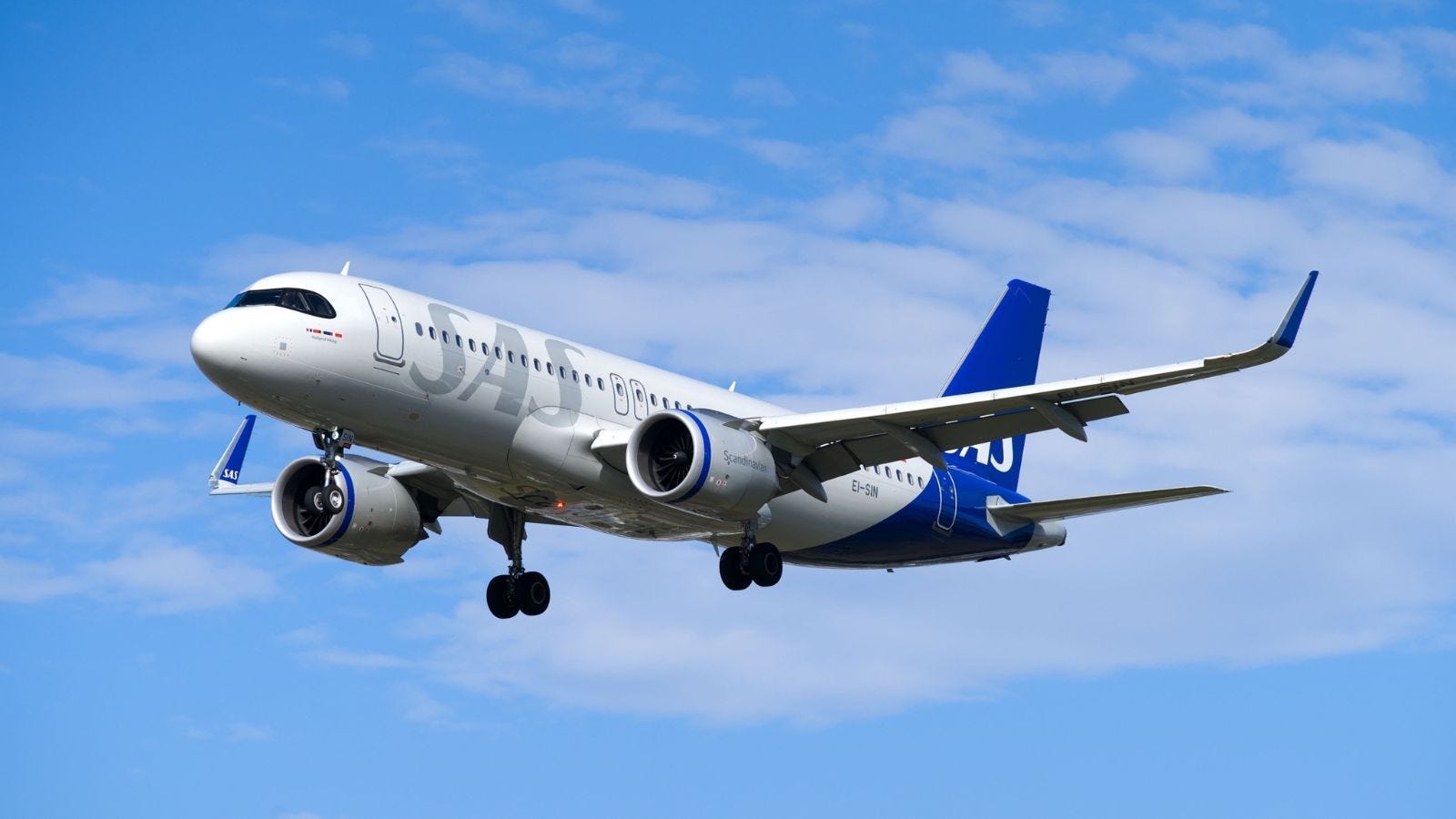
The A320 family constitutes the backbone of SAS short-haul and medium-haul operations. Seating configurations typically range from 150 to 180 depending on variant, with A320neos configured at 174 to 180 seats in a single-class layout featuring a flexible SAS Plus curtained front zone.
New A320neos bring 15 to 30% lower fuel burn than the A320ceo and older 737s they replaced, with CFM International LEAP-1A engines chosen over Pratt & Whitney’s PW1100G. That engine selection has turned out to be particularly valuable, insulating SAS from the accelerated inspections and groundings that have idled roughly 20 to 35% of some rival fleets powered by the PW GTF.
The A321LR is a niche but strategic sub-fleet. With three aircraft in service, the type enables thin long-haul routes such as Copenhagen to Toronto and Oslo to New York, opening transatlantic city pairs that would not support a widebody year-round.
Airbus A330-300: The Proven Long-Haul Workhorse
Eight Airbus A330-300s form the bulk of SAS widebody capacity, with 266 seats per aircraft in a three-class configuration. The A330s currently cover Copenhagen to the United States, Copenhagen to Mumbai, and Stockholm to New York, plus seasonal deployments to Asia.
SAS Airbus A330-300 Configuration:

Seats:         266 total
  SAS Business:  ~32 lie-flat seats
  SAS Plus:      ~56 premium economy seats
  SAS Go:        ~178 economy seats
Range:         ~13,400 km
Typical Route: CPH-USA, CPH-BOM, ARN-JFK
Anniversary:   One A330 wears the 2026 80th anniversary livery
The A330-300 is the type the CEO has publicly flagged as being at the centre of the next major fleet decision.
His commentary to the industry press makes clear that SAS will eventually settle on a single long-haul widebody family, with the candidates being the A330neo/A350 duo from Airbus and a potential mix of Boeing 787 and 777X.
Airbus A350-900: The Flagship
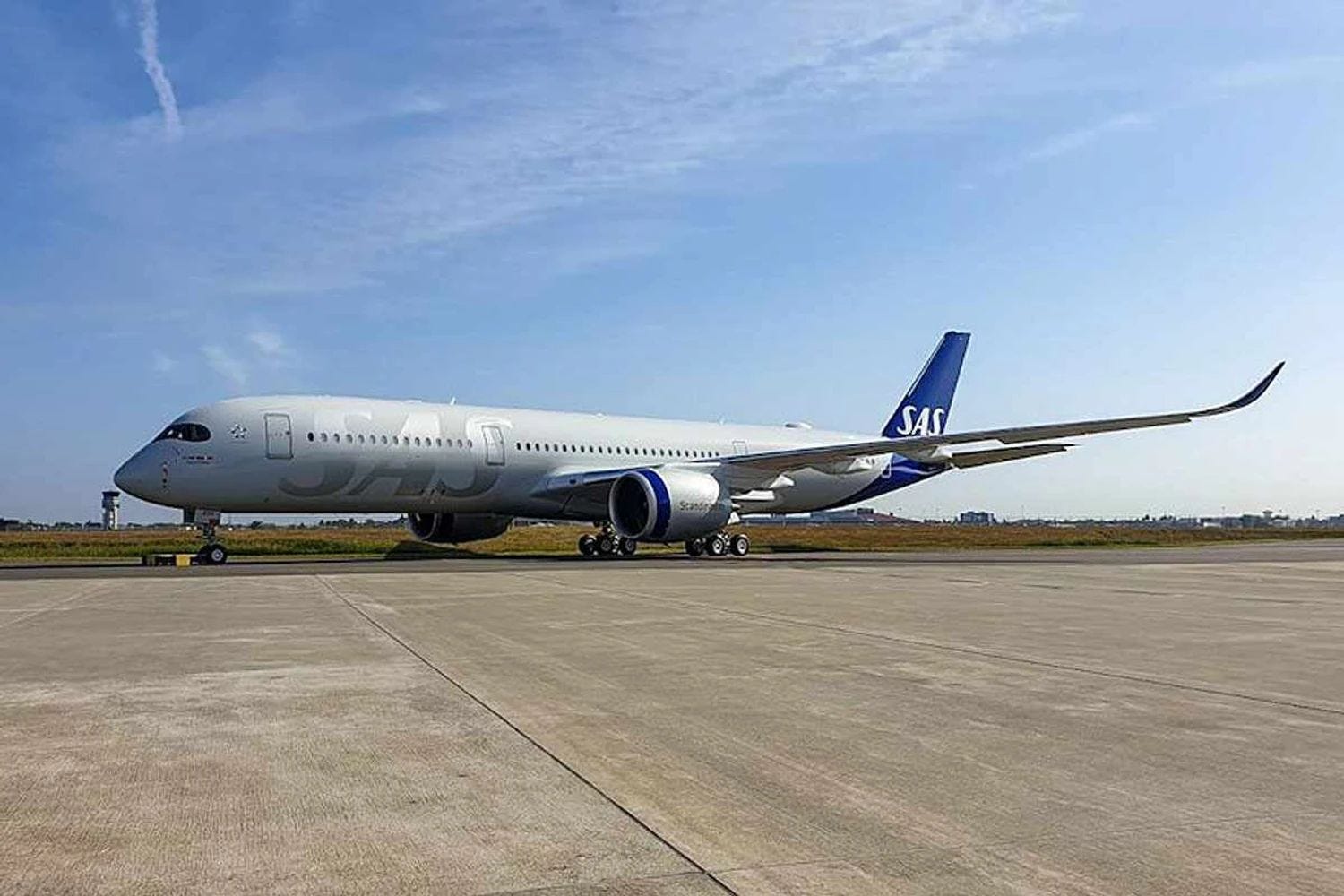
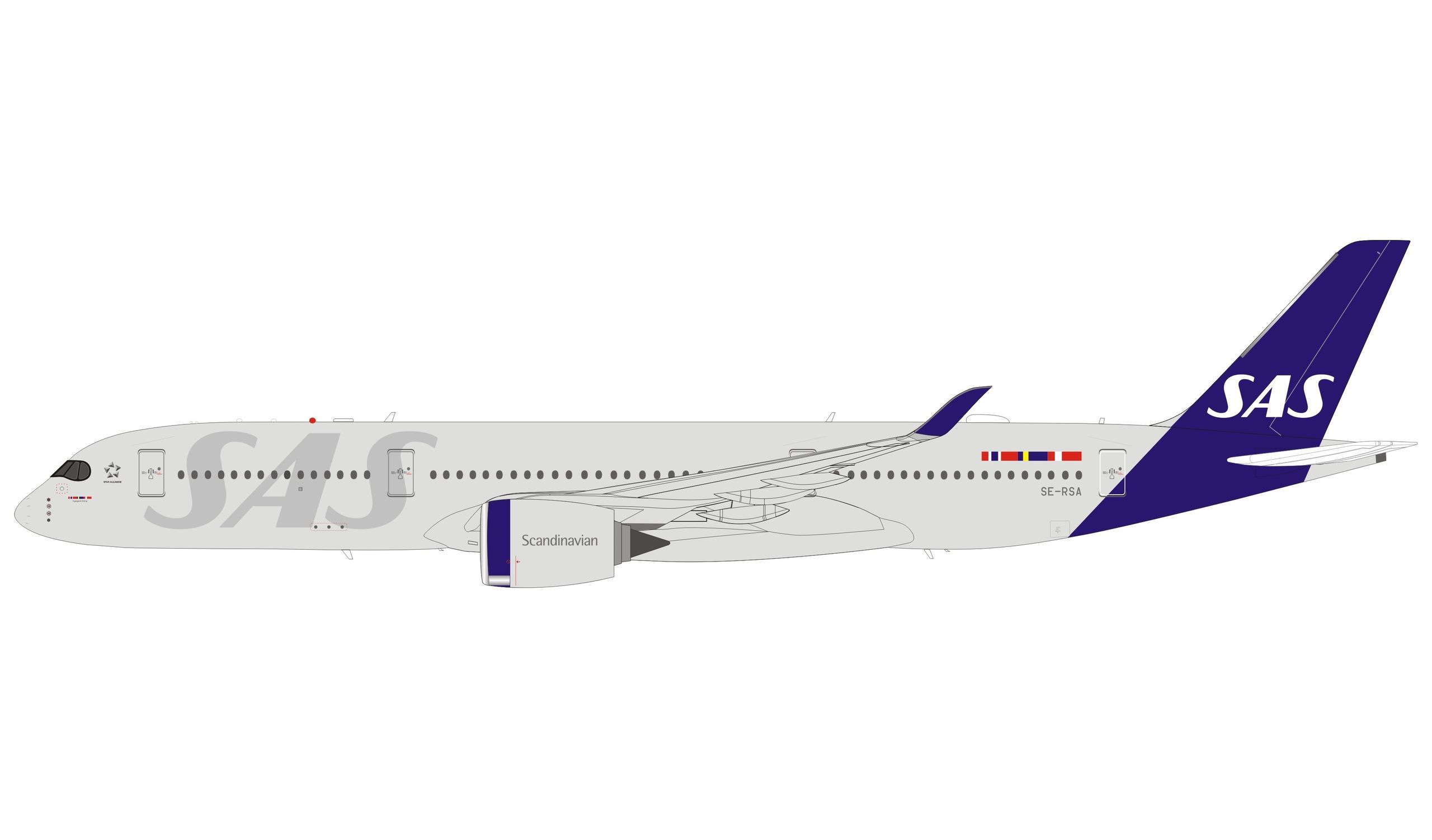
The A350-900 is the flagship of the long-haul operation. SAS currently operates six aircraft with a seventh and eighth scheduled, each configured for 300 passengers across 40 SAS Business, 32 SAS Plus and 228 SAS Go seats.
The A350 has enabled SAS to reopen and stabilize premium Asian routes such as Copenhagen to Tokyo and the new Copenhagen to Seoul route launched in September 2025.
A 34% increase in A350 operations has been announced for the Winter 2026/27 schedule, with capacity uplifts of up to 70% on Boston, 20% on San Francisco, 50% on Seoul and 40% on Tokyo.
Airbus A350-900 Role at SAS:

Fleet:              6 aircraft (growing to 8)
Range:              ~15,000 km
Seats:              300 (40 Business + 32 Plus + 228 Go)
Key Markets:        Tokyo, Bangkok, Seoul, LA, New York, San Francisco
Winter 2026/27:     +34% A350 flying, new Phuket & Krabi service
Fuel Efficiency:    ~25% lower emissions than A330ceo
The A350’s ability to operate 15,000 km sectors is what makes new Winter 2026/27 routes such as Copenhagen to Phuket and Krabi commercially viable on a non-stop basis, unlocking Thailand as a year-round leisure market for Scandinavian travellers.
Embraer E195 and the Incoming E195-E2
Regional connectivity is delivered by SAS Link’s 16 Embraer E195 first-generation aircraft, operating from Bergen, Copenhagen, Stockholm and Oslo. The type has been deployed on routes including Aalborg, Aarhus, Bologna, Paris Charles de Gaulle and intra-Scandinavian city pairs.
The defining fleet story of 2025 was the record order for 45 Embraer E195-E2s with purchase rights for an additional 10 frames, worth approximately USD 4 billion at list prices. First aircraft deliveries begin in late 2027, with the remainder phased over roughly four years.
The E2 is the quietest single-aisle jet currently in production, with a 62% reduction in noise footprint and a 29% fuel burn improvement over the previous E195 generation.
It is powered by the Pratt & Whitney PW1900G geared turbofan and has already been flight-tested on 100% Sustainable Aviation Fuel, with certification for full-SAF operations in development.
Fleet Strategy Philosophy
The cornerstone of SAS fleet strategy is disciplined consolidation.
The carrier has already phased out its Boeing 737s in November 2023, moved to an overwhelmingly Airbus-narrowbody fleet, and is now aggressively pursuing a two-family long-term structure: Embraer E-Jets for regional, Airbus narrowbodies for mainline.
SAS Fleet Strategy Pillars:

1. Narrowbody Simplification
   - All-Airbus A320 family (A319, A320, A320neo, A321LR)
   - CFM LEAP engines, avoiding GTF inspection risk
   - 7 more A320neos on order to reach ~80 of type

2. Regional Modernization
   - 45 E195-E2 firm + 10 options
   - Replaces E195 first-gen and CRJ900 wet-leased capacity
   - 29% better fuel burn, 100% SAF-compatible

3. Long-Haul Decision Pending
   - Current: A330-300 (8) + A350-900 (6, growing to 8)
   - Options under evaluation: A330neo, A350-900/1000, 787, 777X
   - Decision expected during 2026

4. Engine Risk Management
   - Narrowbody standardized on CFM LEAP-1A
   - Regional will adopt PW1900G GTF with E195-E2
   - Diversification across engine OEMs
The widebody decision is the highest-stakes call of 2026. Management commentary strongly suggests SAS will eventually pick a single long-haul type, and given its existing A350 base, the A350 has first-mover advantage, though Boeing’s 787 and the longer-range 777X remain credibly in the mix.
Fleet Age and Technical Modernity
New-generation aircraft now represent the majority of SAS seats.
The A320neo, A350 and soon E195-E2 are all engineered for 15 to 30% lower fuel consumption than the types they replace, a number the airline promotes openly as a core sustainability metric.
The 80th anniversary A330-300 serves as a symbolic bridge between legacy and future. It carries a fully blue livery with reinterpreted Scandinavian flag design and first flew Copenhagen to New York in March 2026, echoing the airline’s original September 17, 1946 transatlantic service.