


Executive Summary
Saudia carried approximately 37 million guests across more than 203,900 flights in 2025, marking a 6% year-on-year rise and confirming its position as the largest legacy carrier in Saudi Arabia.
The airline is executing a fleet transformation with firm commitments covering 105 Airbus A320neo-family jets and 39 Boeing 787 Dreamliners, with talks underway for a potential additional order of around 150 aircraft.
The network has expanded past 100 destinations, with new long-haul services scheduled using the new-generation A321XLR on thin routes to secondary European and Asian cities from summer 2026.
Competitive pressure is intensifying from within the Kingdom itself through the launch of Riyadh Air, alongside external incumbents Emirates, Qatar Airways and Etihad Airways, reshaping Gulf aviation in real time.
Recommended - Read Full Reports


Read All Reports
Table of Contents
Executive Summary
Introduction: A Flag Carrier Reshaped by a Kingdom in a Hurry
Key Facts: Company Profile
Business Overview: The Economics of a Dual-Mandate National Carrier
Corporate Structure and Ownership
Financial Performance: A Closer Look at LTM Trends
Revenue Growth Drivers
Key Services and Product Portfolio
Fleet: In-Depth Analysis
Current Fleet Size and Composition
Fleet Composition by Aircraft Family
Aircraft Type Strategy and Configurations
Cabin Strategy and Cabin Product Roadmap
Fleet Renewal Economics
Cargo Fleet Strategy
Route Network, Major Destinations and Strategy
Destination Footprint and Network Scale
Regional Coverage Breakdown
New Route Strategy for 2026
Network Strategy Philosophy
Codeshare and Partner Network
SkyTeam Alliance Membership
Transit and Stopover Conversion Program
Major Operational Bases (Hubs)
Primary Hub: King Abdulaziz International Airport, Jeddah
Secondary Hub: King Khalid International Airport, Riyadh
Other Operational Bases
Competitive Position
List of Major Competitors
Saudia vs Riyadh Air
Saudia vs Emirates
Saudia vs Qatar Airways
Saudia vs Etihad Airways
Saudia vs Flynas
Saudia vs Turkish Airlines
Competitive Differentiators
Hajj and Umrah Operations: The Pilgrimage Economy
Scale of Operations
Operational Choreography
Economic Significance
Fleet Renewal and Sustainability Strategy
Fuel Efficiency Generation Shift
Sustainable Aviation Fuel and Emissions Program
Cabin Circularity and Lifecycle
Digital, Brand and Customer Experience
Brand Modernisation
Alfursan Loyalty Program
Digital Experience
Human Capital and Nationalisation
Saudi Talent Development
Engineering and Maintenance Capability
Cargo Strategy Deep Dive
Saudia Cargo as a Standalone Business
Freighter Conversion Programme
SkyTeam Cargo Integration
Customer Experience and Onboard Product
Business Class Hard Product
Economy and Cabin Experience
Alcohol Policy and Cultural Positioning
Regulatory, Policy and National Aviation Strategy
GACA and National Aviation Strategy
King Salman International Airport
Airspace and Open Skies
Environmental, Social and Governance Considerations
Decarbonisation Path
Social Impact
Governance
Key Risks with Probabilities and Scenarios
Risk 1: Boeing Delivery Delays
Risk 2: Riyadh Air Competitive Displacement
Risk 3: Fuel Price Volatility
Risk 4: Geopolitical Disruption
Risk 5: Infrastructure Timing at King Salman International Airport
Risk 6: Macro-Tourism Demand
Risk 7: Labour Supply Constraints
Financial and Operational Outlook Through 2030
Passenger Volume Trajectory
Capital Intensity
Margin Outlook
Competitive Capacity Scenarios
Technology, AI and Operations
Operational Technology
AI and Revenue Management
Strategic Themes to Watch in 2026 and Beyond
Theme 1: Execution of the Fleet Programme
Theme 2: Riyadh Air Scaling
Theme 3: Umrah Digitalisation
Theme 4: Cargo Scaling
Theme 5: North America Expansion
My Final Thoughts
Official Sources and Data
Introduction: A Flag Carrier Reshaped by a Kingdom in a Hurry
Saudia is no longer the quiet flag carrier of a closed Kingdom. It is the central aviation platform of a country attempting to triple passenger capacity to 330 million a year before the end of this decade.
Three realities define where the airline is in April 2026.
First, it just closed 2025 with approximately 37 million guests, its largest passenger tally since its 1945 founding.
Second, it ended the year as the second most punctual major airline in the world, an unusually disciplined showing for a carrier of this scale and mission complexity.
Third, it now competes for the same Riyadh-based premium travellers with Riyadh Air, which launched commercial operations to London Heathrow on 26 October 2025.
That internal rivalry changes the strategic calculus for Saudia in a way that external Gulf competition never did.
Key Facts: Company Profile
COMPANY PROFILE SNAPSHOT - SAUDIA (2026)
-----------------------------------------------
Legal Name        : Saudi Arabian Airlines Corporation
Brand             : Saudia (stylized SAUDIA)
IATA / ICAO / Call : SV / SVA / SAUDIA
Founded           : 1945 (first flight with a DC-3 gift from U.S. President Truman)
Headquarters      : Jeddah, Saudi Arabia
Director General  : H.E. Eng. Ibrahim Al-Omar (Saudia Group)
Ownership         : Wholly owned by the Government of Saudi Arabia
Alliance          : SkyTeam (member since May 2012)
Primary Hub       : King Abdulaziz International Airport (JED), Jeddah
Secondary Hub     : King Khalid International Airport (RUH), Riyadh
Fleet Size        : ~170 passenger aircraft (April 2026)
Destinations      : 100+ cities across 5 continents
2025 Passengers   : ~37 million guests (+6% YoY)
2025 Flights      : 203,900+
Group Subsidiaries: Flyadeal, Saudia Cargo, SAEI, CATRION (stake)
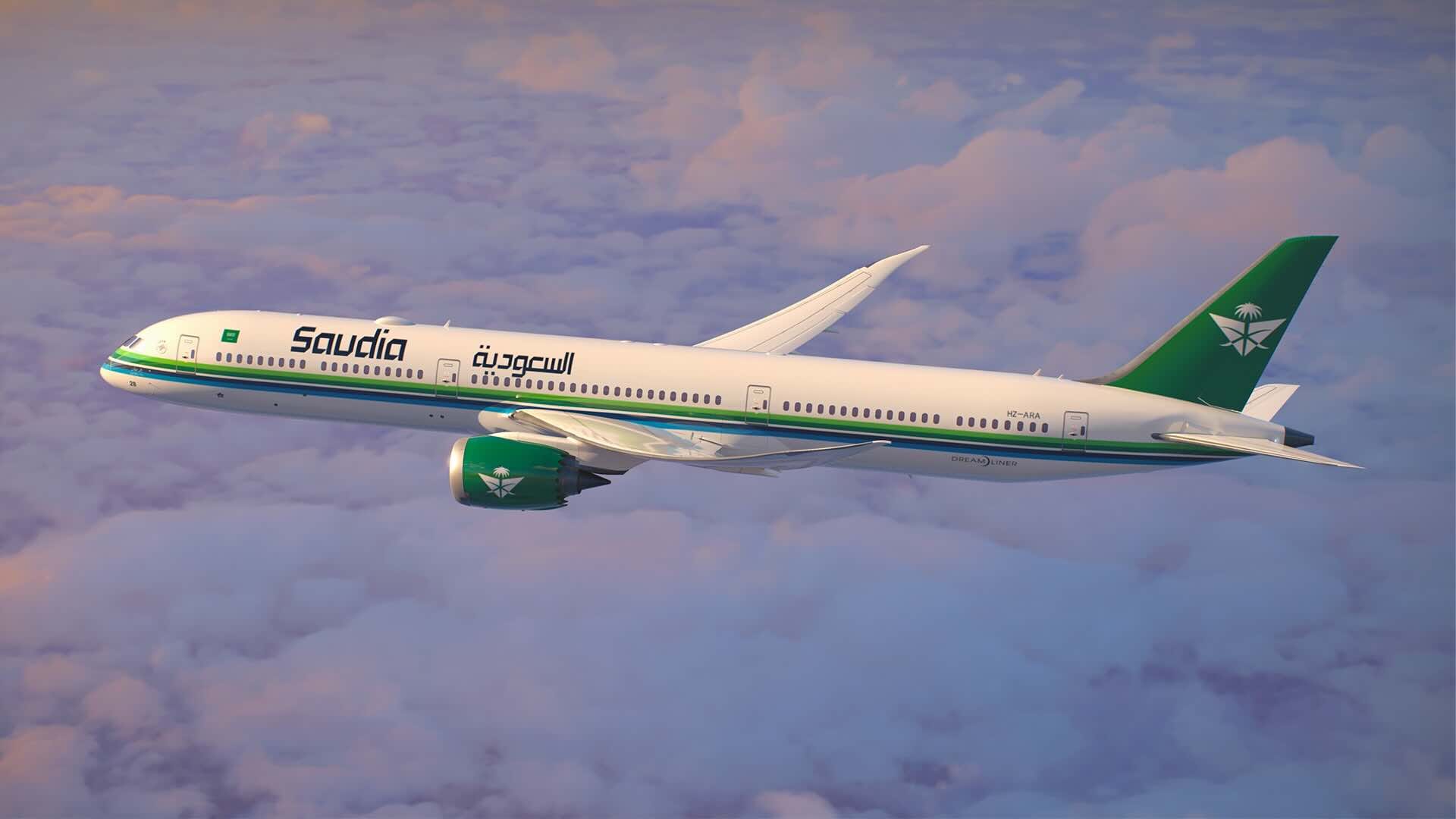
Saudia sits at the intersection of commercial aviation and state strategy. Its operations tie directly into the Kingdom’s Vision 2030 framework, which places aviation and tourism at the center of economic diversification.
The carrier remains a fully state-owned enterprise, which shapes both its capital structure and how decisions flow between commercial management and national policymaking.
Business Overview: The Economics of a Dual-Mandate National Carrier
Corporate Structure and Ownership
Saudia operates as the flag carrier subsidiary of Saudia Group, which itself is wholly owned by the Saudi state.
The Group includes the mainline Saudia passenger airline, low-cost Flyadeal, Saudia Cargo, Saudia Aerospace Engineering Industries (SAEI), and minority interests in related service companies.
This structure matters because decisions about fleet, routes and pricing are not purely commercial. They are shaped by the Kingdom’s Vision 2030 framework, which explicitly tasks the aviation sector with attracting 150 million tourism visits annually and serving 30 million religious tourists by 2030.
The Director General of Saudia Group is H.E. Eng. Ibrahim Al-Omar, who is also on the Kingdom’s aviation power list and has framed the carrier’s work as aligned with the National Aviation Strategy.
Financial Performance: A Closer Look at LTM Trends
Saudia is not a listed entity, so revenue figures are not disclosed with the same granularity as those of listed Gulf peers. The available data points, however, paint a clear directional picture.
During the first half of 2025, the carrier transported more than 17.5 million passengers, up 7.2% year-on-year. Full-year 2025 passenger volume reached approximately 37 million, equating to an underlying year-on-year growth rate of about 6%.
Total flights operated in 2025 exceeded 203,900, a meaningful signal of capacity growth when combined with the higher passenger count. That traffic growth is the backbone of revenue expansion, even if the airline does not publish a consolidated revenue line publicly.
SAUDIA TRAFFIC HIGHLIGHTS (CALENDAR 2025)
-----------------------------------------
Passengers Carried        : ~37 million guests
YoY Passenger Growth      : +6%
Flights Operated          : 203,900+
H1 2025 Passengers        : 17.5 million
H1 2025 YoY Growth        : +7.2%
On-Time Arrival Rate 2025 : 86.53%
Global OTP Ranking 2025   : #2 globally
Transit Passengers 2025 : 3.2 million+Revenue Growth Drivers
The primary top-line growth driver is capacity addition, funded by the aircraft order book and staffed through an expanding pilot and cabin crew base.
The second driver is yield stability supported by a measured upgrade of cabin product, particularly on long-haul 787 and 777 fleets.
A third driver is the pilgrimage economy. Hajj and Umrah operations require dedicated seat allocation that exceeded one million seats for Hajj 2026 alone, supported by a fleet of 158 aircraft during the peak period.
A fourth factor is network diversification. New seasonal and year-round European and Asian routes, many launched through the new A321XLR deployments, open up higher-yield point-to-point markets that were previously uneconomic with larger widebodies.
The fifth growth driver is the brand itself. Saudia’s brand value reached USD 1.1 billion according to Brand Finance, a 34% jump and a return to its highest level since entering the top 50 airline brands ranking in 2021.
Key Services and Product Portfolio
Saudia operates three cabin classes on long-haul widebodies (Business, Premium Economy where fitted, and Economy) and typically two classes on narrowbodies. Long-haul 787-9s feature 24 lie-flat seats in 1-2-1 business class arranged between doors one and two.
The new A321XLRs entering service in 2026 will carry a fully flat business class in a 20-seat configuration, an unusually premium narrowbody product by Middle Eastern standards.
Ancillary and adjacent revenue comes from the 96-hour stopover visa program, which converts transit passengers into short-stay tourists and captures incremental spend in Jeddah, Riyadh, AlUla, and Diriyah.
Fleet: In-Depth Analysis
Current Fleet Size and Composition
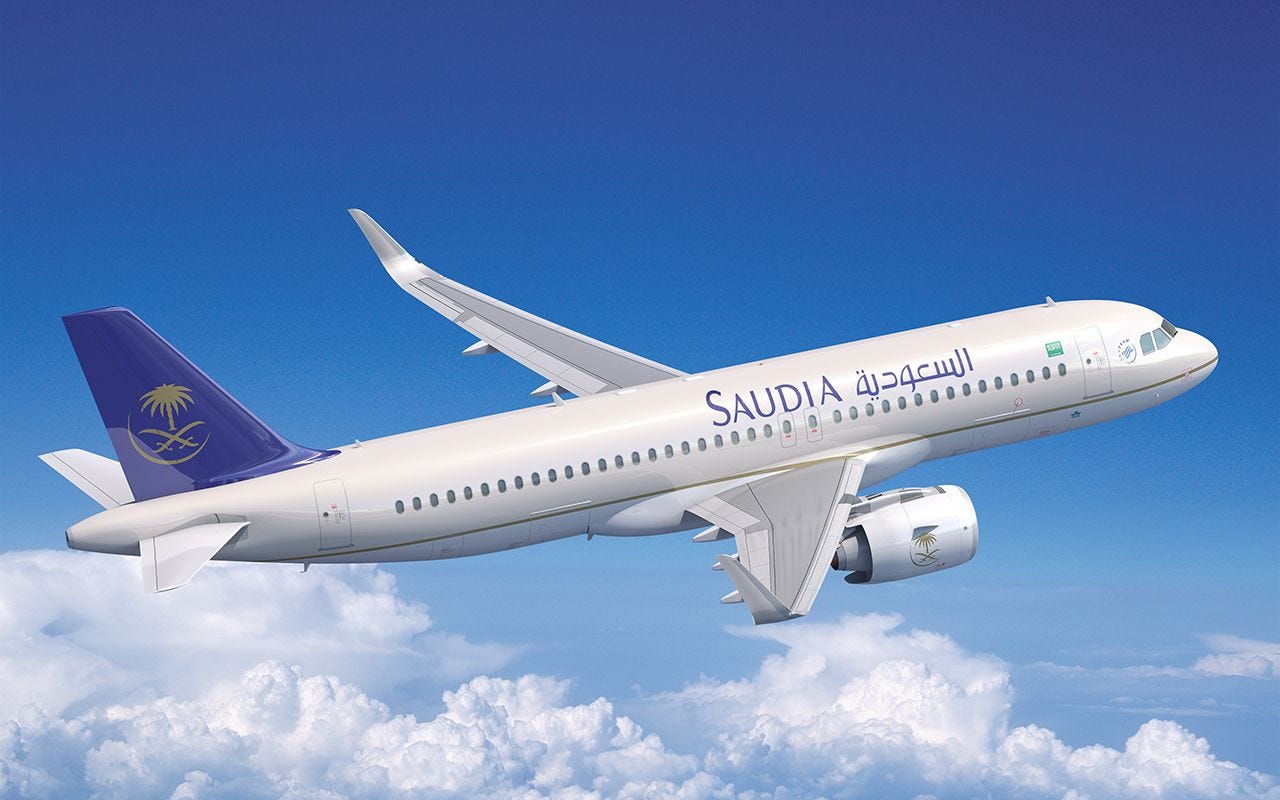
The published Saudia passenger fleet stands at 170 aircraft in service as of April 2026, with another 10 aircraft on order or planned for delivery through the remainder of the decade.
Saudia’s own website lists 149 aircraft under the published fleet summary, with the gap reflecting recent deliveries and lease additions.
The Hajj 2026 operational fleet reached 160 aircraft, which is the peak operational snapshot during the pilgrimage season.
Average fleet age sits at roughly 10.9 years, already competitive against global legacy averages but expected to fall sharply as new A321XLR, A320neo and 787-10 deliveries accelerate.
SAUDIA FLEET SNAPSHOT (APRIL 2026)
----------------------------------
In Service          : ~170 aircraft
On Order / Planned  : 10+ aircraft (existing book)
Potential New Order : Up to 150 aircraft (under negotiation)
Average Fleet Age   : ~10.9 years
Widebody Share      : ~52% (A330, 777, 787)
Narrowbody Share    : ~48% (A320ceo, A320neo, A321neo)
Fleet Composition by Aircraft Family
Saudia operates an all-Airbus narrowbody fleet alongside a mixed Airbus-Boeing widebody fleet. The mainline narrowbody is the A320-214, with 37 frames in service, supplemented by growing numbers of A320neo and A321neo aircraft.

On the widebody side, the long-haul backbone comprises the Airbus A330-300, Boeing 777-300ER, and a growing fleet of Boeing 787-9 and 787-10 Dreamliners. The Group’s composition includes 87 widebodies across A330, B777 and B787, although only about 22% of the overall fleet is new-generation.
The 787 fleet currently comprises 21 Dreamliners in service, split into 13 787-9s and eight 787-10s, with additional frames in delivery.
Aircraft Type Strategy and Configurations
The A320neo family sits at the heart of Saudia’s narrowbody plan. The 2024 order for 105 A320neo-family aircraft is split so that Saudia mainline receives 54 A321neos, while Flyadeal takes 12 A320neos and 39 A321neos.
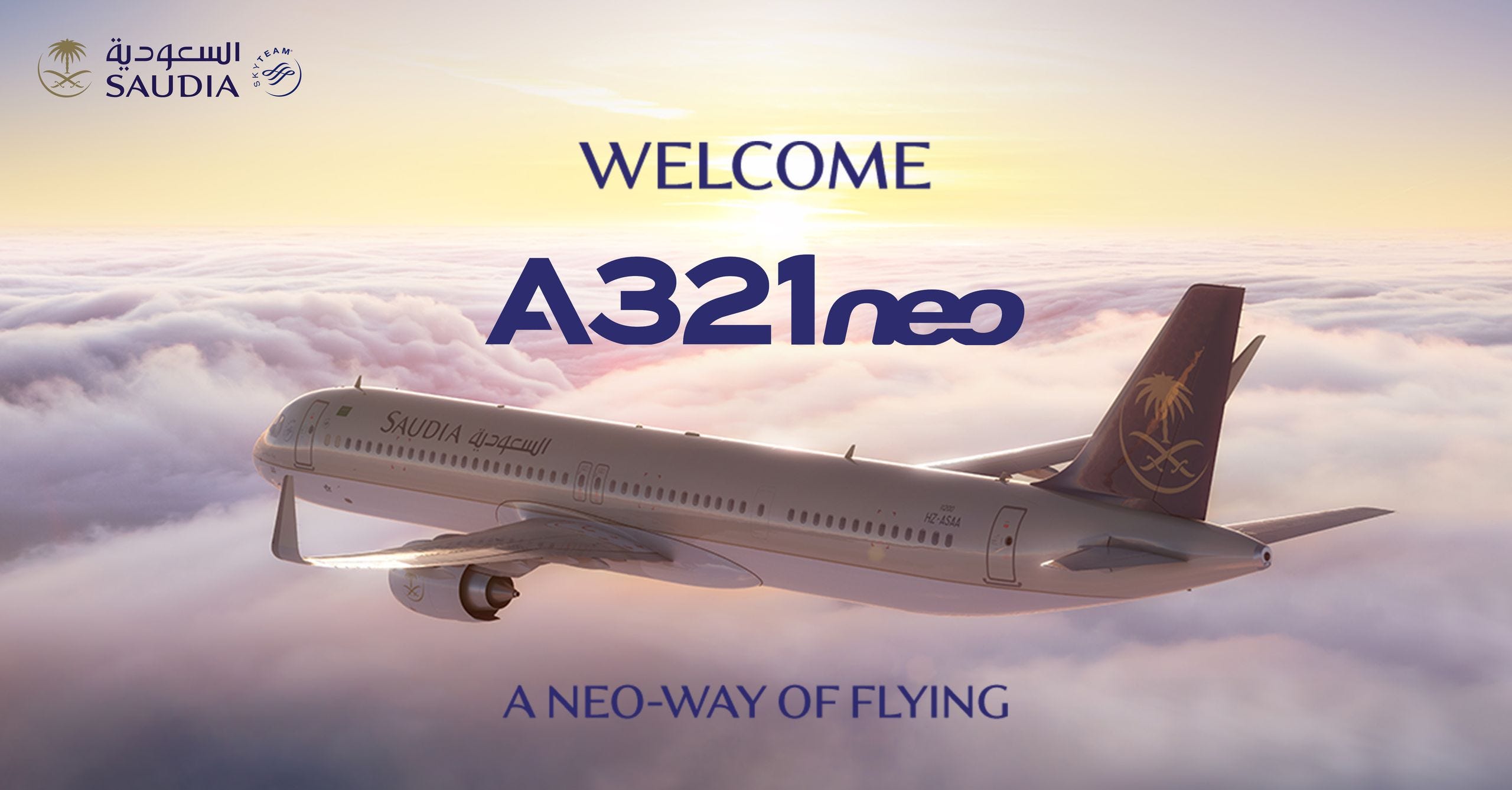
The A321XLR deployment is the more visible strategic shift. It brings lie-flat business class onto a narrowbody platform and allows Saudia to connect secondary Saudi and European cities on long, thin routes that could not previously justify a widebody.
The 787 strategy is dual-role. The 787-9 handles ultra-long-haul and medium-capacity premium markets, while the larger 787-10 absorbs capacity on high-density long-haul routes where 777-300ERs would previously have flown.
The 777-300ER remains a workhorse but is aging. Several frames are being diverted to cargo conversion programs, which doubles as a fleet simplification strategy and a cargo capacity expansion play.
Cabin Strategy and Cabin Product Roadmap
Saudia signed a new cabin interiors deal with Collins Aerospace covering widebody platforms. The refresh is intended to lift business class hard product across the widebody fleet to a consistent level that matches or exceeds Gulf peers on key markets.
The A321XLR’s fully flat business class is the clearest statement of intent. It pulls a premium narrowbody product onto medium-haul European and Asian routes where passengers would normally expect only a recliner seat.
On the 787 fleet, the business class cabin is configured with 30 seats on the 787-10 arranged across three sub-cabins between doors one and two, reflecting a premium-heavy design choice.
The 777-300ER remains a mixed picture, with 30 seats in business class that are increasingly dated by modern standards.
Fleet Renewal Economics
The existing order book alone covers deliveries from 2026 through the end of the decade. That pipeline is the foundation of the airline’s medium-term capacity plan.
On top of that, the reported talks for a further 150 aircraft between both Boeing and Airbus could reshape the fleet again. Plausible scenarios include 20 additional 787-10s, ten more 787-9s, and more Airbus A350s or additional A321neo family aircraft.
The purpose of this volume is not just growth. It is the simultaneous replacement of older A320ceos, A330-300s and 777-300ERs. Fleet renewal on this scale is one of the largest in global aviation in the current decade.
SAUDIA FIRM ORDER BOOK (PUBLICLY DISCLOSED)
--------------------------------------------
Airbus A320neo family (2024 order)      : 105 aircraft (Saudia + Flyadeal)
 - Saudia A321neo                        : 54
 - Flyadeal A320neo                      : 12
 - Flyadeal A321neo                      : 39
Boeing 787-9 / 787-10 (2023 order)       : 39 aircraft (plus 10 options)
Airbus A330-900neo (Flyadeal, 2025)      : 10 aircraft (group level)
Additional order under negotiation : ~150 aircraft (not firm)Cargo Fleet Strategy
Saudia’s cargo arm is a quieter but strategically important line of business. The cargo division intends to double its freighter fleet from 7 to 14 by 2028.
That expansion rides on two pillars. First, new Boeing 777F frames are being added. Second, ten 777-300ERs are being converted into freighters, which simultaneously resolves excess passenger capacity and grows cargo lift.
Saudia Cargo is also a member of SkyTeam Cargo since 2019, which gives it interlining reach into Asia, the Americas and Europe well beyond what a single-operator freighter fleet could provide.