


Executive Summary
Shandong Airlines operates an all-Boeing 737 fleet of 139 aircraft across 360-plus routes, making it one of the largest narrowbody operators in northern China despite serving a single province-based network.
Air China now holds a 51% majority stake in the carrier itself and a 66% controlling stake in parent Shandong Aviation Group, effectively pulling SC into the Air China Group orbit and the broader Star Alliance ecosystem.
Fiscal year 2024 revenue reached CNY 19.59 billion (approximately USD 2.7 billion) with a net loss of CNY 2.26 billion, a sharp reversal from the modest CNY 214.5 million profit recorded in FY 2023.
Fleet renewal is the defining strategic theme for 2026, anchored by a $405 million, 10-aircraft lease deal signed with four domestic Chinese lessors and a 10-unit Comac C909 order that will introduce a non-Boeing type for the first time.
Recommended - Read Full Reports


Read All Reports
Table of Contents
Executive Summary
Introduction
Key Facts: Company Profile
Business Overview
Corporate Structure and Ownership
Management and Governance
Financial Analysis: Revenue, Losses and Drivers
Revenue Growth Drivers
Key Products and Services
Shandong Airlines Fleet: In-depth Analysis
Fleet Size and Composition
Fleet Age and Renewal Pressure
The 2026 Lease Deal: Structure and Rationale
Aircraft Types Strategy and Cabin Configuration
The Comac C909 Move: Breaking the Boeing-Only Streak
Cargo Fleet: SDA Cargo and the Air China Cargo Partnership
Fleet Strategy Synthesis
Route Network, Major Destinations and Strategy
Network Scale and Shape
Domestic Network
International Network
Network Strategy
Codeshare Partnerships
Major Operational Bases (Hubs)
Jinan Yaoqiang International Airport (TNA): The Primary Hub
Qingdao Jiaodong International Airport (TAO): The Second Hub
Focus Cities
Competitive Position
Major Competitors
Shandong Airlines vs China Eastern Airlines
Shandong Airlines vs Shenzhen Airlines
Shandong Airlines vs Xiamen Airlines
Shandong Airlines vs Spring Airlines
Shandong Airlines vs Qingdao Airlines
Shandong Airlines vs Hainan Airlines
Competitive Position Summary
Safety Record and Operational Performance
IOSA Certification and Safety Audit
Service Quality Rating
Operational Punctuality
Loyalty Programme and Alliance Integration
Digital Transformation and Commercial Strategy
Revenue Management and Scheduling Technology
In-Flight Product Evolution
Corporate Social Responsibility and Regulatory Environment
Sector Context: Chinese Aviation in 2026
Traffic Environment
Supplier Diplomacy
Key Risks, Probabilities and Scenarios
Risk 1: Chronic Loss-Making and Balance Sheet Pressure
Risk 2: US-China Trade Tensions and Boeing Supply
Risk 3: Fuel Price Volatility
Risk 4: Competitive Pressure from LCCs
Risk 5: Integration Risk with Air China Group
Risk 6: Airport Infrastructure Constraints
Strategic Outlook for 2026-2028
What Shandong Airlines Must Do
Scenario Planning
Additional Considerations for Industry Stakeholders
The Boeing Loyalty Question
The Provincial Identity Advantage
The Succession Question
My Final Thoughts
Official Sources and Data
Introduction
Shandong Airlines sits in an unusual position in 2026.
It is big enough to operate a 139-aircraft all-Boeing 737 fleet, yet small enough to lean heavily on its parent Air China for survival after posting a CNY 2.26 billion net loss for fiscal year 2024.
That paradoxical mix of scale, dependence, and Boeing loyalty defines almost every decision the carrier is making right now.
The March 2026 announcement of a $405 million lease agreement for ten additional 737s, paired with a pending order for ten Comac C909 regional jets, tells a story of forced modernization rather than ambitious expansion.
The carrier is replacing ageing metal with younger metal while its Jinan hub prepares for a three-runway expansion.
This in-depth strategic analysis report examines the airline from every practical angle: ownership, financials, fleet, routes, hubs, competition, and risks. The goal is to give executives and industry stakeholders an outlook of where Shandong Airlines stands in 2026.
Key Facts: Company Profile
Legal Name:            Shandong Airlines Co., Ltd.
IATA / ICAO:           SC / CDG
Call Sign:             SHANDONG
Founded:               12 March 1994
Commenced Ops:         September 1994
Headquarters:          Shandong Airlines Building, East Second Ring Road, Jinan
Parent Group:          Air China Group (via Shandong Aviation Group)
Listing:               Shenzhen Stock Exchange (200152) B-shares
Main Hubs:             Jinan Yaoqiang (TNA), Qingdao Jiaodong (TAO)
Focus Cities:          Beijing Capital, Chongqing, Xiamen, Yantai-Penglai
Total Fleet:           139 aircraft (all-Boeing 737 narrowbody)
Orders:                31 aircraft (21 B737 MAX 8 + 10 Comac C909)
Weekly Flights:        4,400+
Destinations:          70+ cities (domestic + international)
Routes:                360+
Employees:             Approx. 10,000
2024 Revenue:          CNY 19.59 billion (~USD 2.7 billion)
2024 Net Result:       CNY -2.26 billion (net loss)
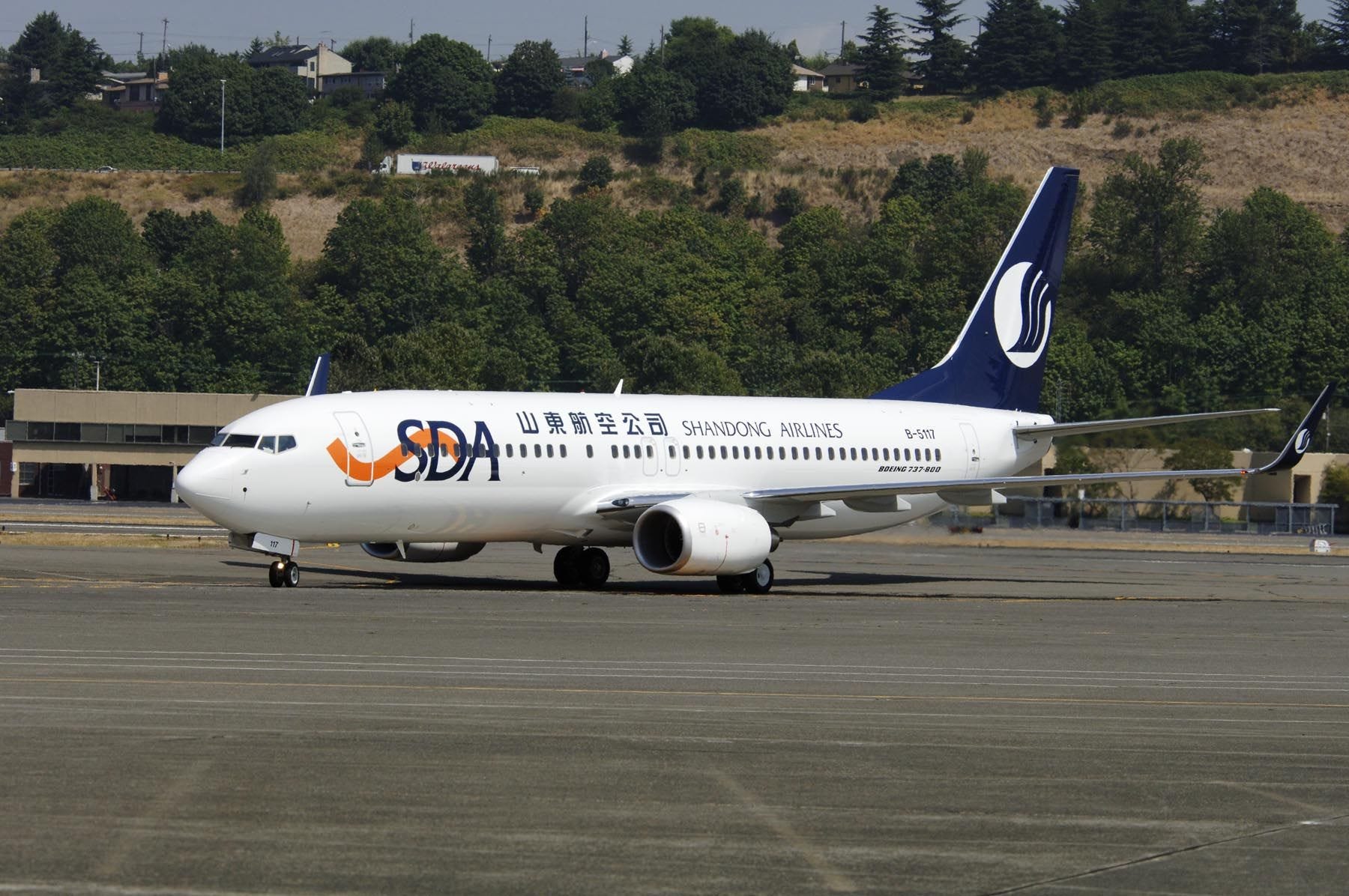
Safety Record: 31 consecutive years without a hull-loss fatal accidentThe carrier describes itself on its own corporate site as an enterprise “controlled by Air China Limited” and co-funded by Shandong Hi-Speed Group and Shandong Finance Group, among others.
Its stated brand vision is Fly Honestly, Fly Better, a Confucian-flavoured slogan that reflects the airline’s deep regional identity rooted in Qilu culture.
Since launch, Shandong Airlines has accumulated over 6.19 million safe flight hours and transported a cumulative 339 million passengers, per disclosures made by the company at the close of 2025.
Business Overview
Corporate Structure and Ownership
Shandong Airlines has a two-tier ownership structure that has become progressively more concentrated under Air China.
The airline itself is majority owned by Air China, which holds a 51% strategic stake, while Shandong Aviation Group retains roughly 37% as the direct controlling shareholder.
Above that layer, Air China completed its push to control the parent Shandong Aviation Group in 2024, paying CNY 33 million to lift its stake to 51.7%.
A subsequent cleanup transaction involving Shansteel Financial Holdings and Qingdao Qifa pushed the parent ownership to 66%.
OWNERSHIP STRUCTURE (2026)

Shandong Airlines Co., Ltd. (listed 200152)
├── Air China Limited (direct stake): ~51%
├── Shandong Aviation Group (controlling): ~37%
│       └── Controlled by Air China Group: ~66%
└── Public free float (B-shares): ~12%
The practical effect is that Shandong Airlines now functions as a de facto subsidiary of the Air China Group, even though it retains its own Shenzhen-listed share class and independent management.
Management and Governance
Company filings list Miao Liubin as chairman of the executive board, with Wang Wuping serving as director and president, and Xu Chuanyu as board chairman of Shandong Airlines Group.
Xu Chuanyu has served as the public face of the group’s strategic direction, frequently citing the carrier’s 30-plus-year history of safety as the foundation of corporate identity.
Governance under Air China’s control has accelerated commercial systems integration.
The airline chose Sabre AirVision Schedule Manager and Fares Manager platforms to modernize revenue management, aligning its toolset with the broader Air China commercial stack.
Financial Analysis: Revenue, Losses and Drivers
Shandong Airlines reported revenue of CNY 19.59 billion (approximately USD 2.7 billion) for the fiscal year ended December 31, 2024, a 7% increase over CNY 18.29 billion the previous year.
However, the bottom line moved the other way: the airline swung to a net loss of CNY 2.26 billion from a small CNY 214.5 million profit in FY 2023.
The loss reflects the squeeze that has hit most mid-tier Chinese carriers.
Yields compressed as capacity returned faster than demand, fuel costs stayed stubbornly high relative to pre-pandemic baselines, and Shandong’s older 737-800 fleet drove above-average maintenance and fuel burn per ASK.
REVENUE TREND (CNY billion, fiscal year)

2021:  8.72    (pandemic trough)
2022:  6.82    (full-year lockdowns)
2023:  18.29   (reopening rebound)
2024:  19.59   (+7.1% YoY, loss-making)

Latest interim: CNY 10.22 billion reported for a reporting period
(Source: company filings, Shenzhen Stock Exchange 200152)
Broader context matters here.
The big three Chinese carriers, Air China, China Eastern, and China Southern, remained a mixed bag in 2025, with only China Southern posting a clear turnaround to a net profit of CNY 857 million.
China Eastern posted a small CNY 274 million pre-tax profit on revenue of CNY 139.94 billion in 2025, while Air China remained loss-making.
Shandong’s struggles are thus not an outlier but an amplified version of sector-wide conditions in China.
Revenue Growth Drivers
Three levers are actively shaping the top line for Shandong Airlines.
First, domestic passenger traffic in China grew 5.5% in 2025 to reach 770 million, giving SC a rising tide to capture.
Second, international flying is being aggressively restored. The carrier announced direct Jinan services to Hanoi, Ho Chi Minh City and Kuala Lumpur beginning January 2026, with the Jinan–Kuala Lumpur launch tied to Visit Malaysia 2026 promotions.
Third, cargo economics improved through a 2025 agreement that transferred bellyhold operations to Air China Cargo, providing predictable revenue to Shandong’s passenger fleet while relieving it of cargo sales complexity.
Key Products and Services
Shandong Airlines operates a two-class cabin on most of its 737 fleet, with eight business class seats and 159 to 168 economy seats depending on configuration. Its newest Boeing 737 MAX 8 aircraft introduced RECARO R3 economy seats with Bluetooth connectivity and seatback entertainment screens.
The Shandong Airlines 737-800 standard layout features 8 business seats in a 2-2 configuration and 159 to 168 economy seats in 3-3 configuration, a fairly industry-standard setup.
Ancillary offerings include paid seat assignment, a prepaid baggage scheme, upgrades on meals, and a frequent flyer programme integrated with Air China’s PhoenixMiles. The airline markets passenger and cargo services, air charters, ground handling, and pilot training through its Qingdao flight academy.
Shandong Airlines Fleet: In-depth Analysis
Fleet Size and Composition
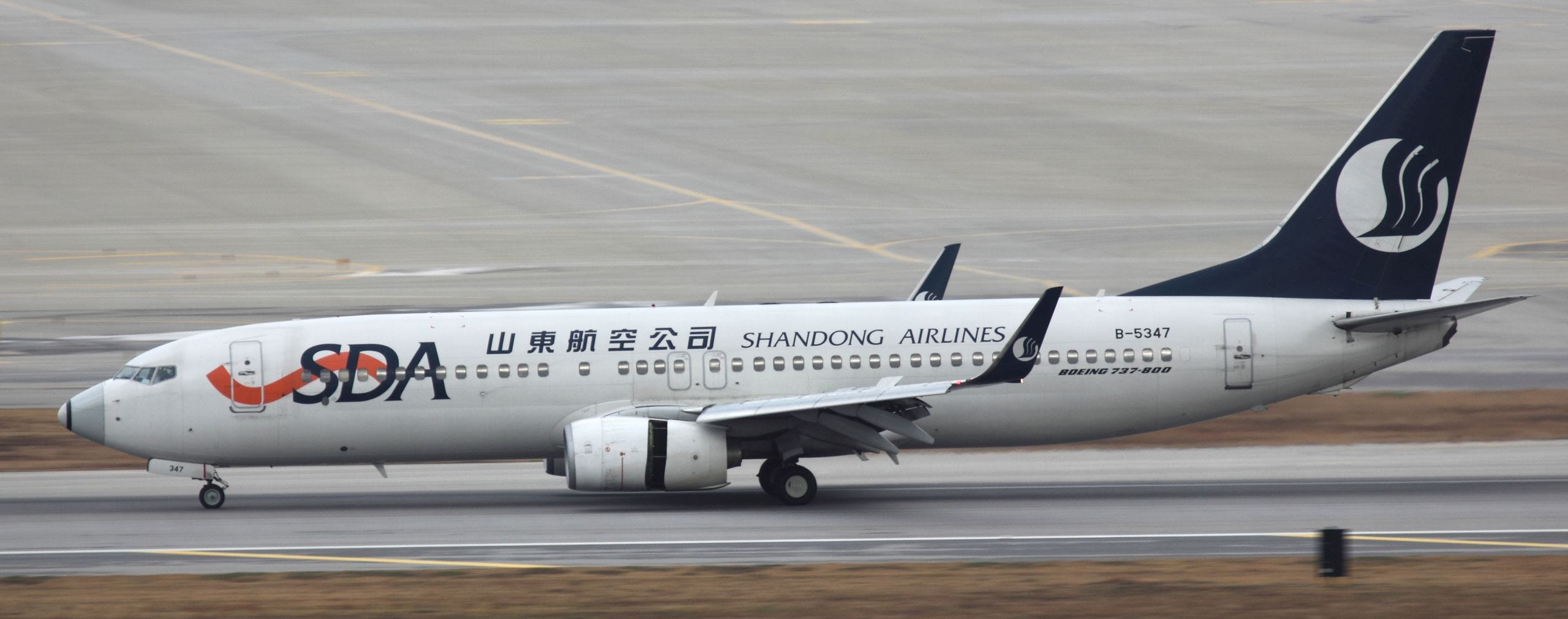
As of April 2026, Shandong Airlines operates a fleet of 135 aircraft in active service with 3 units on order or planned, per tracking data, while the carrier itself cites 139 Boeing 737 aircraft in its corporate profile. The small discrepancy reflects retirements and cargo conversions moving through the system.
The more complete picture from industry data shows the fleet composition breaking down as follows, with 31 aircraft on order across two types.
FLEET COMPOSITION (August 2025 basis, confirmed April 2026)

Passenger Fleet
  Boeing 737-700           2 aircraft (stored, exit imminent)
  Boeing 737-800         118 aircraft (workhorse, all-economy-based regional variants)
  Boeing 737 MAX 8        13 aircraft (active), 21 on order
  Comac C909               0 aircraft, 10 on order

Cargo Fleet (SDA Cargo)
  Boeing 737-800BCF        5 aircraft (freighter conversions)

Total in service:        138 aircraft
Total on order:           31 aircraft
The decisive feature of this fleet is its narrow-gauge simplicity.
Every single passenger aircraft in service today is a Boeing 737, a commonality that produces substantial cost savings in pilot training, maintenance tooling, and spare parts inventory.
Fleet Age and Renewal Pressure
The average fleet age sits at 11.9 years based on active aircraft tracked as of April 2026. That number is meaningfully higher than younger regional peers and is the single most cited reason for the 2026 lease deal.
For context, the 737-800 sub-fleet had an average age around 8.9 years in 2022, implying that without renewal it has aged well past the 10-year mark where maintenance C and D checks become more frequent and expensive.
However, some aircraft in the existing fleet are too old, making the lease route a pragmatic alternative to a large cash purchase.
The 2026 Lease Deal: Structure and Rationale
In March 2026, Air China disclosed to the Shanghai Stock Exchange a binding arrangement under which Shandong Airlines will lease 10 Boeing 737 aircraft at a total commitment of CNY 2.88 billion (approximately USD 405 million).
Deliveries are phased over the next two years.
2026 LEASE DEAL BREAKDOWN

Aircraft types:       6 x Boeing 737-800, 4 x Boeing 737 MAX
Total value:          CNY 2.88 billion (~USD 405 million)
Lease durations:      10 years on 3 x 737-800
                      11 years on 3 x 737-800
                      12 years on 4 x 737 MAX
Lessors:              Bank of Communications Financial Leasing
                      Xiamen Aircraft Leasing
                      Sichuan Saide Aviation Technology
                      Minsheng Financial Leasing
Condition:            "Relatively new" and "in good technical condition"
Delivery window:      Phased over 2026-2027
Air China explicitly stated that the transaction will stabilise the fleet size, meaning the carrier is using these leases primarily to replace ageing aircraft rather than add net capacity.
Splitting the lease across four separate Chinese lessors diversifies counterparty risk and aligns with Beijing’s preference for keeping aircraft financing within the domestic banking system.
Aircraft Types Strategy and Cabin Configuration
The Boeing 737-800 remains the backbone of the operation, with 118 units deployed across the domestic trunk network and regional international routes.
Most operate with the two-class configuration described earlier, though a handful of high-density layouts exist for tourism routes into Southeast Asia.

The Boeing 737 MAX 8 rejoined the Shandong fleet following the global grounding’s end, and the carrier has 13 in active service with a further 21 on firm order. MAX deliveries to Shandong resumed in 2023 after a multi-year pause triggered by the two fatal accidents of the MAX 8 worldwide in 2018-2019.
737 MAX 8 CABIN CONFIGURATION (Shandong Airlines)

Business Class:       8 seats (2-2 layout)
Economy Class:      168 seats (3-3 layout, RECARO R3)
Total:              176 seats

Amenities:          Seatback screens, Bluetooth audio, USB-C
Engine:             CFMI LEAP-1B
Range:              3,515 nautical miles (6,510 km)
Cargo capacity:     3,300 kg
The 737 MAX 8 delivers approximately 14% lower fuel burn per trip compared to the 737-800, which matters enormously on the longer domestic sectors where Shandong competes directly with the big three.
The Comac C909 Move: Breaking the Boeing-Only Streak
The most strategically significant fleet decision is Shandong Airlines placing 10 firm orders for the Comac C909, formerly known as the ARJ21 Xiangfeng. This is the first time in the airline’s 32-year history that it will operate a non-Boeing type at scale beyond the brief Bombardier CRJ experiment of the 2000s.
The C909 is a 78 to 90 seat regional jet produced by Chinese state aerospace company Comac, with Comac having delivered approximately 166 C909s since maiden flight in 2008.
The type fills a capacity gap below the 176-seat 737 MAX that Shandong’s existing fleet cannot address efficiently.
Politically, the order aligns Shandong Airlines with Beijing’s drive to diversify away from single-supplier exposure to American manufacturers. Operationally, the C909 enables thinner regional routes out of Jinan and Qingdao that are not viable on a 737 gauge.
Cargo Fleet: SDA Cargo and the Air China Cargo Partnership
Shandong Airlines operates a small dedicated freighter fleet of five Boeing 737-800BCF units, used primarily for Yantai-based cargo flows into northeastern Asia.
In mid-2025, the passenger bellyhold operation moved under an exclusive agreement with Air China Cargo. That deal effectively outsourced cargo sales and operations while keeping the freighter arm inside SC.
Fleet Strategy Synthesis
The fleet strategy for 2026-2028 can be summarized in three words: modernize, diversify, stabilize.
The airline is not pursuing growth, it is re-platforming the existing 139-aircraft footprint into a younger, more efficient, and less politically exposed configuration.
Older 737-800s are being retired or returned, mid-life leased 737-800s are bridging the transition, factory-fresh 737 MAX 8s are arriving on firm order, and the C909 is opening a new regional segment.
The all-Boeing identity will end in the 2026-2027 window when the first C909 is handed over.