


Executive Summary
Fleet scale and mix: Sichuan Airlines operates approximately 213 aircraft as of late 2025, with an all-Airbus passenger fleet and a growing A321 and A330 freighter operation, plus 20 Comac C919 narrowbodies on order.
Network reach: The carrier serves 104 domestic and 31 international destinations across 23 countries as of April 2026, with Chengdu Tianfu, Chengdu Shuangliu, Chongqing and Kunming functioning as four operational hubs.
Ownership and capital: In late 2023, shareholders injected 12 billion yuan (about $1.69 billion) to strengthen the balance sheet, keeping the airline under a state-controlled ownership coalition including Sichuan Airlines Group, China Southern, China Eastern and Air China.
Strategic positioning: The airline is the dominant feeder for the twin Chengdu hubs, supports high-altitude Tibet and Yunnan markets, and serves as the main long-haul carrier from Sichuan province to Los Angeles and Vancouver.
Recommended - Read Full Reports


Read All Reports
Table of Contents
Executive Summary
Introduction
Key Facts: Company Profile
Business Overview: Corporate Structure, Capital and Commercial Strategy
Corporate Identity and Historical Evolution
Shareholder Structure and Ownership
Capital Injections and Financial Health
Wuliangye Yibin Equity Development
Core Business Segments and Revenue Drivers
Products, Services and Customer Proposition
Fleet: In-Depth Analysis
Fleet Size and Composition
Narrowbody Strategy: The A320 Family Backbone
Widebody Strategy: A330 and A350 Long-Haul Capabilities
Fleet Age Profile and Modernization
Aircraft Configuration and Cabin Strategy
Future Fleet Strategy and Comac C919 Induction
Cargo Fleet Evolution and Freighter Strategy
Special Livery and Branding Aircraft
Route Network, Major Destinations and Strategy
Network Scale and Geographic Coverage
Domestic Network Structure
High-Altitude Plateau Network
International Network and Long-Haul Services
Southeast Asia and Indian Subcontinent Strategy
Codeshare Strategy and Alliance Positioning
Russian and CIS Corridors
Major Operational Bases (Hubs)
Chengdu: The Twin-Hub Capital
Chengdu Tianfu International Airport (TFU)
Chengdu Shuangliu International Airport (CTU)
Chongqing Jiangbei International Airport (CKG)
Kunming Changshui International Airport (KMG)
Focus Cities and Secondary Operational Bases
Competitive Position
Major Competitors
Sichuan Airlines vs. China Southern Airlines
Sichuan Airlines vs. China Eastern Airlines
Sichuan Airlines vs. Air China
Sichuan Airlines vs. Chengdu Airlines (Same-City Rival)
Sichuan Airlines vs. Tibet Airlines
Sichuan Airlines vs. Hainan Airlines
Sichuan Airlines vs. Spring Airlines (LCC)
Other Key Strategic Dimensions
Safety Record and Flight 8633 Legacy
Sichuan Cuisine as Commercial Differentiator
Cargo Strategy and E-commerce Trade
High-Altitude Operations Capability
Chengdu as the Third Chinese City Aviation Hub
Crew, Training and Human Capital
Digital, Distribution and Customer Experience
Sustainability and Fleet Efficiency
Key Risks: Probabilities and Scenarios
Risk Framework Overview
Risk 1: Long-Haul Demand Shock
Risk 2: Comac C919 Delivery Delay
Risk 3: Fuel Price Shock
Risk 4: Geopolitical Rerouting
Risk 5: Safety Incident
Risk 6: Shareholder Dilution
Risk 7: Cargo Yield Compression
Risk 8: Currency Volatility
Strategic Outlook and Commercial Priorities
Short-Term Priorities (2026-2027)
Medium-Term Priorities (2027-2030)
Long-Term Strategic Questions
My Final Thoughts
Official Sources and Data
Introduction
Sichuan Airlines is the largest carrier based in Western China and one of the most operationally distinctive airlines in the country’s aviation system.
The carrier has quietly built one of Asia’s most disciplined all-Airbus widebody and narrowbody fleets, anchored in the booming Chengdu aviation double-hub and increasingly important in the high-altitude Tibetan and Yunnan networks.
This analysis report examines the airline as it enters the second quarter of 2026, with fresh data on fleet composition, hub operations, route network, and shareholder structure.
Key Facts: Company Profile
Company name:         Sichuan Airlines Co., Ltd. (四川航空)
IATA / ICAO:          3U / CSC
Callsign:             SI CHUAN
Founded:              19 September 1986
Commenced operations: 14 July 1988 (Chengdu-Wanzhou)
Restructured as Co.:  29 August 2002
Headquarters:         Chengdu Shuangliu Int'l Airport, Chengdu, Sichuan
Primary hub:          Chengdu Tianfu Int'l (TFU) and Chengdu Shuangliu (CTU)
Secondary hubs:       Chongqing Jiangbei (CKG), Kunming Changshui (KMG)
Fleet size (2025):    ~213 aircraft (all Airbus passenger) + freighters
Fleet age:            ~10 years average
Destinations:         104 domestic + 31 international (23 countries)
Employees:            6,000+
Alliance:             None (not a Star, SkyTeam or Oneworld member)
Parent:               Sichuan Airlines Group Co., Ltd.
Website: sichuanair.comThe airline traces its lineage back to the late 1980s, operating its first revenue flight on July 14, 1988 between Chengdu and Wanzhou using a small, mixed propeller fleet.
Over nearly four decades, the carrier has transitioned from a provincial operator to one of the top ten Chinese airlines by fleet size, while deliberately avoiding a public listing and a global alliance membership.
That independence is central to its identity and shapes most of the strategic decisions covered in this report.

Business Overview: Corporate Structure, Capital and Commercial Strategy
Corporate Identity and Historical Evolution
Sichuan Airlines was established on September 19, 1986 as a provincial carrier under the Civil Aviation Administration of China (CAAC) reform program.
It was reorganized into Sichuan Airlines Co., Ltd. on August 29, 2002, becoming a joint-stock company with multiple airline shareholders.
The carrier’s parent company, Sichuan Airlines Group Co., Ltd., is a state-owned enterprise held by the Sichuan provincial government. The group structure positions the airline as a provincial flag carrier for one of China’s most populous and economically strategic inland provinces.
Key corporate milestones
1986  Sichuan Airlines established as a provincial carrier
1988  First revenue flight Chengdu-Wanzhou
2002  Restructured as Sichuan Airlines Co., Ltd.
2018  Flight 8633 windshield incident (all survived)
2019  Took delivery of first Airbus A350-900
2021  Chengdu Tianfu International Airport opens; dual-hub era begins
2023  12 billion yuan shareholder capital injection approved
2025  Fleet crosses 210 aircraft; Chengdu aviation hub exceeds 90M passengers
2026 Ongoing recovery of long-haul routes and cargo expansionShareholder Structure and Ownership
Sichuan Airlines operates under a shareholder coalition that is highly unusual by global standards.
According to the corporate disclosures summarized on Baidu Baike, the airline’s equity is split among a provincial group, the three Chinese flag carriers and a private restaurant investor.
The ownership breakdown as publicly disclosed remains:
Sichuan Airlines Co., Ltd. Group: 40%
China Southern Airlines: 39%
China Eastern Airlines: 10%
Air China: 10%
Chengdu Gingko Restaurant Co.: 1%
Shareholder role in practice
Sichuan Airlines Group  → controlling shareholder (state-owned, Sichuan)
China Southern          → largest minority; deepest strategic cooperation
China Eastern           → fleet/tech collaboration; partial codeshares
Air China               → historical legacy; minority coordinator
Gingko Restaurant       → 1% legacy stake retained for food service ties
This arrangement is strategically unique because Sichuan Airlines’ three largest minority shareholders are also its biggest direct and indirect competitors.
The result is a structure where the three national flag carriers coexist as passive investors and occasional codeshare partners instead of hostile rivals, at least at Chengdu.
Capital Injections and Financial Health
In December 2023, the airline’s shareholders approved a capital contribution of 12 billion yuan, equivalent to roughly $1.69 billion at the exchange rate at the time. The injection was structured in proportion to existing shareholdings and targeted balance sheet repair following multi-year pandemic losses.
The capital top-up was the single largest shareholder intervention in the airline’s history. It came as Chinese carriers collectively posted their first full-year operating improvements since 2019.
For context, the broader Chinese airline industry returned to partial profitability in 2025, with China Southern reporting a net profit of 857 million yuan for 2025, its first annual profit in five years. Sichuan Airlines is not a publicly listed carrier, so it does not publish stand-alone audited consolidated statements in the way Chinese H-share airlines do.
What we know about financial footing (latest public data)
2023: ~12 billion yuan capital injection approved
2024: Chinese airline industry began narrowing losses
2025: Big-3 Chinese carriers swung back toward profit; 3U not listed
2026: No public filings; inferred from shareholders and CAAC industry data
It’s important to note that because the airline is not publicly traded, there is no quarterly revenue LTM number to disclose. Any revenue figure for Sichuan Airlines circulating in third-party databases is estimated, not audited, and is not used in this profile.
Wuliangye Yibin Equity Development
In a notable 2024 transaction, the famous Sichuan baijiu producer Wuliangye Yibin took a stake in the broader Sichuan Airlines Group structure. That deal reinforced the provincial government’s goal of aligning flagship provincial brands.
Wuliangye is headquartered in Yibin, Sichuan, and is one of China’s top two premium baijiu producers by revenue. The cross-investment is more than symbolic because it creates a natural co-branding, onboard catering and in-flight retail opportunity for the airline’s premium cabins.
This is one of the clearest examples of provincial industrial policy shaping airline commercial partnerships in China today.
Core Business Segments and Revenue Drivers
Sichuan Airlines operates three core commercial segments: scheduled passenger aviation, cargo and mail, and maintenance/ground services.
The heart of the business is domestic scheduled passenger service built around the twin Chengdu hubs, which generated the vast majority of revenue passenger kilometers over the last decade.
Secondary revenue contributions come from international scheduled passenger services and from the growing belly and dedicated freighter cargo operation.
A smaller third-party stream includes maintenance, repair and overhaul (MRO) work performed at Chengdu facilities for the airline’s own fleet and for a limited number of outside customers.
Revenue mix (conceptual, not public)
Primary driver   → Domestic scheduled passenger (>70% of RPKs)
Secondary        → International scheduled passenger (incl. US, EU, SE Asia)
Tertiary         → Cargo and mail (belly + 9-aircraft freighter unit)
Auxiliary        → Ancillary, ground handling, MRO, catering
The domestic business has three natural tailwinds: the population scale of Sichuan and Chongqing (over 115 million combined), the dual-airport Chengdu hub capacity, and the ongoing Chinese high-altitude and Tibetan plateau air travel surge that Sichuan is operationally certified to serve.
Products, Services and Customer Proposition
The carrier offers three passenger cabin classes across its widebody fleet (business, premium economy on selected A350s, and economy) and two classes on most narrowbody aircraft (business and economy).
In-flight meals have long been promoted as a differentiator, with the airline building menus around Sichuan cuisine, a culinary brand recognized as a UNESCO City of Gastronomy distinction for Chengdu.
The airline’s loyalty program is called Golden Pandas Club (金熊猫俱乐部), and it operates independently of any global alliance mileage scheme. Members earn tier status based on flown segments and spend, with redemption primarily available on the airline’s own metal and selected codeshare partners.
Sichuan Airlines is not a Star Alliance, SkyTeam or Oneworld member, despite historically persistent rumors about potential alliance entry. That independence is consistent with the carrier’s preference for bilateral codeshare expansion over multilateral alliance commitments.
Cabin and service summary
Widebody:   Business (flat-bed on A350/A330), Economy, selected PE rows
Narrowbody: Business (recliner) + Economy on most A319/A320/A321
Meals:      Sichuan-focused hot menus incl. spicy regional dishes
Loyalty:    Golden Pandas Club (standalone program, no global alliance)
Codeshares: Bilateral, including China Southern domestic expansionFleet: In-Depth Analysis
Fleet Size and Composition
Sichuan Airlines operated approximately 213 aircraft as of April 2026, making it one of the top ten Chinese carriers by fleet size and one of the largest all-Airbus operators in Asia.
The average fleet age sits near 10 years, below the global widebody average and in the typical range for the Big-3 Chinese carriers.
The carrier is unusual in the Chinese market because it is effectively a single-vendor operator for passenger aircraft, with every flying passenger jet coming from the Airbus A320 and A330 families or the A350 program.
That consistency has compounded benefits in training, maintenance and spare parts rotation.
Sichuan Airlines passenger fleet (reported late 2025)
Airbus A319-100      18
Airbus A320-200      55
Airbus A320neo       38
Airbus A321-200      46
Airbus A321neo       21
Airbus A321LR         6
Airbus A330-200       4
Airbus A330-300       7
Airbus A350-900       9
Subtotal passenger  204 (approximate)
When the dedicated freighter fleet is added, the total aircraft count rises close to the 213 figure publicly tracked by fleet data services.
Sichuan Airlines Cargo fleet (late 2025)
Airbus A321-200/P2F  4 (converted narrowbody freighters)
Airbus A330-200F     3 (production freighters)
Airbus A330-300/P2F  2 (converted widebody freighters)
Total freighters     9
The freighter program is relatively new and expanding. The carrier added its third A321 freighter in 2024 and has continued to convert and induct additional passenger-to-freighter units into 2025 and 2026.
Narrowbody Strategy: The A320 Family Backbone
The A319/A320/A321 family is the backbone of the domestic network, with 184 narrowbodies across six sub-types carrying the majority of daily departures. The mix is balanced between classic ceo variants (A319, A320-200 and A321-200) and current neo variants (A320neo, A321neo and A321LR).
The A319 fleet is particularly important because that aircraft is the workhorse on China’s high-altitude routes. The A319 carries a special certification for hot-and-high operations and is the primary type Sichuan uses on plateau destinations like Lhasa, Shangri-La and Kangding.
Why the A319 matters at Sichuan Airlines
- Certified for Chinese high-altitude airports (>2,438m / 8,000ft)
- Lower payload penalty at Tibetan plateau destinations
- Identical type-rating with larger A320/A321, no extra pilot pool
- 18 units in fleet, primarily Chengdu-based, Tibet and Yunnan flows
The A320-200 is numerically the single largest sub-type at 55 aircraft, most of them older CEO variants that will gradually be retired or transferred as the A320neo fleet expands. The neo family collectively represents 65 aircraft (A320neo + A321neo + A321LR), or roughly 35% of the narrowbody count.
The A321LR is the most strategically flexible narrowbody type in the fleet. Those six aircraft enable medium-haul international flying, including services into Southeast Asia, parts of the Middle East and lower-density European routings.
Widebody Strategy: A330 and A350 Long-Haul Capabilities
The widebody fleet is small but strategically important, with 20 aircraft across three types: four A330-200s, seven A330-300s and nine A350-900s. These 20 widebodies carry all the carrier’s true long-haul services and most high-density domestic trunk flying.
The A350-900 is the flagship. Sichuan took delivery of its first A350 in 2018 and progressively expanded the fleet, with units configured for Chengdu to Los Angeles, Vancouver, Sydney and Melbourne rotations.
Widebody sub-fleet specialization
Airbus A350-900 (9)  → Flagship long-haul (US, Canada, Australia, Europe)
Airbus A330-300 (7)  → Medium-to-long haul (SE Asia trunk, busy domestic)
Airbus A330-200 (4)  → Niche/long/thin long-haul; smaller cabin
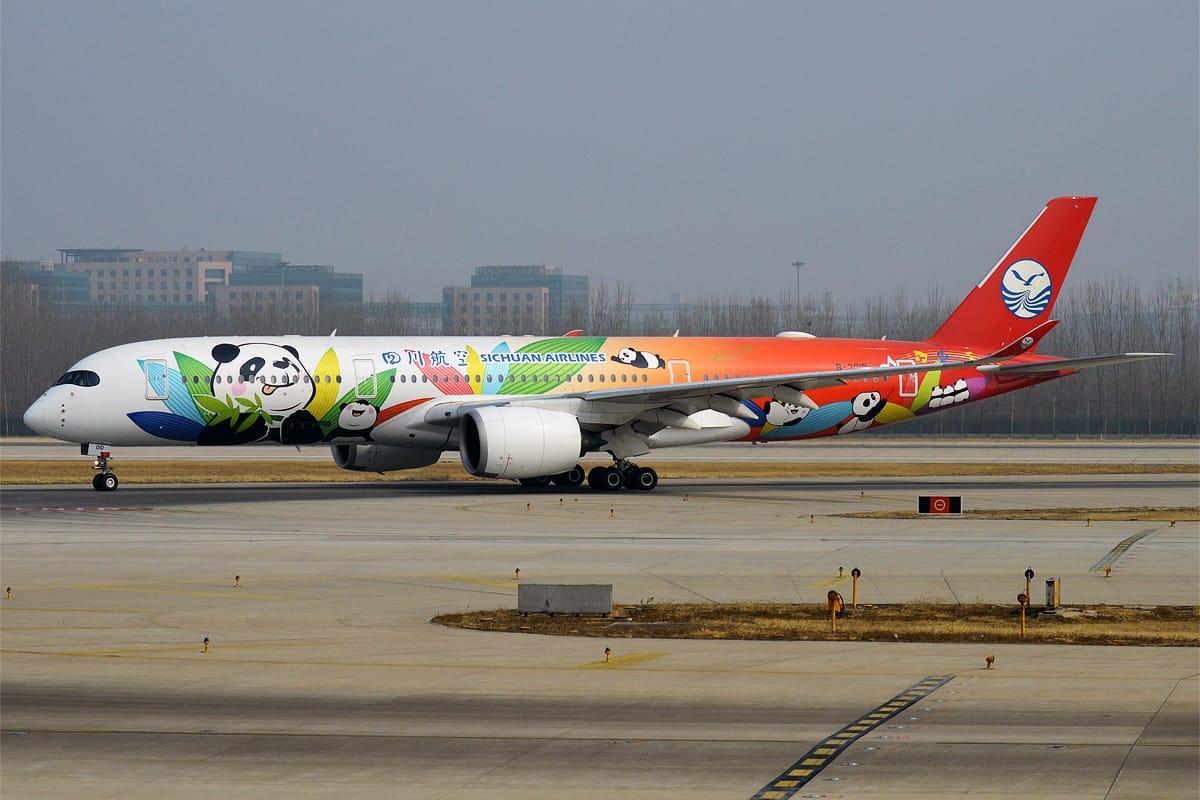
The A350-900 fleet is distinctive because of the special panda livery applied to one airframe, known publicly as “Panda Route.” The livery is a commercial and cultural tool, aligning the aircraft with the panda diplomacy associated with Chengdu’s global image.
Fleet Age Profile and Modernization
The reported average fleet age sits at approximately 10 years, close to the Big-3 Chinese carrier average. The age skew is heavily concentrated in the older A320-200 sub-fleet, with many CEO airframes approaching their second heavy maintenance check cycle.
The neo fleet is, by contrast, substantially younger. The A320neo and A321neo deliveries began in 2018 and have continued since, with aircraft averaging between five and eight years of service.
The widebody fleet is also relatively young, with all nine A350s delivered between 2018 and the mid-2020s. That means the A350 average age is roughly five years, offering a long remaining economic life and a low cost per available seat kilometer.
Aircraft Configuration and Cabin Strategy
Sichuan Airlines standardizes cabin configurations by sub-type to simplify maintenance, catering and crew training.
The A350-900 is the only aircraft in the passenger fleet with a true flat-bed business class across all airframes, and it is also the widebody most often deployed for the airline’s special interior installations.
The A350 cabin uses Thales Avant IFE systems, chosen for multilingual content flexibility and compatibility with passenger electronic devices. That upgrade was a meaningful step because older A330 aircraft in the fleet use a previous-generation IFE setup.
Typical seat configurations (public reports; may vary)
A350-900   33 business + 24 premium economy + 280 economy ≈ 337 seats
A330-300   24 business + 267 economy ≈ 291 seats
A330-200   30 business + 234 economy ≈ 264 seats
A321neo    8 business + 190 economy ≈ 198 seats
A320neo    8 business + 150 economy ≈ 158 seats
A319-100   8 business + 120 economy ≈ 128 seats
On narrowbody metal, business class is a recliner-type product rather than a flat bed, consistent with the short and medium-haul Chinese domestic market.
The A321LR is an exception, offered with an enhanced business product for international medium-haul sectors.
Future Fleet Strategy and Comac C919 Induction
Sichuan Airlines has publicly ordered 20 Comac C919 narrowbody aircraft, the first such order placed by the airline. The order reflects both strategic diversification away from a single-vendor fleet and the broader Chinese government push to support domestic aerospace manufacturing.
The C919 program has experienced delivery slippage. Comac delivered only 13 C919s through late December 2025, roughly half of the annual production target.
For 2026, Chinese airlines collectively expect approximately 33 C919 deliveries, distributed primarily among China Eastern, Air China and China Southern. Sichuan Airlines is expected to join the C919 operator club later in 2026 or 2027.
C919 induction challenges for Sichuan Airlines
- First non-Airbus narrowbody since fleet standardization
- Requires new type-rating program for pilots
- Separate MRO ecosystem and spare parts inventory
- Commercial uncertainty on C919 dispatch reliability
- Potential earnings tailwind if Comac delivers at pace in 2027+
The induction will not displace the Airbus narrowbody fleet but will complement it.
Sichuan’s long-standing Airbus pilot base and maintenance infrastructure means Airbus types will remain the overwhelming majority of the fleet into the 2030s.
Cargo Fleet Evolution and Freighter Strategy
The airline has been building a meaningful air cargo business on top of its belly capacity for more than five years.
It operates a mixed narrowbody and widebody freighter fleet consisting of three A330-200F production freighters, two A330-300 passenger-to-freighter conversions, and four A321 converted narrowbody freighters.
The A330-200F production freighters are rare globally. Only about three dozen were built, and Sichuan Airlines is one of a small club of Asian carriers to operate them in regular commercial service.
Cargo operational priorities
Primary focus   → Transpacific Chengdu-North America e-commerce flows
Secondary focus → Europe (Liege, Frankfurt, Amsterdam) trunking
Tertiary focus  → Southeast Asia perishables and pharma reverse logistics
Feeder role     → A321P2F for regional China/Asia next-day service
The cargo unit has worked closely with third-party handlers at Chengdu Tianfu and at select European gateways.
For example, ASR Cargo Center at Liege took over Sichuan’s outbound cargo handling in March 2026, an operational signal that the airline continues to treat freighter operations as a growth priority.
Special Livery and Branding Aircraft
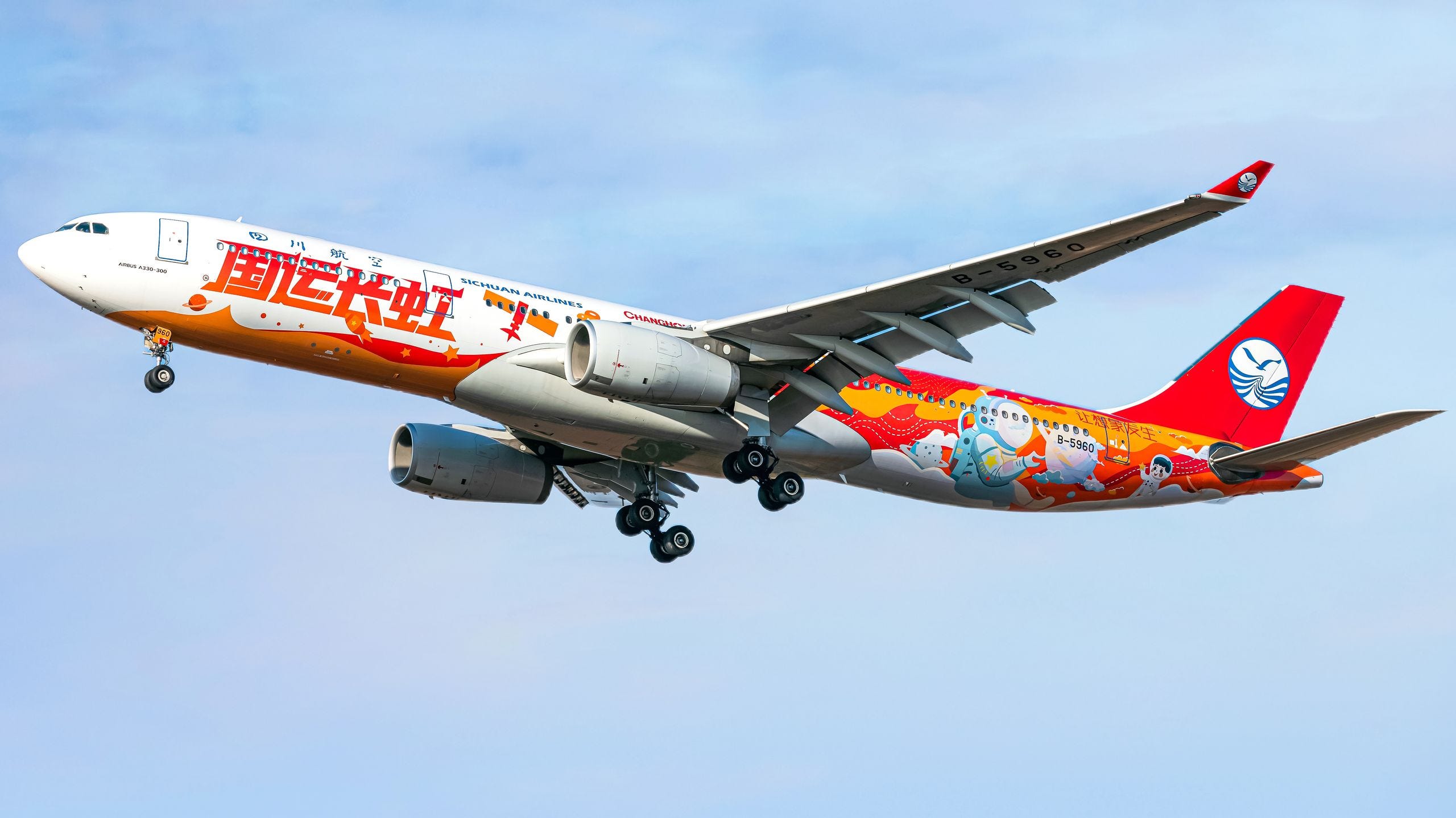
The airline is recognized for multiple special liveries on its widebody fleet, including a Panda livery on the A350 and historical Wuliangye, Changhong and Sichuan Bank liveries on A330 aircraft.
The strategic logic is that each livery ties the airline to a strategic provincial stakeholder. Changhong is a major Sichuan consumer electronics company, Wuliangye is the provincial baijiu champion, and Sichuan Bank is a regional financial institution.
This approach has turned the widebody fleet into a flying advertisement for Sichuan provincial enterprise, with the Panda livery serving a softer cultural diplomacy function.