


Welcome to AviationOutlook: The aviation newsletter built exclusively for decision-makers.
Become an “Annual” member now & get this special discount offer.
As a paid member, you get access to:
200+ Reports - All major airlines + aerospace & defense companies (updated regularly).
Daily / Weekly - Deep-dive analysis & insights.
Monthly - Industry outlook reports.
In case you missed it, here are the latest analysis reports:
Embraer - Company Analysis and Outlook Report 2026 (Updated)
American Airlines’ Six-Route Europe Play: Yield Discipline or Widebody Overreach?
Check Out All Reports
Executive Summary
The SIA Group closed FY2024/25 with record revenue of S$19,540 million and a record net profit of S$2,778 million, the latter boosted by a S$1,098 million non-cash accounting gain tied to the completion of the Air India-Vistara merger in November 2024.
For FY2025/26, the Group flew a record 42.4 million passengers, a 7.7% year-on-year increase, with the Group passenger load factor reaching 90.6% across Singapore Airlines and Scoot.
The combined SIA Group operated a fleet of approximately 208 aircraft as of 30 September 2025, with a further 67 jets on order, including 31 Boeing 777-9s now delayed until 2027.
The mainline carrier serves 79 airports across 34 countries from Changi, with Australia being the most-served nation and Jakarta hosting the highest frequency, while a 25.1% strategic stake in Air India broadens reach into the Indian subcontinent.
Recommended - Read Full Reports


Read All Reports
Table of Contents
Executive Summary
Introduction
Singapore Airlines Company Profile: Key Facts
Singapore Airlines Revenue & Financial Analysis
FY2024/25 Full-Year Performance: A Record on the Surface
Yield Compression and Capacity Growth
Cargo as a Quiet Stabiliser
FY2025/26 First Half: The Air India Drag Materialises
Q2 FY2025/26 in Focus
FY2025/26 Operational Records
Balance Sheet Strength
Singapore Airlines Revenue Growth Drivers and Key Products
Singapore Airlines Fleet Analysis
Fleet Size and Composition (Mainline)
Aircraft Type Strategy and Configuration
Airbus A350-900: The Workhorse Backbone
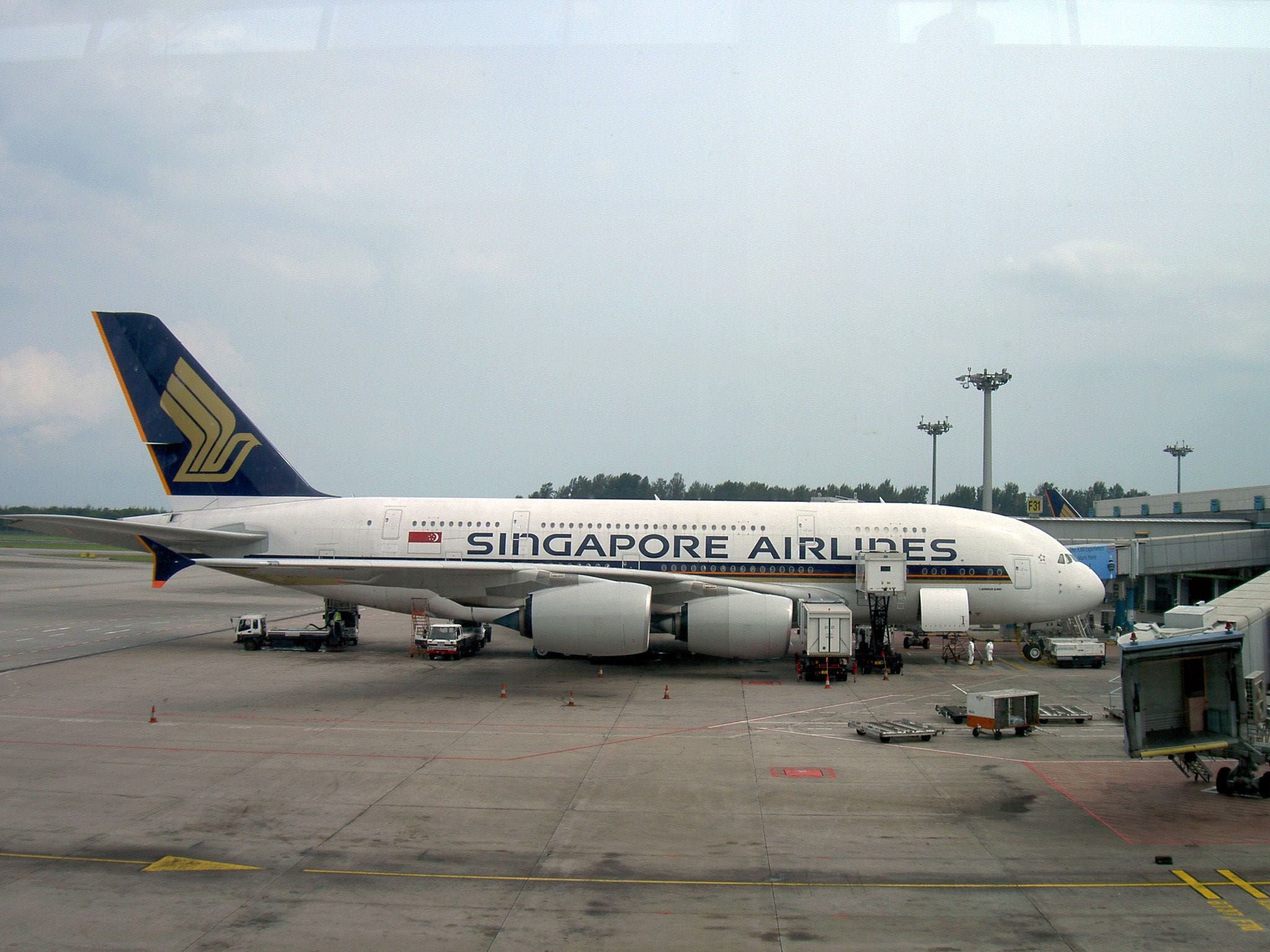
Airbus A380-800: The Premium Flagship
Boeing 777-300ER: The High-Capacity Long-Hauler
Boeing 787-10: The Regional Widebody
Boeing 737-8 MAX: The Short-Haul Standard
The Boeing 777-9 Delay and Its Consequences
Order Book and Future Deliveries
Scoot Fleet Strategy
Cabin Product Strategy and Refleet
Singapore Airlines Route Network, Major Destinations + Strategy
Network Footprint in 2026
Ultra-Long-Haul Backbone
Northern Summer 2026 Network Adjustments
Riyadh Launch in 2026
Cairns and Australia Reinforcement
Sixth-Freedom Strategy
Codeshare Network
Major Operational Bases (Hubs)
Singapore Changi Airport: The Singular Hub
Engineering and Maintenance Footprint
Air India Partnership and Indian Hubs
Scoot’s Operational Footprint
Singapore Airlines Competitive Position
Major Competitors
Singapore Airlines vs. Cathay Pacific Airways
Singapore Airlines vs. Emirates
Singapore Airlines vs. Qatar Airways
Singapore Airlines vs. Qantas Airways
Singapore Airlines vs. ANA and Japan Airlines
Singapore Airlines vs. Air India
Singapore Airlines vs. IndiGo
Cargo Strategy and Singapore Airlines Cargo
Loyalty and Customer Strategy
Sustainability Strategy and Sustainable Aviation Fuel
Brand and Service Strategy
Strategic Partnerships and Joint Ventures
Singapore Airlines Key Risks Analysis
Risk 1
Risk 2
Risk 3
Risk 4
Risk 5
Risk 6
Risk 7
Risk 8
Risk 9
Risk 10
My Final Thoughts
Official Sources & Data
Introduction
Singapore’s flag carrier has spent the past 18 months absorbing two seismic shifts: the merger that transformed its long-standing India joint venture into a 25.1% equity stake in Air India, and the deepening competition from Gulf and Chinese carriers that has compressed yields across long-haul markets.
The result is a paradoxical financial picture.
Headline net profit hit a record in FY2024/25, yet underlying operating profit fell by 37.3%, exposing how much of the bottom line was driven by accounting gains rather than core trading.
For airline stakeholders, the question is no longer whether SIA can defend its premium positioning.
It’s whether the carrier’s fleet renewal, dual-brand structure with Scoot, and its India bet can sustain growth as the global widebody supply chain remains broken.

Singapore Airlines Company Profile: Key Facts
Singapore Airlines Limited operates as the flag carrier of Singapore, headquartered at Airline House on Airport Boulevard near Changi Airport. The Group is publicly traded on the Singapore Exchange under the ticker C6L.
The Group structure is built on two operating airline brands plus engineering, cargo, and training subsidiaries. The mainline is positioned as a premium full-service carrier, while Scoot operates the medium and short-haul low-cost segments.
SIA GROUP — KEY FACTS SNAPSHOT (As of 2026)
-------------------------------------------------------
Founded                   : 1 May 1947 (as Malayan Airways)
Rebranded                 : 1 October 1972 (as Singapore Airlines)
Hub                       : Singapore Changi Airport (SIN)
CEO                       : Goh Choon Phong (since 1 January 2011)
Chairman                  : Peter Seah Lim Huat
Listing                   : SGX:C6L
Major Shareholder         : Temasek Holdings
Alliance                  : Star Alliance (member since 1 April 2000)
Loyalty Programme         : KrisFlyer / PPS Club
Subsidiaries              : Scoot, SIA Engineering Company
Equity Stake              : 25.1% in Air India
Group Fleet (Sep 2025)    : 208 aircraft + 67 on order
FY2024/25 Revenue         : S$19,540 million (record)
FY2024/25 Net Profit      : S$2,778 million (record)
FY2025/26 Passengers : 42.4 million (record, +7.7% YoY)The carrier remains majority-owned by Singapore’s sovereign wealth investor Temasek Holdings.
This shareholding structure has historically given the airline patient capital and a longer time horizon than private-sector peers, particularly during the pandemic recovery phase.
The corporate culture is built around an obsession with service quality, captured in the long-running “Singapore Girl” branding and the World’s Best Cabin Crew accolade in the 2025 Skytrax rankings.
The Group ranked second overall behind Qatar Airways in those awards.
Singapore Airlines Revenue & Financial Analysis
FY2024/25 Full-Year Performance: A Record on the Surface
The Group’s revenue climbed S$527 million (+2.8%) to a record S$19,540 million for the financial year ended 31 March 2025. Net profit rose 3.9% to S$2,778 million.
Yet the headline disguised a sharper fall in operating performance. Operating profit dropped to S$1,709 million, a decline of S$1,019 million or 37.3% versus the prior year.
The gap between record net profit and falling operating profit is explained by a single line item.
The completion of the Air India-Vistara merger in November 2024 produced a S$1,098 million non-cash accounting gain tied to the revaluation of the Group’s investment in Air India.

Yield Compression and Capacity Growth
Heightened competition was the principal force squeezing operating profit. SIA and Scoot together carried 39.4 million passengers, an 8.1% increase, but capacity expanded faster than traffic.
Group passenger load factor fell 1.4 percentage points to 86.6%. This dynamic, where capacity outpaced demand, hit yields across long-haul Europe and trans-Pacific markets.
Cargo as a Quiet Stabiliser
Cargo flown revenue rose 4.4% to S$2.2 billion for the year, supported by sustained e-commerce volumes and disruptions in container shipping that shifted urgent freight to air.
FY2024/25 INCOME STATEMENT HEADLINES (SGD million)
-------------------------------------------------------
Total Revenue                 19,540   (+2.8% YoY)
Cargo Flown Revenue            2,200   (+4.4% YoY)
Operating Profit               1,709   (-37.3% YoY)
Net Profit                     2,778   (+3.9% YoY)
Of which: Air India Gain       1,098   (Non-cash, one-off)
Final Dividend                  30 cts (per share)
Total FY Dividend               40 cts (per share)
Passengers Carried (millions)   39.4   (+8.1% YoY)
Group Passenger Load Factor 86.6% (-1.4 ppts)FY2025/26 First Half: The Air India Drag Materialises
The first half of FY2025/26 (April-September 2025) revealed the other side of the Air India coin. Group revenue edged up 1.9% to a first-half record of S$9,675 million.
Operating profit at S$803 million was marginally higher year-on-year, and passenger load factor improved 1.3 percentage points to 87.7%. The two carriers transported 20.8 million passengers, an 8% increase.
However, net profit collapsed 67.8% to S$239 million. The decline was driven by a S$417 million swing in the share of results from associated companies, reflecting Air India’s losses now flowing through equity accounting.
Q2 FY2025/26 in Focus
The second quarter showed a healthier underlying picture. Operating profit rose 22.5% to S$398 million on record quarterly revenue of S$4,885 million.
Yet the same Air India-related drag pulled net earnings down 82.1% year-on-year to just S$52 million for the quarter.
1H FY2025/26 SUMMARY (SGD million)
-------------------------------------------------------
Group Revenue                  9,675   (+1.9% YoY, record)
Group Expenditure              8,872   (+2.0% YoY)
Operating Profit                 803   (+marginal YoY)
Net Profit                       239   (-67.8% YoY)
Passengers (millions)           20.8   (+8.0% YoY)
Passenger Load Factor          87.7%   (+1.3 ppts)
Cash & Bank Balances           6,400
Long-term Fixed Deposits       2,100
Undrawn Credit Lines           3,300
Shareholders' Equity          15,500   (as of 30 Sept 2025)
Debt-to-Equity Ratio            0.70x
FY2025/26 Operational Records
The Group flew a record 42.4 million passengers in FY2025/26, a 7.7% rise on the previous year. March 2026 alone saw 3.8 million passengers, with traffic up 14.7%.
The Group’s full-year passenger load factor reached 90.6%, with mainline SIA recording a monthly load factor of 90.3% in March 2026, a new monthly record. Scoot posted 91.7% in the same month.
The March 2026 record was partly driven by traffic disruption to European competitors caused by Middle East airspace conflicts, which rerouted Europe-Asia traffic through Changi.
Balance Sheet Strength
As of 30 September 2025, Group shareholders’ equity stood at S$15.5 billion. Cash and bank balances closed at S$6.4 billion, with a further S$2.1 billion in long-term fixed deposits and S$3.3 billion in undrawn committed credit lines.
Debt balances fell by S$2 billion, lowering the debt-equity ratio to 0.70 times. This liquidity profile provides substantial resilience against fuel-price shocks and a continued period of yield compression.
The Board declared an interim special dividend of 3 cents and an interim dividend of 5 cents per share for the current financial year. A capital return plan proposes a special dividend of 10 cents per share annually for three financial years.
Singapore Airlines Revenue Growth Drivers and Key Products
Revenue is driven by four principal product pillars at the mainline carrier: Premium Suites, First Class, Business Class, and Premium Economy, alongside Economy. The full-service product is the highest-yielding, particularly on ultra-long-haul Europe and US routes.
Scoot complements the parent by capturing price-sensitive medium and short-haul demand. Its Embraer E190-E2 narrowbodies opened up thinner regional routes while the Boeing 787-9 and 787-10 fleet supports longer-range leisure markets.
Cargo, branded as Singapore Airlines Cargo, contributes a stable secondary revenue stream. It runs both belly cargo on passenger aircraft and a dedicated freighter operation handling e-commerce, perishables, and pharma traffic.
Singapore Airlines Fleet Analysis
Fleet Size and Composition (Mainline)
Singapore Airlines mainline operates one of the world’s most modern widebody-heavy fleets. As of March 2026, the airline had an active fleet of 144 aircraft, with 148 in service and 4 inactive units.
The composition reveals a deliberate twin-OEM strategy. Airbus accounts for the bulk of widebodies through the A350 family, while Boeing supplies the high-density 777-300ER, the 787-10, and the narrowbody 737-8 MAX.


SIA MAINLINE ACTIVE FLEET — MARCH 2026
-------------------------------------------------------
Aircraft Type           Active    Mission Profile
-------------------------------------------------------
Airbus A350-900 LH        34      Long-haul, 253-303 seats
Airbus A350-900 MH        23      Medium-haul, 303 seats
Airbus A350-900 ULR        7      Ultra-long-haul, 161 seats
Airbus A380-800           10      Premium long-haul flagship
Boeing 777-300ER          21      Long-haul, high capacity
Boeing 787-10             28      Medium-haul widebody
Boeing 737-8 MAX          21      Short and medium-haul
-------------------------------------------------------
TOTAL ACTIVE             144
TOTAL IN SERVICE         148
The average fleet age of the mainline operation sits around 8.7 years, considerably younger than legacy peers in Europe and North America.
Aircraft Type Strategy and Configuration
Airbus A350-900: The Workhorse Backbone
The A350-900 is the most important aircraft in the SIA inventory. The carrier operates three sub-variants tailored for different mission profiles, a fleet planning approach few other airlines have replicated at scale.
The Long-Haul (LH) variant, in 253-seat configuration, handles services to Europe and the western United States. The Medium-Haul (MH) variant, in 303-seat configuration, serves regional Asia and India.
The Ultra-Long-Range (ULR) variant carries just 161 seats, with 67 in business class and 94 in premium economy. This dedicated configuration is essential for the Newark and JFK nonstops, which run blocks of up to 19 hours and 15 minutes.
Airbus A380-800: The Premium Flagship
SIA was the launch operator of the A380 in 2007 and continues to deploy the type on its flagship routes. With 10 active aircraft as of March 2026, the A380 operates to London Heathrow, Sydney, Hong Kong, Tokyo, and Dubai.
From 29 March 2026, the A380 replaced the 777-300ER on Dubai services for the entire Northern Summer schedule. This signals confidence in the type as a yield instrument on dense premium markets.
Boeing 777-300ER: The High-Capacity Long-Hauler
The 21 active 777-300ERs handle high-capacity long-haul work where premium-heavy A350 configurations would leave revenue on the table. The type serves Paris CDG, Frankfurt, and a daily Singapore-Frankfurt-New York JFK rotation.
From 1 July 2026, the 777-300ER will deploy on Singapore-Amsterdam services, introducing First Class on the route for the first time.
Boeing 787-10: The Regional Widebody
The 787-10 is the carrier’s medium-haul widebody for Asian markets. With 28 active units, the Dreamliner serves dense routes across India, Indochina, and East Asia where the A350-900 MH would be over-sized.
Two new 787-10s entered service in early 2026, registered 9V-SDB and 9V-SDC.
Boeing 737-8 MAX: The Short-Haul Standard
The MAX 8 standardised the short-haul narrowbody fleet after the integration of SilkAir into the mainline brand. With 21 active aircraft and another 8 still on order, the type operates regional services within Southeast Asia.
The configuration includes 10 lie-flat business class seats inherited from SilkAir, providing brand continuity for premium passengers on shorter sectors.
The Boeing 777-9 Delay and Its Consequences
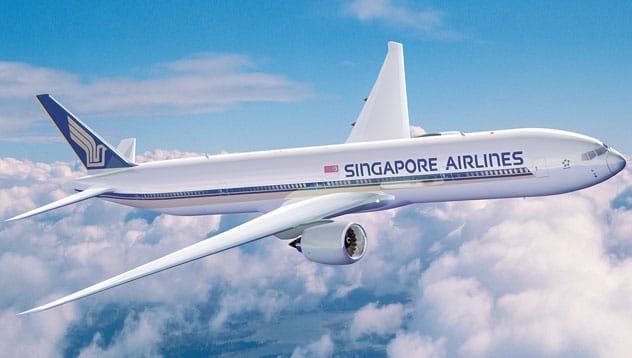
The most consequential fleet event of 2025 was Boeing’s confirmation that 777-9 deliveries will not begin until 2027. SIA has 31 of the variant on order.
The delay has forced a strategic pivot. SIA has officially stopped including the 777-9 in its 12-month delivery outlook and is shifting next-generation cabin products onto the A350 fleet instead of waiting indefinitely.
CEO Goh Choon Phong stated publicly that the carrier is not expecting major impact from the delay, citing the resilience of the existing widebody mix.
Order Book and Future Deliveries
SIA MAINLINE ORDER BOOK (March 2026)
-------------------------------------------------------
Aircraft Type          On Order    Expected
-------------------------------------------------------
Boeing 777-9               31      2027 onwards
Boeing 787-10               3      Ongoing 2026
Boeing 737-8 MAX            8      April 2026 onwards
-------------------------------------------------------
TOTAL                      42 (mainline only)
Group-wide, including Scoot, the order book stood at 67 aircraft as of 30 September 2025.
Scoot Fleet Strategy
Scoot, the wholly-owned low-cost subsidiary, has rapidly transformed its narrowbody fleet. The introduction of the Embraer E190-E2 opened thinner regional markets that the Airbus A320 family would have struggled to operate profitably.
The wider Scoot fleet pairs the regional Embraers and Airbus A320/A321neos with Boeing 787-8 and 787-9 widebodies for medium-haul markets stretching to Athens, Berlin, and Australia.
Cabin Product Strategy and Refleet

The 777-9 delay has prompted SIA to introduce its full suite of next-generation long-haul cabins on the A350 fleet first. This is a meaningful shift, as the A350 was originally not intended to receive the new product earlier than the 777-9.
The new long-haul product set includes redesigned First Class on selected widebodies, a refreshed Business Class with greater density without losing privacy, and an improved Premium Economy.