


Executive Summary
Spring Airlines closed 2025 with operating revenue of RMB 21.46 billion (up 7.3% year on year) and net profit attributable to shareholders of RMB 2.317 billion, reinforcing its position as China’s most profitable low-cost carrier on a per-seat basis, per the airline’s 2025 annual report.
The carrier operates a disciplined all-Airbus A320 family fleet of 134 aircraft as of the end of 2025, and signed a firm order for 30 A320neo family jets in December 2025 with deliveries scheduled between 2028 and 2032.
Route network spans 88 domestic and 24 international destinations across 12 countries, anchored by the twin Shanghai hubs of Hongqiao and Pudong, plus the strategic secondary base at Shijiazhuang Zhengding.
Full-year 2025 passenger load factor reached 91.5%, unit ASK cost dropped 5.0% to RMB 0.300, and international capacity surged 28.5% year on year, driven by aggressive rebuilding on Japan, Thailand, and Korea corridors.
Recommended - Read Full Reports


Read All Reports
Table of Contents
Executive Summary
Key Facts: Company Profile
Business Overview
Revenue Architecture and LTM Financial Performance
Revenue Growth Drivers
Unit Revenue and Pricing Environment
Cost Structure and Operational Efficiency
Key Products and Services
Fleet: In-depth Analysis
Fleet Size and Composition at End of 2025
Aircraft Type Strategy and Configuration
Fleet Strategy and Future Orders
Fleet Utilization and Productivity
Route Network, Major Destinations and Strategy
Domestic Network Breadth
International Expansion Pattern
Network Strategy and Commercial Philosophy
International Recovery Trajectory
Major Operational Bases (Hubs)
Shanghai Hongqiao International Airport
Shanghai Pudong International Airport
Shijiazhuang Zhengding International Airport
Secondary Bases and Domestic Crew Structures
Competitive Position
Major Competitors
Spring Airlines vs. Juneyao Airlines
Spring Airlines vs. China United Airlines
Spring Airlines vs. Chengdu Airlines
Spring Airlines vs. Hainan Airlines
Scale Competitors Beyond China
Spring Japan: The JAL-Affiliated Subsidiary
Safety Record and Operational Excellence
Digital Distribution and Commercial Innovation
Ancillary Revenue and Product Tiering
Corporate Governance and Leadership
Sustainability and Fleet Modernization
Market Environment: Chinese Aviation in 2026
Key Risks with Probabilities and Scenarios
Fuel Price Volatility Risk
Currency Depreciation Risk
International Market Political Risk
Regulatory and Slot Allocation Risk
Competition Intensification Risk
Travel Demand Shortfall Risk
Forward Outlook and Strategic Posture
My Final Thoughts
Official Sources and Data
Key Facts: Company Profile
Spring Airlines Co., Ltd. is the largest privately owned low-cost carrier in mainland China and the flagship aviation subsidiary of Shanghai Spring International Travel Service.
The airline was approved by regulators on 26 May 2004 and began commercial operations on 18 July 2005 with a single leased Airbus A320 flying a Shanghai to Yantai route.
The company trades on the Shanghai Stock Exchange under ticker 601021.SH, having completed its listing in January 2015. Its headquarters sit in the Changning District of Shanghai, a short drive from Hongqiao Airport, placing the executive team within walking distance of its busiest operational base.
COMPANY OVERVIEW (as of April 2026)
-----------------------------------
Legal name:          Spring Airlines Co., Ltd.
Chinese name:        春秋航空股份有限公司
IATA / ICAO / Call:  9C / CQH / AIR SPRING
Founded:             26 May 2004
Commenced service:   18 July 2005
Headquarters:        Changning District, Shanghai
Listed:              SSE: 601021 (since January 2015)
Chairman:            Wang Yu
CEO:                 Zhang Xiuzhi
Parent:              Spring Airlines Ltd.
Fleet size:          134 aircraft (end-2025)
Fleet type:          100% Airbus A320 family
Destinations:        88 domestic + 24 international
Main hubs:           Shanghai Hongqiao, Shanghai Pudong, Shijiazhuang
Subsidiary:          Spring Japan (minority stake, ~30%)
Loyalty program:     Spring Pass
2025 revenue:        RMB 21.46 billion (+7.3% YoY)
2025 net profit:     RMB 2.317 billion (+2.0% YoY)
Load factor 2025: 91.5%Spring is the only Chinese airline to have continuously achieved an overall Grade A rating in the Civil Aviation Administration of China’s “Four Rates” assessment covering safety, on-time performance, service quality, and flight execution.
In October 2025, Airline Ratings awarded Spring a seven-star safety rating, the top tier in its global assessment methodology.
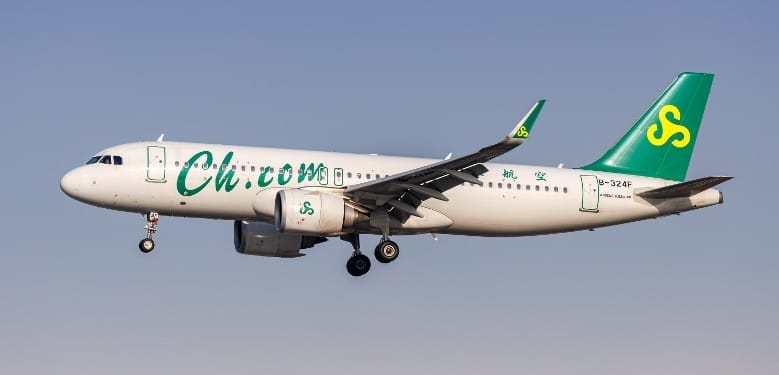
The airline’s brand architecture rests on the “3S” logo representing Safety, Sincerity, and Smile, and its public slogan “Don’t think, Just fly” captures the no-frills ethos at the heart of its commercial model.
The visual identity was refreshed in 2021 with a cleaner green-and-silver livery now rolling out progressively across the fleet.
Business Overview
Revenue Architecture and LTM Financial Performance
Spring Airlines generated revenue of RMB 21.46 billion in full-year 2025, representing 7.3% growth over the prior year. Net profit attributable to shareholders reached RMB 2.317 billion, a modest 1.96% improvement that reflects the persistent fare pressure the whole Chinese aviation industry absorbed through 2025.
The quarterly profit pattern through 2025 tells a story of tightening conditions in the first half followed by a sharp fourth-quarter recovery.
Attributable net profit across the four quarters registered RMB 677 million, RMB 491 million, RMB 1.167 billion, and negative RMB 18 million respectively, with the traditionally weak Q4 seeing a 94.5% reduction in losses compared with the prior year.
On a trailing twelve month basis as of the end of 2025, the carrier’s revenue translates to approximately USD 2.98 billion at prevailing exchange rates, positioning Spring firmly within the top tier of Asian low cost carriers by turnover.
The gap between top-line growth and bottom-line growth in 2025 signals the compression of unit revenue that has defined the post-reopening phase of the Chinese domestic market.
Revenue Growth Drivers
Capacity expansion was the dominant engine of 2025 revenue growth.
Total available seat kilometers grew 12.1% year on year, with international ASK surging 28.5%, domestic ASK rising 8.7%, and Hong Kong-Macao-Taiwan regional ASK declining 27.7% as resources rotated toward more profitable international flying.
Revenue passenger kilometers moved in near-perfect lockstep with capacity, also increasing 12.1% for the full year. Domestic RPK climbed 9.1%, international RPK jumped 27.5%, and regional RPK contracted 27.6%, confirming that Spring has successfully redeployed idle wide-network capacity from low-yielding regional routes into the more productive outbound tourism corridors.
2025 CAPACITY AND TRAFFIC BREAKDOWN
-----------------------------------
                      ASK YoY   RPK YoY   Load Factor
Total network:        +12.1%    +12.1%    91.5%
Domestic:             +8.7%     +9.1%     92.5%
International:        +28.5%    +27.5%    88.0%
HK-Macao-Taiwan:      -27.7%    -27.6%    90.7%
Load factors continue to set the industry benchmark. The full-year figure of 91.5% exceeded the 2019 pre-pandemic peak by 0.72 percentage points, with the domestic load factor of 92.5% reflecting the near-impossible-to-beat seat-filling discipline of the Spring commercial team.
Unit Revenue and Pricing Environment
Unit revenue metrics contracted across the board in 2025, mirroring the broader sectoral fare compression. Revenue per RPK fell 3.8% to RMB 0.370, while revenue per ASK slipped 3.7% to RMB 0.339, with Spring essentially trading ticket price for flown seats to fill its expanded capacity.
The Chinese aviation sector adopted what analysts describe as a “volume for price” strategy across 2025, and Spring was no exception.
Because the airline already operated at sector-leading load factors, it had less capacity to absorb incremental traffic before running into physical ceilings, meaning fare discounts flowed more directly through to reported yields than for full-service peers.
An inflection appeared in the early months of 2026. Industry data through March 2026 show ticket prices turning positive year on year, and company guidance flagged April fare improvements, which analysts expect to provide meaningful tailwinds against the 74% year on year spike in domestic jet fuel prices seen that same month.
Cost Structure and Operational Efficiency
Spring Airlines operates with the lowest unit ASK cost among publicly listed Chinese carriers. Full-year 2025 unit ASK cost came in at RMB 0.300, representing a 5.0% year-on-year decline. Unit fuel cost fell 9.6% to RMB 0.101, while unit non-fuel cost dropped 2.5% to RMB 0.199.
The decline in unit fuel expense reflected a 9.5% reduction in average jet fuel prices through 2025, a benefit the airline passed partially to consumers through lower fares. Rising load factors simultaneously helped dilute fixed non-fuel costs across a larger revenue base, producing the best cost structure in the Chinese industry on a per-seat-kilometer basis.
Third-party research documenting the airline’s commercial model notes that Spring’s unit sales cost sits at approximately RMB 0.0045 per ASK, well below the industry average.
The airline essentially eliminated traditional advertising and avoided travel agency commissions from day one, marketing itself instead through direct channels that it controls end to end.
2025 UNIT ECONOMICS (RMB per unit)
----------------------------------
Unit revenue per ASK:        RMB 0.339  (-3.7% YoY)
Unit revenue per RPK:        RMB 0.370  (-3.8% YoY)
Unit total cost per ASK:     RMB 0.300  (-5.0% YoY)
  - Unit fuel cost per ASK:  RMB 0.101  (-9.6% YoY)
  - Unit non-fuel per ASK:   RMB 0.199  (-2.5% YoY)
Spread (revenue - cost/ASK): RMB 0.039
Aircraft utilization rose to 9.97 block hours per aircraft per day in 2025, up 0.67 hours year on year, though still 1.27 hours below the 2019 peak of 11.24 hours.
That utilization gap represents Spring’s single largest operational lever for 2026, because closing even half of it would unlock several percentage points of unit cost improvement at no incremental capital outlay.
Key Products and Services
Spring offers a tiered product architecture that sits between pure-play budget carriers and regional hybrid models. The core base fare strips out complimentary meals, checked baggage, and seat selection, with passengers paying modest supplements for any of these via the airline’s direct channels.
Ancillary services have expanded significantly since the company’s 2015 listing. Passengers can purchase hotels, scenic attraction tickets, baggage upsells, onboard meals, preferred seat selection, visa assistance, car rental, and airport transfers through the ch.com booking flow.
The company has taken particular pride in being the only major Chinese airline that launched without relying on either the TravelSky booking system or traditional ticket agents.
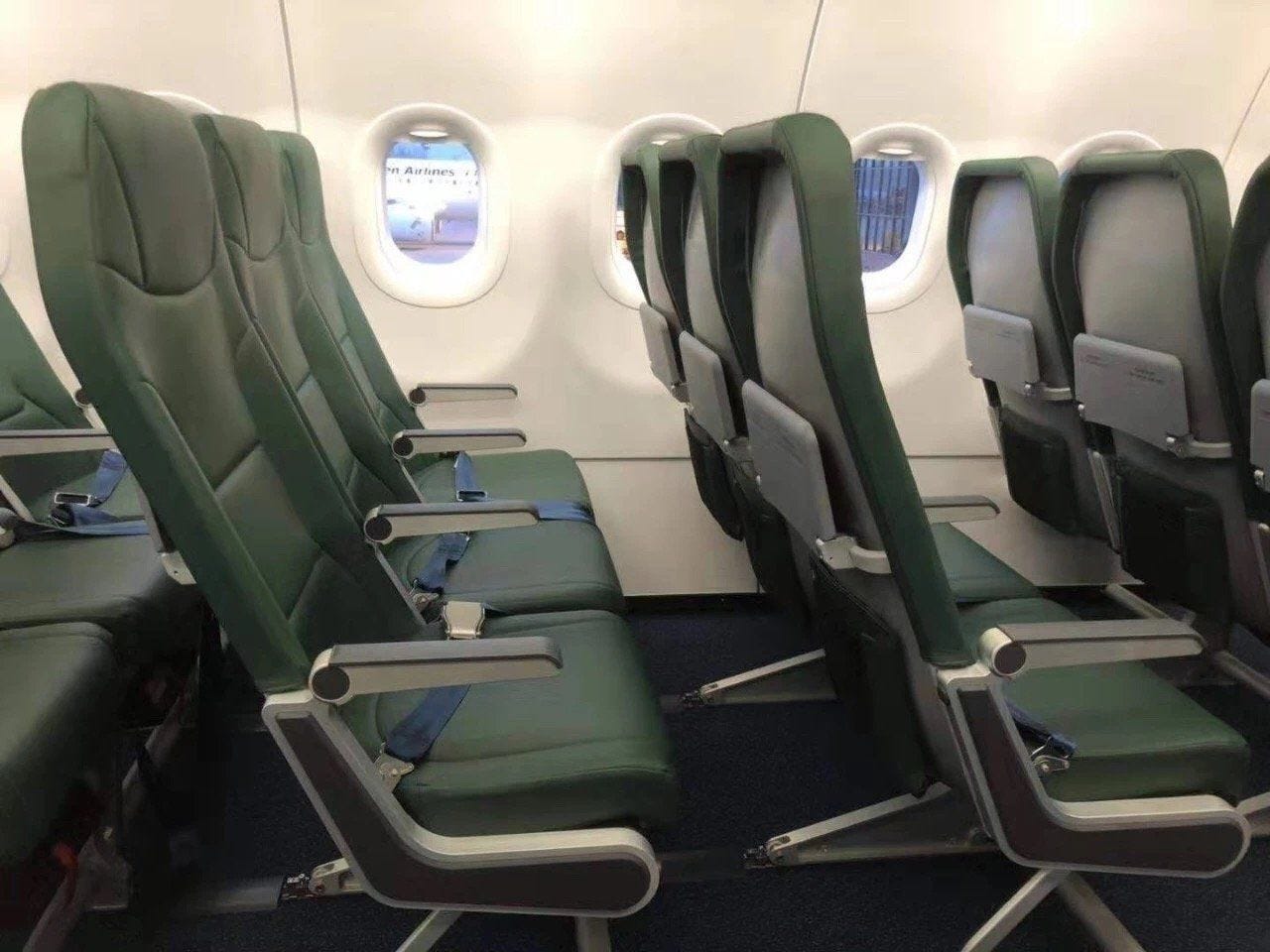
Newly delivered aircraft from February 2019 onwards feature cabin upgrades including seats with a fixed 114 degree backrest recline angle, which the airline describes as a compromise between its ultra-dense seating philosophy and passenger comfort expectations on longer regional flights.
The product hierarchy extends upward with “Spring Plus” seats offering more legroom for a fee, and a premium “Business Seat” product on selected international routes.
Direct distribution remains central to the commercial model.
The ch.com website and the Spring mobile app together handle the overwhelming majority of ticket sales, allowing the airline to preserve margin that full-service competitors surrender to global distribution systems and travel agencies.
Fleet: In-depth Analysis
Fleet Size and Composition at End of 2025
Spring Airlines closed 2025 with 134 aircraft in service. The airline maintains a strict single-family fleet policy rooted in the Airbus A320 platform, a discipline that delivers meaningful savings on pilot training, spare parts inventories, maintenance contracts, and crew scheduling complexity.
Fleet composition as of the most recent disclosures breaks down into three variants.
The airline operates roughly 75 first-generation Airbus A320-200s configured in three different dense layouts accommodating 174, 180, or 186 passengers. It also flies around 47 A320neo aircraft configured for 186 seats and 12 A321neos configured for 240 seats across the extended fuselage.
SPRING AIRLINES FLEET COMPOSITION (end-2025)
--------------------------------------------
Aircraft type        In service   Orders   Typical seats
Airbus A320-200      ~75          0        174 / 180 / 186
Airbus A320neo       ~47          7+       186
Airbus A321neo       ~12          4+       240
---------------------------------------------
Total                134          30 (+11) All-Airbus
The 186 seat configuration represents Spring’s most aggressive use of cabin real estate, achieved through the adoption of slim line seats, a reduced galley footprint, and the removal of one lavatory relative to standard configurations. The 240 seat A321neo pushes this density philosophy onto the larger airframe, producing the lowest available unit cost in the fleet.
Fleet age averages approximately 7 years based on ch-aviation and Planespotters records, making Spring’s fleet marginally older than the global A320 family average but meaningfully younger than the fleets of its state-owned domestic peers.
The airline added only five net new aircraft across 2025, a deliberately restrained expansion pace that reflects the availability constraints of Chinese macro financing and delivery slots in the global A320 supply chain.
Aircraft Type Strategy and Configuration
The choice of an exclusively Airbus A320-family fleet rests on four interlocking commercial arguments.
First, common type ratings allow pilots to fly any aircraft in the operating fleet with only differences training, which slashes training cost and maximizes crew flexibility for schedule recovery.
Second, maintenance inventories and tooling consolidate around a single aircraft type, producing measurable savings on working capital.
Third, the densified 186 seat A320neo and 240 seat A321neo configurations produce the lowest per-seat fuel burn in their respective categories, because the fixed aerodynamic and engine penalties are amortized across more revenue-producing seats.
Fourth, the A320neo engine options deliver roughly 15% fuel burn improvement relative to the ceo generation, a structurally important cost lever given that fuel represents about one-third of the airline’s total operating expense base.
The A321neo deserves specific attention within the Spring strategy. Its range permits the airline to operate longer international sectors without needing to migrate to a wide-body platform, opening destinations across Southeast Asia, Northeast Asia, and the Indian subcontinent from Shanghai with superior unit economics compared with a smaller aircraft on the same stage length.
SEAT DENSITY BY AIRCRAFT TYPE
-----------------------------
A320-200 (174y):    1 lavatory removed, standard galley
A320-200 (180y):    Mid-density traditional layout
A320-200 (186y):    Slimline seats, reduced galley
A320neo (186y):     Max density + 15% fuel burn gain
A321neo (240y): Extended fuselage, range flexFleet Strategy and Future Orders
On 29 December 2025, Spring Airlines signed a firm order with Airbus for 30 A320neo family aircraft at a price not exceeding the USD 4.13 billion list value. The jets will deliver in batches from 2028 through 2032, pending the customary Chinese government approvals that accompany aircraft purchases.
This December 2025 order landed alongside a parallel commitment from Juneyao Airlines for 25 A320-family jets, a joint announcement that reopened the long-stalled bilateral aircraft dialogue between Beijing and Airbus.
Airbus had been in on-off negotiations since 2024 to secure an order for approximately 500 Chinese jets, and the Spring plus Juneyao combined commitment represents an important signaling event for the relationship.
Spring’s existing order book prior to the December 2025 announcement included roughly 7 undelivered A320neos and 4 undelivered A321neos, implying a total forward fleet pipeline of 41 aircraft including the new commitment.
If delivery slots hold and the airline retires no additional A320ceo aircraft during the interval, the fleet could realistically reach around 170 to 175 aircraft by the end of the decade.
The forward fleet strategy has two notable implications for stakeholders.
The shift toward A320neo family aircraft accelerates the retirement of older A320ceo airframes, which will drive a meaningful step down in fuel burn per seat once the cohort reaches critical mass.
The timing of deliveries also aligns with the tail end of China’s 15th Five Year Plan period (2026 to 2030), during which the Civil Aviation Administration has signaled continued infrastructure investment in secondary cities and interior regions where Spring has deliberately cultivated a presence.
Fleet Utilization and Productivity
Fleet productivity, measured in block hours per aircraft per day, remains Spring’s most visible operational recovery story. The 2025 figure of 9.97 hours compares with 9.30 hours in 2024 and 11.24 hours in 2019, illustrating the protracted recovery of Chinese aviation to full pre-pandemic productivity norms.
The productivity gap persists because certain international markets, particularly Greater China regional flying, have not fully recovered, and because slot constraints at some secondary domestic airports continue to cap the number of rotations possible on a single aircraft per day.
The airline has responded by tilting deployments toward higher utilization international markets where slot availability is less constrained, a pattern visible in the 28.5% year on year international ASK growth delivered in 2025.
AIRCRAFT UTILIZATION TREND (block hours/day)
--------------------------------------------
2019 (pre-pandemic peak):  11.24 hours
2024:                       9.30 hours
2025:                       9.97 hours
Gap to 2019 peak:           1.27 hours
Every additional hour of daily utilization effectively adds one aircraft worth of capacity for every 10 aircraft in the fleet, so closing the productivity gap over the course of 2026 and 2027 could be the equivalent of adding an organic 13 to 15 aircraft without any capital spending beyond the ordinary delivery stream.