


Executive Summary
SWISS closed 2025 with CHF 502 million operating profit on total revenue of CHF 5.50 billion, carrying 18.1 million passengers at a systemwide load factor of 83.3 percent, the most profitable airline within the Lufthansa Group portfolio.
The carrier has entered a long-haul transformation, taking delivery of its first Airbus A350-900 in October 2025 and its second airframe in early February 2026, with a total of ten A350s planned to replace the legacy A340-300 quadjets.
Q1 2026 produced a CHF 30 million operating result, nearly ten times the prior-year quarter, even as CEO Jens Fehlinger warned about jet fuel cost pressure and a structural pilot and crew rebalancing across the network.
New 2026 routes include Zurich to Poznań (Poland) and Rijeka (Croatia), while the flagship Airbus A350 is being deployed to Boston, Seoul, and additional North American gateways from the start of the summer 2026 schedule.
Recommended - Read Full Reports


Read All Reports
Table of Contents
Executive Summary
SWISS Company Profile: Key Facts
SWISS Revenue and Financial Analysis
Full Year 2025 Revenue Performance
Latest Earnings Report and Forward Guidance
Revenue Growth Drivers
Key Services and Product Offering
SWISS Fleet Analysis
Fleet Size and Composition Overview
Long-Haul Fleet Strategy
Airbus A350-900 Introduction Timeline
Short and Medium-Haul Fleet
Fleet Age and Modernization Trajectory
SWISS Route Network Strategy
Network Footprint and Scale
Summer 2026 New Routes
Long-Haul Network Strategy
European and Domestic Network
Major Operational Bases (Hubs)
Zurich (ZRH) – The Primary Hub
Geneva (GVA) – The Secondary Base
Maintenance and Engineering Footprint
SWISS Competitive Position
Major Competitors
SWISS vs Lufthansa
SWISS vs Air France-KLM
SWISS vs Turkish Airlines
SWISS vs British Airways
SWISS vs Gulf Carriers (Emirates, Qatar, Etihad)
Sustainability and Operational Efficiency
AeroSHARK Rollout
Sustainable Aviation Fuel
Engine Reliability Program
Cargo Operations: Swiss WorldCargo
SWISS Senses Cabin Strategy
Business Class
First Class
Premium Economy and Economy
Retrofit Plan for Existing Fleet
Group Structure and Strategic Position
Customer Experience and Frequent Flyer Programme
Key Risks: Forward-Looking Assessment
Risk 1
Risk 2
Risk 3
Risk 4
Risk 5
Risk 6
Risk 7
Risk 8
Risk 9
Risk 10
Operational Reliability and Brand Reputation
My Final Thoughts
Official Sources and Data
SWISS Company Profile: Key Facts
SWISS, the flag carrier of Switzerland, was formed from the assets of the bankrupt Swissair and regional subsidiary Crossair, with operations beginning on 1 April 2002.
The airline is fully integrated within the Lufthansa Group following its acquisition in 2005, and operates under the brand of premium Swiss quality with a clear hub-and-spoke design.

The carrier holds a registered office in Kloten, near Zurich Airport, and operates as a member of Star Alliance with reciprocal lounge, baggage, and frequent flyer privileges across 26 member airlines.
Its sister airline, Edelweiss Air, complements the SWISS network on leisure routes and is also Lufthansa Group-owned.
SWISS – Key Facts (2026)
-------------------------------------------------
IATA / ICAO code         : LX / SWR
Founded                  : 1 April 2002
Headquarters             : Kloten, Switzerland
Parent group             : Lufthansa Group
Alliance                 : Star Alliance
CEO                      : Jens Fehlinger
Primary hub              : Zurich (ZRH)
Secondary base           : Geneva (GVA)
Fleet size (approx.)     : ~92 aircraft
Destinations (summer 26) : 112 destinations
2025 Passengers          : 18.1 million
2025 Operating profit    : CHF 502 million
2025 Revenue             : CHF 5.50 billion
The leadership team led by CEO Jens Fehlinger has stated that SWISS aims to lay foundations for profitable growth during 2026 by reducing complexity, streamlining the fleet, and rolling out its new “SWISS Senses” cabin product across the long-haul system.
SWISS Revenue and Financial Analysis
Full Year 2025 Revenue Performance
The 2025 financial year marked a clear inflection point for the airline.
Total revenue fell 2.6 percent to CHF 5.50 billion, with operating profit dropping to CHF 502.2 million from CHF 684 million in 2024. Despite the decline, SWISS remained the most profitable airline within the Lufthansa Group umbrella.
Higher unit costs, a softer yield environment on certain long-haul markets, and elevated Zurich infrastructure charges combined to compress margins through the year.
The carrier still reached a 9.3 percent operating margin, a level that placed SWISS approximately ten times more profitable than mainline Lufthansa Airlines.
SWISS Financial Year 2025 (Reported in CHF)
-------------------------------------------------
Total revenue        : CHF 5.50 billion (-2.6% YoY)
Operating profit     : CHF 502.2 million (-26.6% YoY)
Operating margin     : ~9.3%
Passengers carried   : 18.1 million (+0.6% YoY)
Seat load factor     : 83.3%
Capacity (ASK)       : Slightly above 2024
Source: SWISS / Lufthansa Group Investor RelationsLatest Earnings Report and Forward Guidance
The carrier’s Q1 2026 operating result reached CHF 30.0 million, a significant jump from CHF 3.3 million in Q1 2025.
Q1 has historically been the seasonally weakest quarter for the carrier given the slower European leisure cycle, so a material year-on-year improvement is a credible read on underlying booking momentum.
CEO Jens Fehlinger told stakeholders that demand into the Far East strengthened, partly because Gulf carrier capacity in Europe has been less available in some markets and partly because premium-leisure demand to Asia continued to recover.
He flagged the persistent risk of jet fuel volatility, alongside a structural cost increase tied to the new A350 introduction phase.
Revenue Growth Drivers
The first major lever for revenue progression in 2026 and beyond is the premium cabin uplift on long-haul services. The new SWISS Senses business and first class products, deployed initially on the A350-900, address a market gap in long-haul premium travel where Swiss premium yield has lagged peers such as Lufthansa First on rebuilt A380s and Air France La Première.
The second lever is network restoration. Several engine-related groundings during 2025, particularly involving Pratt & Whitney GTF issues on the A220 and A320neo families, depressed available seat kilometers. As those engines progressively return to service, SWISS regains revenue capacity it could not deploy in 2025.
A third driver is the cargo side of the business. Swiss WorldCargo and Lufthansa Cargo entered a new strategic cooperation that deepens commercial and operational synergies while keeping both brands. Swiss WorldCargo also joined the joint business agreement between Cathay Pacific Cargo and Lufthansa Cargo on the transatlantic, opening new commercial channels.
Key Services and Product Offering
SWISS divides its passenger product into SWISS First, SWISS Business, SWISS Premium Economy and SWISS Economy.
The introduction of exclusive suites in SWISS First on the A350 represents the carrier’s most ambitious premium upgrade in over a decade.
The new business class is structured as eight Business Suites with sliding doors, integrated within a 45-seat cabin that includes five distinct seat configurations to match traveler preferences.
This product targets a premium-business demographic that has shifted upmarket post-pandemic.
SWISS Cabin Classes (A350-900 reference layout)
-------------------------------------------------
SWISS First           : Private suites (up to 3 incl. Grand Suite)
SWISS Business        : 45 seats, 8 Business Suites with doors
SWISS Premium Economy : Larger seat pitch / dedicated cabin
SWISS Economy         : Standard short and long-haul economy
Special               : Grand Suite (double bed configuration)
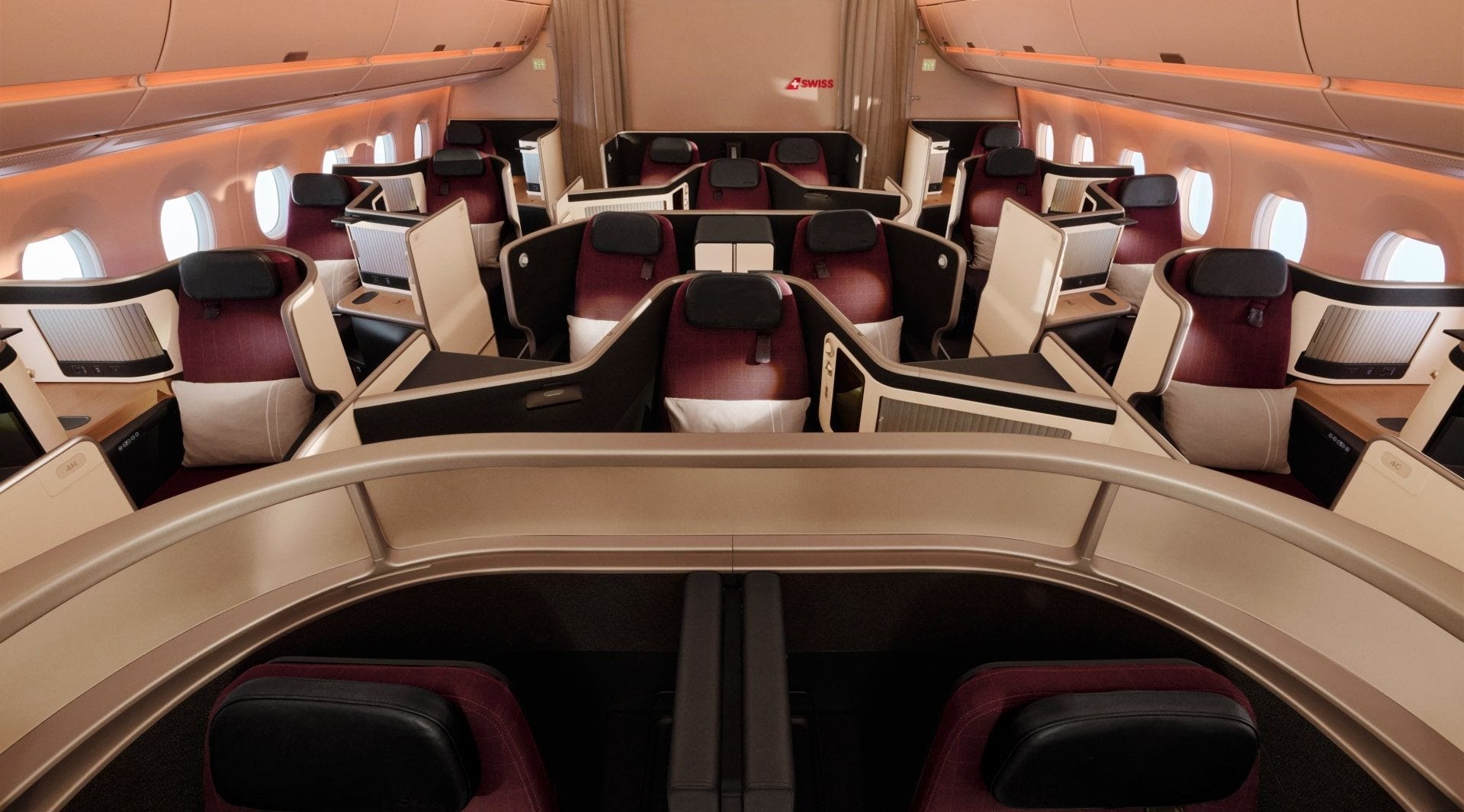
The premium economy cabin offers a meaningful gap between economy and business, addressing the corporate mid-tier traveler who can no longer justify lie-flat seats but expects more than 31 inches of pitch.
This segmentation reflects a wider European premium positioning strategy that mirrors approaches taken by Lufthansa Allegris and Air France La Première.
SWISS Fleet Analysis
Fleet Size and Composition Overview
SWISS operates a fleet of 92 aircraft across five active sub-fleets, working towards a target of two aircraft types by 2028 per CEO Fehlinger’s strategy.


The carrier therefore, sits in the middle of a generational fleet renewal, retiring older quadjets while welcoming new Airbus A350-900 widebodies.
The long-haul fleet currently consists of twelve Boeing 777-300ERs, fourteen Airbus A330-300s, the remaining A340-300s slated for retirement, and the first two A350-900s.
The carrier’s short and medium-haul operation runs on Airbus A220-100, A220-300, A320neo and A321neo aircraft, with the A220 family used for thinner European and select North African routes.
Long-Haul Fleet Strategy
The long-haul backbone is anchored by the Boeing 777-300ER, which carries the heaviest passenger loads on transpacific and Asian markets.
All twelve Boeing 777s have been equipped with AeroSHARK film, a riblet surface technology developed with Lufthansa Technik and BASF that mimics shark skin to reduce drag.
SWISS Long-Haul Fleet Snapshot (2026)
-------------------------------------------------
Boeing 777-300ER       : 12 (all with AeroSHARK)
Airbus A330-300        : 14 (cabin refurbishment underway)
Airbus A350-900        : 2 in service, 8 more on order
Airbus A340-300        : Phasing out by end of 2025/26
Note: A350 to debut SWISS Senses cabin first;
777 and A330 refit to follow.
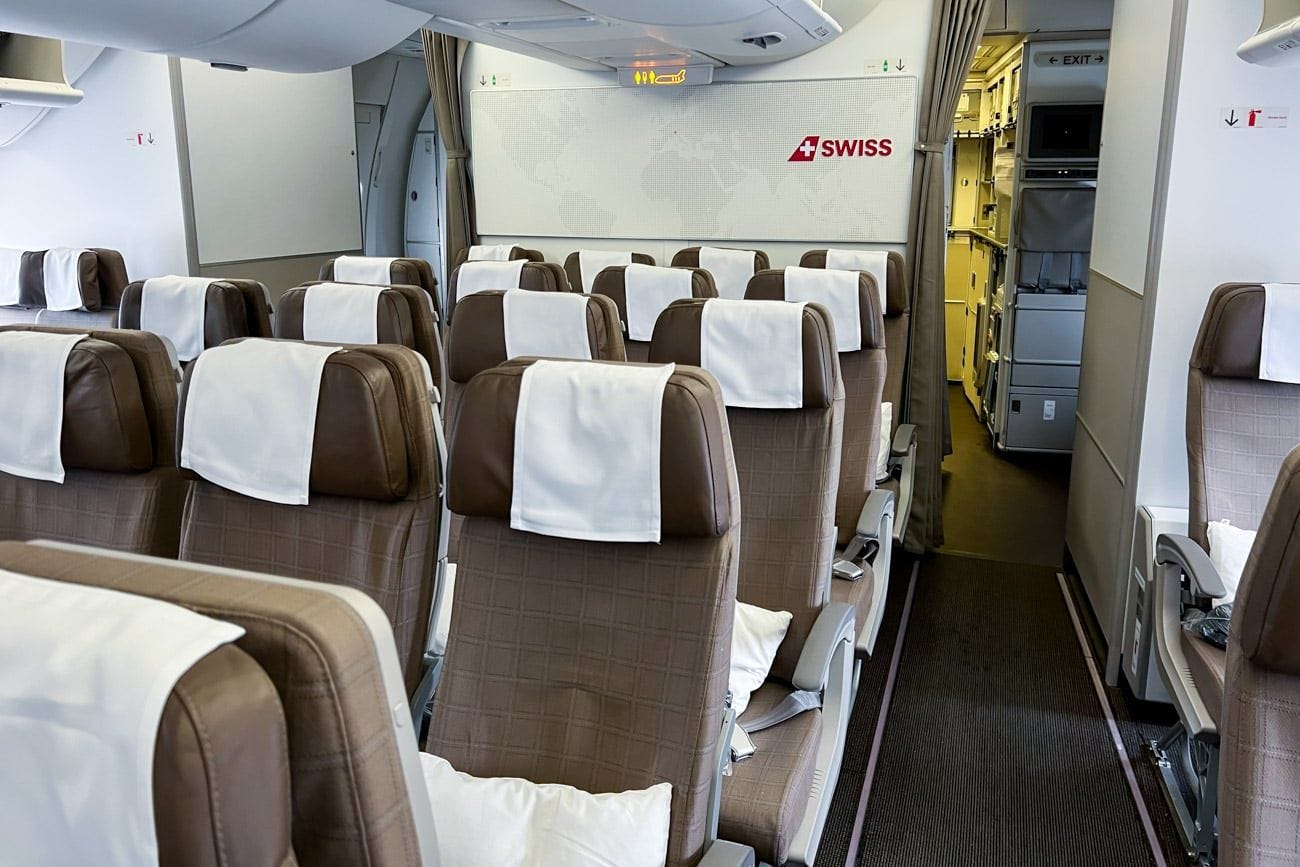
The Airbus A330-300 fleet is positioned as the mid-density widebody, deployed across North America, the Indian subcontinent and parts of the Middle East. These aircraft will receive a Swiss Senses retrofit after the A350 induction, gradually aligning the entire long-haul fleet with the same premium cabin philosophy.
The A340-300, the last quadjet still in the fleet, has been used in 2026 for the final stretch of operations before retirement. Several airframes were reported as the final regular year of A340 operations, with the remaining frames likely operating limited routes until the new A350s ramp up to displace them.
Airbus A350-900 Introduction Timeline
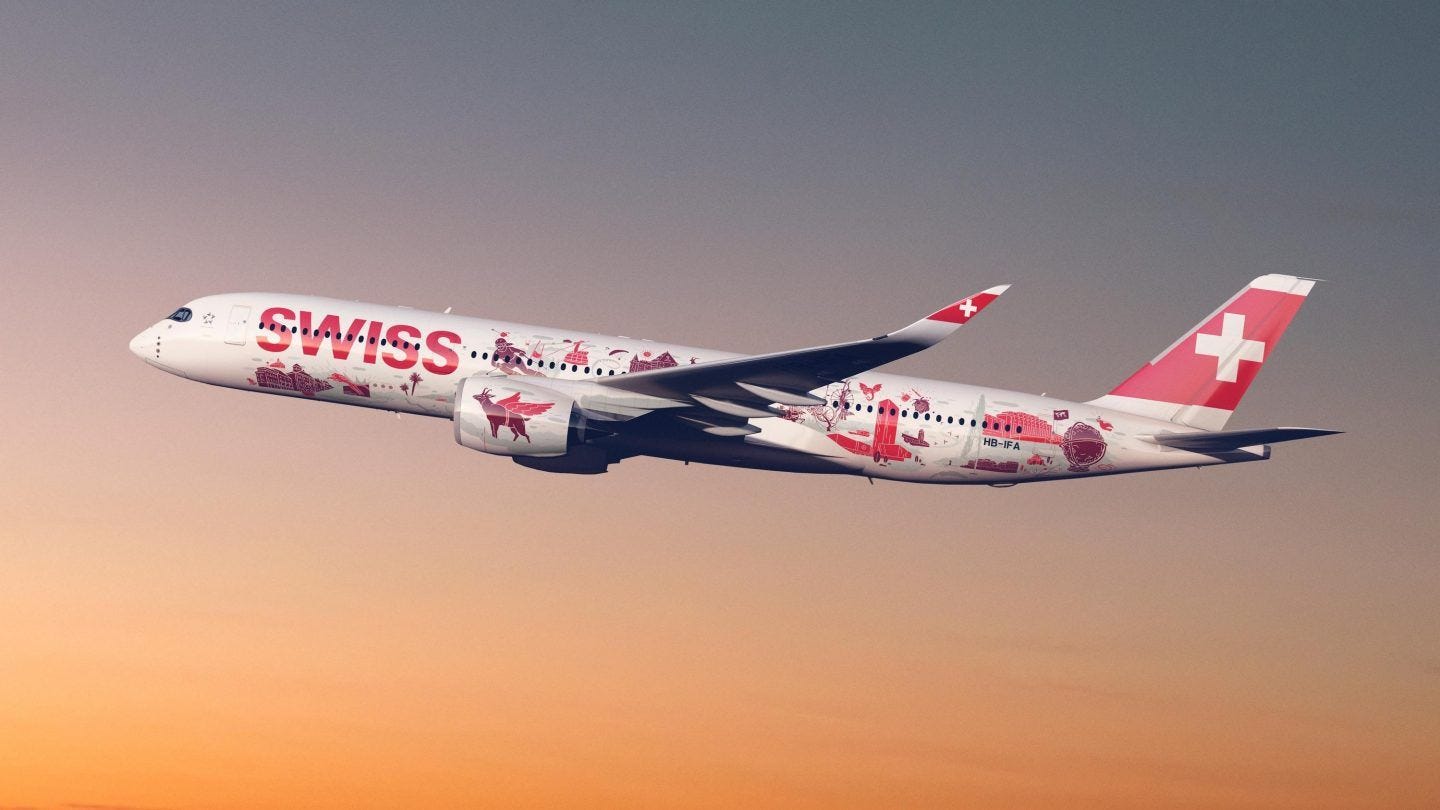
The first A350-900, registered HB-IFA and wearing a special “Wanderlust” livery, was delivered from Toulouse in October 2025. The aircraft features the new SWISS Senses cabin and 25 percent lower fuel burn per seat compared to the older long-haul widebodies it replaces.
The second airframe, named “Delémont,” joined the fleet in early February 2026 wearing the classic SWISS livery, becoming the first A350 in the standard scheme. Together with the first frame, SWISS now operates two A350-900s, with eight more to follow under the firm order book.
From the start of the 2026 summer schedule, the A350 also moves onto Zurich-Seoul, where its 11-hour 10-minute block time will be 50 minutes shorter than the older equipment it replaces.
Short and Medium-Haul Fleet
The short-haul backbone is the Airbus A220 family, the type for which SWISS was the global launch customer when it ordered the program back when it was still called the Bombardier CSeries. SWISS operates both A220-100 and A220-300 variants from Zurich and Geneva.
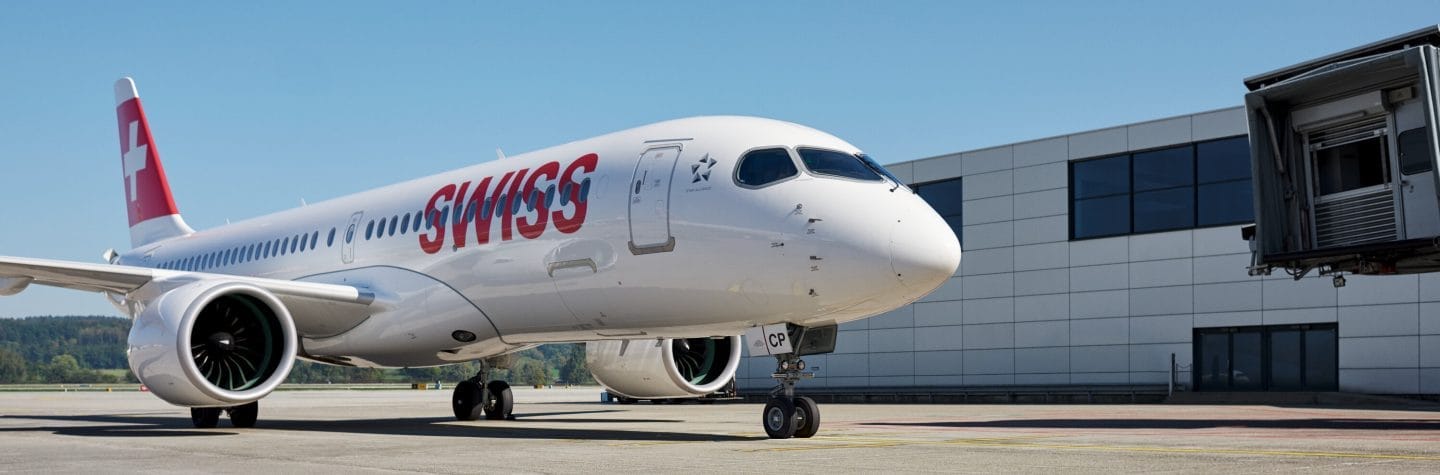
The A220-300 seats 145 passengers and is positioned as the larger of the two variants, capable of operating into short runways like London City.
The A220-100, with around 125 seats, has experienced periods of operational disruption tied to engine availability issues impacting the entire Pratt & Whitney GTF fleet across the global industry.
SWISS also operates a substantial Airbus A320neo and A321neo fleet, including seven A321neos and twelve A320neos by early 2026 figures cited by the airline, complementing the older A320 and A321 ceo aircraft they are progressively replacing.
Fleet Age and Modernization Trajectory
The current SWISS fleet has an average age in the high single digits, but the figure will trend lower as more A350s arrive, A340s retire, and Airspace cabin neo deliveries continue.
The strategic direction is clearly toward simplification: fewer aircraft types, fewer engine variants, and a more consistent cabin product.
The fleet modernization carries an environmental dimension. Lufthansa Group is committed to 10 percent SAF coverage by 2030 where infrastructure allows, with SWISS contributing through fleet renewal as the highest single-impact lever for emissions reduction.
Fleet Strategic Targets (Outlook to 2028)
-------------------------------------------------
Fleet types target           : ~2 main types
A350-900 inducted            : 10 over induction window
A340-300 status              : Out of service
Long-haul cabin              : Unified SWISS Senses
Engine reliability priority  : PW1100G / PW1500G fleet
SAF coverage target (Group)  : 10% by 2030