


Executive Summary
Thai AirAsia closed the financial year 2025 with revenue of THB 45,690.9 million and a return to net profitability, even as average fares declined and Chinese inbound traffic softened.
The carrier currently operates a fleet of 62 narrow-body Airbus aircraft from its core hub at Don Mueang International Airport, retaining the largest narrow-body fleet of any Thai airline.
In May 2026, parent group AirAsia placed a landmark order for 150 A220-300s that will reshape Thai AirAsia’s fleet over the coming decade.
The airline announced a 30% capacity reduction for May and June 2026 in response to a sharp jet fuel spike and softer travel demand.
Recommended - Read Full Reports


Read All Reports
Table of Contents
Executive Summary
Why Thai AirAsia Matters Right Now?
Thai AirAsia Company Profile: Key Facts
Thai AirAsia Revenue and Financial Analysis
Full Year 2025 Revenue and Profitability
Revenue Mix: Scheduled Passenger and Ancillary Services
Q1, Q2 and Q3 2025 Quarterly Trajectory
Cost Structure: Fuel and CASK
2026 Revenue Guidance
Thai AirAsia Fleet Analysis
Fleet Size and Composition
Aircraft Configuration and Cabin Strategy
Fleet Strategy Through 2030
Fleet Renewal and Retirement Profile
Maintenance and Lessor Strategy
Thai AirAsia Route Network Strategy and Major Destinations
Network Scope: Routes and Destinations
Domestic Network Strategy
International Network: ASEAN Core
International Network: Greater China and Northeast Asia
International Network: South Asia and India
Fifth Freedom Operations
May to June 2026 Network Adjustment
Codeshare and Interline Strategy
Major Operational Bases (Hubs)
Bangkok Don Mueang International Airport (DMK)
Phuket International Airport (HKT)
Chiang Mai International Airport (CNX)
Krabi International Airport (KBV)
U-Tapao and Hat Yai Operations
Thai AirAsia Competitive Position
Major Competitors
Thai AirAsia vs. Thai Airways International
Thai AirAsia vs. Bangkok Airways
Thai AirAsia vs. Nok Air
Thai AirAsia vs. Thai Lion Air
Thai AirAsia vs. Thai VietJet
Competitive Position Summary
Thai AirAsia Within the AirAsia Group Restructuring
The Capital A to AirAsia X Transition
Implications for Thai AirAsia
Risks of the Transition
Sustainability and Operational Strategy
Fleet Modernisation as Carbon Strategy
Operational Efficiency Programme
Customer Experience and Product Strategy
Distribution and Booking Platform
Ancillary Revenue Strategy
Loyalty and Engagement
Key Risks for Thai AirAsia
Risk 1
Risk 2
Risk 3
Risk 4
Risk 5
Risk 6
Risk 7
Risk 8
Risk 9
Risk 10
Outlook for 2026 and Beyond
Near-Term Outlook (Rest of 2026)
Medium-Term Outlook (2027 to 2028)
Long-Term Outlook (2029 to 2030)
Industry Context: Thai Aviation in 2026
Strategic Tools and Technology Investments
Digital Distribution
Operational Technology
Customer Data and Personalisation
My Final Thoughts
Official Sources and Data
Why Thai AirAsia Matters Right Now?
Bangkok’s Don Mueang Airport is one of the busiest low-cost hubs anywhere in Southeast Asia, and Thai AirAsia is the operator that effectively built the modern shape of that traffic.
The carrier serves more than 70 destinations on 318 routes with a fleet that has grown back to roughly 62 narrow-bodies, and its parent company Asia Aviation Plc reported a net profit return for the full-year 2025.
Yet 2026 is shaping up as the most operationally tense year since the pandemic recovery began.
The airline is simultaneously absorbing a fuel price surge, slower mainland Chinese inbound traffic, the parent group’s full integration under AirAsia Aviation Group, and a historic 150-aircraft A220 order that will redraw fleet planning for the rest of the decade.
For airline industry stakeholders watching Asia-Pacific low-cost carrier (LCC) competition, Thai AirAsia is no longer just a regional point-to-point operator.
It’s now the central narrow-body engine inside the merged AirAsia airline group, and the choices being made at Don Mueang in 2026 will influence how the wider AirAsia network looks by 2030.
QUICK OVERVIEW: Thai AirAsia in May 2026
- Largest narrow-body LCC fleet in Thailand
- 62 active aircraft, all Airbus A320 family
- Don Mueang base + 4 secondary hubs
- 25 domestic + 46 international destinations
- 30% mid-Q2 2026 capacity cut announced
- New CEO/GM Phairat Pornpathananangoon as of 31 Jan 2026Thai AirAsia Company Profile: Key Facts
Thai AirAsia is a Thailand-based low-cost carrier that began operations in February 2004 with flights from Bangkok Don Mueang to Hat Yai, Phuket, and Chiang Mai.
It is wholly owned at the operating-company level by Asia Aviation Public Company Limited (AAV), which is listed on the Stock Exchange of Thailand under the ticker AAV.
The carrier operates under the AirAsia brand globally and is part of the AirAsia airline group following the completion of the aviation business disposal from Capital A to AirAsia X (now operating as a unified AirAsia entity) in January 2026.
CORE COMPANY FACTS
- Legal entity: Thai AirAsia Co., Ltd.
- Holding company: Asia Aviation Public Co. Ltd. (SET: AAV)
- Headquarters: Don Mueang, Bangkok
- IATA / ICAO codes: FD / AIQ
- Founded: 2003; first revenue flight Feb 2004
- General Manager: Phairat Pornpathananangoon (since 31 Jan 2026)
- Outgoing CEO/Advisor: Santisuk Klongchaiya
- Fleet: ~62 Airbus A320 family
- Primary hub: Bangkok Don Mueang (DMK)
The shareholder structure of the parent listed entity, Asia Aviation Plc, is led by AirAsia Aviation Group Limited at 40.71%, followed by Mr. Tassapon Bijleveld at 17.75% and Thai NVDR Company Limited at 8.45%, with the balance held by Thai institutional and retail investors.
AAV in turn holds 100% of Thai AirAsia at the operating company level.
That structure is important. Thai AirAsia is the only operating airline asset inside the AAV holding, which means the listed entity’s results are effectively a clean read on the carrier’s economics, with no diluting business segments such as ground handling or maintenance.
The leadership transition that took effect on 31 January 2026 also matters. Phairat Pornpathananangoon, the former Chief Financial Officer, was appointed as the new General Manager, succeeding Santisuk Klongchaiya, who is retiring after years at the top and will remain involved as an advisor.
Thai AirAsia Revenue and Financial Analysis
Thai AirAsia is the single largest contributor to Asia Aviation’s revenue, accounting for essentially all of the group’s top line.
The financial picture in 2025 was a story of returning profitability against a softer demand backdrop.
Full Year 2025 Revenue and Profitability
Total revenue from sales and services for full year 2025 reached Baht 45,690.9 million, while CAPA reporting on the same release puts the net profit at approximately USD 71 million, with EBITDA of THB 7,835.1 million.
Within the headline numbers, the airline carried 22.7 million passengers across the year, a slight decline of 1% YoY, and operated at a load factor of approximately 87%.
THAI AIRASIA FY2025 (AAV) HIGHLIGHTS
- Revenue from sales & services: THB 45,690.9 million
- Year-on-year revenue change: -8% (vs. 2024 high base)
- EBITDA: THB 7,835.1 million
- CASK: THB 1.76 (down 5% YoY)
- Net profit: ~USD 71 million
- Passengers carried: ~22.7 million
- Load factor: ~87%
- Foreign exchange gain: THB 2,541.9 million
The reported revenue movement is partly a base effect. The 2024 numbers benefited from the post-pandemic fare rebound, when constrained capacity across Asia-Pacific kept yields elevated.
Average fare in 2025 declined 9% to a more normalised level, pulling top-line revenue down even as unit costs continued to fall.
The reported core profit of THB 302.7 million for 2025 was significantly supported by foreign exchange gains of THB 2,541.9 million, driven by the appreciation of the Thai Baht through the year, which reduces the local currency burden of USD denominated lease and fuel exposures.
Revenue Mix: Scheduled Passenger and Ancillary Services
The revenue model is structured around two main streams. Scheduled passenger services contribute the bulk of the top line, while ancillary services have steadily increased their share.
Ancillary streams include checked baggage, seat selection, meal pre-orders, priority boarding (the airline’s “Hot Seat” and “Premium Flatbed” products are operated within the broader AirAsia group), and fees on aircraft-paid services.
The airline also distributes flights and packages through the AirAsia MOVE app, which bundles flights with hotel stays through the SNAP Flight+Hotel feature.
REVENUE STREAMS
1. Scheduled passenger ticket sales (largest single line)
2. Ancillary fees (baggage, seats, meals, priority)
3. Cargo and mail (rising as belly-hold volumes grow)
4. Charter and wet-lease revenue (smaller contribution)
5. Travel platform commissions via AirAsia MOVE / SNAP
Connectivity revenue through the AirAsia group’s “Fly-Thru” product is also a meaningful contributor.
Capital A’s third-quarter 2025 results disclosed that group-level Fly-Thru pax surged 16% YoY to roughly 1 million in 3Q25, lifting year-to-date growth by 5%. Vietnam and Australia were highlighted as standout connecting markets for those passengers.
For Thai AirAsia specifically, Fly-Thru is a way to monetise its very dense Don Mueang short-haul network by feeding passengers onto Thai AirAsia X long-haul flights to Northeast Asia, India, and Australia, without operating those long-haul sectors itself.
Q1, Q2 and Q3 2025 Quarterly Trajectory
Quarterly disclosure paints a clear picture of how the year unfolded. Q1 2025 was the strongest quarter, with core profit up 6% YoY to THB 1.299 billion on the back of efficient cost management and lower fuel costs, despite revenue from sales and services declining by 4%.
Q3 2025, traditionally the weakest quarter for Thai aviation due to monsoon season and lower inbound demand, came in much softer. The airline reported a Q3 2025 net loss of THB (875) million on EBITDA of THB 361 million, with 4.73 million passengers carried at an 80% load factor.
QUARTERLY VIEW: AAV / THAI AIRASIA 2025
Q1 2025: Core profit ~THB 1.299 bn, revenue -4% YoY
9M 2025: Revenue THB 32,322 mn, -11% YoY
Q3 2025: Net loss THB 875 mn, 4.73 mn pax, 80% LF
FY 2025: Revenue THB 45,691 mn, EBITDA THB 7,835 mn
The 9-month 2025 cumulative revenue of THB 32,322 million was down 11% YoY, signalling that the fourth quarter (peak high season for Thailand) contributed disproportionately to the full year, which is consistent with the typical Thai inbound calendar.
Cost Structure: Fuel and CASK
Cost per available seat kilometre (CASK) is the metric that matters most for an LCC, and Thai AirAsia’s CASK in 2025 improved 5% YoY to THB 1.76.
That is a strong achievement given that broader Asia-Pacific aviation faced re-inflation in maintenance, lessor rates, and ground handling.
The fuel exposure remains the central swing factor. Jet fuel typically represents around 30% to 40% of operating cost for an LCC of this profile, and the carrier is now pivoting heavily on capacity discipline rather than hedging to manage fuel volatility, given the 30% capacity cut announced for May to June 2026.
2026 Revenue Guidance
Looking into 2026, management is targeting high-single-digit revenue growth from sales and services and passenger traffic of 23.5 million, supported by a strategy that emphasises domestic leadership, deeper India connectivity through Thai AirAsia X partnerships, and selective recovery of mainland Chinese routes.
The Bangkok Post’s reporting on the 2026 guidance specifies a 6% to 9% year-on-year revenue growth target with an 85% load factor, indicating that management has trimmed the load factor expectation versus the 90% level it pursued in 2025.
Thai AirAsia Fleet Analysis
Thai AirAsia operates one of the most homogenous LCC fleets in Asia, with every aircraft drawn from the Airbus A320 family. That single-family discipline is one of the most important cost levers the carrier owns.
Fleet Size and Composition
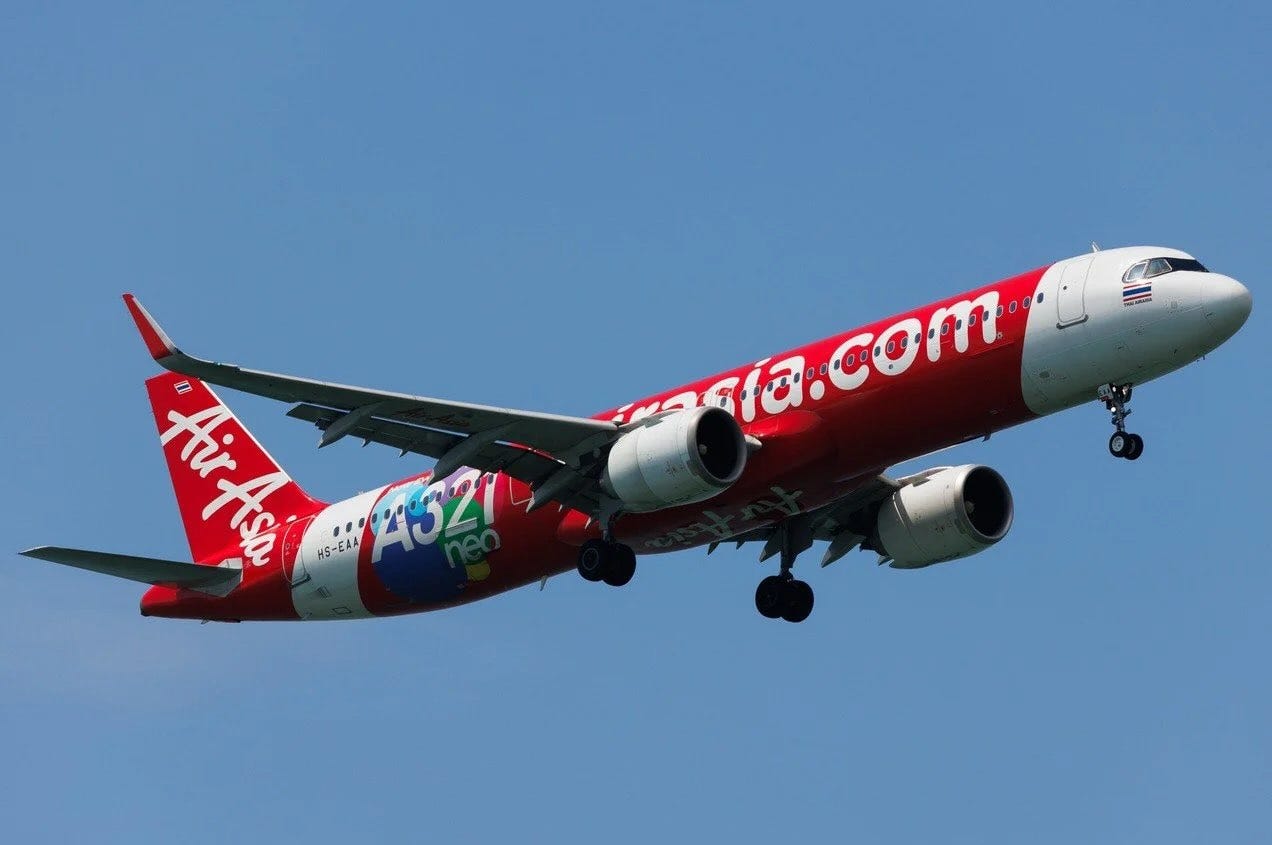
The current fleet sits at 62 aircraft, with an average fleet age of 11.5 years. The composition reported by ch-aviation consists of forty-four A320-200s, eleven A320-200Ns, and seven A321-200NX variants.

FLEET COMPOSITION (May 2026)
A320-200 (CFM-powered classic): 44
A320-200N (neo): 11
A321-200NX (neo): 7
Total in service: 62
Average fleet age: 11.5 years
Fleet family: 100% Airbus A320 family
The seven A321neos are the largest aircraft in the fleet, configured for higher-density single-class operations. They serve as a unit-cost weapon on the airline’s busiest trunk routes, where additional seats can be filled without proportionally increasing crew or slot costs.
The A320neo aircraft, fitted with CFM LEAP-1A engines, deliver materially better fuel burn than the older A320-200 ceo aircraft they are gradually replacing, which is critical given the fuel pressure the airline is currently navigating.
Aircraft Configuration and Cabin Strategy
Thai AirAsia operates a single-class economy configuration across its fleet, in line with the AirAsia group standard. The A320 family aircraft are configured with 180 seats in the A320 ceo, 186 in the A320neo, and 236 in the A321neo, all in standard economy layout.
The product structure is layered through ancillary tiers rather than through cabin classes. Customers can buy “Hot Seats” for extra legroom at the front of the cabin and exit rows, “Quiet Zone” seating (a child-restricted section), and bundled fare families that include baggage, meals, and seat selection.
CABIN LAYOUT BY TYPE
A320-200 (ceo): 180 seats, 1 class
A320-200N (neo): 186 seats, 1 class
A321-200NX (neo): 236 seats, 1 class
Service style: full LCC unbundled
Branded seats: Hot Seat, Quiet Zone, Standard
This single-class density is intentional. It allows Thai AirAsia to underprice full-service competitors on point-to-point sectors and protects the unit cost advantage that underpins the LCC model.
Fleet Strategy Through 2030
Fleet strategy at Thai AirAsia is now inseparable from group-level decisions made at AirAsia Aviation Group. The most consequential of these is the May 2026 order for 150 Airbus A220-300s announced in Mirabel, Canada.
Airbus’ own release confirms that Malaysia’s AirAsia placed an order for 150 latest generation A220-300 aircraft on 6 May 2026. Reuters reporting added that the 150 firm order comes with 150 options, making it the largest A220 commitment ever placed.
A220 ORDER (May 6, 2026)
Customer: AirAsia (group level, deployed across affiliates)
Type: A220-300
Firm: 150 aircraft
Options: 150 aircraft
Approximate list value: USD 14+ billion
Delivery start: 2028 (initial 10 aircraft)
Site: Airbus A220 final assembly, Mirabel
The strategic logic is what aviation analysts have called right-sizing. FlightGlobal’s coverage frames the deal as the final piece of long-drawn-out fleet renewal plans, addressing markets where the A320 is too large but a regional jet is too small.
For Thai AirAsia specifically, the A220-300 unlocks routes that are economically marginal on a 180-seat A320.
Think second-tier Indian cities, secondary Vietnam and Cambodia points, and frequency increases on thin Northeast Asia routes where the airline currently struggles to push more than four or five weekly departures.
Fleet Renewal and Retirement Profile
The carrier still operates 44 A320-200 ceos, the oldest core of the fleet. These aircraft are progressively being phased out as A320neos and A321neos arrive, and the longer-term A220-300 deliveries from 2028 onward will accelerate that retirement cycle.
The average fleet age of 11.5 years is moderately high for an LCC, reflecting the pause in fleet renewal during the pandemic period. Bringing this down is a key efficiency priority over the next four years.
The AirAsia group has separately confirmed that 11 new aircraft will arrive across the group in 2026, including A321LRs and additional A321neos, with leased aircraft also reinforcing capacity. Thai AirAsia is expected to absorb a meaningful portion of these deliveries.
Maintenance and Lessor Strategy
Operating a single-family fleet means simplified maintenance training, common spares pooling, and easier wet-leasing within the AirAsia group.
Aircraft can be transferred between Thai AirAsia, Indonesia AirAsia, Philippines AirAsia, and AirAsia Berhad in Malaysia with minimum recertification overhead.
The carrier sources aircraft through a mix of operating leases and direct purchase, with the majority being leased to optimise capital deployment. That posture is consistent with the broader AirAsia group’s aviation business consolidation under a single airline holding entity.